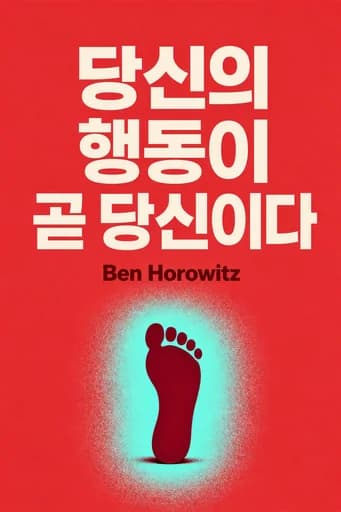
Ben Horowitz's culture-shaping manifesto reveals how actions define organizations. Recommended by McKinsey and tech leaders, it controversially draws leadership lessons from Genghis Khan and Toussaint Louverture. What if your company's success hinges not on what you say, but what you do?
Ben Horowitz, author of What You Do Is Who You Are and co-founder of the venture capital firm Andreessen Horowitz, is a bestselling author and respected authority on leadership and organizational culture.
A Silicon Valley entrepreneur with a Columbia University and UCLA computer science background, Horowitz draws from his experience as CEO of Opsware (acquired by HP for $1.6 billion) and his tenure at Netscape and AOL to explore how leaders shape company culture through intentional actions.
His earlier book, The Hard Thing About Hard Things, a New York Times bestseller translated into 16+ languages, established his reputation for blending candid leadership advice with tech industry insights. Horowitz’s blog and talks dissect management challenges, while his Cultural Leadership Fund bridges tech and underrepresented communities.
What You Do Is Who You Are has been adopted by Fortune 500 executives and startups alike, reinforcing its status as a modern leadership staple.
What You Do Is Who You Are explores how leaders can build purposeful organizational cultures by analyzing historical models like Haitian revolutionary leader Toussaint Louverture, Japanese samurai, and Shaka Senghor’s prison reform. Horowitz emphasizes actionable techniques over abstract ideals, such as embedding cultural priorities through counterintuitive decisions and adapting traditions to modern contexts like diversity initiatives.
This book is essential for entrepreneurs, executives, and managers aiming to shape company culture strategically. It’s particularly valuable for leaders navigating organizational scaling, diversity challenges, or mergers, offering frameworks to align team behavior with core values.
Yes—it combines historical storytelling with practical advice, making it a standout in leadership literature. Horowitz’s focus on measurable cultural actions (e.g., redefining hiring criteria for diversity) provides tools absent in most culture-focused books.
Key ideas include:
Horowitz defines culture as “how your company makes decisions when you’re not there.” It’s shaped by behaviors that help employees survive and succeed, such as how they allocate time or handle unspoken expectations.
The book analyzes:
Horowitz argues against quota-based diversity, advocating instead for redefining hiring criteria (e.g., prioritizing “helpfulness” over traditional metrics) and creating traditions that celebrate differences, like inclusive decision-making processes.
Four models are highlighted:
While The Hard Thing focuses on startup survival tactics, this book addresses cultural strategy. Both emphasize practical execution, but What You Do provides more historical context and frameworks for long-term cultural impact.
Some reviewers note the historical analogies may oversimplify complex cultures. Others argue the emphasis on leadership-driven change underestimates bottom-up cultural dynamics.
Horowitz’s principles suggest:
With AI disrupting workplace dynamics and Gen Z prioritizing values-aligned employers, the book’s focus on adaptable, action-driven cultures helps organizations navigate rapid technological and generational shifts.
저자의 목소리로 책을 느껴보세요
지식을 흥미롭고 예시가 풍부한 인사이트로 전환
핵심 아이디어를 빠르게 캡처하여 신속하게 학습
재미있고 매력적인 방식으로 책을 즐기세요
Culture is how your company makes decisions when you’re not in the room.
Culture shapes destiny.
Culture is how your company makes decisions when you're not there.
Culture ultimately proves stronger than strategy.
His revolutionary insight was that culture, not color, determined behavior.
What You Do Is Who You Are의 핵심 아이디어를 이해하기 쉬운 포인트로 분해하여 혁신적인 팀이 어떻게 창조하고, 협력하고, 성장하는지 이해합니다.
What You Do Is Who You Are을 빠른 기억 단서로 압축하여 솔직함, 팀워크, 창의적 회복력의 핵심 원칙을 강조합니다.

생생한 스토리텔링을 통해 What You Do Is Who You Are을 경험하고, 혁신 교훈을 기억에 남고 적용할 수 있는 순간으로 바꿉니다.
무엇이든 물어보고, 목소리를 선택하고, 진정으로 공감되는 인사이트를 함께 만들어보세요.

샌프란시스코에서 컬럼비아 대학교 동문들이 만들었습니다
"Instead of endless scrolling, I just hit play on BeFreed. It saves me so much time."
"I never knew where to start with nonfiction—BeFreed’s book lists turned into podcasts gave me a clear path."
"Perfect balance between learning and entertainment. Finished ‘Thinking, Fast and Slow’ on my commute this week."
"Crazy how much I learned while walking the dog. BeFreed = small habits → big gains."
"Reading used to feel like a chore. Now it’s just part of my lifestyle."
"Feels effortless compared to reading. I’ve finished 6 books this month already."
"BeFreed turned my guilty doomscrolling into something that feels productive and inspiring."
"BeFreed turned my commute into learning time. 20-min podcasts are perfect for finishing books I never had time for."
"BeFreed replaced my podcast queue. Imagine Spotify for books — that’s it. 🙌"
"It is great for me to learn something from the book without reading it."
"The themed book list podcasts help me connect ideas across authors—like a guided audio journey."
"Makes me feel smarter every time before going to work"
샌프란시스코에서 컬럼비아 대학교 동문들이 만들었습니다

What You Do Is Who You Are 요약을 무료 PDF 또는 EPUB으로 받으세요. 인쇄하거나 오프라인에서 언제든 읽을 수 있습니다.
A middle manager at your company lies regularly. Everyone knows it. Yet he keeps getting promoted. You preach honesty in every meeting, display integrity on your office walls, and genuinely believe in truthfulness. But your culture-the real one-rewards deception. This jarring disconnect reveals a fundamental truth: culture isn't what you say or what you believe. It's what people do when no one's watching. It's the invisible operating system running beneath every decision, every interaction, every crisis. And here's the uncomfortable part-you can't see your own culture clearly because you're swimming in it. But your newest employee? They see it instantly, in their first week, before they learn to rationalize the contradictions. Culture determines whether your company thrives or implodes, whether your strategy succeeds or fails, and whether talented people stay or flee. The question isn't whether you have a culture. You do. The question is whether you're deliberately shaping it or letting it shape itself.