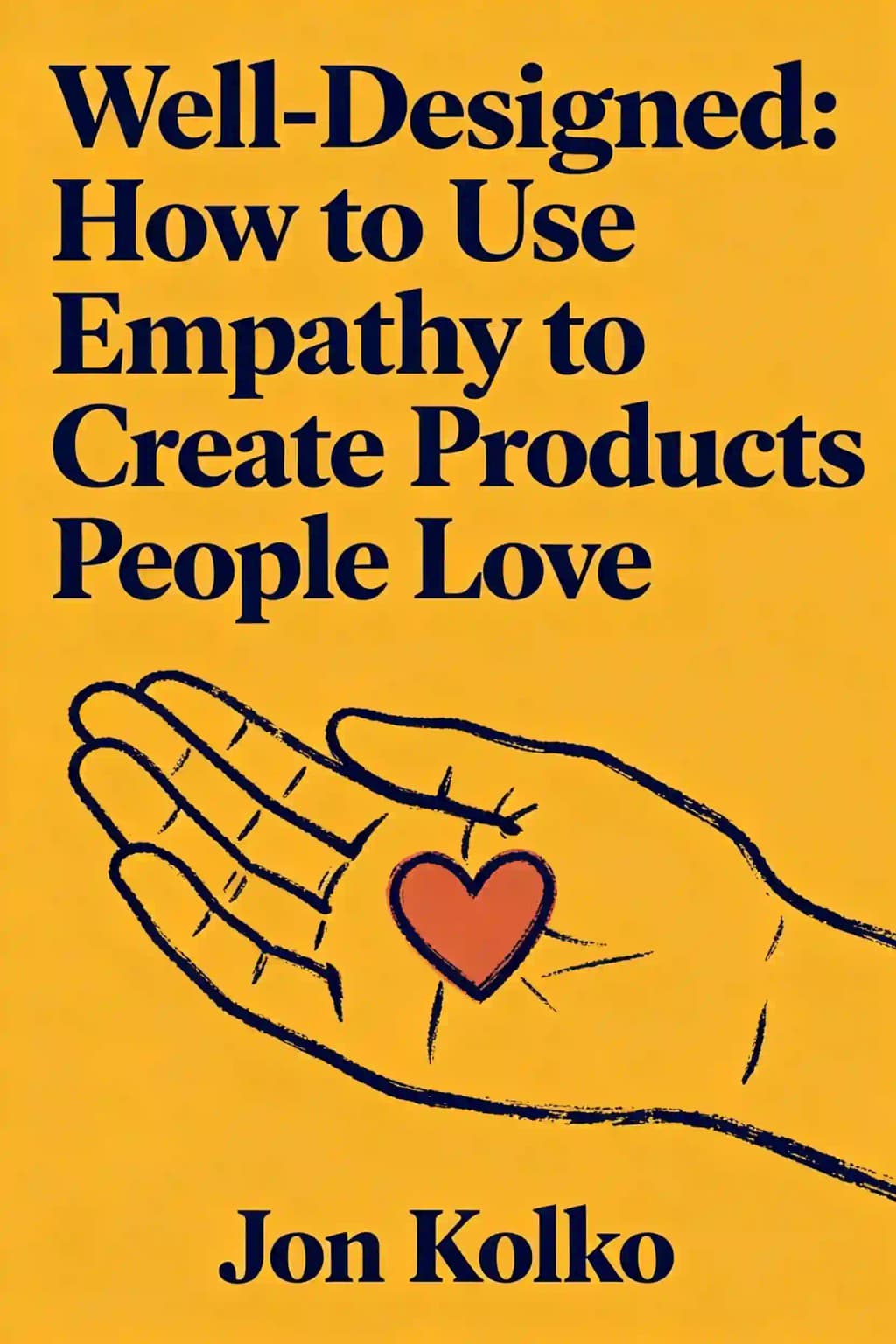
In "Well-Designed," Jon Kolko reveals how empathy - not just data - creates products people genuinely love. This 2014 Harvard Business Review gem transformed how companies like Nest develop emotional connections with users, proving that understanding feelings drives innovation more powerfully than features alone.
Jon Kolko, author of Well-Designed: How to Use Empathy to Create Products People Love, is a renowned designer, educator, and thought leader in interaction design and product innovation.
A Carnegie Mellon University graduate, Kolko’s career spans executive roles at frog design, Blackboard, and MyEdu, where he advocated for human-centered design in enterprise software. His expertise lies in bridging design thinking with business strategy, emphasizing empathy to create emotionally resonant products.
Kolko’s other influential works include Exposing the Magic of Design, a guide to design synthesis, and Wicked Problems: Problems Worth Solving, which tackles complex societal challenges through design. As founder of the Austin Center for Design, he educates future designers on social entrepreneurship.
Kolko’s frameworks are widely adopted by Fortune 500 companies like Ford and AT&T, and his writings remain required reading in design programs globally.
Well-Designed by Jon Kolko argues that empathy-driven design is key to creating products users love. The book presents a four-step design-thinking framework: identifying product-market fit, uncovering behavioral insights through ethnographic research, synthesizing strategies, and refining details through visual storytelling. It emphasizes emotional value over mere functionality, using real-world examples to show how empathy transforms user experiences.
Product managers, designers, and marketers seeking to create emotionally resonant products will benefit most. Kolko’s practical advice on ethnographic research and iterative design is ideal for professionals looking to bridge user needs with business goals. The book also appeals to educators teaching human-centered design methodologies.
Yes—its blend of theory and actionable frameworks makes it valuable for anyone in product development. Readers praise its jargon-free approach and case studies from Kolko’s 15+ years in design. Critics note it leans heavily on product management contexts, but its empathy-focused lens remains widely applicable.
Jon Kolko is a designer, educator, and founder of Austin Center for Design. He’s held leadership roles at Frog Design, Blackboard, and Modernist Studio, working with clients like Ford and AT&T. A Carnegie Mellon graduate, he’s authored multiple books on design thinking and teaches practical empathy as a learned skill.
Unlike traditional feature-focused propositions, Kolko’s emotional value proposition prioritizes how a product makes users feel. By aligning design with emotional outcomes (e.g., Nest’s thermostat creating trust through intuitive interfaces), products foster deeper engagement and loyalty.
Techniques include role-playing user scenarios, conducting observational fieldwork, and creating empathy maps to document emotional pain points. These methods help designers move beyond assumptions to authentically reflect user needs.
Nest is highlighted for its emotionally resonant thermostat design, which led to a $3.2B Google acquisition. Kolko also references firms using iterative storytelling to refine products, though specific examples are anonymized to focus on universal lessons.
While traditional design thinking emphasizes broad ideation, Kolko prioritizes granular emotional insights. His process leans heavily on ethnographic research and visual synthesis, arguing that empathy isn’t innate but a skill developed through structured practice.
Some reviewers argue the book lacks depth in technical execution and overly simplifies team dynamics. Others note its examples skew toward consumer tech, though Kolko’s frameworks are adaptable to other industries.
While Don Norman’s classic focuses on usability heuristics, Kolko emphasizes emotional engagement. Both advocate user-centered design, but Well-Designed offers more tactical steps for embedding empathy into corporate workflows.
As AI-driven products risk feeling impersonal, Kolko’s empathy-first approach helps maintain human-centric innovation. The book’s emphasis on ethnographic research remains critical for understanding nuanced user needs in rapidly evolving tech landscapes.
저자의 목소리로 책을 느껴보세요
지식을 흥미롭고 예시가 풍부한 인사이트로 전환
핵심 아이디어를 빠르게 캡처하여 신속하게 학습
재미있고 매력적인 방식으로 책을 즐기세요
Design isn't merely about making things pretty.
We naturally personify products, especially digital ones.
Empathy isn't an innate trait...it's a skill.
Designers are typically optimistic about the future.
Markets may not be ready for certain products.
Well-Designed의 핵심 아이디어를 이해하기 쉬운 포인트로 분해하여 혁신적인 팀이 어떻게 창조하고, 협력하고, 성장하는지 이해합니다.
Well-Designed을 빠른 기억 단서로 압축하여 솔직함, 팀워크, 창의적 회복력의 핵심 원칙을 강조합니다.

생생한 스토리텔링을 통해 Well-Designed을 경험하고, 혁신 교훈을 기억에 남고 적용할 수 있는 순간으로 바꿉니다.
무엇이든 물어보고, 목소리를 선택하고, 진정으로 공감되는 인사이트를 함께 만들어보세요.

샌프란시스코에서 컬럼비아 대학교 동문들이 만들었습니다
"Instead of endless scrolling, I just hit play on BeFreed. It saves me so much time."
"I never knew where to start with nonfiction—BeFreed’s book lists turned into podcasts gave me a clear path."
"Perfect balance between learning and entertainment. Finished ‘Thinking, Fast and Slow’ on my commute this week."
"Crazy how much I learned while walking the dog. BeFreed = small habits → big gains."
"Reading used to feel like a chore. Now it’s just part of my lifestyle."
"Feels effortless compared to reading. I’ve finished 6 books this month already."
"BeFreed turned my guilty doomscrolling into something that feels productive and inspiring."
"BeFreed turned my commute into learning time. 20-min podcasts are perfect for finishing books I never had time for."
"BeFreed replaced my podcast queue. Imagine Spotify for books — that’s it. 🙌"
"It is great for me to learn something from the book without reading it."
"The themed book list podcasts help me connect ideas across authors—like a guided audio journey."
"Makes me feel smarter every time before going to work"
샌프란시스코에서 컬럼비아 대학교 동문들이 만들었습니다

Well-Designed 요약을 무료 PDF 또는 EPUB으로 받으세요. 인쇄하거나 오프라인에서 언제든 읽을 수 있습니다.
Have you ever noticed how some products feel like they *get* you? Your Nest thermostat learns your rhythms, your Spotify playlist understands your mood, your favorite app anticipates what you need before you ask. These aren't accidents of good engineering-they're the result of something far more human: empathy. While most companies chase feature lists and technical specs, the products that truly succeed are built on a radically different foundation. They're designed by teams who spent time watching real people struggle, dream, and navigate their daily lives. This approach has quietly revolutionized how successful companies build everything from thermostats to social networks, transforming product development from a technical exercise into an art of human connection. The chasm between forgettable products and beloved ones isn't about technology-it's about understanding. Traditional product development follows a predictable script: write requirements documents, check off feature lists, ship on schedule. This mechanical process produces mechanical results. Design-driven companies take a fundamentally different path. They recognize that products aren't just functional tools; they're relationships. Think about how you describe your phone "dying" or an app getting a "makeover." This isn't careless language-it reveals our deep tendency to personify the digital objects in our lives. We form emotional bonds with products, and the most successful ones are designed with this psychological reality in mind.