1장
When the Moon Was Our Battlefield
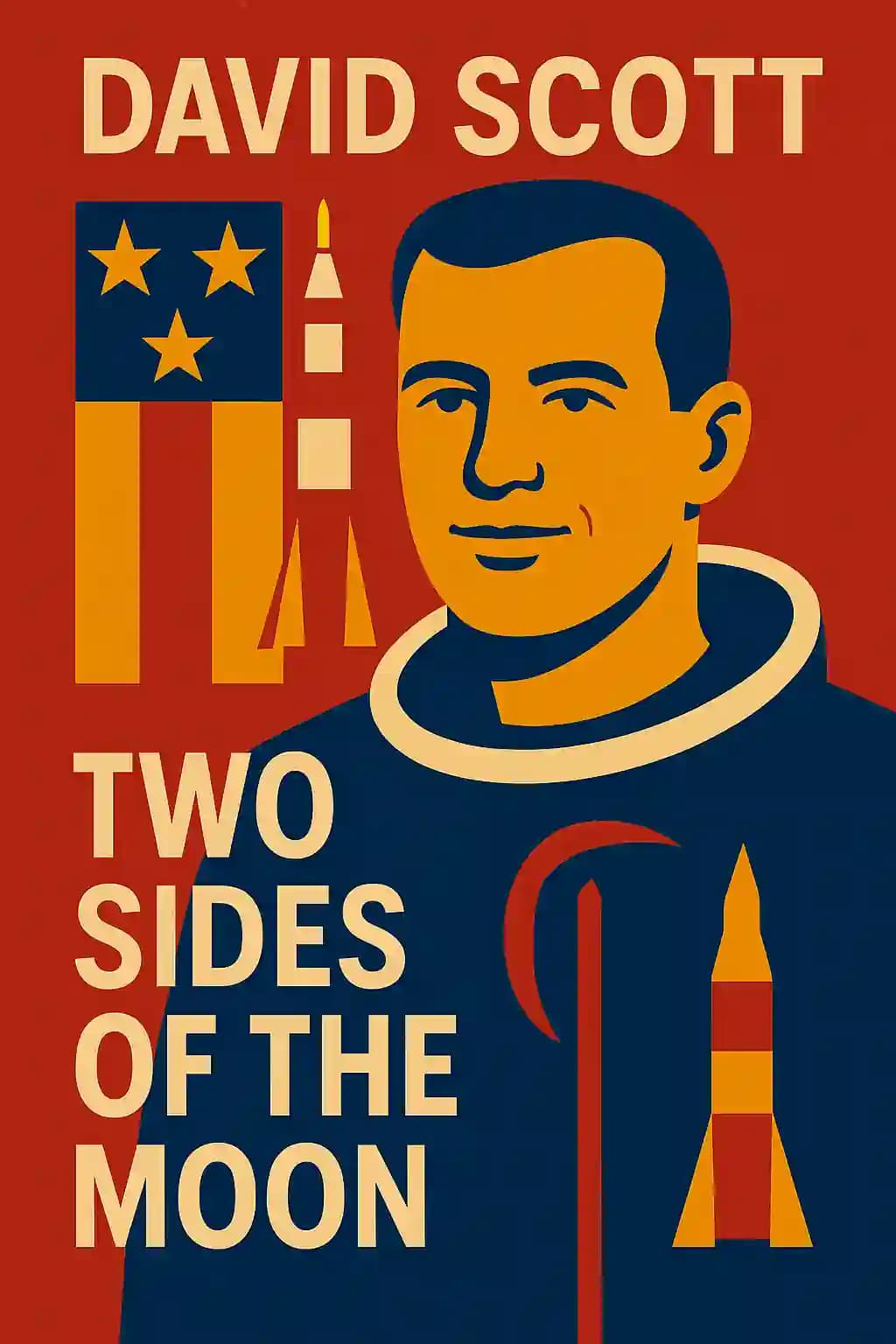
In the frigid darkness of space, two men from opposing sides of the Cold War found themselves on parallel journeys. Alexei Leonov, the "Spacewalker," became the first human to float freely in the cosmic void, tethered only by an umbilical cord as he tumbled uncontrollably before fighting his way back into his spacecraft. David Scott, the meticulous engineer-pilot, faced his own brush with death when his Gemini 8 spacecraft began an uncontrolled spin that nearly rendered him unconscious. These men-once trained to kill each other as fighter pilots-instead became pioneers exploring the ultimate frontier. Their story captivated millions worldwide, with Leonov's spacewalk making him a Soviet hero whose image appeared on stamps across the Eastern Bloc, while Scott would eventually drive the first lunar rover across the Moon's surface. Their shared memoir, "Two Sides of the Moon," became a bestseller not just for space enthusiasts but for anyone fascinated by how the most dangerous military standoff in history transformed into humanity's greatest adventure. As Tom Hanks noted after reading their account, "These weren't just skilled technicians but artists and dreamers who saw beyond the Cold War to what exploration truly meant for our species."
2장
From Childhood Dreams to Cold War Warriors
Alexei Leonov's childhood began in the harsh climate of Siberia, where temperatures plunged below -50C and his earliest memories included the sound of ice-laden branches cracking in the night. Born in 1934 in the remote village of Listvyanka, young Alexei believed his mother's tale that a thousand torches lit the Moon each night. His peaceful childhood was shattered when his father was falsely branded an "enemy of the people" during Stalin's purges. Though his father had supported Bolshevism and collectivization, false testimony led to his imprisonment, and neighbors stripped their home bare, taking everything down to Alexei's trousers. The family fled to Kemerovo, eleven of them-including his pregnant mother-crammed into a sixteen-square-meter room where Alexei slept under a bed.
Despite these hardships, Leonov developed two passions that would define his life: drawing and flying. His artistic talent helped feed the family as he painted canvases for neighbors, while his flying dreams were inspired by a dashing Soviet pilot whose appearance captivated his six-year-old imagination. "You can become a pilot if you study hard, grow strong, and wash with soap," the pilot told him-advice Alexei eagerly followed, watching aviation films repeatedly and keeping by his bed a beloved book about a pilot who learned to fly again after losing his legs.
Half a world away, David Scott's earliest memory also involved aircraft-thirty de Havilland Jenny biplanes flying in formation spelling "USA" across the clear Texas sky, with his mother pointing to one particular aircraft-his father's. Growing up at Randolph Field, he'd slip into his father's leather flying jacket and imagine soaring overhead. Though Air Corps regulations prevented him from flying with his father until age twelve, his father would drop parachute messages from his plane as he flew over their yard. Tom William Scott had become a pilot on a bet, leaving his Hollywood studio job to join the Army Air Corps.
When World War II erupted, Scott's father deployed overseas, and David wouldn't see him for three years. During this time, he attended military school and spent summers in California with his namesake, Uncle Dave. He built model airplanes obsessively and devoured flying films. When his father finally returned as a colonel after commanding an air base in England, he took David on his first flight-an exhilarating, acrobatic experience that cemented his determination to become a pilot.
For Leonov, World War II brought different challenges. When Molotov announced the German invasion on June 22, 1941, Kemerovo quickly transformed as wounded soldiers arrived and factories were relocated there, making it the center of Soviet chemical industry. German sympathizers sabotaged plants, killing thousands, including Leonov's sister among the injured. He started school in autumn 1943, aged eight, walking barefoot on frost-covered boards until the school committee delivered him a pair of girls' shoes, which he treasured nonetheless. The war devastated his family; all four uncles and six male cousins who fought were killed, part of the twenty million Soviet casualties.
As both boys grew into young men, their paths continued to parallel each other despite the vast ideological divide between their nations. Scott excelled at swimming, breaking records and eventually making the US All-American Swimming Team. These athletic experiences taught him competitiveness, teamwork, and mental preparation-skills that would prove invaluable later. Meanwhile, Leonov developed as both an artist and aspiring pilot, eventually earning a coveted spot at Kremenchug Pilots' College in Ukraine in 1953. After two years learning propeller planes, he transferred to Chuguyev Higher Military Pilots' School to train on jets.
3장
Cold Warriors on the Brink
As Cold War tensions escalated in the late 1950s, both men found themselves on the front lines of potential conflict. When Soviet tanks rolled into Budapest in October 1956, Scott's fighter squadron was placed on highest alert-four planes on five-minute standby with pilots sitting in cockpits, eight more on thirty-minute alert. "We knew the Russians outnumbered us five-to-one with excellent pilots; our survival chances weren't good," Scott recalled. They prepared for potential combat over Czechoslovakia with Czech maps and currency. When standard-issue sidearms weren't available, they improvised-two pilots flew to Italy and bought Beretta pistols.
From the Soviet perspective, Leonov saw the Hungarian uprising very differently. Soviet newspapers showed shocking images of maimed communist supporters with Soviet stars carved into their corpses. "I felt disgusted and indignant," he remembered. "The rebels' cruelty undermined any sympathy they might have gained. We remembered Hungarians had allied with Hitler in WWII, and many Soviet soldiers died liberating Hungary. We believed we had the moral right to maintain troops there."
The space race began in earnest when the Soviets launched Sputnik in October 1957. Scott first saw a model of the satellite hanging from the ceiling in a Cologne beer hall during Oktoberfest, making its distinctive "beep, beep, beep." The Germans looked at Americans with confusion-why didn't they have a satellite? Though Scott initially viewed it in military terms rather than as significant for space exploration, it demonstrated Soviet technological strength. For Leonov, Sputnik's launch triggered spontaneous celebration among Soviet pilots, proud of their nation's technological achievement. A poem by Nikolai Krivanchikov captured his imagination: "The day will come when we will embark on interstellar flight... We will chart the fifth ocean of space."
By 1960, both men were on career paths that would lead them to space. Scott had applied to MIT for a graduate degree in aeronautics-the best path to test pilot school at Edwards Air Force Base. At MIT, he studied both aeronautics and the newly added astronautics under brilliant professors pioneering guidance, navigation and control. His thesis focused on celestial navigation mathematics-how to use thirty-six reference stars for lunar navigation, knowledge that would later prove crucial.
Meanwhile, Leonov had been selected for the Soviet space program, beginning training in March 1960. Initially living in humble conditions-sleeping on bunk beds in the corner of a volleyball court with newspapers draped over the net for privacy-the cosmonauts eventually received well-furnished apartments near the aerodrome and access to well-stocked grocery shops without queuing. Their initial group of eight pilots grew to twenty, but safety protocols prevented more than four flying together in one aircraft.
4장
The Race to Space Begins
On April 12, 1961, Yuri Gagarin became the first human in space aboard Vostok 1. Leonov, stationed at a remote monitoring post, recognized his friend's movements on the grainy monitor before hearing his voice: "Zaria 3, what is my flight path?" When Gagarin overheard Leonov, he said, "Give my regards to Blondie," Leonov's nickname. After Gagarin's successful 108-minute flight and safe landing, Moscow erupted in celebration. When Leonov finally returned to the capital, he was astonished to find streets filled with jubilant crowds and fireworks.
Scott was midway through his MIT astronautics course when Gagarin completed his historic flight. The buzz in his department was palpable, and across America it made front-page news. Having temporarily stepped away from military life into academia, Scott viewed it not through a Cold War lens but as a spectacular achievement in human exploration. From his perspective as a student of interplanetary navigation, Gagarin's Earth orbit, while historic, seemed limited compared to the advanced concepts they were studying.
However, the public's rapturous response to Alan Shepard's brief five minutes of weightlessness the following month, combined with Gagarin's achievement, galvanized the Kennedy administration. America wasn't going to accept being continually upstaged by the Soviets, leading to Kennedy's historic May 25, 1961 speech to Congress committing America to landing a man on the Moon before the decade's end-a Herculean task that even NASA's top brass weren't sure how to accomplish.
By 1962, Scott had arrived at Edwards Air Force Base, the "Holy Grail for fighter pilots," where Chuck Yeager had broken the sound barrier and now served as Commandant of the Test Pilot School. Despite the remote location and basic housing, the clear skies were a welcome change from Europe's grim flying weather. "Flying with Yeager was like participating in a graceful aerial ballet with deadly purpose," Scott recalled. The Cold War technology race pushed them to develop faster, better planes than the Soviets, with deadly consequences-within ten years, nearly half his class would be dead.
Meanwhile, Leonov was training intensively for what would become the first spacewalk. The Soviet space program was dominated by one man-Sergei Pavlovich Korolev, known only as "SP" or "Chief Designer." He was treated like a god, a man of highest integrity but extremely demanding. Everyone around him feared making mistakes that might invoke his wrath. After six months of training, the cosmonauts finally met him at the Institute. When he reviewed their group, he seemed to warm immediately to Yuri Gagarin, speaking with him for fifteen minutes. Later Leonov discovered Korolev had identified Yuri as "the man we should send into space first."
5장
First Steps in the Void
By 1965, Leonov was preparing for his historic spacewalk aboard Voskhod 2. The mission would attempt another Soviet first: man's first spacewalk. He trained intensively for two years, simulating weightlessness in a TU-104 aircraft flying parabolic arcs that provided 30-second zero-gravity periods. The complete spacewalk procedure required over 200 of these maneuvers.
Three weeks before their mid-March launch, an unmanned prototype exploded when confused ground signals triggered its self-destruct device. Korolev, despite being ill with lung inflammation, presented them with a stark choice: delay their mission by a year for another unmanned test, or proceed with the only remaining Voskhod vehicle. Cannily mentioning that American Ed White was preparing for a May spacewalk, he left the decision to them. Full of confidence, they chose to fly.
On March 18, 1965, Leonov became the first human to walk in space. When the outer hatch opened, he was lying on his back with limited mobility, but he craned his neck for his first unobstructed view of Earth-a breathtaking sight of deep blue against the dark star-filled sky. With permission from Mission Control, he pushed his upper body out of the airlock, positioned his feet at its rim, and let go. Below him stretched a gigantic, colorful panorama-the entire Black Sea, Greece and Italy to his left, the Crimea ahead, and the snow-capped Caucasus Mountains to his right.
The experience was both exhilarating and terrifying. After ten minutes, his commander Pavel Belyayev called him back, but Leonov's spacesuit had dangerously deformed in the vacuum-his feet pulled from boots and fingers from gloves. Unable to enter feet-first as trained, he had to bleed oxygen and maneuver head-first, risking oxygen starvation. Their troubles continued when they discovered oxygen pressure inside the cabin was steadily increasing to dangerous levels. A single spark could trigger a massive explosion. During reentry, they discovered the cable connecting their landing module to the orbital module hadn't separated, causing them to spin violently at 10 Gs, bursting small blood vessels in their eyes before the cable finally burned through.
After a peaceful descent under parachute, they landed in two meters of snow in a remote forest. Their landing hatch was jammed against a birch tree, and they had to rock it violently to break free. Emerging into the frigid air, they sank chin-deep in snow, surrounded by a taiga of fir and birch trees, their parachute tangled in branches 30-40 meters high. As darkness fell and temperatures plummeted to -30C, they worried about bears and wolves, with only one pistol for protection. They spent the night in their damaged capsule with no way to cover the open hatch.
6장
America Responds: The Gemini Program
When Dick Gordon burst into Scott's office with news of Leonov's space walk, Scott was incredulous. "How could the Russians be so far ahead? What suits were they using? How was their spacecraft configured?" The grainy photographs of Leonov floating in space sparked heated debate, with some Westerners claiming they were fake, but NASA soon accepted that the Russians had achieved another first.
This revelation dramatically affected NASA's Gemini program. After Leonov's achievement, NASA's plans for Gemini 4 quickly became more ambitious, with Ed White secretly training for a full EVA rather than just standing in the hatch as originally planned. The mission succeeded, with White enjoying his spacewalk so much he stayed out twice as long as scheduled, though he encountered difficulties with his bulky suit and closing the hatch afterward.
In August 1965, Deke Slayton assigned Scott as prime crew on Gemini 8 with Neil Armstrong as commander. Their mission would be the most comprehensive yet, combining rendezvous, docking, combined vehicle maneuvers, EVA, experiments and precision reentry. Neil proved an exceptional commander-determined but never overbearing, technically adept, and focused on teamwork. They shared a passion for flying and spent countless hours preparing, from simulating docking in an open field to testing equipment in thermal vacuum chambers.
The program suffered a devastating blow when Charlie Bassett and Elliot See died in a T-38 crash while preparing for Gemini 9. Despite the tragedy, they had to press forward. On March 16, 1966, Scott and Armstrong successfully reached orbit and achieved the historic first docking in space with the Agena target vehicle. But disaster struck when their spacecraft began an unexplained violent roll that intensified even after disconnecting from the Agena. They were spinning at nearly one revolution per second, approaching blackout with no tracking station in range.
With tunnel vision setting in and G-forces throwing their heads outward, Neil made the critical decision to activate the reentry control system-their last resort. Despite the extreme conditions, he managed to locate and flip the awkwardly positioned switch while still fighting the tumble with the hand controller. Gradually, their spin decelerated until it stopped. They discovered thruster number 8 was malfunctioning.
Mission rules were clear: once the reentry system activated, they had to return to Earth. Neil's gentle "Sorry, partner" acknowledged Scott's lost spacewalk opportunity. They faced additional challenges: potential collision with the Agena, landing in a secondary recovery zone in the South China Sea, and programming their reentry with minimal ground contact.
7장
Tragedy Strikes Both Programs
The space race was not without its costs. On January 27, 1967, while working in a simulator at Downey, Scott learned that the Apollo 1 crew-Gus Grissom, Ed White, and Roger Chaffee-had died in a fire on the pad. The somber ceremony with rifle salutes and the playing of "Taps" left everyone wondering about the future of the program.
The Apollo 1 tragedy was widely reported in the Soviet Union, with official condolences sent to the families. By April 1967, the Soviets were ready to launch their first manned Soyuz mission with Vladimir Komarov. Despite multiple unmanned test flights, this was considered high-risk. Komarov's launch went perfectly, but within hours one solar panel failed to deploy, causing power problems. During reentry, the parachute system malfunctioned-the drag chute failed to pull out the main canopy, and the reserve chute became entangled. The capsule crashed at 25 meters per second, killing Komarov instantly before fire consumed the wreckage.
After Komarov's death, the Soviet public finally understood the extreme risks of spaceflight. More resources were allocated to the program, though never matching NASA's funding. All systems were completely reviewed, delaying the next Soyuz launch by eighteen months.
On March 27, 1968, another tragedy struck the Soviet program when Yuri Gagarin died in a plane crash. Leonov was leading cosmonaut training with parachute jumps at Kirzach Airfield when bad weather forced him to cancel the session. He heard two loud booms in the distance that sounded like both an explosion and a sonic boom. After learning Gagarin's plane was missing, Leonov led searchers to where he'd heard the explosion, where they found wreckage. After an all-night search yielded only torn fragments of flying jackets and small pieces of flesh, Leonov identified Gagarin from a distinctive mole.
8장
The Moon Race Intensifies
1968 marked a pivotal year for both American and Soviet space programs as they raced to reach the Moon first. Despite domestic turmoil-Vietnam War setbacks, the assassinations of Martin Luther King and Bobby Kennedy, and Soviet crackdowns in Czechoslovakia-astronauts remained focused on their mission, working 14-15 hour days to overcome technical challenges following the Apollo 1 fire.
By summer 1968, beating Kennedy's deadline became secondary to beating the Russians to the Moon. George Low, with likely access to CIA intelligence about Soviet preparations for manned circumlunar flights, recognized the political implications of letting the Russians achieve this milestone first. A major program change was brewing that would directly affect Scott's mission.
When Jim McDivitt was offered the chance to fly the first circumlunar mission, he declined, preferring to stick with the more technically challenging D mission that involved EVA, rendezvous and docking. Frank Borman became commander of Apollo 8 with Jim Lovell and Bill Anders, while Scott's crew would fly Apollo 9.
On Christmas Eve 1968, Scott joined several astronauts and their wives at Frank Borman's home while Apollo 8 prepared to leave lunar orbit. After twenty hours circling the Moon, the spacecraft would fire its engine to begin the journey home-a critical moment with no communication possible while on the Far Side. If the blackout lasted longer than thirty-seven minutes, it meant the engine had failed. Almost precisely thirty-seven minutes after losing contact, Jim Lovell's voice crackled through with the festive message: "Please be informed there is a Santa Claus."
The mission captured the first "Earthrise" photos and represented a huge Cold War accomplishment-America's first "first" against the Soviets. What few realized was how close the race had been. Soviet Zond spacecraft had already flown unmanned lunar missions in September and November 1968, and another was ready for launch in early December, just weeks before Apollo 8.
Meanwhile, the Soviet lunar program faced mounting technical problems. The N-1 rocket, essential for their lunar landing missions, was severely behind schedule. The first test in February 1969 failed catastrophically when all thirty first-stage engines shut down prematurely after eighty seconds, causing the rocket to crash. The second N-1 test on July 3, 1969, ended even more catastrophically. Just seconds after liftoff, the rocket tilted and collapsed back onto the launchpad with such force that windows shattered kilometers away.
9장
The Eagle Has Landed
By May 1969, it was clear Apollo 11 would attempt the ultimate goal: a lunar landing before Kennedy's deadline. Scott was elated that Neil Armstrong would command Apollo 11, with Mike Collins and Buzz Aldrin completing the crew. Having flown with Neil on Gemini 8, Scott knew his exceptional calm under pressure made him perfect for this historic mission.
On July 16th, Apollo 11 launched perfectly. On July 20th, Scott sat on a step in Mission Operations Control Room, listening as Neil and Buzz brought Eagle toward the lunar surface. Tension mounted when their computer flashed multiple "Program Alarm" warnings indicating processing overload. What they didn't realize then was how desperately Neil was searching for a safe landing spot. The Sea of Tranquility wasn't as smooth as photographs suggested-Neil nearly ran out of fuel avoiding a boulder field on a crater rim.
Hours later, when Neil took his first step, his carefully chosen words were perfect: "That's one small step for man... One giant leap for mankind." Kennedy's deadline had been met. America had beaten the Russians in the arena they'd chosen to demonstrate their system's superiority.
On July 21, 1969, Leonov gathered with about ten fellow cosmonauts and senior military officers at Moscow's Space Transmission Corps facility, all transfixed by the crackling transmissions from Apollo 11. As he watched Neil Armstrong's grainy first steps on the lunar surface, he felt what Russians call "white envy"-a mixture of envy and admiration. "I held my breath as he touched the lunar soil tentatively before standing fully on the Moon," Leonov recalled. "Only two broadcasts have ever affected me so deeply: this moment celebrating human achievement, and later, the 9/11 attacks showing humanity's darkest side."
For those few moments, everyone forgot national divisions-even in the Soviet military center, rival superpower achievements earned applause. That night, looking through his telescope at home, Leonov felt profound pride for all humanity. Days later, cosmonauts gathered to toast Apollo 11's safe return.
Not everyone shared their admiration-Mishin, the new Soviet chief designer who had replaced the deceased Korolev, was upset, blaming their failure on budget disparities. Party leaders sent congratulations but made no public comment. Following the party line, Pravda barely noted Apollo 11's launch and buried the landing on an inside page. Soviet television showed only a short clip after international coverage had already broken the news.
10장
Driving on the Moon
After Apollo 11's success, Scott was appointed commander of Apollo 15 with Al Worden and Jim Irwin as his crew. Their mission would be the first to use the Lunar Roving Vehicle, allowing extended exploration of the lunar surface. Scott struggled to get NASA leadership to appreciate their geological mission, having to argue persistently with Deke Slayton just to add an aluminum rake for collecting small rock fragments and a telephoto lens for distant geological features.
Senior managers initially resisted including more science on Apollo missions with the attitude "Seen one rock, you've seen 'em all." This changed largely due to Professor Lee Silver, their brilliant and enthusiastic geology mentor who took them on monthly field trips, teaching them to observe carefully and analyze formations.
On July 26, 1971, Apollo 15 launched perfectly. After reaching lunar orbit, Scott and Irwin transferred to the Lunar Module Falcon while Worden remained in the Command Module Endeavour. Their descent was unlike any previous Apollo mission-steeper and with a heavier craft due to their additional equipment. When Scott pitched Falcon forward at 6,000 feet altitude, he discovered they were slightly off course. With eighteen careful adjustments to their trajectory, he nudged them back on path. At fifty feet above the surface, the engine kicked up a dense cloud of lunar dust, forcing him to rely entirely on instruments for the final moments.
After landing, Scott conducted a stand-up EVA, opening the upper hatch to survey the landing site. "The view was absolutely breathtaking," he recalled. "Even through my protective visor, the sunlight reflecting off the crystal-clear surface features was intense, contrasting dramatically with the deep blackness of the sky."
The next morning began with the arduous two-hour process of suiting up. After squeezing through the narrow hatch backward and descending the ladder, Scott paused on the surface, reflecting on the moment's significance: "As I stand out here in the wonders of the unknown at Hadley, I sort of realize there's a fundamental truth to our nature. Man must explore. And this is exploration at its greatest."
They deployed the folded Lunar Rover and began their first traverse across the lunar terrain. Driving was more like flying an airplane with a joystick than operating a car, as the reduced gravity sent wheels frequently lifting off the uneven surface. The ride was "a cross between a bucking bronco and a small boat in a heavy swell," kicking up impressive rooster-tails of dust as they traveled.
During their exploration of Spur Crater, they experienced the child-like delight of discovery as they collected fragments of green rock. Then a bright flash caught their attention-a small white rock perched on a gray pinnacle, with crystals catching the sunlight. "I think we found what we came for," Scott radioed excitedly to Mission Control, recognizing it as crystalline rock. This gleaming sample, soon dubbed the "genesis rock" by journalists, was confirmed as anorthosite-believed to be the Moon's primordial crust material, dating roughly 4.1 billion years old.
11장
From Cold War to Cooperation
The year 1972 marked a distinct thaw in US-Soviet relations. During Nixon's historic visit to Moscow in May, he and Premier Kosygin signed an agreement committing both nations to a joint space project-the Apollo-Soyuz Test Project, where spacecraft would dock in orbit and crews would "shake hands in space" as a symbol of cooperation.
At a grand Kremlin reception for Nixon, Brezhnev pulled Leonov aside to ask his thoughts on the project. Leonov assured him he not only believed in it but had always wanted to be involved. When introduced to Nixon, who had just toasted the formal agreement, Leonov proposed his own toast "to future cooperation between our countries, not only in space."
Scott led a technical team of 35 negotiators to Moscow in June 1972 to define the mission configuration and operations, working with Professor Konstantin Bushuyev, a key Soviet engineer-manager from Korolev's design center. His first impression of Moscow was its cleanliness, bleakness and quietness. They stayed at the enormous Rossiya Hotel opposite the Kremlin, constantly monitored by key ladies in the corridors and likely surveillance.
In early 1973, Leonov was asked to command the Soyuz spacecraft for the Apollo-Soyuz project. Though initially reluctant due to language barriers and his desire to continue with the Salyut program, he agreed on condition that Valery Kubasov would be his engineer. He was delighted to learn Tom Stafford would command the Apollo crew, with Deke Slayton and Vance Brand.
The Apollo-Soyuz mission launched in July 1975, with the historic docking occurring on July 17. When the hatches opened, Stafford and Leonov exchanged the first international handshake in space, symbolizing the new era of cooperation. After six days, on July 21, the Soyuz crew prepared for the first Soviet landing broadcast live on television. Landing rockets cushioned their touchdown in a Kazakhstan wheat field, and they quickly boarded a helicopter to Baikonur.
Upon landing in Moscow, Leonov received an extraordinary surprise-a general's uniform delivered directly to their plane. He changed into it before disembarking and formally reported to the State Committee chairman as "General Leonov." He was also awarded a second Hero of the Soviet Union star.
12장
Reflections on the Moon Race
Looking back on their extraordinary journeys, both men gained profound perspective on the space race that defined their careers. Leonov reflected: "The Moon has captivated every civilization since humanity's dawn. Greeks saw it as a resting place for souls bound for paradise, Nordic hunters imagined a captive girl seeking water, and Pacific islanders envisioned an immortal woman weaving a celestial sail."
Though his training focused on reaching the Moon, Leonov's first space flight profoundly changed his perspective when he gazed back at Earth. "I witnessed firsthand our planet's roundness and the fragile thinness of its atmospheric blanket. Despite being propelled into space by Cold War competition, I realized Earth is home to just one human race."
Scott similarly observed: "From Earth, we always see the same features of the Moon due to its synchronous rotation. But from the lunar surface, our planet's appearance constantly changes as it revolves, revealing the interrelated physical and climatic features of our luminous blue globe in a way photographs cannot fully capture."
With old rivalries gone, the two former Cold Warriors created their interwoven memoirs to illustrate how the Moon race was politically motivated-a clash between superpowers demonstrating technological and ideological superiority. As Kennedy said, it was a battle between "freedom and tyranny"-and freedom won. Neil Armstrong's first steps demonstrated the technological strength, scientific expertise, and openness of a free society.
Scott firmly believed this valiant race opened two important frontiers: humanity's first steps to explore worlds beyond our own, and earnest reflection on protecting our planet for future generations. From a historical perspective, planetary exploration is barely post-Columbian in development-Columbus has just returned from the "New World" while Magellan and Cook haven't yet begun their journeys.
"When I look at the Moon today," Scott concluded, "I don't see a hostile, empty world but part of Earth-a radiant body where humanity took its first steps into an endless frontier."