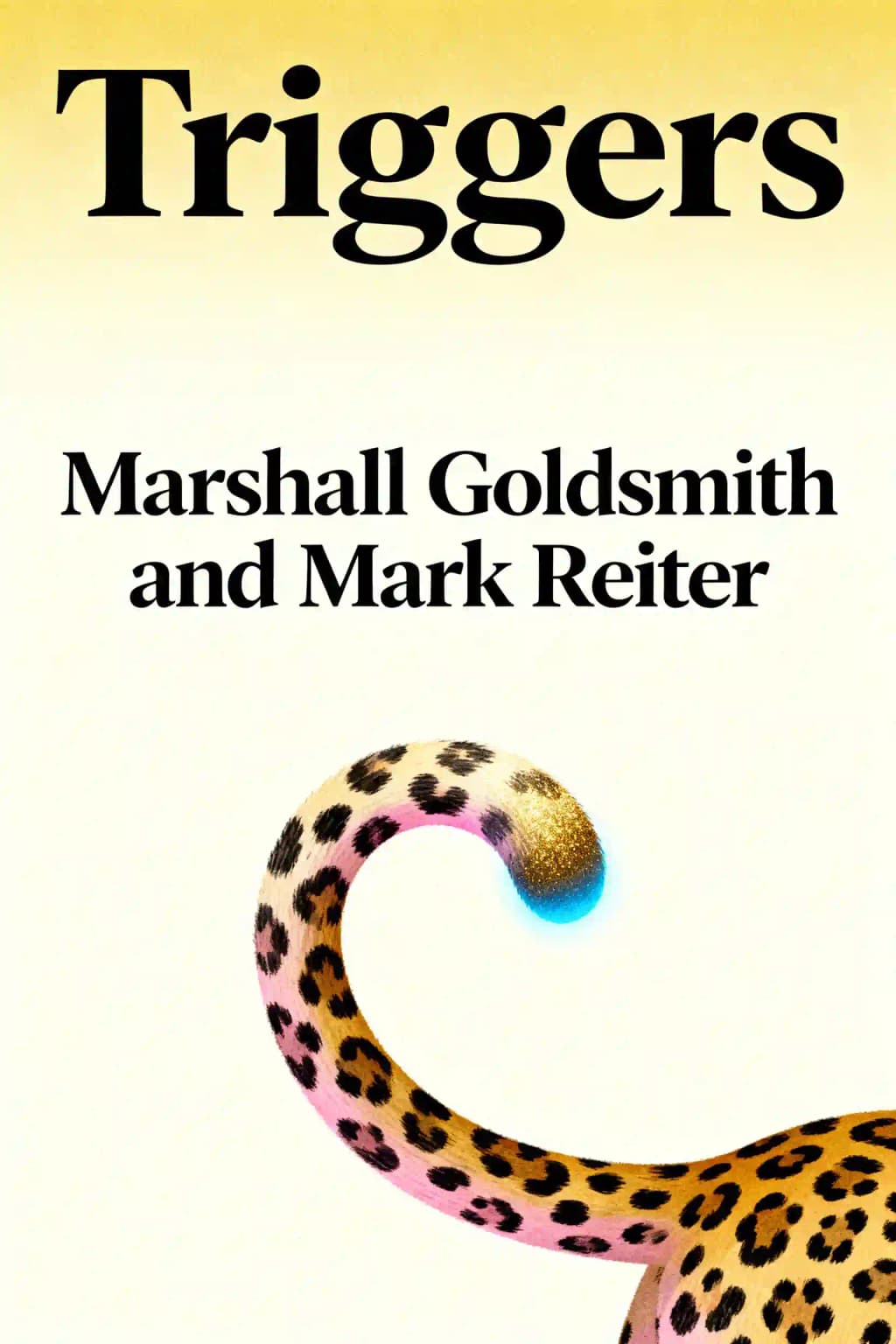
Discover why world-class executives trust Marshall Goldsmith's "Triggers" to break self-sabotaging habits. Learn the revolutionary "active questions" technique that transforms intention into action. Even top business leaders were shocked by how simple environmental triggers hijack our best plans - and how easily we can regain control.
Marshall Goldsmith, a world-renowned executive coach and New York Times bestselling author, co-authored Triggers: Creating Behavior That Lasts—Becoming the Person You Want to Be with Mark Reiter, a seasoned collaborator known for translating complex ideas into compelling narratives.
Goldsmith, a two-time Thinkers50 Leadership Award winner, has spent four decades coaching over 150 CEOs and refining frameworks for sustainable behavioral change—a core theme of Triggers, which blends psychological insights with actionable strategies for personal and professional growth. His prior works, including What Got You Here Won’t Get You There and Mojo, are foundational texts in leadership development.
Reiter’s expertise in distilling executive coaching principles into accessible prose has made him Goldsmith’s trusted co-author across multiple bestsellers. Their collaboration on Triggers earned the book #1 spots on the New York Times and Wall Street Journal bestseller lists, with translations reaching global audiences in 32 languages.
Triggers explores how environmental and psychological factors derail behavior, offering strategies to overcome them. Marshall Goldsmith introduces daily self-monitoring via “active questions” to foster lasting change by focusing on effort, not outcomes. The book combines leadership insights with practical tools, emphasizing accountability in personal and professional growth.
Professionals seeking behavioral change, leaders aiming to improve team dynamics, and individuals interested in self-improvement will benefit. The book targets those committed to actionable strategies, explicitly excluding those resistant to change (“successful adults won’t change unless they want to”).
Yes, for its actionable frameworks like active questions and AIWATT. Reviews praise its blend of executive coaching wisdom and relatable anecdotes, though some note the daily discipline required. It’s ideal for readers valuing structure over abstract theory.
Goldsmith identifies belief triggers (e.g., “I don’t have time”) that sabotage change. By reframing these mental barriers through self-questioning, individuals take ownership of their responses.
Triggers are external cues (people, events) prompting automatic reactions. They’re neutral—productive or counterproductive based on response. Example: A critical colleague triggering defensiveness vs. curiosity.
Unlike habit-forming guides, Triggers emphasizes daily environmental awareness and instant course correction. The “magic bullet” is relentless self-monitoring, not willpower alone.
Some note the simplicity of active questions risks underestimating deeper psychological barriers. Others highlight the challenge of maintaining daily discipline long-term.
While Atomic Habits focuses on incremental routines, Triggers targets immediate environmental influences. The books complement each other—habits build systems; triggers demand real-time accountability.
Yes. Examples include:
Daily prompts include:
By treating change as a daily practice, not a one-time goal. The book argues sustained self-awareness—not motivation—drives lasting improvement.
저자의 목소리로 책을 느껴보세요
지식을 흥미롭고 예시가 풍부한 인사이트로 전환
핵심 아이디어를 빠르게 캡처하여 신속하게 학습
재미있고 매력적인 방식으로 책을 즐기세요
Meaningful behavioral change is perhaps the most difficult challenge humans face.
Understanding doesn't guarantee doing.
We overestimate it and underestimate how our environment undermines it.
We're masters at avoiding change, especially when it applies to ourselves.
No one can make us change unless we truly want to change.
Triggers의 핵심 아이디어를 이해하기 쉬운 포인트로 분해하여 혁신적인 팀이 어떻게 창조하고, 협력하고, 성장하는지 이해합니다.
Triggers을 빠른 기억 단서로 압축하여 솔직함, 팀워크, 창의적 회복력의 핵심 원칙을 강조합니다.

생생한 스토리텔링을 통해 Triggers을 경험하고, 혁신 교훈을 기억에 남고 적용할 수 있는 순간으로 바꿉니다.
무엇이든 물어보고, 목소리를 선택하고, 진정으로 공감되는 인사이트를 함께 만들어보세요.

샌프란시스코에서 컬럼비아 대학교 동문들이 만들었습니다
"Instead of endless scrolling, I just hit play on BeFreed. It saves me so much time."
"I never knew where to start with nonfiction—BeFreed’s book lists turned into podcasts gave me a clear path."
"Perfect balance between learning and entertainment. Finished ‘Thinking, Fast and Slow’ on my commute this week."
"Crazy how much I learned while walking the dog. BeFreed = small habits → big gains."
"Reading used to feel like a chore. Now it’s just part of my lifestyle."
"Feels effortless compared to reading. I’ve finished 6 books this month already."
"BeFreed turned my guilty doomscrolling into something that feels productive and inspiring."
"BeFreed turned my commute into learning time. 20-min podcasts are perfect for finishing books I never had time for."
"BeFreed replaced my podcast queue. Imagine Spotify for books — that’s it. 🙌"
"It is great for me to learn something from the book without reading it."
"The themed book list podcasts help me connect ideas across authors—like a guided audio journey."
"Makes me feel smarter every time before going to work"
샌프란시스코에서 컬럼비아 대학교 동문들이 만들었습니다

Triggers 요약을 무료 PDF 또는 EPUB으로 받으세요. 인쇄하거나 오프라인에서 언제든 읽을 수 있습니다.
Have you ever wondered why you keep making the same mistakes despite your best intentions? The gap between what we intend to do and what we actually do isn't just frustrating-it's the central challenge of human behavior. Drawing from 35+ years coaching Fortune 500 executives, Marshall Goldsmith reveals that meaningful change doesn't require complicated techniques-just awareness, structure, and consistent effort in the face of environmental triggers that constantly shape our behavior. The brilliance lies in understanding that our environments control us far more than we control them. Every situation presents different who-what-when-where-why specifics that put our behavioral integrity at risk. The mother who confidently manages her home transforms into a different person in a budget meeting. A teacher who shows patience with students might become aggressive in traffic. These aren't signs of hypocrisy but evidence of how powerfully our surroundings influence who we become.