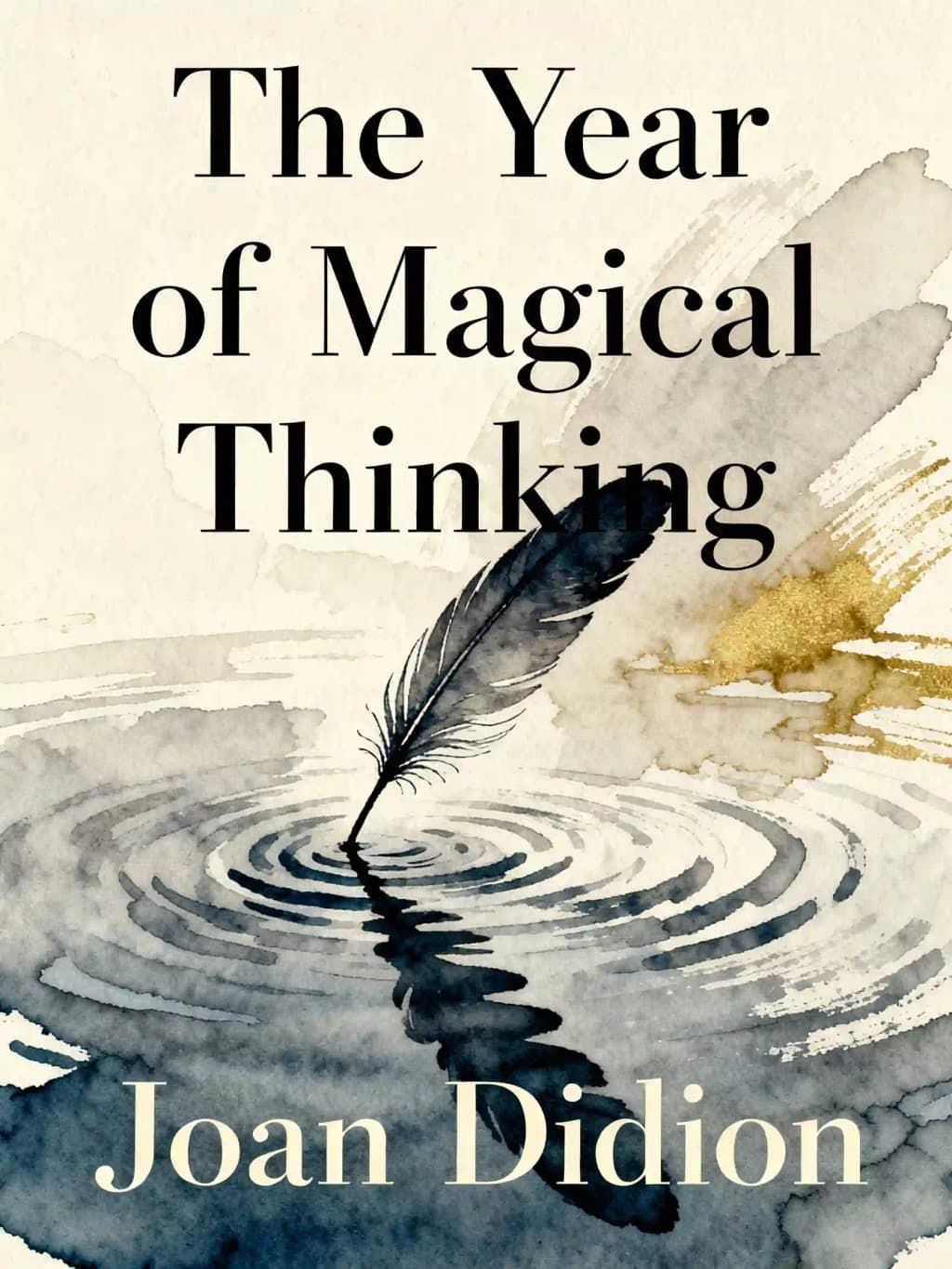
In Joan Didion's raw memoir of grief, she chronicles the year following her husband's sudden death. This National Book Award winner became therapy for countless mourners, with Vanessa Redgrave bringing its shattering honesty to Broadway. How do we survive when everything changes in an instant?
Joan Didion (1934–2021), author of The Year of Magical Thinking, was a cornerstone of American literature and New Journalism, renowned for her incisive explorations of grief, identity, and societal upheaval. This memoir, rooted in her sudden loss of husband John Gregory Dunne and her daughter’s critical illness, distills raw personal trauma into universal reflections on mourning.
A UC Berkeley graduate and Vogue alumna, Didion’s career spanned essays, novels, and screenplays, including collaborations with Dunne on films like A Star Is Born. Her iconic works, such as Slouching Towards Bethlehem and The White Album, cemented her status as a chronicler of 20th-century cultural fragmentation.
The Year of Magical Thinking won the National Book Award and became a finalist for the Pulitzer Prize, later adapted into a Broadway play. Didion’s influence extends beyond literature, with her essays required reading in universities worldwide. Explore her penetrating insights on California’s myths in Where I Was From or her later meditation on loss in Blue Nights, both testaments to her unflinching clarity. The book has been translated into over 30 languages, affirming its global resonance.
The Year of Magical Thinking explores Joan Didion’s grief following the sudden death of her husband, John Gregory Dunne, and her daughter Quintana Roo’s critical illness. Through candid reflections, Didion dissects the psychological mechanisms of loss, particularly “magical thinking”—the irrational belief that one can reverse tragedy through ritual or denial. The memoir blends personal anguish with broader insights into mourning’s universal complexities.
This memoir resonates with readers navigating grief, psychology enthusiasts, and fans of Didion’s precise prose. It appeals to those seeking raw, intellectual explorations of loss or studying autobiographical writing. Critics and literary scholars also value it for its contribution to New Journalism and its unflinching examination of emotional resilience.
Widely acclaimed, the book won the National Book Award and is praised for its lucid, analytical approach to grief. Didion’s ability to transform personal tragedy into a universal narrative makes it a seminal work on mourning. Its enduring relevance and critical acclaim solidify its status as a modern classic.
Didion defines “magical thinking” as the subconscious belief that specific actions or rituals can alter reality, such as keeping her husband’s shoes in case he returns. This coping mechanism illustrates the mind’s struggle to process irreversible loss, blending logic with irrational hope during trauma.
Notable quotes include:
These lines encapsulate the memoir’s themes of sudden upheaval and the isolating nature of sorrow.
Didion’s spare, introspective prose—hallmarks of her New Journalism roots—creates clinical detachment to dissect grief’s chaos. Her fragmented narrative mirrors disorientation post-loss, while precise details anchor the emotional weight. This style elevates personal trauma into a broader meditation on human fragility.
Some critics argue Didion’s analytical tone feels emotionally distant, potentially alienating readers seeking sentimental solace. Others note the memoir’s narrow focus on her privileged perspective, though this intentional choice underscores grief’s isolating nature.
Unlike sentimental accounts, Didion’s memoir dissects grief intellectually, blending reportage with introspection. Its structural precision and lack of overt sentimentality distinguish it from works like C.S. Lewis’s A Grief Observed, offering a unique lens on mourning’s psychology.
Quintana’s hospitalization and uncertain prognosis compound Didion’s grief, layering maternal fear atop widowhood. Her absence and fragile health symbolize unresolved anguish, heightening the memoir’s tension between hope and despair.
Key themes include:
Her journalism career sharpened her observational rigor, evident in the memoir’s meticulous detail. Experiences writing about social upheaval (e.g., Slouching Towards Bethlehem) informed her ability to frame personal pain within broader cultural and psychological contexts.
The memoir redefined autobiographical writing by merging unflinching self-analysis with universal truths about loss. Its awards, enduring academic study, and continued cultural relevance—especially in discussions about grief—cement its status as a literary landmark.
저자의 목소리로 책을 느껴보세요
지식을 흥미롭고 예시가 풍부한 인사이트로 전환
핵심 아이디어를 빠르게 캡처하여 신속하게 학습
재미있고 매력적인 방식으로 책을 즐기세요
Grief turns out to be a place none of us know until we reach it.
I know why we try to keep the dead alive: we try to keep them alive in order to keep them with us.
We are imperfect mortal beings, aware of that mortality even as we push it away, demanding what amounts to perfection.
Life changes fast. Life changes in the instant.
The Year of Magical Thinking의 핵심 아이디어를 이해하기 쉬운 포인트로 분해하여 혁신적인 팀이 어떻게 창조하고, 협력하고, 성장하는지 이해합니다.
The Year of Magical Thinking을 빠른 기억 단서로 압축하여 솔직함, 팀워크, 창의적 회복력의 핵심 원칙을 강조합니다.

생생한 스토리텔링을 통해 The Year of Magical Thinking을 경험하고, 혁신 교훈을 기억에 남고 적용할 수 있는 순간으로 바꿉니다.
무엇이든 물어보고, 목소리를 선택하고, 진정으로 공감되는 인사이트를 함께 만들어보세요.

샌프란시스코에서 컬럼비아 대학교 동문들이 만들었습니다
"Instead of endless scrolling, I just hit play on BeFreed. It saves me so much time."
"I never knew where to start with nonfiction—BeFreed’s book lists turned into podcasts gave me a clear path."
"Perfect balance between learning and entertainment. Finished ‘Thinking, Fast and Slow’ on my commute this week."
"Crazy how much I learned while walking the dog. BeFreed = small habits → big gains."
"Reading used to feel like a chore. Now it’s just part of my lifestyle."
"Feels effortless compared to reading. I’ve finished 6 books this month already."
"BeFreed turned my guilty doomscrolling into something that feels productive and inspiring."
"BeFreed turned my commute into learning time. 20-min podcasts are perfect for finishing books I never had time for."
"BeFreed replaced my podcast queue. Imagine Spotify for books — that’s it. 🙌"
"It is great for me to learn something from the book without reading it."
"The themed book list podcasts help me connect ideas across authors—like a guided audio journey."
"Makes me feel smarter every time before going to work"
샌프란시스코에서 컬럼비아 대학교 동문들이 만들었습니다

The Year of Magical Thinking 요약을 무료 PDF 또는 EPUB으로 받으세요. 인쇄하거나 오프라인에서 언제든 읽을 수 있습니다.
Life changes fast. Life changes in the instant. One moment you're sitting down to dinner with your husband of nearly forty years, and the next, he's slumped over in his chair, gone forever. This is what happened to Joan Didion on December 30, 2003, when her husband John Gregory Dunne died suddenly of a massive coronary event. The shock was compounded by the fact that their only daughter, Quintana, lay unconscious in a nearby hospital, suffering from pneumonia and septic shock. In the span of moments, Didion's world collapsed, thrusting her into what she would later call her "year of magical thinking" - a period marked by grief so profound it altered her perception of reality itself. What follows is not just a journey through loss, but an exploration of how the mind attempts to make sense of the senseless, to find order in chaos, to keep breathing when the very ground beneath you has disappeared.