1장
The Digital Revolution's Unexpected Freedom Fighter
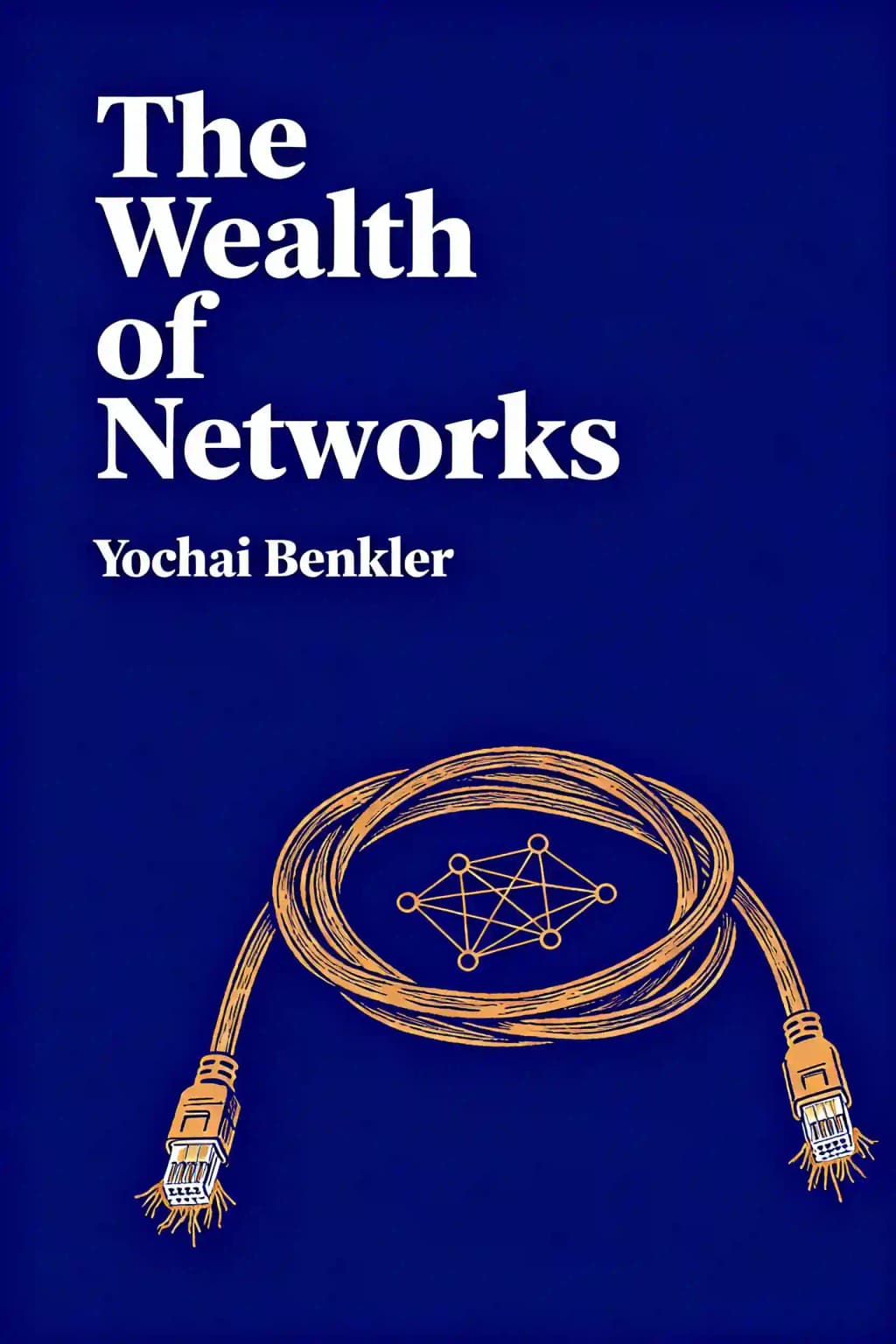
The Wealth of Networks isn't just another technology book-it's a manifesto that fundamentally reimagines how society can organize itself in the digital age. When Yochai Benkler published this groundbreaking work in 2006, few could have predicted its profound impact. Tim O'Reilly called it "the most important book about the Internet since Lawrence Lessig's Code," while Cory Doctorow declared it "the most important and powerful book about the Internet written so far." Even beyond tech circles, Benkler's ideas penetrated mainstream discourse, with The Economist naming him among the top eight business minds and Foreign Policy listing him among the world's top 100 public intellectuals. The book's central thesis-that networked information technologies enable unprecedented non-market, cooperative forms of production-has transformed how we understand everything from software development to political activism.
2장
The Networked Information Economy: A Fundamental Transformation
For over 150 years, modern democracies relied on industrial information economies where mass media corporations controlled the production and distribution of information, knowledge, and culture. This system concentrated the means of communication in the hands of a few commercial entities, limiting who could speak publicly and what could be said. But something remarkable has happened: the material conditions of information production have radically changed.
The networked information economy represents a profound shift from this industrial model. As computers became cheaper and more powerful, and as network connections spread globally, the physical capital required for effective information production and communication has distributed into the hands of billions. This shift has placed the material means of information production in the hands of ordinary people, creating what Benkler calls "the practical possibility of making anyone a creator."
Consider the difference: In 1976, creating and distributing a documentary required expensive equipment, professional skills, and access to broadcast or theater distribution networks-all controlled by commercial gatekeepers. Today, a smartphone, basic editing software, and an internet connection allow anyone to create and distribute video content worldwide. This transformation isn't limited to entertainment; it extends to news reporting, scientific research, educational materials, and political discourse.
What makes this shift so significant is that it enables nonmarket, nonproprietary production to flourish at the core of advanced economies. When the physical capital needed for information production becomes widely distributed, human creativity and existing information become the primary inputs. And unlike physical resources, human creativity cannot be transferred or commodified in the same way-it remains with the individual. This creates space for new forms of production outside traditional market mechanisms.
The result is a new information environment where decentralized individual action-specifically cooperative action through nonmarket mechanisms-plays a much greater role than ever before. This doesn't mean markets disappear, but they now coexist with robust social production systems that were previously impossible at scale.
3장
Commons-Based Peer Production: The New Model of Cooperation
At the heart of this transformation is a new mode of production that Benkler calls "commons-based peer production." This approach organizes projects without relying on either markets (with their price signals) or managerial hierarchies (with their commands). Instead, it depends on decentralized, collaborative systems based on sharing resources and outputs among loosely connected individuals.
Free software represents the most visible example. Projects like Linux-which powers most web servers, Android phones, and countless other systems-are created by thousands of volunteers who contribute code not because bosses direct them or because they're offered direct payment, but through a complex mix of motivations including reputation, skill development, and shared purpose.
What makes peer production work? Three key elements: First, these projects break work into small, independent modules that can be completed by different people at different times. Second, they implement quality control mechanisms that filter contributions based on merit rather than credentials. Third, they create governance structures that allow coordination without centralized control.
Wikipedia exemplifies these principles. Anyone can edit articles, but changes must meet community standards. Contributions are evaluated based on quality rather than the contributor's identity. Governance emerges through social norms, discussion pages, and an evolving set of policies rather than top-down management. The result is an encyclopedia with quality comparable to traditional reference works but created through a radically different production model.
This approach extends beyond software and encyclopedias. Scientific research increasingly relies on distributed collaboration, with projects like Galaxy Zoo engaging hundreds of thousands of volunteers in astronomical classification. Creative works emerge through platforms like YouTube, where individual creators build on each other's ideas. Even physical products are being designed through open collaborative processes, from furniture to farm equipment.
What's revolutionary about peer production isn't just its ability to create high-quality information goods, but how it fundamentally challenges our assumptions about human motivation and organizational efficiency. People contribute to these projects for reasons that traditional economics struggles to explain-intrinsic satisfaction, social connection, reputation, and the joy of creativity often prove more powerful motivators than financial compensation alone.
4장
Enhanced Individual Freedom in the Networked Environment
The networked information economy dramatically enhances individual autonomy in three critical ways. First, it expands what people can do for themselves independently. With access to global information resources and tools for creation, individuals can produce their own expressions and seek information without depending on commercial media gatekeepers.
Consider someone researching a medical condition. In the industrial information economy, they might have access to a few books and whatever their doctor told them. Today, they can access medical journals, patient communities, and diverse perspectives that allow them to become genuinely informed participants in their own healthcare decisions.
Second, the networked environment enables accomplishing more through loose affiliations without requiring stable organizations. Projects that previously demanded substantial formal institutions-like building an encyclopedia or mapping a city-become attainable through fluid, low-commitment cooperative relationships. Individuals can contribute to collective efforts without surrendering their autonomy to organizational hierarchies.
Third, even when participating in formal organizations, individuals have more effective tools for self-organization and independent action. From workplace collaboration platforms to community organizing tools, technology enables more horizontal coordination with less need for top-down control.
This enhanced autonomy makes people less susceptible to manipulation by media owners and increases the diversity of perspectives available to each person. We're no longer limited to the worldview presented by a handful of commercial media outlets; instead, we can construct our understanding from a rich tapestry of sources, including direct access to primary materials and diverse interpretations.
What's at stake here isn't some abstract notion of freedom but the practical ability of individuals to perceive a broader range of possibilities against which to measure their choices-to author their own lives with greater awareness of alternatives and less constraint from external gatekeepers.
5장
The Networked Public Sphere: Transforming Democratic Discourse
Perhaps the most profound impact of the networked information economy is its transformation of the public sphere-the space where citizens communicate about matters of common concern. The mass media model that dominated the twentieth century created a public sphere with severe limitations: few intake points for new information, minimal opportunities for citizen participation, and strong commercial pressures toward sensationalism over substance.
The networked public sphere offers a fundamentally different structure. Rather than funneling public discourse through a small number of commercial entities, it enables a distributed conversation where millions can participate directly. This doesn't mean everyone gets equal attention, but it creates multiple pathways for important information to reach public consciousness.
How does this work in practice? Consider the case of Trent Lott's 2002 comments praising Strom Thurmond's segregationist presidential campaign. Traditional media initially ignored these remarks, but bloggers-first liberal, then conservative-investigated Lott's history of racially charged statements and demanded accountability. Within days, the story migrated to mainstream media, ultimately forcing Lott's resignation as Senate majority leader.
This pattern has repeated countless times: information that powerful interests might prefer to suppress emerges through networked channels, gains visibility through distributed attention, and eventually reaches broader public awareness. From the Abu Ghraib photographs to corporate malfeasance to political corruption, the networked public sphere has repeatedly demonstrated its capacity to surface important information despite resistance from traditional power centers.
Critics worry this system creates information overload or echo chambers where people only encounter perspectives they already agree with. But research shows that the networked environment actually creates more exposure to diverse viewpoints than traditional media consumption. The structure of the web, with its clustering around topics but strong connections between clusters, facilitates information flow across ideological boundaries while allowing communities of interest to develop specialized knowledge.
What emerges isn't cacophony but a complex, multilayered system of filtering and accreditation. Communities of interest form clusters where initial vetting occurs before observations travel to progressively more visible sites through what Benkler calls an "attention backbone." This structure resists both information overload and money's corrupting influence, as attention depends more on engaging interested communities than reaching massive passive audiences.
6장
A More Participatory Culture: From Consumption to Creation
The twentieth century saw folk culture largely displaced by commercial mass culture, transforming people from co-creators into passive consumers. Time previously spent on storytelling, amateur performances, and communal singing became dominated by radio, phonographs, and television. We developed expectations of "production values" unattainable with untrained voices and crude tools.
The networked information economy reverses this trend, enabling a revival of folk culture where many more people actively participate in creating cultural meaning rather than passively consuming it. Digital tools have dramatically lowered the technical barriers to cultural production, allowing ordinary people to create and share music, videos, stories, and art that approach professional quality.
This shift toward a participatory culture has profound implications. When people actively engage in creating and remixing culture rather than merely consuming it, they develop a more critical, reflective relationship with their cultural environment. The practice of producing culture makes us all more sophisticated "readers" who can more thoughtfully engage with the media we encounter.
Consider how platforms like YouTube have transformed video creation from a professional specialty to a widespread amateur practice. Or how digital audio workstations have enabled bedroom musicians to create professional-quality recordings. Or how fan fiction communities have developed sophisticated networks of creation, critique, and distribution outside commercial publishing channels.
What's emerging isn't a replacement for professional cultural production but a complementary layer of participatory culture that enriches our collective creative environment. This new folk culture exists alongside commercial production, often in conversation with it, as fans remix, respond to, and reinterpret mainstream content while creating original works that sometimes influence commercial production in return.
The result is a cultural environment that's both more transparent and more malleable. It's more transparent because the networked structure makes visible the multiple meanings and interpretations that exist around cultural symbols. And it's more malleable because digital tools enable ordinary people to reshape and respond to culture rather than simply accepting it as given.
7장
Justice and Human Development: Knowledge as a Global Commons
Beyond its effects on individual freedom and democratic discourse, the networked information economy opens new avenues for addressing global justice and human development. Information, knowledge, and culture are core inputs into human welfare-agricultural knowledge affects food security, medical innovation impacts health, and educational resources enable individual growth and social mobility.
The industrial information economy distributed these resources primarily through market mechanisms, making access dependent on ability to pay. This system systematically underserved those with limited financial resources, particularly in developing countries. When twenty thousand American teenagers can pay more for acne medication than a million Africans can afford for malaria vaccines, a system overly reliant on proprietary models becomes fundamentally unjust.
The networked information economy enables alternative approaches based on commons rather than property. Free software provides powerful computing tools without licensing costs. Open access scientific publishing makes research findings available to researchers worldwide. Open educational resources offer learning materials that can be freely adapted to local contexts.
These commons-based approaches are particularly valuable for developing countries. They provide access to essential knowledge resources without the prohibitive costs of proprietary systems. They enable local adaptation without permission from distant copyright holders. And they create opportunities for participation in global knowledge production based on human ability rather than financial capital.
Consider agricultural innovation, where commons-based approaches are emerging to counter the privatization of seed development. Projects like BIOS (Biological Innovation for Open Society) are creating open-source biotechnology tools that researchers and farmers can freely use and adapt. These efforts aim to ensure that agricultural innovation serves the needs of the world's poorest farmers rather than just profitable markets.
Or look at medical research, where initiatives like the Public Library of Science are making cutting-edge research freely available worldwide, while organizations like OneWorld Health develop treatments for neglected diseases outside profit-driven pharmaceutical models. These approaches don't eliminate the need for market-based innovation but complement it by addressing needs that markets systematically neglect.
8장
Social Ties: Strengthening Human Connection
Critics of digital technology often worry that online interaction will replace face-to-face connection, leading to social isolation and community breakdown. But research consistently shows the opposite: internet use strengthens existing relationships while enabling new forms of connection that were previously impossible. Studies from the Pew Research Center demonstrate that people who are most active online also tend to be more socially engaged in their physical communities, participating in more civic organizations and maintaining larger in-person social networks.
The evidence is clear-people primarily use digital communication to maintain and deepen relationships with family, friends, and neighbors. Seventy-nine percent of internet users communicate with existing social connections online, while only 26 percent use it to meet new people. Rather than replacing in-person interaction, digital tools supplement it, allowing people to maintain contact across distances and schedule face-to-face gatherings. Parents use group chats to coordinate children's activities, distant relatives share daily moments through photo streams, and friends use social media to organize local meetups and celebrations.
What's emerging isn't a replacement for traditional community but a new form of social organization that sociologist Barry Wellman calls "networked individualism." We're becoming adept at fulfilling community functions through overlapping social ties of varying duration and intensity. We maintain strong bonds with family and intimate friends while developing a wider range of weaker connections that serve specific purposes. These weak ties prove invaluable for professional networking, information sharing, and accessing diverse perspectives and opportunities.
This shift doesn't leave us isolated; it gives us greater flexibility in how we construct our social worlds. We can maintain connections with geographically distant friends who share our interests while strengthening local community ties. For example, someone might participate in an online support group for a rare medical condition while also using neighborhood apps to organize local events. We can participate in multiple communities simultaneously rather than being limited to those defined by physical proximity. Digital platforms enable us to join professional associations, hobby groups, and social movements regardless of location. We can create support networks tailored to our specific needs rather than accepting whatever social structures happen to exist in our immediate environment.
The key insight is that digital communication doesn't replace other forms of interaction-it transforms our overall communication patterns. People primarily "buy" their online time by watching less television, substituting active communication for passive consumption. Research shows that each hour spent on social media typically replaces 30 minutes of television viewing and 30 minutes of other activities. This represents a net gain for social connection, not a loss. Moreover, digital platforms are evolving to support richer forms of interaction, from video calls that capture nonverbal cues to virtual reality spaces that create shared experiences. These technologies are enabling new forms of presence and intimacy that complement, rather than compete with, traditional social bonds.
The impact of digital communication varies across different demographic groups. Young people, in particular, seamlessly blend online and offline social interactions, while older adults often use digital tools to maintain family connections and combat isolation. Immigrant communities use digital platforms to maintain ties with their home countries while building new local networks. These varied use patterns suggest that digital social tools are adaptable to different needs and cultural contexts, enhancing rather than diminishing our capacity for meaningful human connection.
9장
The Battle for the Digital Commons
None of these positive developments is inevitable. The transformation toward a more open, participatory information environment threatens substantial redistribution of power and wealth from twentieth-century industrial information producers to both individuals and new market entrants. Unsurprisingly, incumbents aren't accepting this reallocation passively, deploying extensive lobbying efforts, technical measures, and legal strategies to maintain their position.
A fierce battle is underway across what Benkler calls the "institutional ecology" of the digital environment. This battle plays out across three layers: the physical infrastructure (networks and devices), the logical layer (software and protocols), and the content layer (information, knowledge, and cultural works). Each layer represents a critical battleground where traditional gatekeepers fight to maintain control against emerging distributed models.
At the physical layer, telecommunications companies seek control over what information can flow through their networks, pushing for tiered service models and opposing net neutrality principles. They argue for the right to prioritize certain types of content and charge differential rates for access. Meanwhile, copyright industries push for regulations requiring computers to include technical restrictions on copying, such as trusted computing platforms and hardware-level DRM. These efforts threaten the open architecture that enables innovation without permission and could create permanent bottlenecks controlled by incumbent players.
At the logical layer, proprietary software companies work to maintain their dominant position against open-source alternatives through various technical and legal mechanisms. Microsoft's efforts to maintain Windows' dominance through proprietary protocols and file formats exemplify this struggle. Content industries use increasingly sophisticated digital rights management technologies to control how software interacts with cultural works, limiting interoperability and user freedom. Patents on software and business methods create additional barriers to innovation outside established channels, with patent thickets making it difficult for new entrants to develop competing products without risking litigation.
At the content layer, copyright terms have been repeatedly extended - from the original 14 years to now life plus 70 years - while fair use has been narrowed through restrictive interpretations and aggressive litigation. New legal tools like the DMCA's anti-circumvention provisions criminalize activities that were previously legal, such as format-shifting or creating interoperable products. These changes systematically favor commercial producers over commons-based ones and threaten traditional practices of sharing and reuse that have historically driven cultural innovation.
What's at stake in these battles is whether there will be a core common infrastructure governed as a commons and available to anyone outside the market-based proprietary framework. This commons would include basic communications protocols, fundamental software tools, and a rich public domain of cultural materials. Without such a commons, the transformative potential of the networked information economy could be severely constrained, limiting both individual freedom and collaborative innovation. The outcome will largely determine whether the internet remains a platform for distributed creativity and democratized production or becomes primarily a delivery channel for proprietary content and services.
10장
A Moment of Opportunity and Challenge
We stand at a historic crossroads where the future of information production hangs in the balance. Two distinct paths lie before us: a return to the industrial model of centralized control, or the emergence of a new paradigm based on decentralized, nonmarket collaboration. While digital technologies enable this transformation, the ultimate outcome will be determined not by technical capabilities alone, but through deliberate social choices and political decisions that shape our institutional framework.
The networked information economy presents unprecedented opportunities for human advancement across multiple dimensions. It enables ordinary citizens to become creators rather than mere consumers, transforming the way knowledge is generated and shared. Through platforms like wikis, open-source software projects, and citizen journalism, individuals can now contribute meaningfully to the collective knowledge commons. This shift democratizes innovation and cultural production in ways previously unimaginable, allowing diverse voices and perspectives to flourish outside traditional commercial channels.
The potential benefits extend far beyond individual empowerment. Enhanced democratic discourse becomes possible when citizens can easily access information, engage in public debate, and coordinate collective action. Participatory culture flourishes as people share creative works, remix existing content, and collaborate across geographical boundaries. Global challenges like poverty, education, and healthcare access can be addressed through distributed problem-solving and knowledge sharing.
However, realizing these possibilities requires vigilantly protecting several crucial conditions. First, networks must remain open and neutral, free from gatekeepers who might restrict the flow of information. Second, we must preserve general-purpose computing devices that users can freely modify and control. Third, intellectual property rules need to balance innovation incentives with the freedom to build upon others' work. Finally, social norms supporting sharing, collaboration, and the commons must be cultivated and defended against purely market-based logic.
The stakes in this battle extend far beyond technical or legal considerations. We are deciding fundamental questions about power, autonomy, and social organization in the digital age. Will we create an environment that empowers individuals to shape their information landscape, or will we allow corporate and state interests to impose artificial scarcity and control? Will we embrace the potential for peer production and collaborative creativity, or retreat to familiar industrial-era models?
The choices we make today will profoundly influence human development in the twenty-first century. By supporting commons-based production and protecting the institutional conditions it requires, we can build a future characterized by greater individual autonomy, more vibrant democracy, and richer cultural exchange. We can break down barriers to opportunity and enable human flourishing across the globe. The technology exists - what remains is the social and political will to realize its emancipatory potential. The responsibility for choosing this path lies with all of us.