1장
The Weight of Memory: Stories from a War That Never Ends
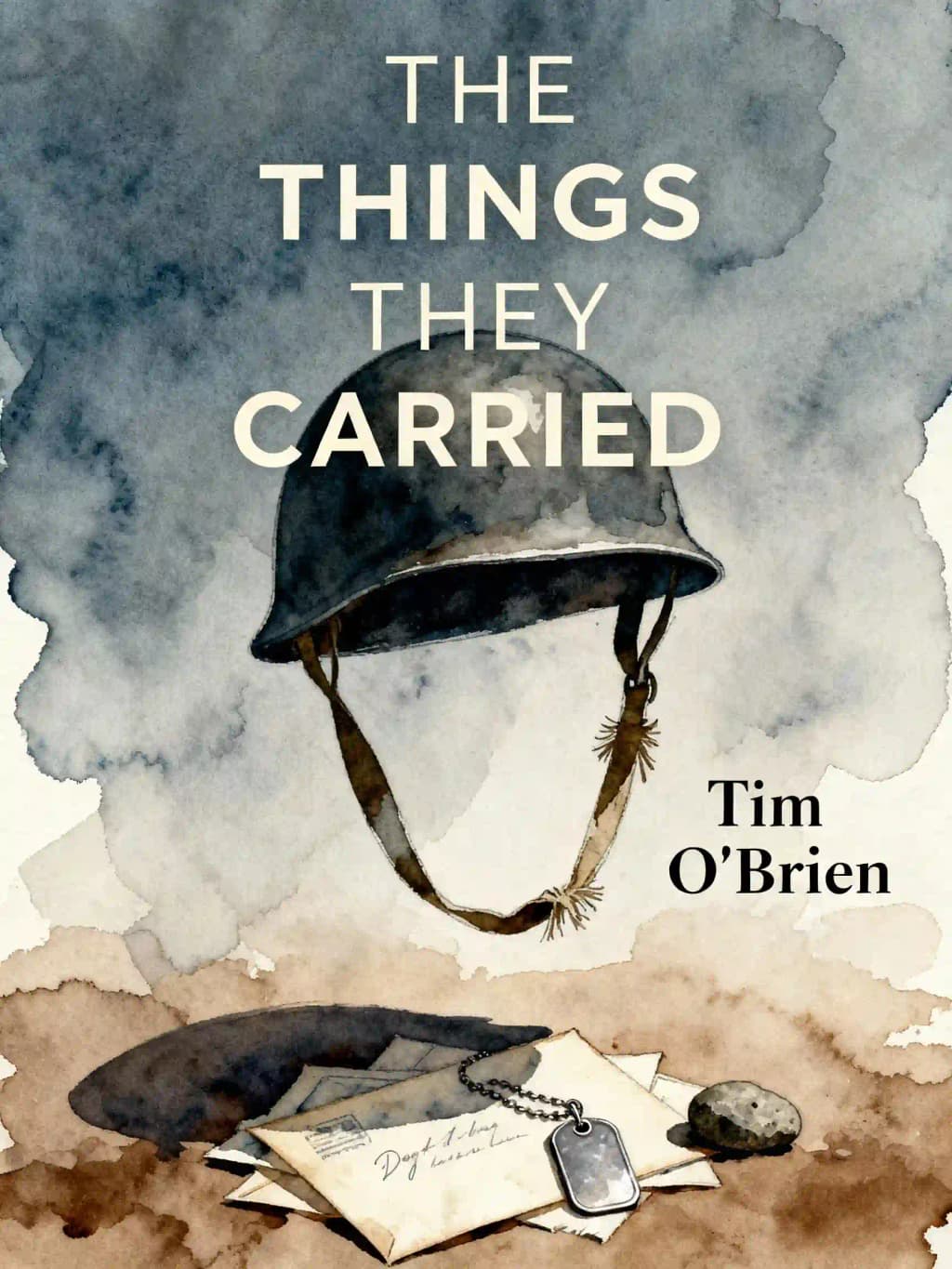
In Tim O'Brien's haunting masterpiece, soldiers carry not just physical burdens but the crushing weight of memory, guilt, and love. Published in 1990, this book quickly established itself as one of the most influential works about the Vietnam War, earning the National Book Critics Circle Award and becoming required reading in schools across America. Barack Obama included it among his essential reads, and veterans frequently cite it as the truest depiction of war's psychological toll. What makes this work so powerful isn't just its unflinching look at combat, but its exploration of how stories themselves-true, false, or somewhere in between-become our way of carrying the unbearable. Through interconnected stories that blur the line between memoir and fiction, O'Brien creates something more honest than fact: emotional truth that continues to resonate decades after the war's end.
2장
The Physical and Emotional Burdens of War
First Lieutenant Jimmy Cross carried letters from Martha, a college junior who signed them "Love" but didn't mean it. He carried her photographs, especially treasuring one where she leaned against a brick wall at Mount Sebastian College, wearing a white dress and looking beautiful but distant. Her eyes gazed past the camera, suggesting a detachment that tormented Cross. Each night, while his men slept, he would meticulously arrange these tokens at the bottom of his rucksack, creating elaborate fantasies of walking with her along Jersey Shore or sharing coffee in Boston, desperate attempts to construct normalcy amid the surreal horror of Vietnam.
The physical burden each soldier carried was precisely calculated and brutally real. They humped military necessities: M-16 rifles, ammunition magazines, claymore mines, grenades, and flak jackets. Their basic combat load - including C rations, water, can openers, mosquito repellent, dog tags, and basic survival gear - typically weighed between 15-20 pounds. Specialized equipment added more: an M-16 (7.5 pounds), M-60 machine gun (23 pounds), or PRC-25 radio (26 pounds). The massive Henry Dobbins carried extra rations; his size demanded more fuel. Dave Jensen, obsessed with hygiene, carried three kinds of soap, dental floss, vitamin supplements, and foot powder. Ted Lavender, perpetually anxious, carried tranquilizers - six or seven pounds of dope until his death.
The invisible weights proved far heavier than any physical burden. They carried grief for fallen comrades, terror of hidden mines, and guilt over killing. They carried homesickness that felt like a stone in their gut, and the crushing responsibility of staying alive. They carried America itself - its inflated dreams of victory, its naive patriotism, its distant parades and protests, and the crushing weight of representing a nation increasingly divided about their presence there. They carried each other's lives in their decisions, their watchfulness, their shared silence.
When Ted Lavender was shot outside Than Khe village - killed instantly by a sniper while returning from relieving himself - they carried his body through the mud to the evacuation helicopter. That night, as smoke rose from the burned village, Lieutenant Cross removed Martha's letters and photographs from his rucksack. In his foxhole, he burned each item methodically, blaming his love-struck distraction for Lavender's death. He vowed to be a harder man, a better leader, to carry his men's lives more carefully. But such promises, like the war itself, carried their own weight.
Twenty years later, when Cross visited O'Brien in Massachusetts, he pulled out a new photograph of Martha - not the original he'd burned, but one she'd given him at a college reunion in 1979. Despite the decades, despite Vietnam, despite his marriage to another woman, he admitted he still loved her. Some burdens lighten with time, but others, like phantom limbs, you carry forever, their weight as real as any rucksack.
3장
The Slippery Nature of Truth in War Stories
How do you tell a true war story? Not with moral lessons or tidy conclusions. A true war story can't be believed and often can't even be told. It doesn't instruct or encourage virtue. It embarrasses you with its raw obscenity and evil.
Consider Rat Kiley writing to his dead friend's sister, pouring his heart into a letter describing what a great guy her brother was-how he volunteered for dangerous missions, had "steel balls," and made the war almost fun with his crazy antics. After mailing it, Rat waited two months for a reply that never came. "The dumb cooze never writes back," he said. That's a true war story-the obscenity of "cooze" capturing the rawness of his grief.
Or take Mitchell Sanders' story about a six-man patrol who set up listening posts in the mountains. After a few days of deep silence, they began hearing strange music-violins and cellos, opera singers, glee clubs, and finally a cocktail party with people chattering in languages they couldn't identify. Spooked, they called in artillery on the mountains. When they returned to base, their colonel demanded an explanation for the unauthorized artillery strike. They said nothing. They were ordered to go back, but found only silence. Sanders paused dramatically before revealing the moral: "Nobody listens."
The next morning, Sanders admitted he'd made up parts of the story-the glee club, the opera-but insisted the essence remained true. The six men had heard something inexplicable in the mountains. When asked again for the moral, he simply said, "Hear that quiet? That's your moral."
In true war stories, you can't separate what happened from what seemed to happen. The pictures get jumbled; the edges blur. When a booby trap explodes, you close your eyes and duck and float outside yourself. The truths are contradictory: war is hell, but war is also mystery and terror and adventure and courage and discovery and holiness and pity and despair.
A true war story is never about war. It's about sunlight. It's about love and memory. It's about sorrow. It's about sisters who never write back and people who never listen.
4장
The Transformative Power of Vietnam
Mary Anne Bell arrived in Vietnam wearing culottes and a pink sweater, a high school sweetheart from Cleveland Heights come to join her boyfriend Mark Fossie at a medical detachment near Tra Bong. She was tall, with blue eyes and long legs, the classic American girl next door. At first, she played the role perfectly-setting up house in the medical hooch, decorating their quarters with plastic flowers, planning their future in Ohio with three kids and a house near Lake Erie.
But Vietnam changes people. Within two weeks, Mary Anne was learning Vietnamese phrases and helping the medics, fascinated by their work. "I've never been happier in my whole life," she told Fossie, though something in her voice had already changed. She began asking questions about the war, wanting to see more.
Then came the night patrols. She started going out with the Green Berets-six silent, secretive men who lived apart from the others. At first for a few hours, then overnight, then for days at a time. When Fossie confronted her, she simply said, "I'm here. I'm in the war."
For a while, she tried to play along with Fossie's fantasy of normalcy. She wore her pink sweater again, cooked elaborate dinners, even announced their engagement. But her eyes had changed-"utterly flat and indifferent." Three weeks later, she disappeared into the mountains with the Green Berets.
When Fossie finally tracked her down in their hootch, he found a scene from another world. Candles burned on the floor. Tribal music played. The air stank of incense and the deeper, more primitive smell of blood and scorched hair. A necklace of human tongues hung around Mary Anne's throat.
"You're in a place where you don't belong," she told him. Vietnam had awakened something primal in her. "I feel close to my own body. I'm learning how to live with it... Sometimes I want to eat this place. The whole country-the dirt, the death-I just want to swallow it and have it there inside me."
Eventually, she walked alone into the mountains and never returned. The Greenies said she was still out there somewhere, wearing her pink sweater and necklace of human tongues, ready for the kill.
This wasn't just Mary Anne's story. Vietnam transformed everyone. Some, like Norman Bowker, couldn't adjust to civilian life afterward. Others, like the narrator, became storytellers trying to make sense of what happened. The war entered them all like a virus, changing their DNA in ways they couldn't reverse.
5장
The Crushing Weight of Guilt and Responsibility
Lieutenant Jimmy Cross carried the heaviest burden of leadership, tormented by Ted Lavender's death on the trail to Than Khe. While Lavender was shot in the head during a routine bathroom break, Cross was lost in fantasies about Martha's volleyball games and the softness of her lips. He spent countless nights retracing every decision, convinced that his distraction had cost a man's life. Even decades later, during his meeting with the narrator in Massachusetts, Cross's hands would shake when discussing Lavender, the letters from Martha long since burned but the guilt still smoldering.
The death of Kiowa in the shit field spawned a web of interconnected guilt that ensnared multiple soldiers. Lieutenant Cross tortured himself over ignoring the local Vietnamese farmers who had warned about the field's flooding during monsoon season. He had dismissed their gestures about rising water, prioritizing military protocol over local knowledge. A young soldier named Mark Fossie couldn't shake the memory of showing Kiowa a photograph by flashlight - a simple act of sharing that he believed drew the mortar fire. Norman Bowker's guilt was perhaps the most visceral - he could still feel Kiowa's boot in his hands, could still smell the mud and excrement as his friend was pulled under, could still hear himself choking out "I'm sorry" into the darkness.
The narrator's personal guilt centers on a young Vietnamese soldier he killed on a trail near My Khe. The memory is crystallized in precise detail: the star-shaped hole appearing in the soldier's eye, the way he fell like a marionette with cut strings, the smell of burnt gunpowder mixing with jungle rot. Though the narrator maintains it was a reflexive action, he's haunted by the soldier's peaceful expression and casual posture - signs that the man might have simply walked past. "Sometimes I can see him walking toward me through the fog," he writes. "He'll always be alive in my memory, coming down that trail, forever young, forever approaching."
The broader question of their purpose in Vietnam compounds their individual guilt. They struggle to reconcile their actions with any greater meaning or justification. Were they defending democracy or simply participating in senseless violence? The absence of clear answers makes their specific acts of violence feel even more personally weighted.
Norman Bowker's tragic story exemplifies how this guilt destroys lives long after the war. He circles his hometown lake in an endless loop, rehearsing conversations he can never have. He wants to explain how the Silver Star slipped away like Kiowa in the mud, how the putrid stench of the shit field finally broke his grip on both his friend and his courage. His inability to communicate these experiences leads to profound isolation. When he writes to the narrator asking for help telling his story, the sanitized version he receives back - stripped of the shit field's horror and Kiowa's brutal death - only deepens his despair. His suicide in the YMCA locker room becomes another weight for the narrator to carry.
This guilt transforms into a permanent companion for these men, as much a part of their post-war identity as any physical scar. It shapes their memories, their relationships, and their ability to move forward. Like the items they humped through Vietnam - ammunition, rations, photographs of loved ones - guilt becomes something they carry not by choice but by necessity, a burden that can never be set down.
6장
The Thin Line Between Courage and Cowardice
What makes a person brave? Is it the absence of fear, or action despite fear? In Vietnam, these questions haunted every soldier.
When the narrator received his draft notice, he drove north toward the Canadian border, torn between his conscience (which told him the war was wrong) and his fear of shame. "I was afraid of walking away from my own life, my friends and my family, my whole history, everything that mattered to me." At the Rainy River, with Canada visible on the opposite shore, he couldn't make himself leave. "I was a coward. I went to the war."
In combat, the lines blurred further. Men killed because they were embarrassed not to. They performed brave acts not from conviction but from fear of seeming afraid. After Ted Lavender's death, the platoon carried themselves with poise, using hard vocabulary-"greased," "offed," "zapped"-to contain their terror.
Norman Bowker obsessed over almost winning the Silver Star for valor. He'd held onto Kiowa in the shit field, trying to pull him from the muck while mortars fell around them. But when the stench became overwhelming, he let go. That moment haunted him-the gap between who he wanted to be and who he was when tested.
Even seemingly brave men like Curt Lemon had their vulnerabilities. Though fearless in combat, he fainted at the mere thought of dental work. Later, to restore his pride, he insisted the dentist extract a perfectly healthy tooth.
Perhaps most telling is the story of Dave Jensen and Lee Strunk. After a vicious fight over a missing jackknife, they became unlikely friends who made a pact: if either received a "wheelchair wound," the other would end his suffering. When Strunk lost his leg to a booby trap, his first words to Jensen were, "Oh Jesus, man, don't kill me." The formal agreement meant nothing against the primal will to survive.
In the end, courage in Vietnam wasn't about heroic charges or dramatic sacrifices. It was about enduring, about carrying the weight of fear day after day without breaking. Sometimes it was simply about continuing to breathe when everything inside you wanted to stop.
7장
The Healing and Destructive Power of Stories
For O'Brien, stories are not just entertainment-they're survival tools, ways of processing trauma and preserving what might otherwise be lost. "Stories can save us," he writes. "In a story, I can steal back time."
Through storytelling, he resurrects the dead: Linda, his first childhood love who died of a brain tumor; Kiowa, who sank into the mud during a midnight mortar attack; Ted Lavender, shot while returning from the latrine; Curt Lemon, blown into a tree by a booby trap. In his stories, they live again.
"I'm forty-three years old, and a writer now," he tells us, "and the war has been over for a long while. Much of it is hard to remember. I sit at this typewriter and stare through my words and watch Kiowa sinking into the deep muck of a shit field, or Curt Lemon hanging in pieces from a tree."
But stories can also distort and deceive. Throughout the book, O'Brien blurs the line between truth and fiction, challenging us to consider what "truth" really means in the context of war. Is factual accuracy more important than emotional authenticity? Can a "made-up" story convey deeper truths than a strictly factual account?
He introduces the concept of "story-truth" versus "happening-truth." The happening-truth: he was once a soldier who witnessed death but was often too afraid to look closely. The story-truth: he killed a young Vietnamese man and can describe the star-shaped hole where his eye had been. "I can see that young man step out of the fog. I can see him standing there in the center of that red clay trail... his shoulders slightly stooped, his head cocked to the side... he seemed at ease there, not afraid, just doing what he had to do."
This invented detail makes the experience real in a way that mere facts cannot. "What stories can do, I guess, is make things present." Stories allow him to attach faces to grief, to look at what he couldn't bear to see in the moment, to feel brave again through the act of confronting memory.
Yet stories can also be weapons. When the narrator seeks revenge on medic Bobby Jorgenson for botching his treatment after being wounded, he uses ghost stories to terrorize him at night. The psychological warfare reveals how stories can manipulate and harm as easily as they can heal.
In the end, O'Brien suggests that storytelling is both burden and salvation-the only way to carry the weight of experience forward into a life worth living.
8장
The Blurred Line Between Living and Dead
In Vietnam, the distinction between living and dead wasn't always clear. The soldiers called the Vietnamese "ghosts" for their ability to appear and disappear, to move through the landscape without sound. At night, even skeptics believed in such magic.
The Americans became ghosts too. They moved through villages like apparitions, burning hooches, then vanishing back into the jungle. They carried photographs of the dead alongside pictures of the living. They spoke to fallen comrades in their dreams.
When Curt Lemon died, blown into a tree by a booby trap, Dave Jensen and the narrator had to climb up to retrieve the body parts. What haunted the narrator twenty years later wasn't just the gore, but Jensen singing "Lemon Tree" as they threw down the pieces. The memory blurs-was Lemon really dead if his presence remained so vivid?
In one of the book's most surreal scenes, a fourteen-year-old Vietnamese girl dances barefoot in the dirt after American soldiers burn down her village and kill her family. She moves gracefully, smiling to herself with a dreamy expression, placing her palms against her ears as if to block out the horror. Is she alive or dead in that moment? Is her dance an affirmation of life or a communion with the dead?
The narrator himself exists in this liminal space. He describes floating outside himself during combat, watching events unfold as if from a distance. Years later, he still inhabits multiple realities-the forty-three-year-old writer typing in his quiet room and the young soldier watching Kiowa sink into the mud.
Most poignantly, he brings his childhood sweetheart Linda back to life through dreams after she dies of a brain tumor. In these dreams, they go ice skating together, and he asks what being dead is like. Linda smiles: "Well, right now, I'm not dead. But when I am, it's like being inside a book that nobody's reading... All you can do is wait."
This is what O'Brien does with his stories-he opens the book, turns the pages, and brings the dead back into the light. "In a story, I can steal back time," he writes. "I can cheat death... I'm skimming across the surface of my own history... and when I take a high leap into the dark and come down thirty years later, I realize it is as Tim trying to save Timmy's life with a story."
9장
The Impossibility of Coming Home
For those who survived Vietnam, coming home presented challenges as profound as the war itself. They returned to a country that either vilified them or, worse, seemed indifferent to their experiences. The distance between civilian life and what they'd endured created a chasm too wide to cross.
Norman Bowker exemplifies this disconnect. After returning to his small Iowa hometown, he finds himself driving endlessly around a lake, imagining conversations he can never have. How could he explain to his father or anyone else what happened that night in the shit field? How could he make them understand the smell, the rain, the way Kiowa disappeared into the muck?
At the A&W drive-in, a speaker asks, "Order?" then "What you want?" and finally "Name it, friend"-three perfect openings to tell his story. But Bowker can only order a hamburger and soda. The distance between what happened and what can be communicated feels insurmountable.
Even the landscape seems to mock his experiences. The peaceful lake, the boys hiking along its shore, the stalled motorboat-all these normal scenes feel disconnected from the reality he carries inside. Eight years later, Bowker hangs himself in a YMCA locker room.
The narrator experiences this alienation differently. After being wounded and transferred to rear echelon duty, he returns to visit Alpha Company during a lull in fighting. Though his old friends welcome him, he feels the separation immediately-his starched fatigues and clean haircut marking him as no longer truly part of their blood fraternity. "You don't belong here anymore," Mitchell Sanders tells him bluntly.
Years later, when the narrator returns to Vietnam with his daughter Kathleen, the disconnect persists. Standing at the field where Kiowa died, he tries to connect past and present, but the landscape has changed-the once-terrible shit field now appears peaceful, with yellow butterflies and blue sky. His ten-year-old daughter, bored and confused by his pilgrimage, asks why he can't forget "some dumb thing that happened so long ago."
This is the final burden these men carry-the knowledge that they can never truly come home, never fully explain what they experienced, never completely rejoin the world they left behind. They exist in the liminal space between two realities, carrying stories that can never be fully told or understood.