1장
Voices from the Front Lines: A Nation's Collective Memory
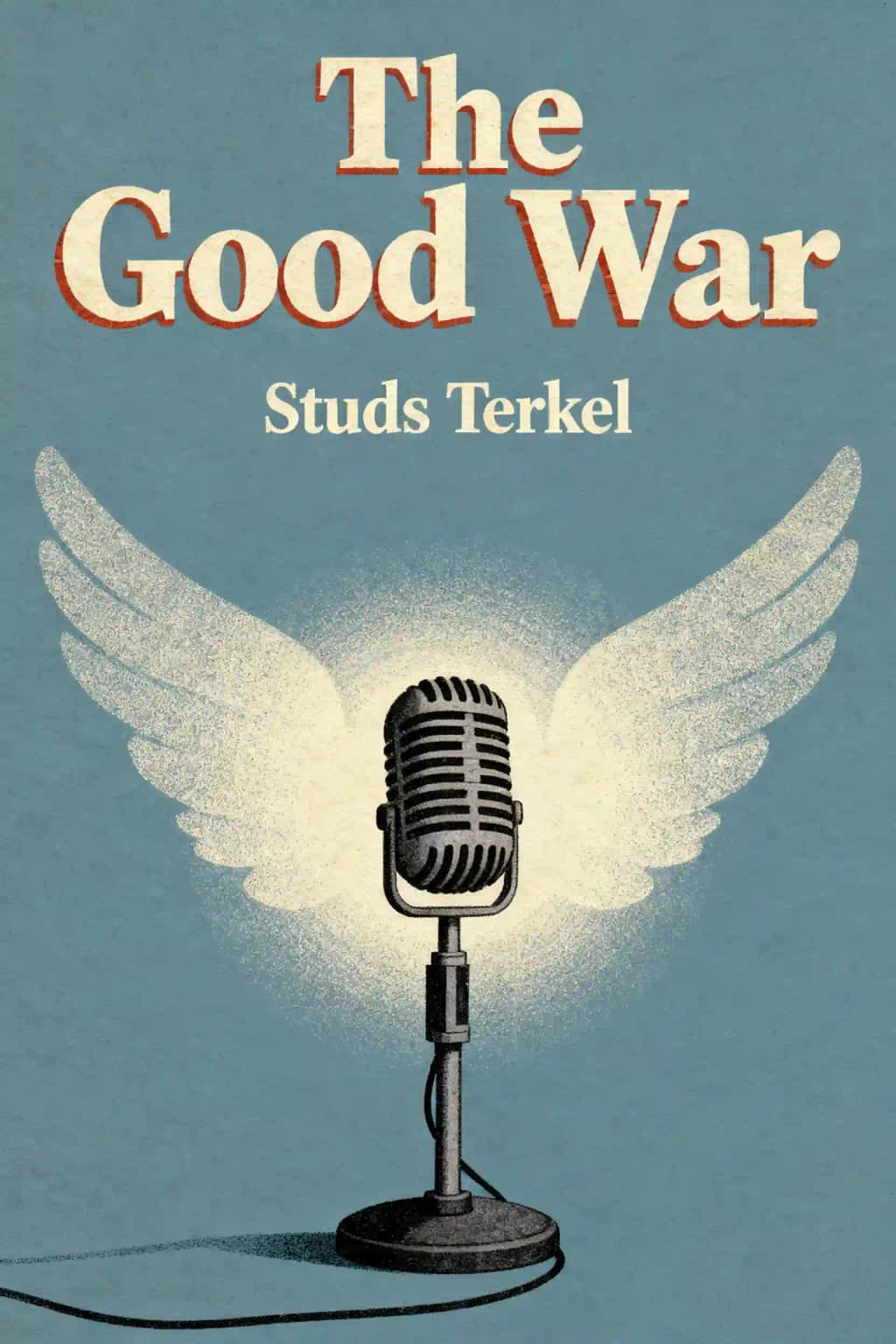
World War II was unlike any conflict before it-a global struggle that transformed not just nations, but individual souls. Studs Terkel's "The Good War" captures this transformation through the voices of those who lived it. When the book was published in 1984, it struck a cultural nerve, winning the Pulitzer Prize and becoming an instant classic. Celebrities from Tom Hanks to Ken Burns have cited it as inspiration for their own explorations of the war. What makes this oral history so compelling is how it challenges the very notion of a "good war" while honoring the sacrifices of those who fought. As American society increasingly questioned its military interventions abroad in the decades following Vietnam, Terkel's work offered a nuanced counterpoint to both blind patriotism and cynical dismissal-revealing the human complexity behind what has become America's defining national mythology.
2장
The Day Everything Changed: Pearl Harbor and Its Aftermath
For most Americans, the war began with shocking suddenness on December 7, 1941. John Garcia, a sixteen-year-old Hawaiian pipe fitter apprentice, initially dismissed the explosions as practice drills until he saw anti-aircraft fire erupting across Pearl Harbor. Racing to work on his motorcycle, he found his assigned ship, the USS Shaw, engulfed in flames. When ordered to fight fires on the USS Pennsylvania where bombs had penetrated near ammunition magazines, Garcia refused: "I was young and sixteen, not stupid, not at sixty-two cents an hour." Instead, he spent the day swimming in the harbor rescuing sailors blown off ships.
The attack triggered immediate panic on the mainland. Dennis Keegan, then a senior at the University of San Francisco, witnessed chaos in San Francisco as people smashed streetcar lights and theater marquees during an improvised blackout. His landlady and her daughter sat terrified in darkness, believing false radio reports that "The Japs are comin'!" and that the Golden Gate Bridge had been bombed. Tom Bradley, who would later become mayor of Los Angeles, described the immediate aftermath as "bedlam"-sirens wailing, aircraft guns firing randomly at non-existent enemies, and widespread panic gripping the city.
For Japanese Americans, Pearl Harbor marked the beginning of a nightmare. Peter Ota and his family were forced from their homes and sent to converted horse stables at Santa Anita racetrack with communal facilities and no privacy. Later transferred to Amache, Colorado-a "desolate, flat, barren" camp that resembled a prison-they ironically studied American history and "talked about freedom all the time." After the war, Ota was drafted into the army but needed special clearance to visit his sick mother in California, where he was escorted by FBI agents through train stations while people called him "dirty Jap"-despite being about to serve in the same uniform.
The attack also transformed ordinary Americans into warriors overnight. Frank Keegan, just sixteen when Pearl Harbor was attacked, recalls how he and five high school friends armed themselves with rifles to defend California against the expected Japanese invasion. Two years later, he joined the merchant marine, serving on Liberty ships-slow vessels built in just thirty days that "every once in a while... would break up because Rosie missed a rivet." When news of Hiroshima reached his ship, his reaction was: "Thank God that's over... Nice goin', Harry. You did it to 'em." The war had changed his life trajectory completely: "If it weren't for the war, I would be selling you insurance right now."
3장
Baptism by Fire: Young Americans Face Combat
For most American soldiers, combat was a shocking introduction to the brutal realities behind patriotic rhetoric. Robert Rasmus, a self-described Sunday school "mama's boy," found himself carrying his sergeant's body with "half his head blown off and the brains coming out on my hands." After just one day of fighting, his unit's appearance changed dramatically-dirty uniforms, bloody faces-giving them a veteran's perspective when seeing fresh troops. Returning to recover bodies in daylight, he had a profound realization seeing dead German soldiers: "These were no longer an abstraction... They were exactly our age."
In the Pacific theater, the fighting took on an especially savage character. E.B. "Sledgehammer" Sledge, who became a biology professor after the war, witnessed brutality that stripped away civilization's veneer. He describes how survival depended on faith in your buddies rather than patriotism, and how American troops began collecting gold teeth from dead Japanese and desecrating corpses. "It was a no-quarter, savage kind of thing," Sledge explains, though moments of humanity remained. When he prepared to collect gold teeth from a dead Japanese soldier, a Navy medic intervened, preventing his further moral decline.
The psychological toll of combat was immense. Joe Hanley describes how his buddy Kevin died in his arms during the "Climb to Climbach" on December 15, 1944, hit by German artillery. Joe had joked it was a "miracle wound" that would send Kevin home, not realizing he was fatally injured. The quiet artist who dreamed of becoming a cartoonist disappeared, replaced by someone who needed constant action and "lived on cognac." Years later, he would marry his dead friend's widow, though he never planned it. December 15th haunts him annually, and he still questions why he survived unscathed while Kevin died: "It was so ridiculous for him to die and me to live."
For those captured by the enemy, survival itself became the only goal. Anton Bilek endured the infamous Bataan Death March-a brutal sixty-mile trek where thousands died from exhaustion, disease, and Japanese brutality. "If you fell out to the side, you were either shot by the guards or bayoneted and left there." At Camp O'Donnell, he witnessed horrific death rates-50 Americans and 350 Filipinos daily. Despite suffering from beriberi, blindness, and dysentery, Bilek survived until the war's end, witnessing the Nagasaki atomic bomb blast from twenty-five miles away: "We turned around and there's the big mushroom, way up in the air."
4장
The Home Front Revolution: Rosie and Beyond
While men fought overseas, American society underwent a profound transformation at home. For women, military work ironically liberated them from domestic confinement. Peggy Terry earned ninety dollars a week testing airplane radios in Michigan war plants and met Polish immigrants who introduced her to union consciousness. "A whole new world just opened up," she recalls. Despite official pressure to relinquish jobs to returning veterans after the war, "the taste for independence was never really lost"-"for millions of American women home would never again be a Doll's House."
Black Americans also experienced limited advancement. Sarah Killingsworth, who moved from Tennessee to Los Angeles in 1935, found new opportunities during the war. Initially working as a maid for $20 a week, she secured a job at Douglas Aircraft in the ladies' restrooms on the graveyard shift, earning $40 weekly. The war significantly improved racial conditions in Los Angeles, which had been "just like bein' in the South" when she arrived. "It wasn't until the war that it really opened up," she notes, concluding that despite the tragic loss of life, "I think it was for a worthy cause, because it did make a way for us."
Not all wartime experiences were empowering. Dellie Hahne was swept up in the excitement and patriotic pressure that "women married soldiers and sent them overseas happy." After just six weekends of knowing her soldier husband Glenn, she married him despite warnings about his character. Following him to military bases across America, she witnessed the misery behind the glamorized war: pregnant women on crowded trains, hostile treatment of military wives in local communities, and growing cynicism as the conflict dragged on. Her hasty marriage to "a uniform" resulted in divorce and financial struggle, directly influencing the rest of her life.
Those who cared for wounded soldiers witnessed the war's most devastating consequences. Betty Basye Hutchinson worked in a plastic surgery dressing room at a burn-and-blind center, changing dressings for severely wounded soldiers with missing facial features and horrific burns. She recalls escorting a badly disfigured pilot to the officers' club for his first outing, and later walking with him in Pasadena where civilians stared in horror and wrote letters to newspapers asking to keep the wounded "off the streets." She criticizes romanticized war depictions for failing to show war's true horror: "Somebody should have said, See, underneath this water is Leslie Bidwell. He died, you see?"
5장
Communities Transformed: Neighborhoods at War
The war reshaped American communities in profound ways. Mike Royko, who later became a Chicago Tribune columnist, grew up in a predominantly Polish working-class Chicago neighborhood during WWII. At nine when the war started, he witnessed his community transform as men left for war and women like his sister became factory workers. The neighborhood installed flagpoles with markers listing the killed locals, and social codes were strictly enforced-women with overseas husbands were closely watched, with one pregnant woman becoming a neighborhood pariah.
Ethnic communities experienced particularly complex transformations. Paul Pisicano, a Sicilian-American architect, reflects on growing up in an Italian-speaking New York neighborhood where Mussolini was initially revered as a superhero. He describes the painful experience of watching Italian soldiers surrender in films during WWII, and the neighborhood's relief when Italy switched sides. After the war, Italian-Americans underwent a transformation-moving to suburbs, becoming professionals through the GI Bill, and adopting right-wing politics. Pisicano laments this assimilation: "The war bred the culture out of us"-as they abandoned their communal traditions, wine cellars, and appreciation for opera in pursuit of respectability and money.
The war also exposed America's racial divisions. Dempsey Travis, a Black real estate broker from Chicago's South Side, describes the stark racial segregation in the military as "two armies, one black, one white." After being shot by white American soldiers at Camp Shenango, Travis was hospitalized where a Red Cross worker remarked, "Niggers don't die when you shoot 'em in the head." At Camp Lee, Virginia, he witnessed German POWs riding in the front of streetcars while Black Americans sat in the back. Despite these experiences, Travis used the GI Bill to overcome educational barriers, calling those four years "the turning point in my life" where he learned about "men, racism, values, and myself."
Racial tensions occasionally erupted into violence on the home front. Don McFadden witnessed the infamous zoot-suit riots of 1943 in Los Angeles, where servicemen targeted Mexican Americans, especially those in distinctive zoot suits. He recalls seeing innocent people dragged off streetcars and beaten, and theaters being stopped mid-movie for servicemen to drag out and assault zoot-suiters. McFadden himself was arrested during these riots after punching an unidentified detective and spent time in jail alongside many beaten Mexican Americans.
6장
The War Machine: Industry, Politics, and Power
The war transformed America from a Depression-ravaged nation into the world's dominant industrial power. Sleepy towns like Seneca, Illinois-a quiet Corn Belt town 70 miles southwest of Chicago-were transformed when the government built massive shipyards. Between 1942 and 1945, this unlikely inland location produced 157 LSTs (Landing Ship, Tanks) for the war effort, forever changing the small community. As one resident observed, "Everything started openin' up for us. We got a chance to go places we had never been able to go before."
For businesses, wartime conditions created unprecedented prosperity. Lee Oremont, a CPA who became a supermarket partner in 1942, witnessed how "the problem of making money disappeared. It became automatic." Starting with $65,000 net worth, they made $100,000 the first year as customers with defense jobs splurged on food. Shortages became profit opportunities-when they acquired 500 cases of terrible canned pears just before rationing began, they sold out in a day. Oremont dismisses business "genius" during this period: "It didn't take a genius to make money during the war... All you had to do was open a store and not get dead drunk."
The Roosevelt administration pivoted dramatically from New Deal reforms to war production. Tommy Corcoran, a former New Deal advisor, recounts how FDR told him to "cut out this New Deal stuff" to appease war production leaders. James Rowe witnessed Washington's transformation from "Dr. New Deal" to "Dr. Win the War." Roosevelt shocked New Dealers by redirecting PWA funds to build navy ships and bringing in dollar-a-year businessmen (mostly Republicans) to run industry. The war created tensions between reformers and businessmen, particularly around antitrust exemptions.
Despite these tensions, the government managed to control inflation successfully through price controls. John Kenneth Galbraith, as head of price control from 1941-43, recalls how his team successfully managed inflation during the war-unlike WWI and Vietnam. Several factors helped: the Depression left room for expanding output rather than raising prices, the war had unanimous public support, and manufacturers protected their trademarks by maintaining quality.
7장
The Atomic Shadow: From Trinity to Fallout
The development and use of atomic weapons marked a turning point in human history. Philip Morrison, who helped design the plutonium core for the atomic bomb, witnessed the Trinity test with "awe and wonder and dismay and fear and triumph." He personally loaded the Nagasaki bomb onto Bock's Car and later viewed Hiroshima photos "with awe and terror." Morrison explains the military rationale for dropping both bombs in quick succession: to convince Japan they faced an endless supply. The physicist argues the atomic bomb's true significance wasn't its destructiveness but its efficiency-"That's why we're in this big trouble"-allowing one plane to destroy what previously required hundreds.
Those who worked on the Manhattan Project often didn't understand what they were creating until after Hiroshima. Marnie Seymour was smugly proud of her work at Oak Ridge, thinking they were part of an elite working on a "blockbuster." They learned what they'd been doing only when her husband saw a newspaper headline about Hiroshima while on leave. The aftermath haunted them-of eighteen couples from their motel, most couldn't have children. Two of their four children had birth defects. Many who witnessed postwar atomic tests developed cancer. Pregnant women on their bus route miscarried so frequently they called it "the abortion line."
Father George Zabelka, the Catholic chaplain for the 509th Composite Group that dropped the atomic bombs, blessed crew members before missions-not the planes or bombs-as was customary for men facing danger. The shock came when they learned 80,000 people died in one explosion. Yet despite his role as a priest, he felt no immediate horror-just relief the war would end. Later, meeting Japanese civilians and seeing dying children with radiation sickness started his moral awakening. The "worm started squirming" as he recognized these were "God's children."
The hibakisha (survivors of Hiroshima and Nagasaki) carry the deepest scars. Hajimi Kito, a 19-year-old soldier when the bomb dropped, recalls cremating countless bodies and hearing children's desperate screams for water. He describes becoming emotionally detached-"I was just carrying an object"-to cope with the horror. Hideko "Tammy" Friedman, who was 11, recounts searching for her mother among the devastation, singing lullabies hoping they might somehow reach her. Her mother was never found, only presumed dead near ground zero.
8장
Legacy of the "Good War": From Victory to Cold War
As World War II ended, the United States emerged as the world's dominant industrial and military power. Returning GIs found "a wholly new society" with unprecedented opportunities. The GI Bill enabled blue-collar workers to "better myself more than, say, hitting the local factory," creating a new middle class. Suburbs, once "the exclusive domain of the 'upper class,'" became accessible through developments like Levittown and Park Forest.
Yet alongside this prosperity came the Cold War. Telford Taylor, returning in 1949 after serving as chief American prosecutor at Nuremberg, found Washington transformed from Roosevelt's liberalism to anti-Communist paranoia. Archibald MacLeish's prescient essay noted how thoroughly American politics had become defined by opposition to Russia: "whatever the Russians did, we did in reverse," with no politician electable unless "on record as detesting the Russians."
The Cold War mindset quickly affected military operations. Arno Mayer, who worked in intelligence with captured German generals, was instructed to keep them comfortable and talkative-but only about the Red Army, not Germany itself. Even months after D-Day, American intelligence was already focused on the next confrontation. When Mayer once exploded at officers who claimed Hitler's only mistake was persecuting Jews, he was nearly court-martialed for disobeying orders to "keep them happy."
Perhaps the most poignant symbol of this transition was the meeting of American and Soviet troops at the Elbe River. Joseph Polowsky, part of a 28-man patrol sent to locate Russian forces, reached the Elbe on April 25, 1945, where American and Russian soldiers embraced in celebration. Lieutenant Kotzebue and Polowsky, along with Russian Lieutenant Colonel Gardead, took an informal oath of friendship amid the carnage. Though another American patrol received official recognition for meeting the Russians hours later, Polowsky remained devoted to what he called "the Oath of the Elbe." The meeting transformed his life-he organized reunions between American and Soviet veterans and wrote countless letters to officials promoting peace.
9장
The Next Generation: Living in the Shadow
For those born during and after the war, World War II cast a long shadow. Nora Watson, born in 1943 to a fundamentalist preacher in rural Pennsylvania, describes how discovering Holocaust photographs at age twelve fundamentally altered her worldview. "It takes the bottom out of the world," she explains, especially combined with atomic fears. The industrial-scale horror executed by human hands destroyed her sense of security: "The floor that opened up is knowing the magnitude of what we can do and will, under circumstances we can't foresee, do to one another."
In Germany, children born during the war grappled with their parents' complicity. Joachim Adler, born in late 1944 in a bombed-out German village, describes challenging his father's wartime participation, rejecting the "just following orders" justification. Unlike his father's generation, Joachim firmly states he would refuse to fight and would accept imprisonment instead. He attributes this stance to greater international communication that wasn't possible thirty years earlier: "We have our minds, we can discuss."
The "boom babies" born after the war grew up with unprecedented prosperity and expectations. Steve McConnell, born in 1947, describes his generation's extraordinary sense of entitlement and power. "I always had a sense that our generation was bigger and better than any that had come before," he explains, recounting their carefree suburban adolescence. His perspective shifted during college when, as a USC football player, he rejected the administration's use of athletes to "bust heads" at anti-war demonstrations. Now at 34, he acknowledges his generation's painful adjustment to diminished expectations: "We had everything... Now is the time of diminished expectations."
For younger generations, nuclear threat became a constant backdrop to everyday life. George Seymour, at 28, represents a generation living under the shadow of nuclear annihilation. Unlike his older brother who believed in political action during the 1960s, George maintains a pragmatic resignation: "Many of my friends, myself, assume that one way or another we won't die natural deaths." Even children absorbed this anxiety. When Chicago street kids aged 11-15 were asked what they wanted to be when they grow up, one girl named Ethel responded with jarring wisdom: "I wanna see if I'm gonna grow up first... my life weren't promised to me."
10장
The Contradictions of Memory: Was It Really "Good"?
The title of Terkel's book-"The Good War"-appears in quotation marks for a reason. Throughout these diverse accounts, a central question emerges: Can any war truly be "good"? For many veterans, the answer remains complex and contradictory. They simultaneously believe in the necessity of defeating fascism while acknowledging the horror and moral compromises of combat.
Admiral Gene LaRocque, who spent four years fighting in the Pacific and participated in thirteen battle engagements, came to see war as "a miserable, ugly business." He argues America fundamentally changed after WWII, becoming militaristic: "We've institutionalized militarism" through the 1947 National Security Act that created the Department of Defense, Joint Chiefs of Staff, and CIA. LaRocque laments how "our military runs our foreign policy" and how America has "used military force 215 times to achieve its international goals since World War Two."
The war's moral ambiguities extended to how America treated its own citizens. Nancy Arnot Harjan, a privileged teenage girl during World War II, witnessed the painful moment when their Japanese employee Mae was sent to what Mae called "a concentration camp," despite her mother's insistence it was "for your protection." This contradiction deeply troubled her idealistic fourteen-year-old mind. "World War Two was just an innocent time in America. I was innocent. My parents were innocent. The country was innocent. Since World War Two, I think I have a more objective view of what this country really is."
Even those who fought heroically sometimes questioned the war's purpose. Timuel Black, who landed at Utah Beach two days after D-Day with his segregated unit, faced continued racism when German POWs were treated better than Black American soldiers. The sight of Buchenwald concentration camp profoundly affected him, crystallizing his determination to fight injustice. Despite his bitter experiences, Black describes being unexpectedly moved to tears upon seeing the Statue of Liberty on his return home-conflicted but determined to make America better.
Perhaps Herman Kogan, a Marine combat correspondent who landed at Okinawa, best captures this contradiction. Though he was often terrified, he sometimes forgot fear while pursuing stories. The experience connected him with a different class of people-selfless kids with no philosophical ideas about war-which kept him from becoming a "University of Chicago intellectual snob." Still, he concludes: "No matter how just a war it was, it was war. It never was a solution to anything. Fuck war."






![[PDF] what do we want students to remember about the “forgotten war”? a](/_next/image?url=https%3A%2F%2Fd1y2du6z1jfm9e.cloudfront.net%2Fassets%2Fpodcast%2Fgreen.png&w=1024&q=50)


