Revolutionize your workplace with the science-backed meeting strategies that earned spots on 25+ "best of" lists. Discover why standing meetings take less time than sitting ones, and why silent brainstorming outperforms vocal sessions - insights trusted by IBM, P&G, and the SEC.
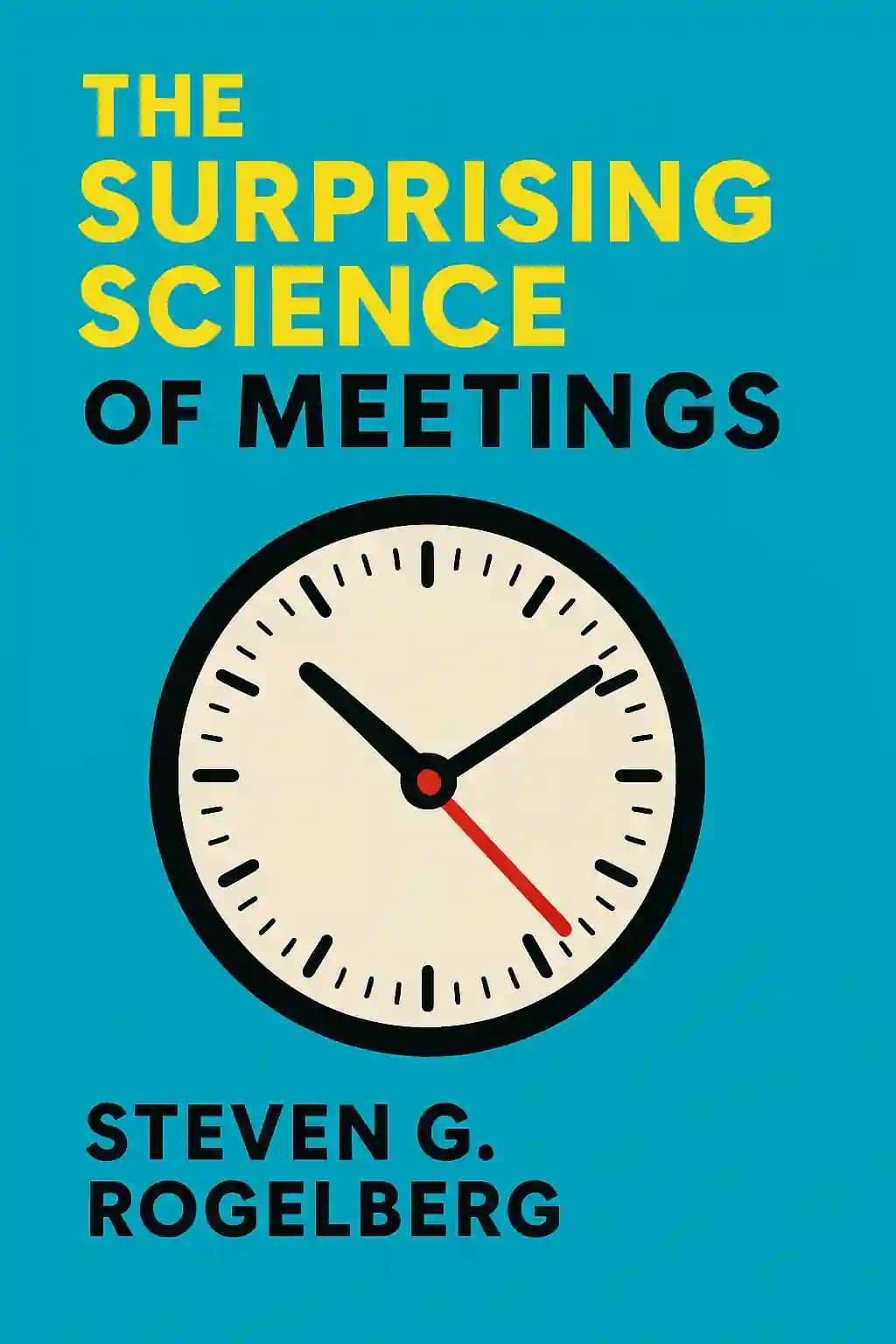
Steven G. Rogelberg, organizational psychologist and New York Times bestselling author of The Surprising Science of Meetings: How You Can Lead Your Team to Peak Performance, is globally recognized as the foremost expert on workplace meetings. A Chancellor’s Professor at UNC Charlotte, Rogelberg combines his PhD in industrial-organizational psychology with decades of research to address leadership challenges in team efficiency and organizational dynamics. His work has been featured on CBS This Morning, NPR’s Morning Edition, and in the Wall Street Journal, while Adam Grant hails him as the “world’s leading expert on how to fix meetings.”
Rogelberg’s insights stem from consulting with Fortune 500 companies like Google and Amazon, directing nonprofit outreach initiatives serving 3,000 organizations, and pioneering frameworks adopted by the United Nations and London Stock Exchange. His follow-up book, Glad We Met: The Art and Science of 1:1 Meetings, expands on practical strategies for managerial effectiveness.
The Surprising Science of Meetings appeared on over 25 “best leadership book” lists and was named the #1 leadership book to watch by the Washington Post. Awarded the Humboldt Prize for lifetime achievement, Rogelberg’s methods are taught in top MBA programs and implemented by executives worldwide.
The Surprising Science of Meetings provides evidence-based strategies to transform unproductive meetings into efficient, engaging sessions. Drawing on 15+ years of research and surveys of 5,000+ employees, Rogelberg identifies common meeting pitfalls (e.g., poor time management, disengagement) and offers actionable fixes, such as optimizing attendee lists and refining agendas. The book combines organizational psychology with real-world examples to help leaders eliminate wasted time and boost outcomes.
This book is essential for managers, team leaders, and employees who regularly organize or attend meetings. It’s particularly valuable for professionals in corporate, tech, or nonprofit sectors seeking data-driven methods to reduce meeting fatigue and improve collaboration. Rogelberg’s insights cater to both novice leaders and seasoned executives aiming to foster accountability and productivity.
Yes—the book is praised for its actionable advice and rigorous research. Business Insider calls it “compelling,” while organizational psychologist Adam Grant hails Rogelberg as the “world’s leading expert on how to fix meetings.” Readers gain tools to shorten meetings, engage participants, and measure success, making it a high-ROD (return on decisions) resource for workplace efficiency.
Core ideas include:
Rogelberg also debunks myths, like the necessity of weekly status updates.
Unlike generic leadership guides, Rogelberg’s work zeroes in on meetings as a microcosm of organizational health. While books like Atomic Habits focus on personal routines, this title offers a systems-level approach to collective efficiency. It’s frequently compared to Patrick Lencioni’s Death by Meeting but stands out for its empirical depth and focus on behavioral science.
Some reviewers note the advice leans heavily on corporate settings, with less guidance for remote or hybrid environments. Others suggest the book could explore systemic causes of meeting dysfunction (e.g., organizational culture) more deeply. However, its practicality and research-backed framework outweigh these gaps.
While primarily focused on in-person interactions, Rogelberg’s principles apply universally: clear agendas, minimized multitasking, and proactive timekeeping. He emphasizes camera-on policies and using breakout rooms for large virtual groups—a prescient take given the post-2020 shift to remote work.
With 55 million daily U.S. meetings wasting $1.4 trillion annually, Rogelberg’s strategies remain critical as workplaces grapple with AI-driven scheduling tools and Gen Z’s demand for efficiency. The book’s focus on psychological safety and inclusivity aligns with modern DEI priorities, making it a timely resource for evolving teams.
Rogelberg, a UNC Charlotte Chancellor’s Professor and recipient of the Humboldt Award, merges academic rigor with real-world consulting experience (e.g., Google, Bank of America). His research on “meeting recovery” and attendee psychology underpins the book’s credibility, earning endorsements from thought leaders like Dan Pink.
For complementary reads, consider:
저자의 목소리로 책을 느껴보세요
지식을 흥미롭고 예시가 풍부한 인사이트로 전환
핵심 아이디어를 빠르게 캡처하여 신속하게 학습
재미있고 매력적인 방식으로 책을 즐기세요
Meetings are easy targets for ridicule.
Meetings serve vital organizational functions.
Employees want meetings as part of their ideal workday.
Allowing poorly conducted meetings is like permitting theft.
Leaders overestimate their meeting facilitation skills.
The Surprising Science of Meetings의 핵심 아이디어를 이해하기 쉬운 포인트로 분해하여 혁신적인 팀이 어떻게 창조하고, 협력하고, 성장하는지 이해합니다.
The Surprising Science of Meetings을 빠른 기억 단서로 압축하여 솔직함, 팀워크, 창의적 회복력의 핵심 원칙을 강조합니다.

생생한 스토리텔링을 통해 The Surprising Science of Meetings을 경험하고, 혁신 교훈을 기억에 남고 적용할 수 있는 순간으로 바꿉니다.
무엇이든 물어보고, 목소리를 선택하고, 진정으로 공감되는 인사이트를 함께 만들어보세요.

샌프란시스코에서 컬럼비아 대학교 동문들이 만들었습니다
"Instead of endless scrolling, I just hit play on BeFreed. It saves me so much time."
"I never knew where to start with nonfiction—BeFreed’s book lists turned into podcasts gave me a clear path."
"Perfect balance between learning and entertainment. Finished ‘Thinking, Fast and Slow’ on my commute this week."
"Crazy how much I learned while walking the dog. BeFreed = small habits → big gains."
"Reading used to feel like a chore. Now it’s just part of my lifestyle."
"Feels effortless compared to reading. I’ve finished 6 books this month already."
"BeFreed turned my guilty doomscrolling into something that feels productive and inspiring."
"BeFreed turned my commute into learning time. 20-min podcasts are perfect for finishing books I never had time for."
"BeFreed replaced my podcast queue. Imagine Spotify for books — that’s it. 🙌"
"It is great for me to learn something from the book without reading it."
"The themed book list podcasts help me connect ideas across authors—like a guided audio journey."
"Makes me feel smarter every time before going to work"
샌프란시스코에서 컬럼비아 대학교 동문들이 만들었습니다

The Surprising Science of Meetings 요약을 무료 PDF 또는 EPUB으로 받으세요. 인쇄하거나 오프라인에서 언제든 읽을 수 있습니다.
Picture this: 55 million meetings happen daily in America alone, costing a staggering $1.4 trillion annually-with an estimated $250 billion completely wasted on ineffective gatherings. Since the 1970s, meeting frequency has exploded fivefold, with executives now spending 56-60% of their working hours in meetings. Some university chancellors average seven meetings daily, totaling nearly five hours, while nonprofit executives often spend six and a half hours meeting-many of which are simply preparing for other meetings! This meeting epidemic reflects shifting organizational values toward inclusion and flatter hierarchies. But the costs are enormous. Beyond the direct financial impact, we rarely calculate the facilities, equipment, opportunity costs, and psychological toll of bad meetings. Most organizations simply accept poor meetings as inevitable-a necessary evil of professional life. What's your organization's return on meeting investment? Using a Meeting Quality Assessment tool, you can calculate your "Wasted Meeting Time Index." Scores between 0-20% indicate productive meetings (above typical), 21-40% suggest hit-or-miss meetings with considerable waste (sadly typical), and scores above 41% indicate meetings needing substantial improvement. The good news? Meeting science-the systematic study of what happens before, during, and after meetings-offers evidence-based solutions that can transform this productivity killer.