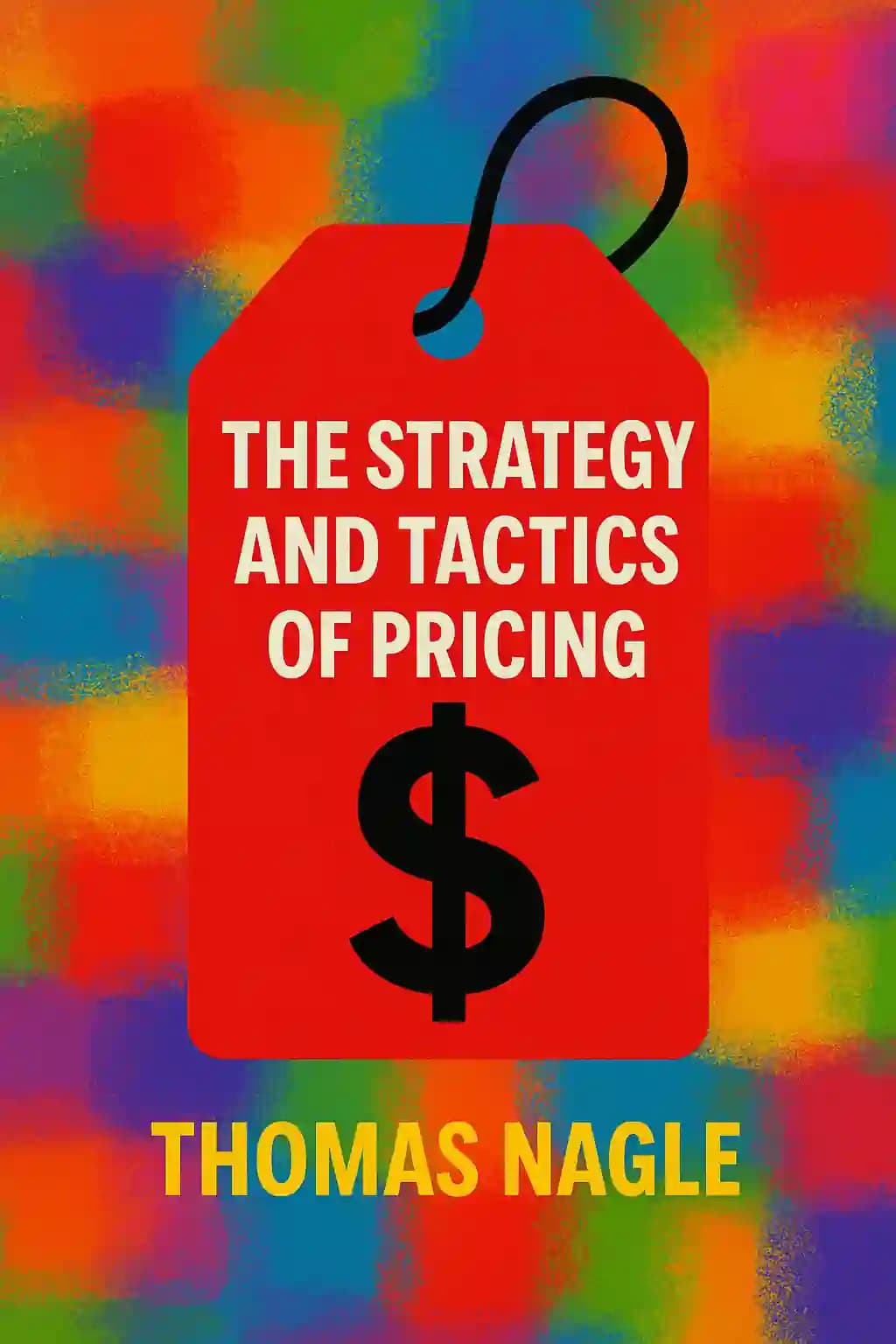
"The Strategy and Tactics of Pricing" revolutionized how businesses capture value, not just set prices. Required reading in top MBA programs and recommended by pricing expert Karan Sood, it's the secret weapon behind countless Fortune 500 pricing strategies. What pricing mistake is costing you millions?
Thomas T. Nagle is a renowned pricing strategist and the bestselling author of The Strategy and Tactics of Pricing. He is a leading authority on value-based pricing and revenue management.
With over three decades of expertise, Nagle co-founded the Strategic Pricing Group (now part of Monitor Deloitte). In this role, he advised Fortune 500 companies across industries on profit optimization through strategic pricing frameworks.
His seminal work explores pricing psychology, market dynamics, and value communication, blending academic rigor with practical boardroom insights. The book, now in its sixth edition, remains essential reading in MBA programs and corporate training worldwide, praised for its actionable methodologies like the "5C" pricing analysis model.
Nagle frequently shares insights through platforms like the Pricing Leadership Podcast and industry keynotes. Translated into 12 languages, The Strategy and Tactics of Pricing has sold over 500,000 copies since its 1987 debut, cementing its status as the definitive guide for pricing professionals.
The Strategy and Tactics of Pricing provides a comprehensive guide to value-based pricing, emphasizing strategic decision-making over reactive cost or sales-driven approaches. It teaches readers to proactively shape customer perceptions of value, align pricing with market dynamics, and leverage frameworks like the "value cascade" to enhance profitability. The book integrates behavioral economics and updated case studies to address modern challenges in pricing strategy.
This book is essential for pricing managers, marketing professionals, and business students seeking actionable insights into profit-driven pricing. Entrepreneurs and executives will also benefit from its practical advice on structuring prices, managing competition, and building organizational pricing capabilities.
Yes, it’s a foundational text for mastering pricing strategy, praised for blending theoretical frameworks with real-world applications. Updated editions include discussions on behavioral economics, big data, and digital pricing, making it relevant for modern markets. Industry leaders like McDonald’s Corporate VP Rajeeve Kaul endorse it as a must-read for pricing excellence.
Core concepts include:
The sixth edition integrates behavioral economics to explain how psychological factors like anchoring and loss aversion influence purchasing decisions. This helps businesses design pricing strategies that resonate with cognitive biases, such as tiered pricing to emphasize perceived savings.
The "value cascade" organizes pricing decisions into a logical flow: defining value creation, communicating value effectively, structuring prices to capture value, and implementing policies to sustain profitability. This framework ensures alignment between market strategy and financial goals.
Nagle argues cost-plus pricing ignores market dynamics and customer willingness to pay. Instead, he advocates value-based pricing, where prices reflect the economic benefit customers derive relative to alternatives. This approach maximizes profit while maintaining competitiveness.
Key pitfalls include:
It recommends differentiating through value communication rather than engaging in price wars. Strategies include emphasizing unique benefits, offering tiered pricing, and creating loyalty programs. Companies should also monitor competitors but prioritize their own value proposition.
Yes, the book addresses digital pricing through strategies like subscription models, dynamic pricing, and freemium tiers. It emphasizes leveraging data analytics to test pricing variables and adapt to real-time market feedback.
Nagle outlines steps to build a pricing-centric culture, including cross-functional training, data transparency, and incentivizing teams based on profitability metrics. Leadership must champion pricing as a strategic priority rather than a tactical afterthought.
Some note the content can be dense for beginners, requiring practical experience to fully apply. Others suggest it could expand more on global pricing challenges, such as currency fluctuations. However, its structured frameworks and updated examples remain widely praised.
While both emphasize profitability, Nagle’s work delves deeper into strategic frameworks and behavioral insights, whereas Hill focuses more on cost analysis and margin optimization. Nagle’s integration of academic research makes it better suited for complex pricing environments.
저자의 목소리로 책을 느껴보세요
지식을 흥미롭고 예시가 풍부한 인사이트로 전환
핵심 아이디어를 빠르게 캡처하여 신속하게 학습
재미있고 매력적인 방식으로 책을 즐기세요
Pricing is not merely about calculating numbers but making strategic choices.
Prioritizing profitability over growth leads to sustainable success.
Value is to pricing what location is to navigation.
The bitterness of poor quality remains long after the sweetness of low price is forgotten.
Strategic pricers ask 'What costs can we afford given achievable market prices?'
The Strategy and Tactics of Pricing의 핵심 아이디어를 이해하기 쉬운 포인트로 분해하여 혁신적인 팀이 어떻게 창조하고, 협력하고, 성장하는지 이해합니다.
The Strategy and Tactics of Pricing을 빠른 기억 단서로 압축하여 솔직함, 팀워크, 창의적 회복력의 핵심 원칙을 강조합니다.

생생한 스토리텔링을 통해 The Strategy and Tactics of Pricing을 경험하고, 혁신 교훈을 기억에 남고 적용할 수 있는 순간으로 바꿉니다.
무엇이든 물어보고, 목소리를 선택하고, 진정으로 공감되는 인사이트를 함께 만들어보세요.

샌프란시스코에서 컬럼비아 대학교 동문들이 만들었습니다
"Instead of endless scrolling, I just hit play on BeFreed. It saves me so much time."
"I never knew where to start with nonfiction—BeFreed’s book lists turned into podcasts gave me a clear path."
"Perfect balance between learning and entertainment. Finished ‘Thinking, Fast and Slow’ on my commute this week."
"Crazy how much I learned while walking the dog. BeFreed = small habits → big gains."
"Reading used to feel like a chore. Now it’s just part of my lifestyle."
"Feels effortless compared to reading. I’ve finished 6 books this month already."
"BeFreed turned my guilty doomscrolling into something that feels productive and inspiring."
"BeFreed turned my commute into learning time. 20-min podcasts are perfect for finishing books I never had time for."
"BeFreed replaced my podcast queue. Imagine Spotify for books — that’s it. 🙌"
"It is great for me to learn something from the book without reading it."
"The themed book list podcasts help me connect ideas across authors—like a guided audio journey."
"Makes me feel smarter every time before going to work"
샌프란시스코에서 컬럼비아 대학교 동문들이 만들었습니다

The Strategy and Tactics of Pricing 요약을 무료 PDF 또는 EPUB으로 받으세요. 인쇄하거나 오프라인에서 언제든 읽을 수 있습니다.
What if I told you that the difference between a struggling business and a market leader often comes down to a single decision most companies get completely wrong? Not their product quality. Not their marketing budget. Not even their customer service. It's pricing-the most powerful profit lever that remains mysteriously misunderstood. Consider this: a mere 1% improvement in pricing, assuming no loss of volume, yields an average 11% increase in operating profits. Yet most businesses still set prices by adding a markup to costs or nervously matching competitors. This approach leaves billions on the table every year. Strategic pricing isn't about charging more-it's about charging right, capturing the true value you create for different customers in different situations. Most businesses fall into one of three pricing traps, each more dangerous than it appears. Cost-plus pricing seems logical-calculate your expenses, add a reasonable margin, done. But this ignores a crucial reality: customers don't care what your product costs to make. They care what it's worth to them. A pharmaceutical company spending $50 million developing a life-saving drug shouldn't price it at cost plus 20%. The value isn't in the manufacturing-it's in the years of life it preserves. Customer-driven pricing sounds customer-friendly but essentially surrenders control, training buyers to negotiate aggressively and always expect discounts. Share-driven pricing chases market dominance through low prices, often triggering destructive price wars where everyone loses. Airlines learned this painfully in the 1990s when aggressive price competition led to industry-wide losses exceeding $13 billion.