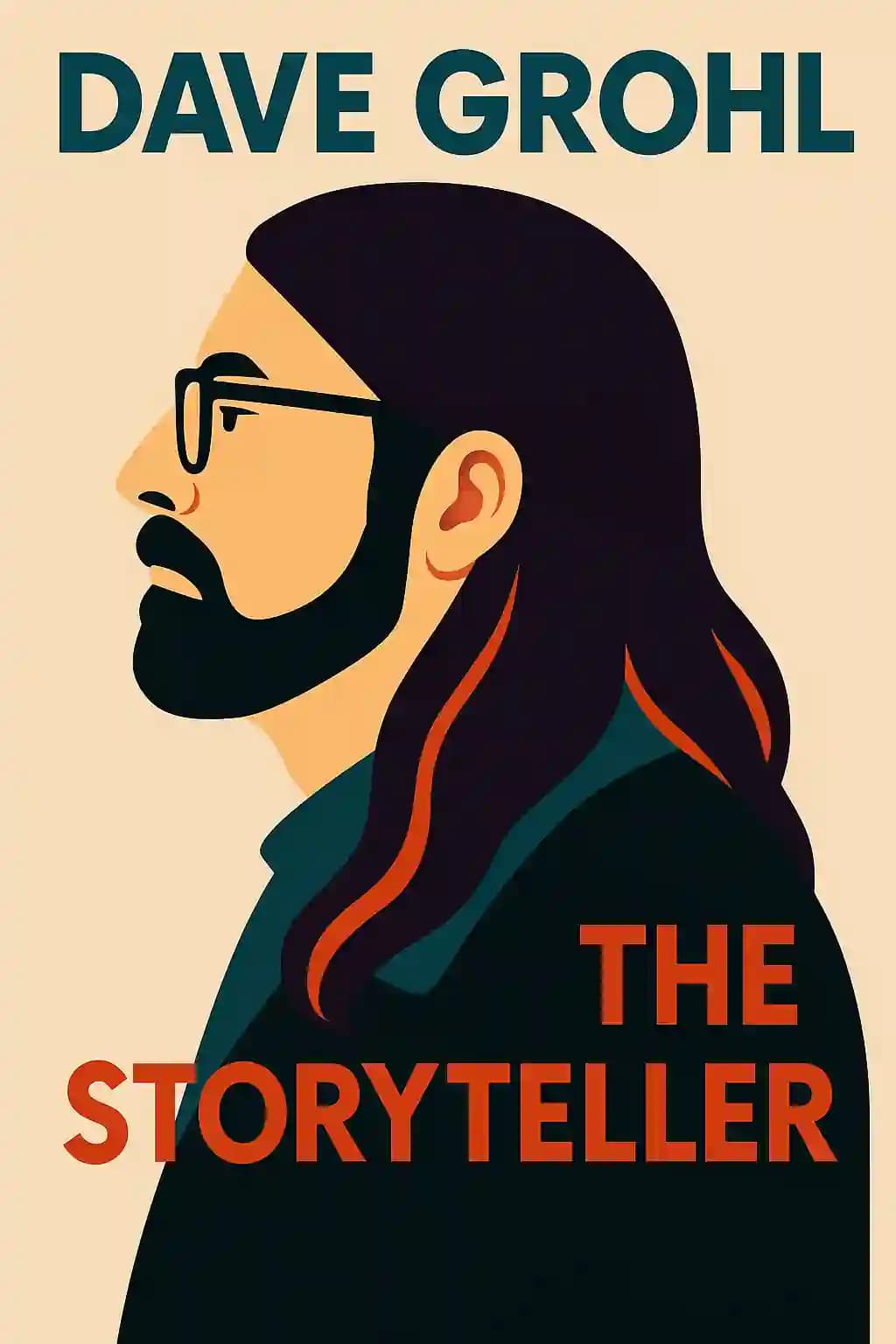
1장
From Punk Kid to Rock Legend: A Journey Through Music and Life
Dave Grohl sometimes forgets he's aged. Looking in the mirror, he sees the evidence of decades in music-chipped teeth from microphones, bags under his eyes from jet lag, patches of white in his beard. At the Hurricane Sandy relief concert, he had an epiphany watching two aging rock stars backstage: one perfectly preserved with dyed hair and cosmetic work, the other authentically weathered with gray hair and natural aging. He decided then to embrace the toll of years rather than fight them, finding beauty in road-worn individuality rather than manufactured perfection.
Grohl's memory remains intact, measuring life in musical increments rather than calendar time. Songs trigger his memories like an unfinished mixtape, each track connecting to a specific moment in his remarkable journey from suburban kid to rock icon. His autobiography has become a cultural phenomenon, landing on The New York Times bestseller list and earning praise from icons like Paul McCartney and Elton John. Through his storytelling, Grohl invites us into the chaotic, beautiful world of a man who transformed from an ordinary suburban kid into one of rock's most beloved figures-all without losing his fundamental decency and wonder.
2장
Musical DNA: The Inheritance of Rhythm and Sound
"Dad, I want to learn how to play the drums." When Dave Grohl's eight-year-old daughter Harper approached him with splintered drumsticks in her tiny hands, he felt overwhelming pride-until realizing he'd never taken formal lessons himself. His only structured instruction came from jazz drummer Lenny Robinson, who'd tried teaching him proper technique during one expensive lesson that revealed Grohl had been holding his sticks backward for years.
With Harper, Grohl skipped the technical fundamentals and went straight for what truly mattered: AC/DC's "Back in Black." When she began playing, he noticed her posture mirrored his own childhood stance perfectly-not coincidence but DNA. Musical abilities aren't divine intervention but flesh and blood, traits carried within our chemistry.
This genetic inheritance had already manifested in his older daughter Violet, verbally gifted from age three with perfect pitch and an ear for imitation. She eventually formed a band with classmates, singing everything from Aretha Franklin to the Ramones. Watching her perform at the Roxy was profound-Harper dreaming of becoming a musician while Grohl's mother witnessed another generation bare their soul to strangers.
Since then, Grohl has performed with both children worldwide, experiencing the same pride his mother felt years ago when he played with jazz musicians at One Step Down. Beyond biology, there's love-an artist's greatest muse. And there's no love like a mother's love, life's greatest song.
3장
First Heartbreak: The Fuel for Creative Fire
Her name was Sandi, and she was Dave Grohl's first heartbreak. In 1982, as a gangly thirteen-year-old entering seventh grade at Holmes Intermediate School, Grohl was leaving behind the familiar faces of his North Springfield neighborhood. Their suburban community of cookie-cutter brick homes was where he'd spent his childhood climbing trees, chewing tobacco, playing hooky, and spray-painting walls-a faded Kodachrome portrait of seventies Americana somewhere between "Stand by Me" and "River's Edge."
Boarding the bus with a plastic comb tucked into his corduroy pants and dirty Nikes, Grohl hoped to survive each day without getting beaten up or expelled. As a horrible student in the early stages of his punk rock chrysalis, having discovered the B-52s and Devo on Saturday Night Live, he longed to fit in while feeling fundamentally different-a misfit waiting for acceptance.
Then he saw Sandi with her ice-blue eyes, feathered blonde hair, and blinding smile. After awkward notes and phone calls, he somehow charmed her into "going steady." But it barely lasted a week before she dropped the bomb: "I'm new here...and I don't really want to get tied down."
Devastated, Grohl trashed all his romantic scribblings. That night he dreamed he was a rock star playing to an arena of fans, with Sandi in the front row sobbing with regret. He woke with sudden clarity-maybe his guitar was the real love of his life. This became the impetus behind every song he's ever written, using heartbreak as fuel. The sweet sting of love refused sends any creative person scrambling to find beauty in pain.
Years later, in 2011, during the Foo Fighters' "Wasting Light" tour, Sandi came to their sold-out Washington DC show. When she appeared in his dressing room, she looked exactly the same, minus the Jordache jeans and feathered hair. That night, playing to his hometown crowd, Grohl looked down to see Sandi standing in the exact spot from his teenage dream thirty years earlier-but instead of sobbing with regret, she was smiling brilliantly with her middle finger in the air, mouthing, "Fuck you, asshole!" It was perfect.
4장
Learning Resilience: The Show Must Go On
When nine-year-old Dave Grohl took a golf club to the skull, he learned something profound about pain. Growing up in North Springfield's cookie-cutter suburban streets, designed for post-WWII federal workers raising families on modest salaries, the hyperactive Grohl sought adventure daily-crawling through drainpipes, jumping off rooftops, and hurling crab apples at passing cars.
That fateful day, after successfully hitting a tethered practice ball in his friends' backyard, he bent down to check the tether post as his friend took his turn-WHACK. The sound echoed through his skull like a basketball bounce. Dazed but conscious, he walked home, only noticing his blood-soaked Superman T-shirt when crossing the street. He gently knocked on his door, trying to minimize the inevitable hysteria: "Mom? Could you come here for a second?"
This wasn't his first trip to Fairfax County Public Hospital. The doctors greeted him like Norm from "Cheers" as he arrived for yet another set of stitches. His body map includes countless scars-hands, knees, fingers, legs, lips, forehead-all repaired like an old rag doll. He'd broken ankles, nearly severed fingers, split his head open (twice on the same hallway corner), survived bike crashes, car accidents, and even being run over at age four.
The strange thing was, he never felt physical pain in those moments-only feared the emotional consequences. He always walked home after injuries, putting on his best game face to avoid inconveniencing his mother more than life already had. He learned this stoicism from watching his mother make sacrifices to raise two happy children, no matter what pain she endured. After all, the show must go on.
This perspective proved prophetic on June 12, 2015, at Sweden's Ullevi stadium. Two songs into a Foo Fighters set before 50,000 fans, Grohl caught his foot on a cable and tumbled off the twelve-foot stage. Landing on concrete, he stood up only to discover his right ankle felt like "a sock full of mashed potatoes"-dislocated completely, with torn ligaments and a snapped fibula.
As paramedics surrounded him, he grabbed a microphone and promised the stunned crowd they'd finish the show. While a Swedish doctor reset his ankle, Grohl bit down on his wife's leather jacket sleeve and laughed through the pain, fueled by Crown Royal and determination. He refused to leave for the hospital, instead demanding the doctor join him onstage, holding his foot in place while he performed seated with his guitar.
They continued for hours, with paramedics eventually fitting him with a plaster cast between songs. The crowd's overwhelming support during "My Hero" and "Times Like These" brought him to tears. This defining moment embodied the band's spirit-born from heartbreak, celebrating life and survival.
5장
The Punk Rock Awakening: Finding Your Tribe
In his aunt Sherry's grand Evanston estate, thirteen-year-old Dave Grohl waited eagerly at the bottom of a winding staircase to greet his ultra-cool cousin Tracey. Though not blood relatives, their connection ran deep-their mothers had been high school friends in Boardman, Ohio, even forming an a cappella trio called the Three Belles with their friend Jeralyn Meyer. They performed standards like "Tea for Two" at local Kiwanis clubs and even on a morning TV cooking show, sharing their love of music without professional aspirations.
The annual 700-mile journey from Virginia to Chicago became Grohl's first taste of travel freedom. After winding through Pennsylvania's hills and Ohio's cornfields, Chicago's skyline appeared like the Emerald City, filling him with wild anticipation. Then came the moment that changed everything-Tracey appeared transformed with Doc Martens, bondage pants, and a shaved head. She was a punk rocker now.
In her bedroom, she introduced him to underground bands like the Misfits, Dead Kennedys, and Black Flag-music created outside corporate structures by people doing it themselves. That night, she took him to see Naked Raygun at the Cubby Bear, his first concert ever. In that sweaty, chaotic room, Grohl found his tribe and was baptized by "spit and sweat and broken glass." He left Chicago with records, a new t-shirt, and a transformed identity-no longer a fragile, insecure kid but a punk rocker ready to show his true self to the world.
This transformation continued when seventeen-year-old Grohl performed a primitive ritual with the John Bonham three-circles logo and the number 606 drawn on a board, hoping to tap into some mystical power that would transform him and grant him the supernatural musical abilities of his heroes. He believed in manifestation before he knew what it was called-that the universe creates what your mind focuses upon. With no diploma or family money, music was all he had. Whether coincidence or not, the success he prayed for eventually found him.
6장
The Road Less Traveled: Life as a Working Musician
At seventeen, Dave Grohl found himself auditioning for Franz Stahl, legendary guitarist of DC's hardcore punk band Scream. When Franz suggested playing some Zeppelin or AC/DC, Grohl practically shouted "No, man... let's do Scream songs!" They blasted through the band's entire catalog in that dingy Arlington head shop basement, and Grohl could see Franz's mood lift as he needed little guidance. He'd learned drums by listening to Scream records, spending every penny from his Shakey's pizza and landscaping jobs on hardcore albums.
After that first audition, Franz invited him back to play with the full band. Grohl was at a crossroads-high school was going nowhere, his grades were dismal, and his father's dreams of him becoming a Republican businessman were laughable. When Kent Stax left Scream to focus on fatherhood, Grohl begged for another chance. His mother's only response to his plan to drop out was "YOU'D BETTER BE GOOD," giving him the freedom to find his path. His father, however, delivered a scathing lecture alongside the guidance counselor about his hopeless future.
Grohl quit his band Dain Bramage, took a job at a furniture warehouse, and finally debuted with Scream on July 25, 1987, at an Amnesty International benefit. Now they were preparing for a fall tour-23 shows across America in just over a month-his first real adventure beyond suburban life.
The van became their home as they embarked across America. Having barely ventured beyond Chicago before, seeing cities like Kansas City, San Francisco, and Los Angeles blew Grohl's mind. This was his escape from suburban monotony into the wild adventure of punk rock touring life.
Their tour took them to legendary venues like CBGB's, where Grohl nearly had a panic attack trying to retrieve his drum key from their van while Harley Flanagan's terrifying pit bull guarded it. They pushed through Detroit (America's murder capital), where he met hardcore hero John Brannon and witnessed Pete's miraculous recovery of their "float bag" with all their money after accidentally leaving it at a gas station.
Arriving in California, Grohl was awestruck by the redwoods and crashing waves along the cliffs. In Santa Cruz, they stayed with Steve Isles and his mother Sherri, who welcomed them with pasta, wine, and incredible weed-true California hospitality. After crossing the entire country on nothing but love of music and will to survive, Grohl stood at the Pacific Ocean feeling like he'd achieved something profound.
7장
Seizing Opportunities: The Path to Nirvana
In Toronto, June 1990, Scream had begun another North American tour in their trusted Dodge van. During their unusually early soundcheck at the Rivoli, Grohl noticed the bartender plastering Iggy Pop promotional posters everywhere. Learning that Iggy was having a record release party before their show but they couldn't attend crushed him.
Later, they watched in awe as Iggy himself emerged from a black limo and disappeared into the club. Just glimpsing him in person was enough to brighten Grohl's world. Then came an unbelievable knock on their van window: "Which one of you is the drummer?" The follow-up question stunned him: "WANNA PLAY DRUMS WITH IGGY POP?"
Inside, Grohl met the legend himself, who introduced himself simply as "Jim." They jammed on classics like "1969" and "I Wanna Be Your Dog," plus a new song called "I Won't Crap Out." Grohl followed along, wondering why Iggy was teaching him something nobody would hear-until he casually dropped: "Great. We go on at six o'clock."
On stage, Iggy transformed into his legendary self, screaming "FUUUUCK YOOOOU!!!" as they launched into "1969." Grohl beat that yellow drum kit like his life depended on it. It ended too quickly, but he'd finally "made it," if only for one night.
Their Scream tour continued despite canceled Midwest shows, forcing them to make a 4,000-mile drive to Olympia, Washington with just their free cigarettes and pocket change. Little did Grohl know it would be their last tour together.
When bassist Skeeter disappeared in Los Angeles, their situation grew desperate. Stranded without money or shows, Grohl survived on the dollar bills of mud wrestlers they were staying with. His rescue came when a friend connected him with Krist Novoselic of Nirvana. After discovering shared musical tastes from NWA to Neil Young during a phone call with Kurt Cobain, they invited him to audition.
Leaving Scream-his family for years-was agonizing. On a collect call from Orange County, his mother gave unexpected advice: "Sometimes you have to put your needs ahead of others." Grohl packed his duffel bag, sleeping bag, and drums into a cardboard box and headed to Seattle, a city he barely knew, starting over but still hungry for adventure.
8장
The Rise and Fall: Nevermind Changes Everything
Kurt Cobain and Dave Grohl shared a filthy Olympia apartment that most wouldn't dare enter. Grohl slept on a cigarette-burned couch too short for his frame, next to Kurt's pet turtle in a putrid terrarium. He survived on the Ampm gas station's three-for-ninety-nine-cents corn dog special, eating one for breakfast and saving two for after rehearsal. Though 2,786 miles from Springfield, Virginia, he was free.
When they received a four-hundred-dollar advance, Grohl blew it like any young musician would-on a BB gun and Nintendo console rather than budgeting for survival. Their days transformed into adolescent recreation-shooting egg cartons in the backyard and playing Super Mario World until dawn.
As Pacific Northwest winter darkness deepened his homesickness, only music kept Grohl from retreating home. Nirvana had an unspoken focus when they played-as Kurt once told music executive Donnie Ienner, "We want to be the biggest band in the world." They rehearsed five days a week in a converted barn studio near Tacoma, beginning each session with "noise jams" that honed their collective instinct and the quiet/loud dynamic they borrowed from the Pixies.
Kurt was remarkably prolific, bringing new songs weekly as they prepared for what would become "Nevermind." Beyond the songs already recorded with Chad Channing, Kurt kept writing-"Come As You Are," "Drain You," "On a Plain," "Territorial Pissings," and "Smells Like Teen Spirit."
They signed with DGC following Sonic Youth's lead, hired their manager John Silva, and chose Butch Vig as producer for his "Midwest Zen demeanor" and ability to amplify every musical element. They selected Sound City Studios in Van Nuys for its amazing drum room, classic console, and low cost.
To fund their thousand-mile journey, they booked a last-minute show at Seattle's OK Hotel on April 17, 1991. When Kurt announced, "This song is called 'Smells Like Teen Spirit,'" the room absolutely exploded-bodies bouncing, a sea of denim and wet flannel before them. THIS WAS NO ORDINARY NEW SONG. This was something else.
"Nevermind" was released September 24, 1991, and within a week Grohl noticed their crowds changing. The uniform of Salvation Army flannels and Doc Martens was now joined by designer jeans and sports jerseys. The "Smells Like Teen Spirit" single had found a broader audience. THE SECRET WAS OUT.
This created an ethical dilemma. As someone raised in the punk underground conditioned to reject corporate influence, how do you process becoming "one of them"? Kurt found this crossroads deeply troubling-the same guy who'd declared "We want to be the biggest band in the world" now faced its horrifying reality. They were attracting the same people who'd bullied them in high school.
By the time they returned to Seattle for their Halloween show, they were completely exhausted but transformed-three disheveled young men who'd left with nothing and returned with a gold record. Their worlds had changed forever, and so had everyone else's. And this was just the beginning.
9장
Rebuilding from Tragedy: The Birth of Foo Fighters
The news of Kurt's death shattered Dave Grohl completely. "He's gone, Dave." Those words sent him crashing to his bedroom floor, overcome with profound sadness. Minutes later, another call: "Hold on...he's not dead." This emotional whiplash-from darkest despair to being born again-left him in a state of emotional limbo, forever changing how he'd process grief.
Thirty-six days later, on April 8, it was real. Kurt was gone. That night, they gathered at his home, bound forever by this devastating event. Life became a series of firsts without him-first coffee, first meal, first drive-each step taking Grohl further from when Kurt was alive.
After Kurt's death, Grohl was lost-they all were. Their world had been pulled out from under them so suddenly and traumatically. What was once his life's greatest joy had become his greatest sorrow. He'd put his instruments away and even turned off the radio, fearing any melody might trigger paralyzing grief.
Seeking clarity, he fled to Ireland's Ring of Kerry, whose serene landscapes had captivated him years earlier. But even there, he couldn't escape-encountering a hitchhiker wearing Kurt's face on a t-shirt triggered a panic attack that ultimately became his turning point. He flew home determined to create again, retreating to what felt most natural: recording songs by himself.
He booked six days at Robert Lang Studios-the same place where Nirvana had recorded their final song-and challenged himself to record fifteen songs in that time. Working feverishly with his friend Barrett Jones, he played nearly every instrument, completing four songs daily. This wasn't just recording; it was therapy-a defibrillator for his heart and faith in music. By week's end, he'd completed what would become the first Foo Fighters record.
When Tom Petty asked if he'd consider playing with the Heartbreakers, offering him his own bus and a relaxed touring schedule, it sounded perfect. Almost too perfect. At twenty-five, Grohl was still hungry and not ready to relax into a "sure thing." He politely declined, choosing instead the cardboard box of cassettes in his truck as his key to a new future. It wasn't a sure thing, but nothing ever is.
10장
Full Circle: Finding Home Again
After seven years in Seattle, Dave Grohl felt his time there had run its course. Despite loving the city, he'd left his heart in Virginia-his forever home. After a twelve-month "lost weekend" in Los Angeles, renting a house near Sunset Strip that he took advantage of with reckless abandon, he set his sights on rural Virginia.
He eventually chose a house on one and a half acres outside Alexandria, where they built the basement studio the Foo Fighters would use for years. The band had recently been freed from their Capitol Records contract thanks to a "key man clause" tied to Gary Gersh's departure-making them completely independent. This freedom proved they were a band because they wanted to be, not because they were obligated.
With the studio's completion came spring, coinciding poetically with their newfound independence as a band. Their DIY studio was far from state-of-the-art-just packing foam, pillows, and sleeping bags nailed to walls for sound treatment-but it embodied the ethos Grohl had learned in DC's punk scene.
This relaxed atmosphere produced what he considers their best album, "There Is Nothing Left to Lose." His obsession with AM Gold music at the time influenced their sound-those rich, melancholy melodies from artists like Andrew Gold, Gerry Rafferty, and Peter Frampton. As nu metal dominated rock, he intentionally moved in the opposite direction, writing gentler, melody-focused songs that reflected his comfort in finally belonging somewhere.
When he accepted the Grammy for Best Rock Album a year and a half later, he felt immense pride that they'd created this independently, away from Hollywood's glitter. From their ramshackle basement studio in the trees he'd climbed as a child, they'd captured the sound of rebirth and found their way back to who they were. After years of pushing through death, divorce, and lineup changes, they'd persevered. One thing was clear: WE DIDN'T HAVE TO DO THIS ANYMORE. WE WANTED TO DO THIS FOREVER.
11장
Legacy and Love: The Next Generation
When Dave Grohl called his mother to tell her "we're having a girl," her voice cracked with emotion. While she cried tears of pride, he stood in shock processing this news. He'd always assumed he'd become a father someday, but only after his touring life ended-he couldn't imagine raising a family while still performing.
It wasn't until playing Neil Young's Bridge School Benefit in 2000 that he realized these worlds could coexist. This annual fundraiser for children with severe speech and physical impairments created an atmosphere of love unlike anything he'd experienced-everyone there for the children, generating healing energy through collective positivity.
Though terrified at the prospect of having a daughter, his mother reassured him with wisdom that has proven true: "The relationship between a father and daughter can be one of the most special relationships in any girl's life."
The day Violet was born, a rare Los Angeles rainbow appeared overhead, calming his nerves. After a difficult labor, she arrived screaming to Beatles music. When he first spoke to her-"Hey, Violet, it's Dad"-she immediately stopped crying and locked eyes with him, recognizing his voice. That connection remains unchanged to this day.
This was a love he'd never experienced-pure and unconditional, unlike the insecurity that comes with fame, where you question if people love you or your celebrity. Being a father to a daughter became the most special relationship of his life. He quickly mastered pedicures, ponytails, and identifying Disney princesses by dress color.
Though touring is the best job on earth, returning home meant immediate daddy duty, partly to relieve his wife but mostly to compensate for his absence. He was haunted by fear that his time away would cause psychological damage, so when home, he was fully present.
Watching his daughters develop made him reflect on his own childhood and his parents' divorce when he was six. How could his father not want to spend every moment with him? Was it that he didn't want to, or didn't know how? This became the root of his fear of being an absent parent and his overcompensation when returning from tour.
They began traveling the world with their daughters, creating a home wherever they were together. The life his father warned would never last had become what he witnessed at Neil Young's house: music and family intertwined.
When his daughter Violet whispered asking if Joan Jett would read her bedtime stories, Joan happily took her hand and they walked upstairs together. Watching them, Grohl prayed Violet would never forget this moment-that someday she'd understand some superheroes are indeed real, and perhaps become her own type of innovator, inspiring generations of young women.
Years later, when faced with performing "Blackbird" solo at the Academy Awards, his courage came from an unexpected source: Violet. A year earlier, they'd performed the song together at her third-grade "Student Entertainment Day." Now she challenged him: "Well? You're gonna do it, right? I mean... you did it at the Student Entertainment Day!" When he finally performed at the Oscars, he closed his eyes and saw Violet's courage, finding his own in the process.
After playing a sold-out show at Chicago's Wrigley Field, Grohl broke down weeping in their dressing room. That summer night in 1982 when his cousin took him to see Naked Raygun had been his baptism, his great awakening. Punk rock became his professor in a school with no rules, teaching him that every person has a voice. He'd built his life on this notion, following it with undying conviction.
In that dressing room, he reflected on his extended family-his bandmates who had become brothers. He thought of those no longer with us-Jimmy, his father, Kurt-and of his wife Jordyn who showed him a future when he was doomed to live in the past. But standing in the middle was the matriarch, his mother, who had given him life twice by allowing him the freedom to become who he wanted to be.
That crosswalk had taken a lifetime to travel, but he was grateful for every step, still that same little boy with a guitar and a dream.