1장
The Hidden Code Behind Human Excellence
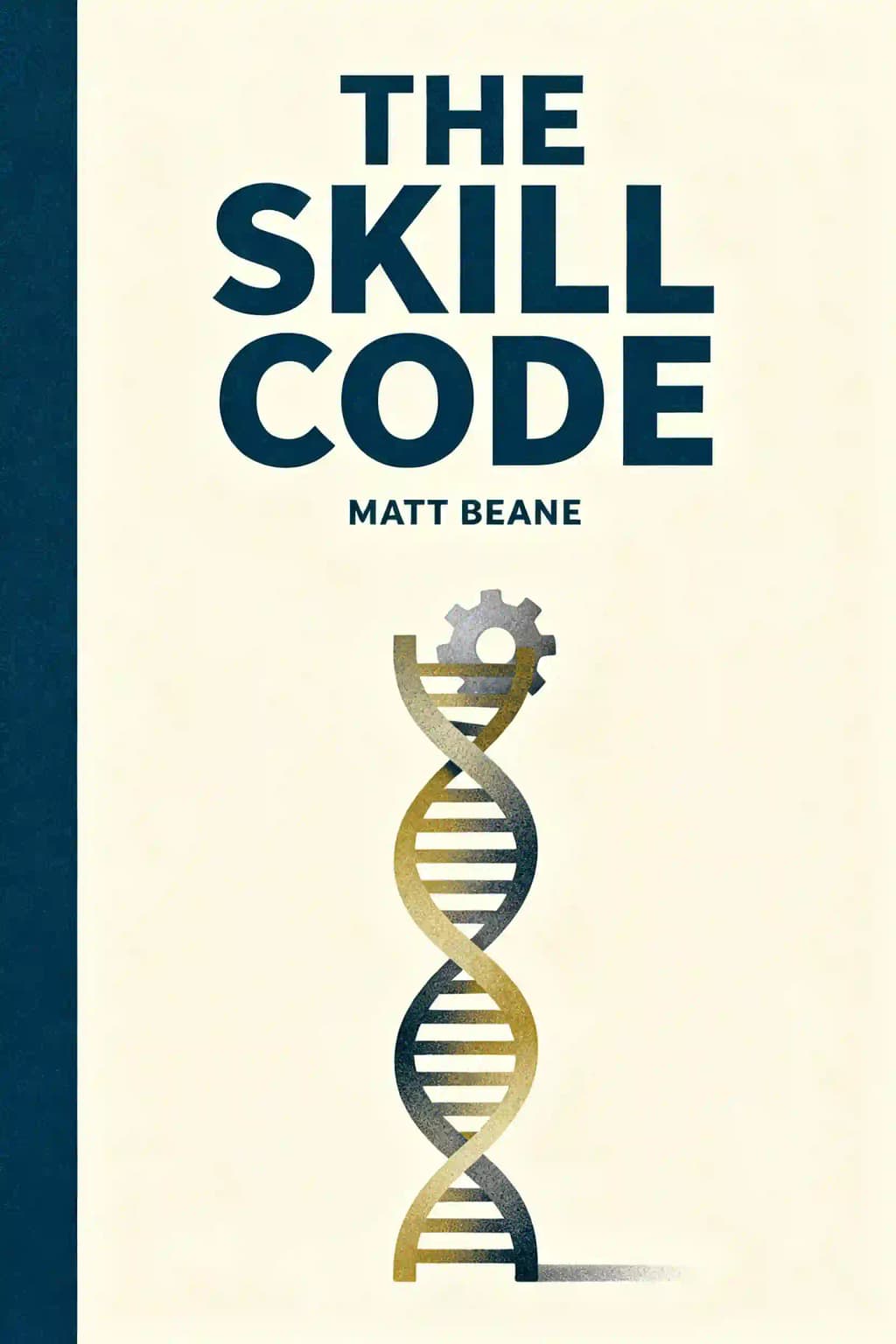
What if the secret to mastering any skill-from surgery to sales, coding to cooking-has remained unchanged for 160,000 years? On a crisp October day, nine-year-old Matt Beane watched a master tinsmith and his apprentice transform metal into art, witnessing an ancient dance of expertise transfer that would later become his life's research. This relationship between expert and novice, the foundation of human skill development since prehistoric times, is now threatened by our technological revolution. The Skill Code, hailed by Adam Grant as "a saving grace for anyone worried about becoming obsolete," has become required reading in Silicon Valley boardrooms and university classrooms alike. Through ten years of immersive research across hospitals, warehouses, and tech companies, Beane uncovers the three essential elements of skill development that technology is inadvertently destroying-and how we can preserve them before it's too late.
2장
The 160,000-Year-Old School Hidden in Plain Sight
From ancient Athens where twelve-year-old Menelaos learned sculpture under Stephanos, to modern surgical residents mastering nerve-sparing techniques, one relationship has remained central to human progress: the expert-novice bond. Despite our advances in formal education, books, and digital learning platforms, this relationship persists as our primary method for developing true mastery-the kind that performs under pressure when lives or livelihoods hang in the balance.
Archaeological evidence reveals this process dates back at least 160,000 years, predating most elements of civilization. Stone tools from this era show signs of expert guidance-the same techniques passed down through generations, with subtle variations indicating personalized instruction. This relationship works because it satisfies complementary needs: experts require assistance with their work, while novices desperately want to learn. The resulting collaboration creates a natural environment for skill development.
What makes this ancient system so effective? The expert-novice relationship creates a perfect laboratory for incremental challenge. Novices begin with simple tasks at the periphery of important work-holding tools, preparing materials, observing procedures-gradually taking on more responsibility as their capabilities grow. This progression isn't arbitrary but carefully calibrated to push novices just beyond their comfort zone while keeping failure stakes manageable.
Consider how surgical residents progress from observing procedures to making the first incision, then gradually handling more complex aspects of operations. Or how apprentice chefs move from basic prep work to managing entire stations. This careful escalation of challenge, guided by someone who understands both the work and the learner's capabilities, creates ideal conditions for skill development that no formal curriculum can match.
But this ancient system now faces an existential threat. As we'll discover, our technological revolution is severing this crucial bond between generations of skilled workers, with profound implications for our collective future.
3장
Decoding the DNA of Skill Development
Through ten years of research on technology and work, I've discovered the hidden code that powers skill development: challenge, complexity, and connection-the three Cs. Like DNA's four amino acids that combine to create all living things, these are the fundamental building blocks of mastery across every domain of human endeavor.
My research methodology is organizational ethnography-immersive field research in real workplaces. I've spent thousands of hours observing workers across diverse disciplines, from surgeons using robots to warehouse employees troubleshooting sorting machines. Rather than focusing on average outcomes, my research specifically targets success in conditions where failure would be expected-finding the "positive needles" in the negative haystack of technological disruption.
What makes this approach unique is its focus on the exceptions-the individuals and teams who manage to develop exceptional skill despite technological barriers. By studying these outliers, we can extract principles that might help everyone navigate our rapidly changing work landscape.
The first element of the skill code is challenge-the calibrated struggle that builds capability. Like weight training for muscles, skills develop when pushed just beyond current capacity, with appropriate recovery time. The second element is complexity-exposure to the messy, multidimensional nature of real work rather than simplified training environments. The third element is connection-the human relationships that provide motivation, context, and guidance through the learning journey.
Together, these three elements form a universal framework for understanding how humans develop mastery. Whether you're learning surgery, software development, or sourdough baking, the same principles apply. The skill code works because it aligns with fundamental aspects of human cognition and motivation that have evolved over thousands of generations.
But in millions of workplaces around the world, we're now blocking this natural process by inserting technology between junior and senior workers. The consequences are more serious than most realize.
4장
The Technological Wedge Driving Experts and Novices Apart
In millions of workplaces, we're severing the expert-novice connection by inserting technology between junior and senior workers. While robots do eliminate some jobs (research shows 3-6 jobs lost per robot purchased), the more critical issue is how technology changes existing jobs. For forty years, research has consistently shown that when we implement automation, relatively few jobs disappear completely, but millions change incrementally. This creates an enormous learning challenge as workers must adapt to new methods, and the pace of change is accelerating.
The problem is vividly illustrated in surgical training, where residents struggle to learn robotic surgery because attending surgeons operate the robots themselves rather than letting trainees practice. Residents finish their education without sufficient skills but are still expected to use robots in their practices. One resident described her experience: "I'm going to graduate having done maybe fifteen cases on the robot. That's not enough. Not even close. But I'll be expected to use it when I start my practice."
This pattern repeats across professions. Law firms use AI for document review that once gave junior lawyers crucial experience understanding case details. Finance automation separates junior bankers from seniors, preventing the relationship-building that traditionally led to mentorship. Manufacturing robots handle complex assembly tasks that once taught workers fundamental skills. The expert-novice connection is fraying across dozens of occupations, creating a multitrillion-dollar skills gap affecting industries from manufacturing to education to healthcare.
What makes this situation particularly troubling is how invisible it remains. Unlike job elimination, which generates headlines and political attention, this gradual erosion of skill development pathways happens quietly, noticed primarily by those directly affected. The long-term consequences only become apparent years later when organizations discover they lack workers with crucial capabilities.
Consider the paradox many industries now face: despite investing heavily in automation to increase productivity, they struggle with persistent skills shortages. The manufacturing sector alone reports over 800,000 unfilled positions in the United States, largely because the traditional pathways for developing skilled workers have been disrupted by the same technologies meant to enhance productivity.
This isn't just about individual careers-it's about our collective capacity to solve problems, innovate, and adapt to changing circumstances. If we continue inserting technological wedges between experts and novices without understanding the consequences, we risk creating a future where true mastery becomes increasingly rare.
5장
Challenge: The Productive Struggle That Builds Mastery
Andre, deputy chef at a three-star Michelin steakhouse, thrives in the controlled chaos of a professional kitchen. After six years working his way up, he now manages operations with precision and authority. His success stems from the mentorship of his former deputy chef Jane, who provided progressively challenging tasks while supporting his development-letting him struggle appropriately without setting him up to fail.
Decades of research confirms we learn best through healthy challenge-not too much to cause burnout, not too little to create stagnation. Robert Bjork's research on "desirable difficulties" shows that effortful learning processes produce better long-term mastery than passive approaches. Studies reveal learning improves with increased stress up to a specific threshold (81% above normal stress readings), after which learning rapidly declines.
Why does challenge work? When we encounter difficulties that stretch but don't overwhelm our capabilities, our brains form stronger neural connections. The effort required to overcome obstacles creates more robust memory pathways and deeper understanding than effortless learning. As one researcher put it, "The brain is like a muscle-it grows with use, especially when that use requires effort."
While self-directed challenge has value, research shows guided challenge produces superior results. Lev Vygotsky identified the "zone of proximal development"-tasks learners can only accomplish with guidance. Benjamin Bloom demonstrated that one-on-one tutoring could elevate average students to the 95th percentile through carefully calibrated challenges with appropriate support.
Effective guides manage frustration both preemptively (by clarifying the payoff of struggle) and reactively (by reframing failures as progress). They provide scaffolding-temporary support structures that gradually disappear as competence grows. Jane did this masterfully with Andre, challenging him with increasingly complex responsibilities while systematically reducing her oversight as his skills developed.
In real workplaces, skill development rarely matches the pristine image of one-on-one tutoring. Novices must often compete for challenging opportunities because when results matter, many prefer you to perform at your current best rather than struggle and learn. This competition creates healthy stress that enhances memory formation specifically for task-related material.
The key is finding the right balance-not too easy, not impossibly hard-with opportunities to recover and repeat. As you assess your own learning environment, ask whether you're regularly encountering challenges that push you just beyond your current capabilities, with appropriate guidance and recovery time. This "goldilocks zone" of challenge is where true mastery develops.
6장
Complexity: Seeing the Whole Picture Beyond Individual Tasks
Complexity-the second element of the skill code-involves understanding the broader context of work beyond individual tasks. Consider Sita, a warehouse shift supervisor who rose from an entry-level position by naturally developing a comprehensive understanding of operations. While her colleagues focused narrowly on their assigned tasks, Sita constantly observed the entire workflow, noticing patterns and connections others missed.
Research across psychology, education, and neurobiology confirms that optimal skill development requires healthy encounters with complexity-neither too much nor too little. Skill fundamentally means getting results in a complex world, not just performing isolated tasks perfectly in controlled conditions.
Novices initially lack understanding of tasks, goals, and work conditions, requiring them to process massive complexity just to grasp basics. Expert field hockey players, for instance, can "chunk and categorize" the game to better direct attention and predict events, while novices struggle with basic comprehension. This initial step creates "declarative" knowledge-information critical for directing action but not directly enabling performance.
While formal education helps people prepare for complexity, research shows declarative knowledge has limits. Albert Bandura's social learning theory demonstrated how people learn effectively through observation without explicit instruction. This implicit learning proves crucial but is increasingly threatened by technologies separating novices from direct experience.
Counterintuitively, explicit instruction can actually impede skill development. Studies on motor skill acquisition show people learn best in realistic, complex situations rather than simplified environments with perfect movements. Experts should direct novices' attention to information-rich aspects of context without over-interpreting them. As Philip did with Sita, minimal prompting about where to look-not how or why-allows implicit learning to flourish.
Beyond doing the work, reflection is critical for skill development. Research by K. Anders Ericsson shows top performers form sophisticated mental maps of their domain during rest periods. London taxi drivers exemplify this, building rich mental representations after riding hundreds of routes. This processing happens both after work (as Sita did during commutes) and sometimes during work as "reflection-in-action" when encountering surprises.
By engaging with complexity, we find the next skill to master. Workers build skill by gradually expanding their view to adjacent areas, starting as novices at the periphery and moving toward core tasks while simultaneously broadening understanding of environmental factors. This expansion allows better handling of surprises, more effective planning, and identification of specialization opportunities that match personal interests.
7장
Connection: The Human Bond That Powers Skill Transfer
While challenge and complexity focus primarily on the self and the task, connection forms the third critical component of skill development. Through Emily's story as a director of enterprise sales, we see how human relationships fundamentally shape skill acquisition. Emily builds her day through meaningful interactions with team members like Brandon and Anoosh, focusing on their success while building bonds of trust and respect. Her approach combines pushing her team toward independence while genuinely connecting with them as people.
Despite celebrating harsh mentorship styles in popular culture, research confirms we simply cannot access healthy challenge and complexity without human connection. Self-determination theory, developed by psychologists Edward Deci and John Ryan, reveals that competence development works in concert with two other basic needs: autonomy and relatedness. When we choose our own goals that align with our sense of self, we pursue them with greater energy and fulfillment. But equally important is relatedness-our fundamental need for warmth, bonding and care from others.
These connections don't just motivate us; they actually shape which skills we choose to develop. John Van Maanen's research at Disneyland showed how new employees primarily learned through informal feedback and modeling the behavior of experienced workers-a process of socialization where outsiders internalize values through social connections.
Connection doesn't just direct our skill development; it sustains our motivation. Douglas Harper's six-year apprenticeship with mechanic Willy demonstrated how seeking an expert's approval motivates greater effort, especially when balanced with autonomy. Kathy Kram's foundational study on mentorship revealed these relationships benefit both parties: novices gain identity and connectedness while experts fulfill their need for generativity and meaning by helping develop the next generation of talent.
Research shows that maintaining trust and respect is essential for skill development. When either party loses respect, learning opportunities disappear. Amy Edmondson's research on psychological safety reveals that top teams express concerns directly but remain genuinely open to alternative perspectives. Effective skill development also benefits from working with multiple experts, as Kathy Kram's research demonstrates.
As novices develop real skill, relationships evolve. Ed Hutchins' research on naval navigation systems revealed how crew members worked up the chain by coaching junior colleagues-embodying the "pay it forward" ethos essential to healthy workplaces. When trust and respect flourish, experts proudly introduce developing talent to new opportunities, transforming hierarchical relationships into peer connections.
Interestingly, even artificial intelligence benefits from healthy connections. Systems with "meta-learners" that guide primary algorithms demonstrate how social connections enhance learning across the human-AI divide.
8장
How Technology Threatens the Skill Code
Emily's company went virtual during the pandemic, and while she focused on adapting their sales approach through technology, she inadvertently weakened the human bonds essential for skill development. Despite her team's continued performance, they were "dying" and "losing their edge" as virtual work reduced accidental collisions, strategic exposure, and collaborative opportunities-all vital components of the skill code.
My research across thirty-one occupations reveals a consistent pattern: in our quest for productivity, we're using technologies in ways that make novices increasingly optional in experts' work. The traditional apprenticeship model of "See one, do one, teach one" is becoming "See one, maybe do one, never teach one." This happens because new tools like AI and automation allow experts to work more efficiently without novices, as demonstrated in microchip design where junior engineers are cut out of complex problem-solving.
Even with less advanced technologies like videoconferencing, we pay a subtle but profound price. Research shows coders in the same building received 23 percent more feedback than remote teammates, with serious consequences for novice skill development. Meanwhile, experts become more productive when freed from teaching responsibilities-medical data revealed patients spent 25 percent longer under anesthesia for each resident present, representing increased risk and $9,026 in additional costs.
This creates a compelling short-term case for excluding novices, but raises the critical question: how will the next generation of professionals develop expertise without apprenticeship opportunities?
The threat to challenge is exemplified by Amber, an experienced OR nurse who finds robotic surgery days mind-numbingly boring. Where she once thrived on the challenge of anticipating a surgeon's needs in traditional procedures, she now sits at a PC while the surgeon operates independently at the console. The physical, mental, and interpersonal challenges that developed her expertise have disappeared.
The threat to complexity appears in Arnold's warehouse experience. Where he once collaborated with colleagues and observed the entire workflow, he now works in isolation between fixed robot stations. Physical barriers prevent conversation and observation of others' work, while his job has been simplified to tending the robot. He's lost access to the complexity that previously enabled comprehensive understanding and skill development.
The threat to connection is illustrated by Casey's experience with a telepresence robot. After the robot arrived, Casey's carefully prepared rounds became irrelevant as the attending physician directly engaged with nurses and patients. This severed the connection that previously allowed Casey to build trust by demonstrating competence.
Across industries, intelligent technologies are breaking crucial novice-expert connections: crime prediction software disconnects beat cops from chiefs, remote diagnostics prevent local technicians from solving problems regularly, and automation turns junior bankers into "script monkeys" without opportunities to prove themselves.
9장
Shadow Learning: Breaking Rules to Build Skills
When conventional skill development pathways are blocked by technology, some individuals find unconventional-often rule-breaking-ways to develop mastery. The chapter introduces Ines, who secretly studied the robots on her manufacturing line, watching engineers during breaks and analyzing error codes. This "inappropriate" curiosity led her to propose a valuable interface improvement that transcended language barriers, though she received no credit for this patentable suggestion.
Rule-breaking has historically been a vital source of innovation and skill development. From Hewlett-Packard's first "Meritorious Defiance" award given to Chuck House for developing a flat screen monitor against orders, to countless breakthroughs throughout history, progress often requires stepping outside established boundaries.
During a two-and-a-half-year study of robotic surgery across multiple teaching hospitals, I discovered that while most surgical residents struggled to learn robotic techniques, approximately one in eight were successfully building skills through similar "deviant" practices. These successful residents weren't communicating with each other about their tactics, yet independently adopted the same approaches across different hospitals.
These shadow learners preserved healthy challenge, complexity, and connection through three key practices. First, "premature specialization" involved focusing on robotics before they "should have," sometimes starting in medical school by sacrificing general education for specialized robotics experience. Second, "digital rehearsal" involved extensive use of video and simulation despite cultural resistance. While senior surgeons believed operating was the only legitimate way to learn ("Watching a movie doesn't make you an actor"), successful residents spent hundreds of hours analyzing YouTube videos and practicing on simulators, often sacrificing lectures or patient rounds for this unauthorized training.
Third, "undersupervised struggle" allowed residents to escape "helicopter teaching" that prevented genuine challenge. They found opportunities to operate with minimal supervision by rotating to hospitals with less robotic expertise, or by working with "superstar" surgeons who ran multiple procedures simultaneously. This created situations where residents operated alone-technically forbidden by medical standards-but with attending physicians available if needed.
Experts also engage in shadow learning, particularly when facing new technologies that challenge their established expertise. Darren, an investment bank director pursuing a managing director role, orchestrated an "inverted apprenticeship" by recruiting two junior bankers to collaboratively learn new financial analysis tools. Though sometimes appearing foolish when the juniors demonstrated greater technical facility, Darren limited outside scrutiny while building his skills. By the end, he matched their technical proficiency while gaining additional insights about team organization.
This "inverted apprenticeship" represents one of four pathways experts take when confronting new technologies. Unfortunately, less than 10 percent of experts construct these mutually beneficial learning relationships. Most either avoid technology entirely while extracting knowledge from juniors through status-preserving interactions, or actively resist new technology, using novices as sources of information to critique the technology while undermining novices' confidence and development.
10장
Reworking the Skill Code for a Technological Future
The author opens with Ernie, an explosive ordnance disposal specialist, approaching a bomb in protective gear-illustrating how technology can sometimes enhance rather than hinder skill development. Before robots, novices couldn't observe experts defusing bombs up close. With the introduction of PackBot in 2002, novices could operate the robot under expert guidance, creating side-by-side learning opportunities previously impossible.
Rather than viewing productivity and skill as opposing forces, we must design systems where they reinforce each other. The "three Ds" framework-discover, develop, and deploy-offers a pathway to nurture human skill alongside technological advancement.
Discovery forms the foundation of reworking the skill code. We must rapidly deepen our understanding of skill development and shadow learning before technological change drives these practices further underground. Most discovery must happen locally, requiring input from practitioners to understand how challenge, complexity, and connection work best in different contexts. We need to identify which combinations and sequences are most effective for specific skills, teams, and industries. Leaders can uncover shadow learning by cultivating psychological safety or bringing in trusted third parties who can ensure anonymity while comparing practices across diverse cases.
Development moves us from sideline observation to active intervention. We must create new rules for skill development that balance technology's benefits with human learning needs. This begins with adjusting our routines to ensure healthy challenge, complexity, and connection while still leveraging technology's advantages. The key principles are to ease up on control, relax hierarchy and status, and follow the skill. We can realign roles to reconnect experts and novices, as demonstrated by investment bankers who had junior analysts work alongside senior partners rather than just running software queries. Though this approach initially slowed work and introduced more mistakes, it ultimately built deeper knowledge, meaningful connections, and even uncovered critical analytical flaws in their software.
Deployment is where plans meet reality and we must take a stand for skill. Despite having tools designed for learning-like surgical robots with dual-console "driver's ed" capabilities-many organizations fail to use them effectively. Everyone-leaders, technologists, investors, and frontline workers-should ask: "How can we handle this technology to get results while building capability in people using it?" This might mean residents asking attendings to use shared control features, attendings requesting vendor guidance on effective teaching techniques, or technology companies highlighting skill-building features in their products.
These approaches complement each other, helping us defend healthy challenge, complexity, and connection in our daily work. While the three Ds help navigate a system that prioritizes efficiency over learning, we must think beyond seeing technology as skill's enemy and envision how it could become skill's ally.
11장
Building a Chimeric Future for Human Skill
The chapter opens with a glimpse into 2037, where Sara, a journeyman welder in Erie, Pennsylvania, confidently accepts a challenging project requiring plastic welding with ultrasonic tools-something she's never done before. She uses advanced AR headsets and AI coaching platforms that blend human and artificial intelligence to rapidly develop new skills.
While Sara's scenario uses realistic near-future tech, the true potential goes much deeper. Today's technologies like ChatGPT, GitHub, and crowd-curated platforms will evolve into comprehensive skill development infrastructures. The key insight is that technology itself isn't causing skill problems-we are, by sacrificing expert-novice bonds for productivity. But with the right infrastructure supporting healthy challenge, complexity, and connection, we could supercharge skill development beyond anything previously possible in human history.
Despite these exciting possibilities, sociological patterns suggest a troubling trajectory toward skill inequality. We're likely to continue weakening expert-novice bonds in favor of productivity gains. This creates a future where only rare individuals who find shadow learning opportunities develop exceptional skills while most fall behind. The consequences extend beyond career limitations for surgeons to the darker reality already present in low-wage work. In warehouses, corporations actively deskill jobs through industrial engineering that extracts skill requirements to increase productivity. Workers in these environments experience skill degradation over time, losing healthy challenge, complexity and connection.
To prevent skill inequality, we must build a global, AI-enabled infrastructure that strengthens rather than undermines skill development. This means creating networks of human experts, novices, and AI focused on building capability within work itself. The future lies in chimeric systems-named after the Greek mythological creature with parts from different animals-that blend human and technological capabilities to achieve what neither could alone.
Early examples appeared in chess, where human-AI partnerships briefly outperformed both humans and AI working independently. Today, some companies use chimeric systems to maintain gas turbines, design computer chips, perform surgery, and harvest crops-achieving greater productivity than either humans or technology alone could manage. However, most current chimeric systems don't develop human skill in the process. We need digital apprenticeships to replace the analog ones we're losing.
The technical foundation for Sara's future skill development system already exists in two forms: integrated/closed systems and discrete/open ones. However, these technologies come with significant challenges: content quality is difficult to assess, platforms don't foster meaningful connections, and overwhelming sensor data often goes unanalyzed.
To address these issues, the author and his colleague created "Surch"-a platform allowing surgical residents to find specific procedure clips in seconds rather than hours. The system enables experts to assign videos to novices and provide feedback on their observations, enhancing connection while engaging with challenge and complexity. This chimeric system uses human inputs to train AI that helps parse videos, creating "semantic maps" similar to book indexes.
People, relationships, and choices-not technology-sit at the core of skill development. A chimeric future for skill will only emerge through our work, relationships, and choices in the everyday bond between experts and novices. Everyone has a critical role: novices must protect healthy challenge, complexity, and connection; experts must enrich the skills journey for novices; managers must insist that productivity and skill development aren't opposed; entrepreneurs must build systems that make it harder to achieve productivity without developing skills; and policymakers must invest in addressing this "negative externality" where firms get short-term productivity boosts while robbing the next generation of skill.