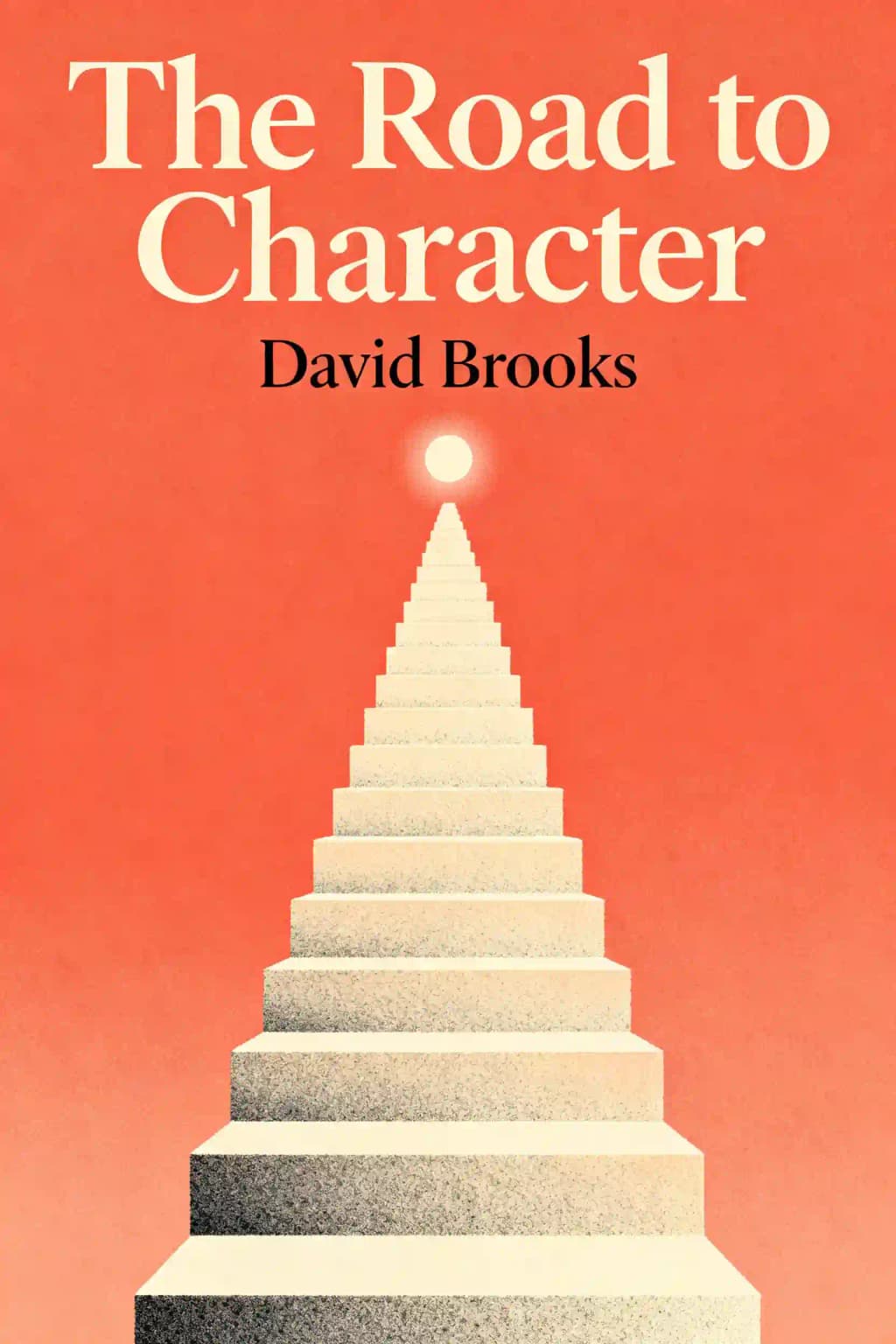
In "The Road to Character," David Brooks challenges our resume-obsessed culture, advocating instead for "eulogy virtues." Bill Gates named it a favorite for its profound wisdom on moral development - a timely reminder that what's remembered at your funeral matters more than your LinkedIn profile.
David Brooks, author of The Road to Character, is a Pulitzer Prize-finalist columnist for The New York Times and a prominent political commentator on PBS NewsHour. He is renowned for his incisive analysis of culture, morality, and human behavior.
A Canadian-American journalist with a history degree from the University of Chicago, Brooks blends his decades of experience in media—including roles at The Wall Street Journal and The Weekly Standard—with philosophical insights to explore themes of virtue, self-discovery, and societal values.
His bestselling books, such as The Social Animal and The Second Mountain, dissect the intersection of psychology, ethics, and community, establishing him as a leading voice on personal and collective fulfillment. Brooks frequently appears on NPR’s All Things Considered and NBC’s Meet the Press, and his work is amplified through his Aspen Institute initiative, Weave, which fosters social connection.
A Yale University lecturer and recipient of over 30 honorary degrees, Brooks’s The Road to Character has been widely praised for its timeless wisdom, earning a spot on The New York Times bestseller list and cementing its status as a modern guide to ethical living.
The Road to Character explores the distinction between résumé virtues (career-focused skills) and eulogy virtues (moral qualities like kindness and courage). David Brooks argues that modern society overprioritizes external success, urging readers to cultivate inner character through humility, self-examination, and learning from historical figures’ moral struggles.
This book suits readers seeking purpose beyond material success, including those interested in ethics, self-improvement, or philosophy. It’s ideal for individuals reevaluating their values or navigating life transitions, offering insights into building a legacy through moral growth.
Yes. Brooks combines historical biographies with timeless wisdom, challenging readers to prioritize humility and moral integrity. Critics praise its nuanced exploration of character development, though some note its idealistic tone.
Key themes include:
Résumé virtues are skills for career success (e.g., ambition, technical prowess). Eulogy virtues define moral character (e.g., honesty, compassion), remembered after death. Brooks argues modern culture neglects the latter, risking hollow achievements.
Humility involves recognizing personal flaws and prioritizing moral growth over self-glorification. Brooks outlines a 15-point "Humility Code" advocating self-awareness, service to others, and embracing life’s challenges as opportunities for growth.
Brooks analyzes figures like Augustine, Dwight Eisenhower, and Frances Perkins to illustrate character-building through adversity. Their stories highlight resilience, self-sacrifice, and the pursuit of moral excellence.
The "Shift" refers to transitioning from a self-centered "Big Me" mindset to one focused on moral purpose. Brooks argues this requires confronting weaknesses and aligning actions with deeper values.
Yes. Brooks advocates journaling for self-reflection, studying moral exemplars, and embracing struggles as growth opportunities. He emphasizes incremental progress over perfection.
Brooks critiques society’s obsession with fame, wealth, and self-promotion, arguing it erodes empathy and moral depth. He urges a return to virtues like duty, humility, and community.
The 15-point Humility Code outlines principles for ethical living, including accepting imperfection, prioritizing love over achievement, and finding purpose through service. It serves as a roadmap for character development.
Some critics argue Brooks oversimplifies historical figures’ complexities or offers vague solutions. Others note the book’s focus on individualism despite advocating communal values.
Unlike The Social Animal (which blends psychology and sociology) or Bobos in Paradise (analyzing cultural elites), The Road to Character focuses on moral philosophy, offering a more introspective, virtue-centered framework.
저자의 목소리로 책을 느껴보세요
지식을 흥미롭고 예시가 풍부한 인사이트로 전환
핵심 아이디어를 빠르게 캡처하여 신속하게 학습
재미있고 매력적인 방식으로 책을 즐기세요
Humility frees you from constantly proving your superiority.
We pursue what Brooks calls 'resume virtues'.
Humility comes with lovely emotions like admiration, companionship, and gratitude.
They don't maximize self-expression or pursue happiness directly.
The Road to Character의 핵심 아이디어를 이해하기 쉬운 포인트로 분해하여 혁신적인 팀이 어떻게 창조하고, 협력하고, 성장하는지 이해합니다.
The Road to Character을 빠른 기억 단서로 압축하여 솔직함, 팀워크, 창의적 회복력의 핵심 원칙을 강조합니다.

생생한 스토리텔링을 통해 The Road to Character을 경험하고, 혁신 교훈을 기억에 남고 적용할 수 있는 순간으로 바꿉니다.
무엇이든 물어보고, 목소리를 선택하고, 진정으로 공감되는 인사이트를 함께 만들어보세요.

샌프란시스코에서 컬럼비아 대학교 동문들이 만들었습니다
"Instead of endless scrolling, I just hit play on BeFreed. It saves me so much time."
"I never knew where to start with nonfiction—BeFreed’s book lists turned into podcasts gave me a clear path."
"Perfect balance between learning and entertainment. Finished ‘Thinking, Fast and Slow’ on my commute this week."
"Crazy how much I learned while walking the dog. BeFreed = small habits → big gains."
"Reading used to feel like a chore. Now it’s just part of my lifestyle."
"Feels effortless compared to reading. I’ve finished 6 books this month already."
"BeFreed turned my guilty doomscrolling into something that feels productive and inspiring."
"BeFreed turned my commute into learning time. 20-min podcasts are perfect for finishing books I never had time for."
"BeFreed replaced my podcast queue. Imagine Spotify for books — that’s it. 🙌"
"It is great for me to learn something from the book without reading it."
"The themed book list podcasts help me connect ideas across authors—like a guided audio journey."
"Makes me feel smarter every time before going to work"
샌프란시스코에서 컬럼비아 대학교 동문들이 만들었습니다

The Road to Character 요약을 무료 PDF 또는 EPUB으로 받으세요. 인쇄하거나 오프라인에서 언제든 읽을 수 있습니다.
We live in a world that celebrates external success above all else. In "The Road to Character," David Brooks identifies a profound cultural shift from what he calls the "Little Me" culture of humility to today's "Big Me" era of self-promotion. This transformation is striking: in 1950, only 12% of high school seniors considered themselves "very important persons" - by 2005, that number had skyrocketed to 80%. Our society constantly reinforces messages of self-importance: "You are special. Trust yourself. Be true to yourself." Even institutions like the Girl Scouts have shifted from teaching self-sacrifice to self-focus. But what if this obsession with external achievement is preventing us from building what truly matters - character? What if the qualities that make a meaningful life aren't the ones that look good on a resume, but rather those mentioned in our eulogies? Most of us live with an internal tension between two competing selves. There's Adam I - our ambitious, career-focused self who seeks external success and status. Then there's Adam II - our deeper self who longs for moral virtue and inner character. Our culture overwhelmingly celebrates and rewards Adam I achievements, while Adam II development gets neglected. The most impressive people somehow integrate these competing selves. They radiate what Brooks calls "moral joy" - a remarkable inner cohesion. These rare individuals answer harsh words with soft responses. They maintain dignity when humiliated. They perform acts of service without self-promotion. What's striking is how different they are from our cultural ideal. They don't maximize self-expression or pursue happiness directly. Instead, they've built character by confronting their weaknesses and developing self-effacing virtues: humility, restraint, and self-discipline.