1장
Dictionary's Dark Secret: Genius, Madman, Murder
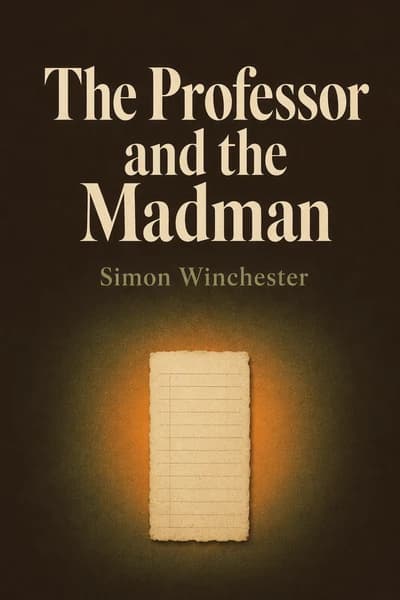
Behind the orderly pages of the Oxford English Dictionary lies one of history's most bizarre collaborations. When Professor James Murray sought contributors for the monumental OED project in 1879, he never expected one of his most prolific helpers was writing from an insane asylum. Dr. W.C. Minor, an American surgeon and convicted murderer, submitted over 10,000 quotations from his cell - all while battling severe schizophrenia.
Winchester's masterful narrative - which spent 57 weeks on bestseller lists - explores this extraordinary friendship between scholar and madman, revealing how genius and insanity often share the same mental landscape. The book illuminates the heroic 70-year effort to create the OED, a project that fundamentally shaped how we understand language evolution.
Readers will discover not just a captivating Victorian-era mystery, but profound insights into the human mind's fragility and resilience. As you journey through this improbable tale of murder, linguistics, and redemption, you'll never look at dictionaries - or mental illness - the same way again. Some stories seem too strange to be true; this one actually happened.
2장
A Fateful Night in Victorian London's Underbelly
In the murky expanse of Lambeth Marsh, a notorious Victorian slum where even London's strict laws seemed to lose their grip, an unusual sound pierced the night air-gunshots. This was the 1870s, when firearms were rare in England, making the sound all the more alarming to the police constables patrolling nearby. Following the echo of violence, they discovered a scene that would alter the course of multiple lives: George Merrett, a hardworking stoker, lay dying on the cold cobblestones, while a well-dressed American stood nearby, smoking revolver in hand.
George had risen early that February morning, as he did most days, dressing in his worn clothes before heading out into the pre-dawn chill. His breath formed clouds in the frigid air as he made his way through dimly lit streets, passing beneath the shadow of the imposing Red Lion Brewery. He never saw the danger that awaited him-a man of military bearing who emerged from the shadows and fired without warning or apparent provocation.
The shooter was William Chester Minor, an American army surgeon of considerable means and education. When apprehended, he calmly admitted to the shooting but claimed it was accidental-a defense against an intruder who existed only in his troubled mind. Minor's demeanor was strangely composed, his speech articulate and refined, creating a jarring contrast with the violence he had just perpetrated.
What could drive such an educated, seemingly respectable man to commit such a senseless act? The answer lay in the shadows of Minor's mind, where paranoid delusions, particularly regarding Irish conspirators he believed were pursuing him, had taken firm root. These delusions, combined with the trauma of his experiences as a Civil War surgeon, had fractured his once-brilliant mind.
At trial, the jury found Minor not guilty by reason of insanity, guided by the McNaughton rules that had long governed such cases in British law. Instead of prison, he was sentenced to Broadmoor Criminal Lunatic Asylum-a Victorian institution that would become his home for decades. This verdict, while sparing him the gallows, would set in motion an extraordinary chain of events that would connect him to one of the most ambitious intellectual projects in history.
3장
The Self-Made Scholar from Scotland
While Minor's tragic story was unfolding, another man was pursuing a very different path. James Murray, born to humble beginnings in the Scottish border town of Hawick in 1837, possessed an insatiable hunger for knowledge that would define his life. Unlike Minor, who had received formal education at Yale, Murray was largely self-taught, having left school at fourteen due to his family's financial circumstances. Yet this early departure from formal education sparked a remarkable journey of autodidactic achievement, as he mastered numerous languages, delved deep into scientific inquiry, and pursued historical studies through sheer determination and intellectual curiosity.
Murray's eccentricities were legendary and often endearing to those who knew him. As a young man, he would take long walks in the Scottish countryside, attempting to teach Latin to cattle he encountered - a practice he later claimed helped him perfect his pronunciation. His quirky experiments ranged from studying the flight patterns of local birds to creating his own botanical classification system. He devoured books on every conceivable subject, from archaeology to zoology, often reading by candlelight late into the night. His personal library grew to thousands of volumes, many annotated with his careful observations and cross-references.
Despite personal hardships that would have deterred many-including the devastating death of an infant daughter and his first wife's prolonged illness-Murray's intellectual pursuits never wavered. He maintained a rigorous daily schedule of study, often rising at dawn to read in multiple languages before beginning his regular work duties. His dedication to learning was so complete that he transformed his home into an informal academy, teaching local children and adults alike, and corresponding with scholars across Europe.
What's remarkable about Murray is how far his self-education took him in an era when formal credentials were increasingly important. Despite lacking university degrees, his linguistic expertise-which included proficiency in Scots, English, French, German, Italian, Latin, Greek, Hebrew, and several other languages-eventually led him to apply for a position at the British Museum. Though he didn't secure that particular role, his association with fellow philologists and his groundbreaking contributions to the study of Scottish dialects established his reputation within scholarly circles. His 1873 paper on the dialect of southern Scotland was particularly influential, demonstrating a methodological rigor that impressed academic linguists.
Murray's network grew through his involvement with the Philological Society, where he formed crucial friendships with influential figures like Frederick Furnivall, who would later champion his appointment to the dictionary project, and Henry Sweet-the latter believed to be the inspiration for Professor Henry Higgins in Shaw's "Pygmalion." These connections, combined with his growing reputation for meticulous scholarship, elevated Murray's standing in the world of language studies and opened doors that would typically have remained closed to someone of his background.
This self-made scholar would eventually find himself at the helm of the most ambitious lexicographical project ever conceived-a complete historical dictionary of the English language that would trace the biography of every word from its birth to the present day. The Oxford English Dictionary project would become his life's work, transforming both the field of lexicography and Murray himself. But the path to this position, like the dictionary itself, would require patience, persistence, and the contributions of many minds-including one that resided behind asylum walls. Murray's appointment as editor would prove to be not just a personal triumph, but a victory for autodidactic learning and the democratization of scholarship.
4장
War's Crucible: The Breaking of a Brilliant Mind
What transforms a Yale-educated doctor into a murderer? For William Chester Minor, the seeds of madness were planted early but found fertile ground in the horrors of the American Civil War.
Born to American missionary parents in Ceylon (now Sri Lanka), Minor grew up in an environment where strict religious piety clashed with the sensual beauty of the tropical island. The naked girls on Ceylon's beaches ignited desires that his puritanical upbringing taught him to suppress and fear-creating an internal conflict that would haunt him throughout his life.
After graduating from Yale Medical School, Minor entered the Civil War as an army surgeon. Initially stationed at northern hospitals, he was somewhat protected from the worst of the fighting. But his eventual posting to the front lines in Virginia exposed him to unprecedented carnage. The Civil War represented a terrible innovation: modern weapons of mass destruction combined with primitive medical knowledge. The result was suffering on a scale that challenged the sanity of even the most stable minds.
The Battle of the Wilderness in May 1864 marked a turning point in Minor's mental deterioration. This hellish engagement, fought in dense forest where fires consumed wounded soldiers unable to escape, created scenes of unimaginable horror. The smoke-filled air echoed with screams as mini bullets tore through flesh and forest alike. In this inferno, Minor witnessed the desertion of Irish soldiers from the Union Army-men who had once been celebrated for their courage but now fled in despair.
Perhaps the most damaging experience for Minor's fragile psyche was his forced participation in the branding of an Irish deserter. Ordered to perform this punishment, Minor hesitated but ultimately complied, searing the letter "D" into the man's face. This act of cruelty, performed against his medical oath to do no harm, seems to have crystallized his growing paranoia about Irish conspirators seeking revenge.
As Minor rose through Army ranks, his behavior became increasingly erratic. He carried an unauthorized Colt .38 for protection against imagined threats. His promiscuity in New York's seedier districts alarmed his peers, especially when he required treatment for venereal diseases. A broken engagement to a dancer led to his reassignment to isolated Fort Barrancas in Florida-effectively exiling him from temptation but deepening his sense of persecution.
By 1868, Minor's headaches and vertigo had become debilitating, and his paranoid delusions unmistakable. Diagnosed with monomania, he resisted institutional care but eventually entered Washington's Government Hospital for the Insane. Though his military career was over, his most significant contribution to history was yet to come-through a most unexpected channel.
5장
From Asylum to Scholarly Haven
William Minor's arrival at Broadmoor Asylum in 1872 marked the beginning of an extraordinary chapter in his troubled life. Unlike the squalid madhouses of earlier eras, Broadmoor represented a more humane approach to mental illness, providing comfortable accommodations for those who could afford them. Minor, with his military pension and family wealth, transformed his two-room cell into something resembling a gentleman's study.
His quarters became filled with books, paintings, and musical instruments. He arranged his furniture with taste and precision, creating an environment where intellectual pursuits could flourish despite his confinement. Each morning, he would rise, dress meticulously, and engage in painting, reading, or playing the flute-activities that provided structure and purpose to his days.
Yet beneath this veneer of normality, Minor's delusions persisted. Night after night, he believed intruders entered his room, poisoned him, or transported him to distant places where he was forced to commit unspeakable acts with women. These hallucinations were so vivid that he devised elaborate systems to detect intruders, including sprinkling flour on the floor to reveal footprints.
Despite these torments, Minor sought redemption. In an unprecedented gesture, he reached out to Eliza Merrett, the widow of the man he had killed. Initially reluctant, she eventually agreed to visit him, bringing books he had ordered. This unusual relationship-the murderer and his victim's widow-created a channel through which Minor could reconnect with the outside world.
It was through one of these books that Minor discovered an appeal for volunteers to help compile quotations for a new English dictionary. This project, which would eventually become the Oxford English Dictionary, needed readers to scour literature for examples showing how words had been used throughout history. For a man with time, education, and a growing library at his disposal, this was an ideal occupation-one that would allow his intellect to serve a purpose greater than his private torment.
6장
The Dictionary Detective's Ingenious System
When Dr. Minor encountered the call for volunteers to assist with the Oxford English Dictionary, he recognized an opportunity to make meaningful use of his confined existence. His approach to the task revealed the methodical mind of a trained physician combined with the patience of a man for whom time had become an abundant resource.
Unlike most volunteers who simply noted interesting words as they encountered them in reading, Minor developed a sophisticated system. He would read books thoroughly, marking words of interest. Then, he would create an index card for each word, noting its context and source. These cards were meticulously organized in custom-built wooden cabinets, allowing him to retrieve examples quickly when specific words were requested by the dictionary's editors.
His first major test came with the word "art"-a seemingly simple term with complex historical usage. When the dictionary team requested quotations, Minor's system allowed him to provide numerous examples almost immediately. His ability to supply precisely what was needed, when it was needed, made him an invaluable contributor to the project.
Over time, Minor's contributions grew exponentially. From quaint agricultural terms to common words requiring dozens of examples, his submissions were consistently thorough and accurate. His work rate was remarkable-sometimes providing hundreds of quotations per month, all written in his elegant hand and accompanied by precise citations.
What makes this achievement even more extraordinary is that it occurred against the backdrop of his continuing mental deterioration. While his days were structured around this scholarly pursuit, his nights remained haunted by vivid hallucinations. The dictionary work became not just an intellectual exercise but a form of therapy-a way to channel his formidable mental energies into something constructive despite his illness.
For the dictionary's editor, James Murray, these contributions from an unknown correspondent named W.C. Minor were becoming increasingly important to the project's progress. Yet Murray had no idea of the circumstances under which these meticulously researched quotations were being produced.
7장
An Unexpected Friendship Blooms
For years, James Murray corresponded with W.C. Minor, grateful for his prolific contributions but unaware of his circumstances. When Minor was notably absent from a grand dinner celebrating the dictionary's progress in 1897, Murray resolved to meet this dedicated volunteer in person.
The scene of their first meeting has become legendary. Murray traveled to Crowthorne in Berkshire, where he believed Minor lived as a retired surgeon with time for scholarly pursuits. Upon arrival, he was directed to Broadmoor Asylum, where the truth was finally revealed: his most valuable contributor was a patient in the criminal lunatic asylum, confined for murder.
Rather than recoiling from this discovery, Murray embraced the opportunity to know Minor better. Their initial meeting blossomed into a friendship that would span decades, transcending the circumstances that separated them. Murray would visit regularly, bringing books and news from the outside world, particularly updates on the dictionary's progress.
Their conversations ranged from specific word etymologies to broader questions of language and history. Murray was careful to plan his visits according to Minor's mental state, which could fluctuate dramatically. On good days, they would walk together on the asylum grounds under the watchful eyes of attendants; on difficult days, they would sit quietly in Minor's rooms, surrounded by his books and quotation slips.
This friendship provided Minor with a vital connection to the intellectual community from which his illness had severed him. For Murray, it offered insight into the mind of a brilliant contributor whose work was becoming increasingly central to the dictionary's development. Their relationship, built on mutual respect and shared intellectual passion, stands as one of the most remarkable in literary history-a testament to how the love of language can bridge even the most formidable divides.
8장
Descent into Deeper Darkness
Despite the purpose and structure that his dictionary work provided, Minor's mental condition continued to deteriorate. His religious delusions intensified, intertwining with sexual guilt that had plagued him since youth. He became convinced that he was being taken from his room at night and forced to commit sexual acts with women, including the wives of prominent figures.
These torments culminated in an act of desperate self-punishment. In 1902, in a moment of religious fervor and overwhelming guilt, Minor performed self-surgery, mutilating himself in an attempt to stop what he perceived as his sinful urges. This shocking act of self-harm underscored the severity of his condition and the limitations of Victorian psychiatric treatment.
Following this incident, Minor's involvement with the dictionary necessarily diminished, though he continued to contribute when his health permitted. His brother Alfred, who had maintained contact throughout his confinement, began advocating for his transfer back to the United States, believing that familiar surroundings might provide some comfort in his declining years.
After thirty-eight years at Broadmoor, Minor was finally released in 1910 through the intervention of Winston Churchill, then Home Secretary, who had a sympathetic inclination toward Americans due to his own maternal heritage. The condition of his release was that he immediately leave the United Kingdom and never return-a bittersweet freedom for a man who had spent most of his adult life in England.
The farewell between Murray and Minor was marked by dignified restraint, though deeply emotional for both men. Murray presented Minor with his portrait-a final token of their unusual friendship. As Minor sailed across the Atlantic, accompanied by his brother, he left behind both the scene of his tragedy and the great work to which he had contributed so significantly.
Upon returning to America, Minor was settled into St. Elizabeth's Hospital in Washington, D.C.-the same institution where he had been treated before his fateful journey to England. There, surrounded by the familiar landscapes of his youth, he found some measure of peace in his final years, though his mind remained fractured by the illness that had defined his life.
9장
Legacy in Letters and Lives
With modern psychiatric knowledge, we can now recognize Minor's condition as paranoid schizophrenia, later complicated by dementia. The cruel irony is that his most productive contributions to the dictionary occurred during periods of relative stability within his illness-islands of clarity in a sea of delusion.
While Minor's mental health declined, the dictionary project continued its slow, methodical progress toward completion. By 1927, nearly seventy years after its conception, the Oxford English Dictionary was finally finished-a monumental achievement spanning 414,825 words and 1,827,306 illustrative quotations, all meticulously typed by hand. Celebrations were held in both Europe and America, marking what many considered the greatest achievement in lexicography.
Minor's contribution to this landmark work cannot be overstated. His thousands of quotations, gathered through decades of patient reading, form an integral part of the dictionary's historical record of the English language. Though occasionally criticized for its Victorian biases, the OED remains unrivaled in its scope and scholarship-a testament to the power of collaborative intellectual endeavor.
The story of William Chester Minor and James Murray reminds us that great achievements often come from unexpected sources. Minor's tragedy-the killing of George Merrett-left indelible scars on both families. Merrett's widow and children struggled for years after his death, while Minor's brilliance was confined within the walls of an asylum. Yet through his contribution to the dictionary, Minor found a form of redemption, channeling his fractured genius into a project that would outlast him.
Perhaps the most poignant aspect of this story is how Minor's madness became both his penance and his purpose. Through the dictionary work, he created something lasting and valuable from within the confines of his illness and imprisonment. While George Merrett's memory faded with time, Minor's contributions live on in the pages of the Oxford English Dictionary-a living memorial few can match.
10장
Words as Monuments to Human Connection
The Oxford English Dictionary stands as a testament not just to the evolution of language but to the power of human collaboration across boundaries of circumstance, geography, and even sanity. What began as an ambitious Victorian project became a century-spanning endeavor that united thousands of volunteers-from renowned scholars to anonymous readers who sent in quotation slips from across the globe.
At its heart, this is a story about connections-between words and meanings, between past and present, and most poignantly, between two men from vastly different backgrounds who found common purpose in their love of language. Murray, the self-educated Scotsman who rose to scholarly prominence through determination, and Minor, the Yale-educated doctor whose brilliant mind was fractured by illness, formed an unlikely but profound friendship that transcended conventional boundaries.
The dictionary they helped create continues to evolve in the digital age, with new words and meanings added regularly to reflect our changing world. Yet the core of the OED remains as Murray and Minor knew it-a meticulous record of how words live and breathe through human usage across time.
When we consult a dictionary today, we rarely consider the human stories behind its creation-the countless hours of reading, the careful selection of quotations, the debates over definitions and etymologies. "The Professor and the Madman" reminds us that behind every great work lies human struggle, passion, and connection. It invites us to see dictionaries not as mere reference books but as living monuments to our collective intellectual heritage-and to the remarkable individuals who helped build them, word by carefully chosen word.
In an age of instant information and algorithmic language processing, there's something profoundly moving about the handcrafted nature of the original OED-about Murray's correspondence with thousands of volunteers, Minor's meticulously indexed quotation slips, and the generations of editors who shaped this vast repository of linguistic knowledge. Their legacy lives on each time we pause to consider the precise meaning of a word, tracing its journey through centuries of human expression-a journey that, like Minor's own story, reminds us how language connects us across time, circumstance, and even the boundaries of our own minds.