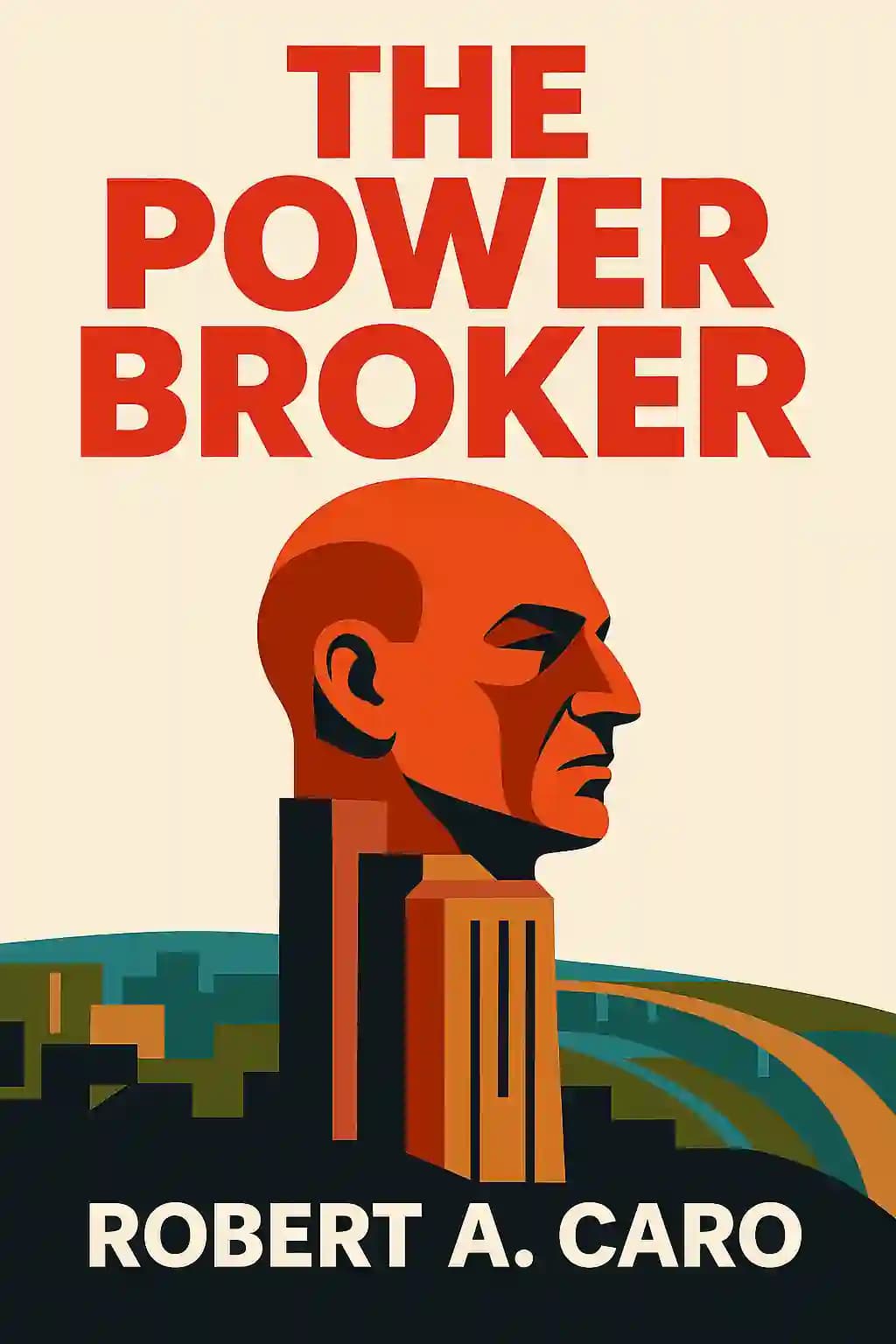
The Power Broker reveals how one unelected official reshaped New York through 1,336 pages of political genius and ruthlessness. Winner of the Pulitzer Prize, this epic exposes how cities are truly built - and why Jane Jacobs called it "an immense public service."
Robert Allan Caro, Pulitzer Prize-winning author and historian, is renowned for his meticulously researched biographies exploring political power and urban development. His seminal work, The Power Broker: Robert Moses and the Fall of New York, revolutionized political biography by exposing how unelected officials shape cities, earning the 1975 Pulitzer Prize and recognition as one of the Modern Library’s 100 greatest nonfiction books of the 20th century.
A Princeton graduate and former investigative reporter for Newsday, Caro’s seven-year investigation into Moses’s infrastructure empire established his reputation for unflinching detail and narrative depth.
Caro’s multivolume series The Years of Lyndon Johnson—including The Path to Power, Means of Ascent, Master of the Senate, and The Passage of Power—has garnered two National Book Awards and a National Humanities Medal from President Barack Obama. His work is celebrated for blending rigorous archival research with gripping storytelling, dissecting how ambition and institutional leverage redefine American democracy.
Translated into over 20 languages, The Power Broker remains a cornerstone of political and urban studies, routinely cited in academia and journalism for its timeless analysis of power dynamics.
The Power Broker chronicles Robert Moses' rise as New York's unelected "master builder," detailing how he shaped the city’s infrastructure through parks, highways, and public works while accumulating unprecedented political power. The Pulitzer Prize-winning biography exposes Moses' authoritarian methods, his clashes with figures like FDR, and the lasting urban crises caused by his projects, from displaced communities to congestion.
Urban planners, political science students, and history enthusiasts will gain insights into power dynamics and urban development. It’s ideal for readers interested in meticulously researched biographies or critiques of institutional corruption. Journalists and policymakers can learn from its lessons on governance and the consequences of unchecked authority.
Yes. Praised as a "modern American classic," its 1,200+ pages offer a gripping study of ambition and power. Caro’s investigative rigor—drawing on seven years of research—reveals how Moses manipulated systems to control New York, making it essential for understanding urban policy and political influence.
Moses leveraged public agencies like the Triborough Bridge Authority to control funding and bypass accountability. He forged alliances with banks, unions, and media, intimidating opponents through legal tactics and patronage. His ability to deliver projects quickly earned bipartisan support, even as his methods eroded democratic oversight.
Some argue Caro overly vilifies Moses, downplaying his early achievements like Jones Beach. Others note the book’s length can deter casual readers. However, its depth and unflinching critique of Moses’ legacy—particularly how highways and housing policies deepened racial divides—are widely acclaimed as groundbreaking.
Caro portrays Moses as a tragic figure: an idealist turned autocrat. While his parks and bridges initially modernized New York, later projects like the Cross-Bronx Expressway destroyed neighborhoods and prioritized cars over public transit. The book frames his career as a cautionary tale about centralized power and urban planning’s human cost.
Reviewers liken the biography to “a great Russian novel” for its epic scope and moral complexity.
Unlike shorter biographies, Caro’s work blends granular detail with narrative sweep, akin to Doris Kearns Goodwin’s Team of Rivals. It set a new standard for exposing systemic power abuses, influencing works like Jane Jacobs’ The Death and Life of Great American Cities.
The book warns against prioritizing infrastructure over communities, highlighting how Moses’ projects exacerbated segregation and pollution. It underscores the need for transparency in public projects and the dangers of conflating progress with scale.
As cities grapple with climate resilience and equitable development, Moses’ legacy illustrates the stakes of planning decisions. The book remains a touchstone for debates about public investment, housing policy, and balancing growth with community needs.
Caro spent seven years interviewing Moses’ associates, analyzing sealed archives, and visiting construction sites. His wife, Ina, transcribed thousands of documents. This exhaustive process uncovered Moses’ secretive deal-making and cemented the book’s reputation for precision.
It received the 1975 Pulitzer Prize for Biography, the Francis Parkman Prize, and a National Book Award finalist spot. Modern Library ranked it among the 20th century’s top 100 nonfiction books.
저자의 목소리로 책을 느껴보세요
지식을 흥미롭고 예시가 풍부한 인사이트로 전환
핵심 아이디어를 빠르게 캡처하여 신속하게 학습
재미있고 매력적인 방식으로 책을 즐기세요
Moses created the modern American city's automobile-centered paradigm.
Moses remains a deeply controversial figure.
Moses was very theoretical, always wanting to do exactly what was right.
Moses secured unprecedented powers.
Moses dismissed the idea, ensuring that his magnificent creation would remain primarily available to middle and upper-class white families.
The Power Broker의 핵심 아이디어를 이해하기 쉬운 포인트로 분해하여 혁신적인 팀이 어떻게 창조하고, 협력하고, 성장하는지 이해합니다.
The Power Broker을 빠른 기억 단서로 압축하여 솔직함, 팀워크, 창의적 회복력의 핵심 원칙을 강조합니다.

생생한 스토리텔링을 통해 The Power Broker을 경험하고, 혁신 교훈을 기억에 남고 적용할 수 있는 순간으로 바꿉니다.
무엇이든 물어보고, 목소리를 선택하고, 진정으로 공감되는 인사이트를 함께 만들어보세요.

샌프란시스코에서 컬럼비아 대학교 동문들이 만들었습니다
"Instead of endless scrolling, I just hit play on BeFreed. It saves me so much time."
"I never knew where to start with nonfiction—BeFreed’s book lists turned into podcasts gave me a clear path."
"Perfect balance between learning and entertainment. Finished ‘Thinking, Fast and Slow’ on my commute this week."
"Crazy how much I learned while walking the dog. BeFreed = small habits → big gains."
"Reading used to feel like a chore. Now it’s just part of my lifestyle."
"Feels effortless compared to reading. I’ve finished 6 books this month already."
"BeFreed turned my guilty doomscrolling into something that feels productive and inspiring."
"BeFreed turned my commute into learning time. 20-min podcasts are perfect for finishing books I never had time for."
"BeFreed replaced my podcast queue. Imagine Spotify for books — that’s it. 🙌"
"It is great for me to learn something from the book without reading it."
"The themed book list podcasts help me connect ideas across authors—like a guided audio journey."
"Makes me feel smarter every time before going to work"
샌프란시스코에서 컬럼비아 대학교 동문들이 만들었습니다

The Power Broker 요약을 무료 PDF 또는 EPUB으로 받으세요. 인쇄하거나 오프라인에서 언제든 읽을 수 있습니다.
Robert Moses transformed New York without ever holding elected office. For over four decades, he wielded extraordinary power, building 627 miles of roads, 658 playgrounds, 13 bridges, and reshaping an area inhabited by 12 million people. Though he never learned to drive, Moses created the automobile-centered paradigm that defines American cities to this day. His projects include beloved landmarks like Jones Beach, the Triborough Bridge, and Lincoln Center, yet his methods displaced hundreds of thousands, primarily poor minorities. What makes his story so compelling isn't just the physical transformation he engineered but what it reveals about power itself-how it's acquired, wielded, and the price we pay for progress. Have you ever wondered how our cities came to be designed around cars rather than people? The answer begins with Robert Moses.