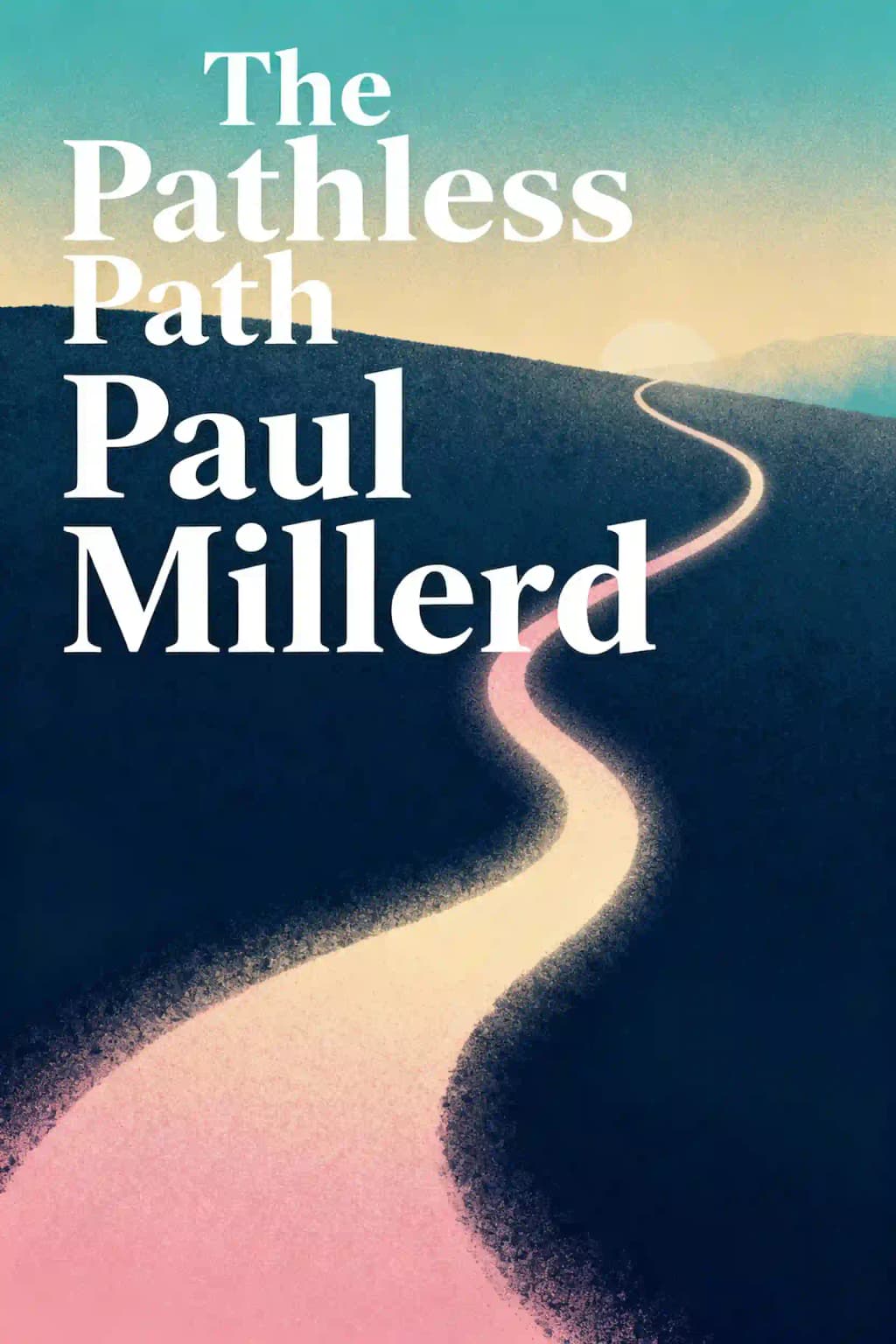
"The Pathless Path" challenges the default life script. Endorsed by David Perell and helping 55,000+ people reimagine work, Paul Millerd's manifesto asks: What if success isn't climbing ladders but creating your own? Could embracing uncertainty lead to greater fulfillment than following society's map?
Paul Millerd is the acclaimed author of The Pathless Path and a leading voice in reimagining modern work and success. A former McKinsey strategy consultant, Millerd left corporate life in 2017 to pursue writing, coaching, and exploring alternatives to traditional career trajectories. His bestselling book blends memoir, cultural analysis, and practical philosophy to examine themes of purposeful work, financial independence, and creative freedom—drawing from his own journey of leaving the "default path" to build a globally location-independent career.
Millerd founded the StrategyU training platform to teach consulting skills outside corporate environments and hosts The Pathless Path Podcast, featuring conversations with unconventional career pioneers. His newsletter, Pathless, reaches over 23,000 subscribers with insights on work-life design.
In September 2024, he released Good Work, a follow-up exploring sustainable, ethical careers in the AI era. The Pathless Path has sold more than 60,000 copies worldwide and been translated into 12 languages, cementing Millerd’s reputation as a visionary guide for professionals seeking meaningful alternatives to burnout culture.
The Pathless Path challenges societal expectations around careers, advocating for embracing uncertainty to pursue meaningful work. Paul Millerd shares his journey from a high-paying McKinsey consulting role to a life of writing, experimentation, and global wandering, emphasizing redefining success beyond traditional metrics like income or prestige.
Professionals feeling trapped in unfulfilling careers, aspiring entrepreneurs, and anyone questioning societal norms around work will find value. It’s particularly relevant for those seeking frameworks to transition from stability-driven “default paths” to purpose-driven lives.
Yes, especially for its actionable insights on overcoming burnout, prototyping lifestyle changes, and redefining work. Readers praise its blend of memoir, philosophy, and practical advice for navigating career transitions.
“Good work” aligns with personal values, energizes rather than drains, and avoids societal metrics of success. Millerd emphasizes prioritizing intrinsic motivation over external rewards.
It illustrates complacency in unfulfilling careers: gradual discomfort (like a frog in warming water) leads to stagnation without conscious action. Millerd uses it to warn against passively accepting unsatisfactory work.
Millerd links burnout to the default path’s pressure to conform, citing studies showing how cynicism and emotional detachment create vicious cycles. The book advocates stepping back to reassess work’s role in life.
This framework encourages small experiments (e.g., side projects, part-time transitions) to test lifestyle changes before fully committing. Millerd used it to leave consulting gradually.
Unlike productivity-focused guides, Millerd’s book prioritizes mindset shifts over tactical hacks. It complements these works by addressing the philosophical underpinnings of work and identity.
Some note its focus on individual agency over systemic barriers (e.g., financial instability). Others find its advice less actionable for those without Millerd’s privileged starting point.
As remote work and AI reshape careers, its lessons on adaptability, self-directed learning, and redefining success resonate with professionals navigating rapid change.
His second book delves deeper into aligning work with personal energy and values, offering frameworks like “Ship, Quit, and Learn” to operationalize the pathless mindset.
저자의 목소리로 책을 느껴보세요
핵심 아이디어를 빠르게 캡처하여 신속하게 학습
It's a call to adventure in a world that urges us to conform.
For many, it can be soul-destroying.
Life is indeed fired at us point-blank...
Learning is naturally the consequence of doing.
Life is not something to be solved; it's something to be lived.
Pathless Path의 핵심 아이디어를 이해하기 쉬운 포인트로 분해하여 혁신적인 팀이 어떻게 창조하고, 협력하고, 성장하는지 이해합니다.
Pathless Path을 빠른 기억 단서로 압축하여 솔직함, 팀워크, 창의적 회복력의 핵심 원칙을 강조합니다.

무엇이든 물어보고, 목소리를 선택하고, 진정으로 공감되는 인사이트를 함께 만들어보세요.

샌프란시스코에서 컬럼비아 대학교 동문들이 만들었습니다
"Instead of endless scrolling, I just hit play on BeFreed. It saves me so much time."
"I never knew where to start with nonfiction—BeFreed’s book lists turned into podcasts gave me a clear path."
"Perfect balance between learning and entertainment. Finished ‘Thinking, Fast and Slow’ on my commute this week."
"Crazy how much I learned while walking the dog. BeFreed = small habits → big gains."
"Reading used to feel like a chore. Now it’s just part of my lifestyle."
"Feels effortless compared to reading. I’ve finished 6 books this month already."
"BeFreed turned my guilty doomscrolling into something that feels productive and inspiring."
"BeFreed turned my commute into learning time. 20-min podcasts are perfect for finishing books I never had time for."
"BeFreed replaced my podcast queue. Imagine Spotify for books — that’s it. 🙌"
"It is great for me to learn something from the book without reading it."
"The themed book list podcasts help me connect ideas across authors—like a guided audio journey."
"Makes me feel smarter every time before going to work"
샌프란시스코에서 컬럼비아 대학교 동문들이 만들었습니다

Pathless Path 요약을 무료 PDF 또는 EPUB으로 받으세요. 인쇄하거나 오프라인에서 언제든 읽을 수 있습니다.
Many of us are familiar with what I call the "default path." It's the well-trodden route that promises safety and certainty: graduate, work a long career, retire, and then pass on. This path is comforting because it offers a sense of security and predictability. However, for many, it can be soul-destroying. It's a path that often leads to a life that feels scripted by others, rather than one that is truly our own. I recall a powerful analogy that illustrates the danger of blindly following this default path: the frog in the pot of water. If you place a frog in a pot of fresh water on the stove and gradually increase the temperature, the frog will feel restless and uncomfortable but not uncomfortable enough to jump out. Without realizing it, the frog is lulled into unconsciousness as the water heats up. This is what happens when we follow the default path without questioning it – we risk missing out on the life we truly desire. The pathless path is an alternative to this default route. It's an invitation to step into the unknown, to embrace uncertainty and discomfort. This path is not about finding a job, making money, building a business, or achieving any other predefined metric. Instead, it's about actively and consciously searching for the work that you want to keep doing. As I often say, "On the pathless path, the goal is not to find a job, make money, build a business, or achieve any other metric. It’s to actively and consciously search for the work that you want to keep doing." This journey requires a deep trust in yourself and in the process of discovery. Milan Kundera once said, "We live everything as it comes, without warning, like an actor going on cold." Life is indeed fired at us point-blank, and this uncertainty can be daunting. However, it's precisely this uncertainty that makes life so rich and meaningful. When we choose the pathless path, we are not trying to solve the problem of an uncertain future; we are learning to trust that this uncertainty is a natural part of life. One of the biggest traps we fall into is believing that the only paths available to us are the ones we've seen others take or the ones we've been on before. This is what I call the "adjacent possible" – we limit ourselves to options that are immediately visible, rather than exploring the vast array of possibilities that exist beyond our current horizon. Imagine a room filled with people who all look the same, talk the same way, and believe the same things. They may seem comfortable, even happy, but they are trapped in a silent conspiracy that constrains the possibilities of their lives. The pathless path encourages you to break free from this conformity and explore the myriad paths that exist beyond the familiar. When someone asks you if there are only two options, and you list a few other paths that they concede are possible but say, "I don't know anyone who has done that," you are hitting against the boundaries of the adjacent possible. It's time to question these boundaries and explore the paths that no one else has taken. Much of our identity is often tied to external validation – our credentials, our job titles, our achievements. But what happens when these external markers of success are stripped away? I recall a personal experience where my identity as a high achiever was challenged when I fell ill. As I said, "So much of my identity had been connected with being a high achiever. Straight A's. Dean's List. McKinsey. MIT. When I was sick, I would have traded every last credential for a single day of feeling okay." This experience taught me a valuable lesson: true happiness and fulfillment come not from external validation but from living a life that is authentic and meaningful to us. The world will ask you who you are, and if you don't know, the world will tell you. But it's crucial to define your own identity and success on your own terms. The pathless path underscores the significance of taking deliberate actions to shape your life. It's about prioritizing agency and making conscious choices rather than following a predetermined script. As I emphasize, "The secret of the world is that it is a very malleable place, we must be sure that people learn this, and never forget the order: Learning is naturally the consequence of doing." You must be willing to question your path and change it if necessary. As Mehmet Murat ildan said, "If you are on the wrong path, change it; no matter on which mile of the road, change it Till you find the right path, change all the paths!" This is not about being reckless but about being intentional and courageous in your choices. The pathless path is not without its challenges, but it is also incredibly rewarding. It's a journey that requires you to be a little crazy, to go against the grain of what most people think. Yet, it's these "experiments in living" that are vital to pushing culture forward and finding true fulfillment. As you embark on this path, remember that life is not something to be solved; it's something to be lived. The moment you think there is no path before you, the path disappears. But the moment you think the opposite, the path appears. All paths need people who see them and are willing to take the first step. In the end, the pathless path is about trusting in the uncertainty of life and finding joy and happiness in the journey itself. It's a call to adventure, a reminder to laugh when things feel out of control, and to trust that an uncertain future is not a problem to be solved but an opportunity to be embraced. As I say, "I want to see people live the lives they are capable of, not just the ones they think they are allowed to live."
