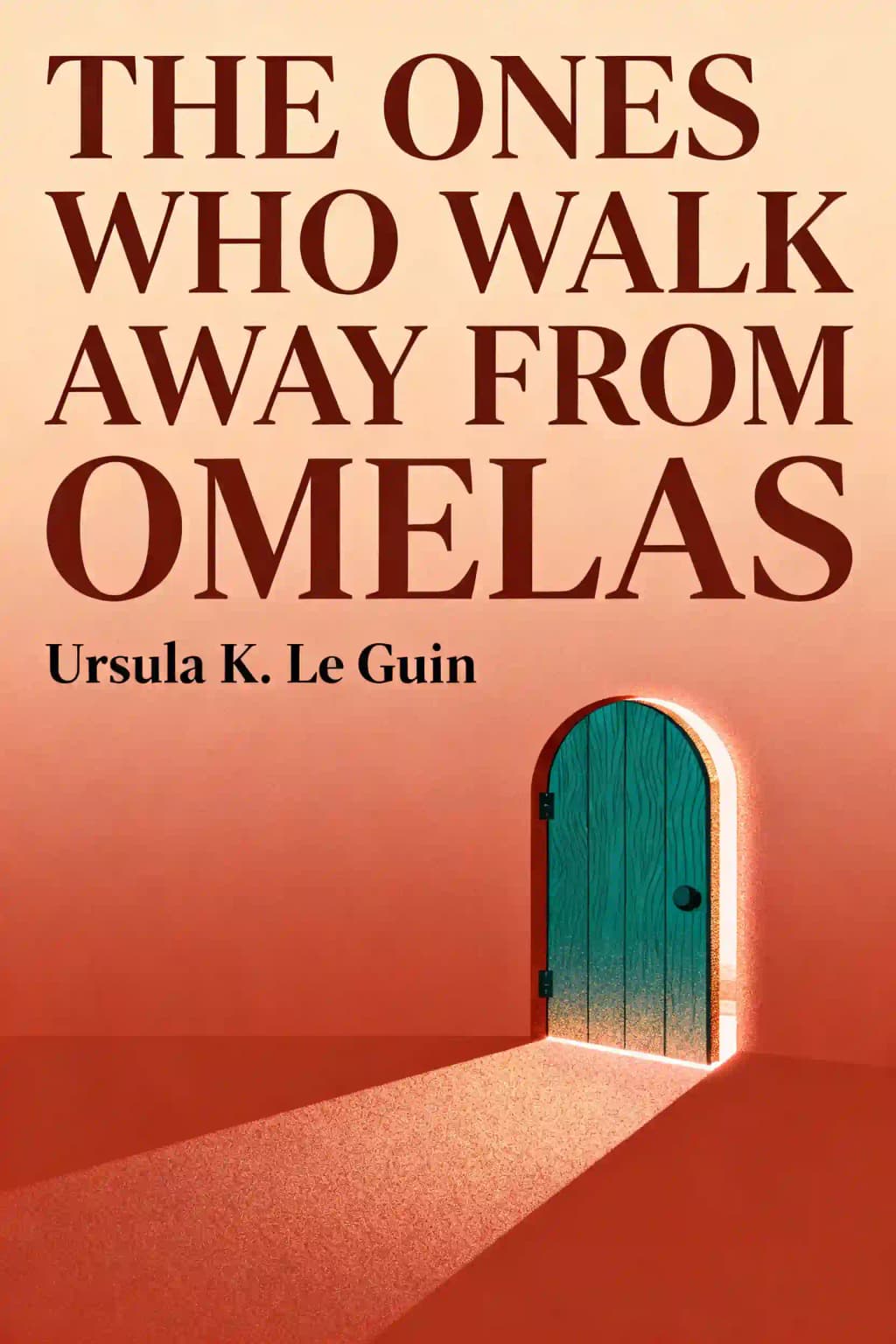
The  ones who walk away from Omelas book cover

The ones who walk away from Omelas

Ursula K. Le Guin
4.37 (55544 Reviews)

The ones who walk away from Omelas 개요

Hugo Award-winning short story that forces readers to confront an impossible moral dilemma: a utopia built on one child's suffering. Ranked 2nd among 20th century short stories, "Omelas" has sparked fierce ethical debates in classrooms worldwide since 1973. Would you stay or walk away?

The ones who walk away from Omelas의 핵심 주제

  • utilitarian moral dilemma
  • scapegoating and sacrifice
  • complicity in suffering
  • cost of utopia
  • individual ethical conscience

The ones who walk away from Omelas의 명언

  • The trouble is that we have a bad habit, encouraged by pedants and sophisticates, of considering happiness as something rather stupid.

  • They were not simple folk, you see, though they were happy.

  • They all know that it has to be there.

  • Now and then one of the adolescents or adults will go to see the child.

  • They leave Omelas, they walk ahead into the darkness, and they do not come back.

The ones who walk away from Omelas의 등장인물

  • The childA malnourished child whose suffering buys joy.
  • Ursula K. Le GuinThe author and narrator of the parable.
  • The citizens of OmelasSophisticated people living in a perfect utopia.

저자 소개

The ones who walk away from Omelas의 저자 소개

Ursula Kroeber Le Guin (1929–2018) was the visionary author of "The Ones Who Walk Away from Omelas" and a pioneering voice in speculative fiction and philosophical literature. Born in Berkeley, California, to anthropologist parents, Le Guin brought a deep understanding of culture and ethics to her writing.

"The Ones Who Walk Away from Omelas" is a powerful short story that explores utilitarianism, moral responsibility, and the hidden costs of utopia—themes that defined her career as one of America's most influential science fiction and fantasy writers.

Her groundbreaking body of work includes masterpieces like The Left Hand of Darkness and the Earthsea series, earning her multiple Hugo and Nebula Awards. She was the first woman to win both awards for best novel. Le Guin received the National Book Foundation Medal for Distinguished Contribution to American Letters in 2014 and was named a Library of Congress Living Legend. Her work has influenced modern writers from Neil Gaiman to Salman Rushdie, and her books have been translated into dozens of languages worldwide.

The ones who walk away from Omelas 요약 다운로드

The ones who walk away from Omelas 요약을 무료 PDF 또는 EPUB으로 받으세요. 인쇄하거나 오프라인에서 언제든 읽을 수 있습니다.

이 책에 대한 FAQ

The Ones Who Walk Away from Omelas by Ursula K. Le Guin is a philosophical short story about a seemingly perfect utopian city whose happiness depends on the suffering of one child locked in a basement. The narrative explores the moral dilemma faced by citizens who discover this truth—some stay and accept the bargain, while others silently walk away from Omelas, rejecting a happiness built on injustice.

Ursula K. Le Guin (1929-2018) was an acclaimed American author who transformed science fiction and fantasy into vehicles for philosophical exploration. Born in Berkeley, California to anthropologist parents, she earned five Nebula and five Hugo awards throughout her career. Le Guin is best known for The Left Hand of Darkness, The Dispossessed, and the Earthsea series, with her work influencing writers like Neil Gaiman and Salman Rushdie.

The Ones Who Walk Away from Omelas is essential reading for philosophy students, ethics enthusiasts, and anyone grappling with questions of social justice and moral responsibility. It appeals to readers interested in thought experiments, utilitarianism debates, and allegorical fiction. High school and college curricula frequently assign it for discussions on collective guilt, complicity, and the limits of consequentialist ethics in creating a just society.

Absolutely. The Ones Who Walk Away from Omelas by Ursula K. Le Guin remains one of the most powerful short stories in modern literature, packing profound ethical questions into just a few pages. Its exploration of systemic injustice, moral compromise, and individual conscience resonates even more strongly in today's context. The story takes only 15-20 minutes to read but sparks discussions that last a lifetime.

The central moral dilemma in The Ones Who Walk Away from Omelas asks whether collective happiness can justify individual suffering. Citizens must choose: accept that their prosperity requires one child's perpetual misery, or reject this utilitarian bargain and walk away into the unknown. This mirrors real-world questions about benefiting from systemic inequalities—whether ignorance, acceptance, or active rejection represents the most ethical response to unjust systems.

The suffering child in The Ones Who Walk Away from Omelas symbolizes the marginalized individuals whose exploitation sustains comfortable societies. The child represents exploited workers, oppressed minorities, and invisible victims of systemic injustice whose suffering makes others' prosperity possible. Ursula K. Le Guin uses this visceral image to force readers to confront how modern comfort often depends on distant suffering—sweatshop labor, environmental destruction, or economic inequality.

Walking away from Omelas represents rejecting complicity in unjust systems, even when the alternative is uncertain. Those who leave choose moral integrity over comfortable prosperity, refusing to accept happiness purchased through another's suffering. Ursula K. Le Guin deliberately leaves their destination ambiguous—the act of walking away itself matters more than arriving somewhere specific. This symbolizes protest, conscientious objection, and choosing principle over pragmatism.

The Ones Who Walk Away from Omelas explores:

  • utilitarianism and its limits—questioning whether maximizing overall happiness justifies harming innocents
  • collective guilt and complicity
  • the scapegoat mechanism in societies
  • moral courage versus complacency
  • the cost of utopia

Ursula K. Le Guin also examines how knowledge creates moral responsibility and whether ignorance can ever be innocence when systemic injustice exists.

The Ones Who Walk Away from Omelas by Ursula K. Le Guin mirrors contemporary issues like climate change, wealth inequality, and global supply chains that benefit some through others' exploitation. The story forces readers to examine their own complicity—smartphones built with conflict minerals, fast fashion produced in sweatshops, or prosperity built on historical injustices. Its 1973 publication continues resonating because systemic inequality remains central to modern life.

The Summer Festival in The Ones Who Walk Away from Omelas represents the city's celebration of its utopian happiness—a joyous occasion with music, processions, and horses adorned for parade. Ursula K. Le Guin describes this idyllic scene in rich detail before revealing the dark foundation beneath it. The festival's perfection makes the subsequent revelation of the suffering child more shocking, emphasizing how outward prosperity can mask hidden brutality.

Critics argue The Ones Who Walk Away from Omelas presents an oversimplified moral binary, ignoring middle-ground responses like reform or revolution. Some find the premise unrealistic—why couldn't citizens free the child and risk losing happiness rather than simply leaving? Others note Ursula K. Le Guin provides no information about where those who walk away go or what they accomplish, making their choice seem passive rather than transformative.

The Ones Who Walk Away from Omelas shares thematic DNA with Dostoevsky's "The Grand Inquisitor" and Shirley Jackson's "The Lottery," both examining collective participation in systemic cruelty. Like Plato's Cave allegory, it explores enlightenment and moral responsibility after gaining knowledge. While shorter and more allegorical than Le Guin's novels The Dispossessed or The Left Hand of Darkness, it distills her central concerns about ethics, freedom, and social justice into potent, unforgettable form.

나만의 학습 방법 탐색하기

The ones who walk away from Omelas은 단순한 책이 아닙니다 — Fiction의 마스터클래스입니다. 당신에게 가장 잘 맞는 방식으로 교훈을 흡수할 수 있도록 5가지 고유한 학습 모드를 제공합니다. 깊이 생각하는 사람이든, 빠른 학습자이든, 이야기를 좋아하는 사람이든, 당신의 스타일에 맞는 모드가 있습니다.

빠른 요약 모드

The ones who walk away from Omelas 요약을 8분 만에 읽거나 듣기

The ones who walk away from Omelas의 핵심 아이디어를 이해하기 쉬운 포인트로 분해하여 혁신적인 팀이 어떻게 창조하고, 협력하고, 성장하는지 이해합니다.

play
00:00
00:00

재미있게 모드

The ones who walk away from Omelas의 교훈을 22분 스토리로

생생한 스토리텔링을 통해 The ones who walk away from Omelas을 경험하고, 혁신 교훈을 기억에 남고 적용할 수 있는 순간으로 바꿉니다.

play
00:00
00:00

개인화 모드

The ones who walk away from Omelas을 나만의 학습 스타일로 경험하기

무엇이든 묻고, 학습 스타일을 선택하고, 나에게 맞는 인사이트를 함께 만들어보세요.

Personalize Mode

샌프란시스코에서 컬럼비아 대학교 동문들이 만들었습니다

BeFreed는 1,000,000 호기심 넘치는 글로벌 커뮤니티를 하나로 연결합니다

"Instead of endless scrolling, I just hit play on BeFreed. It saves me so much time."

@Moemenn
platform
star
star
star
star
star

"I never knew where to start with nonfiction—BeFreed’s book lists turned into podcasts gave me a clear path."

@Chloe, Solo founder, LA
platform
comments
12
likes
117

"Perfect balance between learning and entertainment. Finished ‘Thinking, Fast and Slow’ on my commute this week."

@Raaaaaachelw
platform
star
star
star
star
star

"Crazy how much I learned while walking the dog. BeFreed = small habits → big gains."

@Matt, YC alum
platform
comments
12
likes
108

"Reading used to feel like a chore. Now it’s just part of my lifestyle."

@Erin, Investment Banking Associate , NYC
platform
comments
254
likes
17

"Feels effortless compared to reading. I’ve finished 6 books this month already."

@djmikemoore
platform
star
star
star
star
star

"BeFreed turned my guilty doomscrolling into something that feels productive and inspiring."

@Pitiful
platform
comments
96
likes
4.5K

"BeFreed turned my commute into learning time. 20-min podcasts are perfect for finishing books I never had time for."

@SofiaP
platform
star
star
star
star
star

"BeFreed replaced my podcast queue. Imagine Spotify for books — that’s it. 🙌"

@Jaded_Falcon
platform
comments
201
thumbsUp
16

"It is great for me to learn something from the book without reading it."

@OojasSalunke
platform
star
star
star
star
star

"The themed book list podcasts help me connect ideas across authors—like a guided audio journey."

@Leo, Law Student, UPenn
platform
comments
37
likes
483

"Makes me feel smarter every time before going to work"

@Cashflowbubu
platform
star
star
star
star
star

"Instead of endless scrolling, I just hit play on BeFreed. It saves me so much time."

@Moemenn
platform
star
star
star
star
star

"I never knew where to start with nonfiction—BeFreed’s book lists turned into podcasts gave me a clear path."

@Chloe, Solo founder, LA
platform
comments
12
likes
117

"Perfect balance between learning and entertainment. Finished ‘Thinking, Fast and Slow’ on my commute this week."

@Raaaaaachelw
platform
star
star
star
star
star

"Crazy how much I learned while walking the dog. BeFreed = small habits → big gains."

@Matt, YC alum
platform
comments
12
likes
108

"Reading used to feel like a chore. Now it’s just part of my lifestyle."

@Erin, Investment Banking Associate , NYC
platform
comments
254
likes
17

"Feels effortless compared to reading. I’ve finished 6 books this month already."

@djmikemoore
platform
star
star
star
star
star

"BeFreed turned my guilty doomscrolling into something that feels productive and inspiring."

@Pitiful
platform
comments
96
likes
4.5K

"BeFreed turned my commute into learning time. 20-min podcasts are perfect for finishing books I never had time for."

@SofiaP
platform
star
star
star
star
star

"BeFreed replaced my podcast queue. Imagine Spotify for books — that’s it. 🙌"

@Jaded_Falcon
platform
comments
201
thumbsUp
16

"It is great for me to learn something from the book without reading it."

@OojasSalunke
platform
star
star
star
star
star

"The themed book list podcasts help me connect ideas across authors—like a guided audio journey."

@Leo, Law Student, UPenn
platform
comments
37
likes
483

"Makes me feel smarter every time before going to work"

@Cashflowbubu
platform
star
star
star
star
star

"Instead of endless scrolling, I just hit play on BeFreed. It saves me so much time."

@Moemenn
platform
star
star
star
star
star

"I never knew where to start with nonfiction—BeFreed’s book lists turned into podcasts gave me a clear path."

@Chloe, Solo founder, LA
platform
comments
12
likes
117

"Perfect balance between learning and entertainment. Finished ‘Thinking, Fast and Slow’ on my commute this week."

@Raaaaaachelw
platform
star
star
star
star
star

"Crazy how much I learned while walking the dog. BeFreed = small habits → big gains."

@Matt, YC alum
platform
comments
12
likes
108

"Reading used to feel like a chore. Now it’s just part of my lifestyle."

@Erin, Investment Banking Associate , NYC
platform
comments
254
likes
17

"Feels effortless compared to reading. I’ve finished 6 books this month already."

@djmikemoore
platform
star
star
star
star
star

"BeFreed turned my guilty doomscrolling into something that feels productive and inspiring."

@Pitiful
platform
comments
96
likes
4.5K

"BeFreed turned my commute into learning time. 20-min podcasts are perfect for finishing books I never had time for."

@SofiaP
platform
star
star
star
star
star

"BeFreed replaced my podcast queue. Imagine Spotify for books — that’s it. 🙌"

@Jaded_Falcon
platform
comments
201
thumbsUp
16

"It is great for me to learn something from the book without reading it."

@OojasSalunke
platform
star
star
star
star
star

"The themed book list podcasts help me connect ideas across authors—like a guided audio journey."

@Leo, Law Student, UPenn
platform
comments
37
likes
483

"Makes me feel smarter every time before going to work"

@Cashflowbubu
platform
star
star
star
star
star

더 많은 이야기를 보시겠어요?

웹에서 사람들이 BeFreed에 대해 이야기하는 방법
1.5K Ratings4.7
지금 바로 학습 여정을 시작하세요


