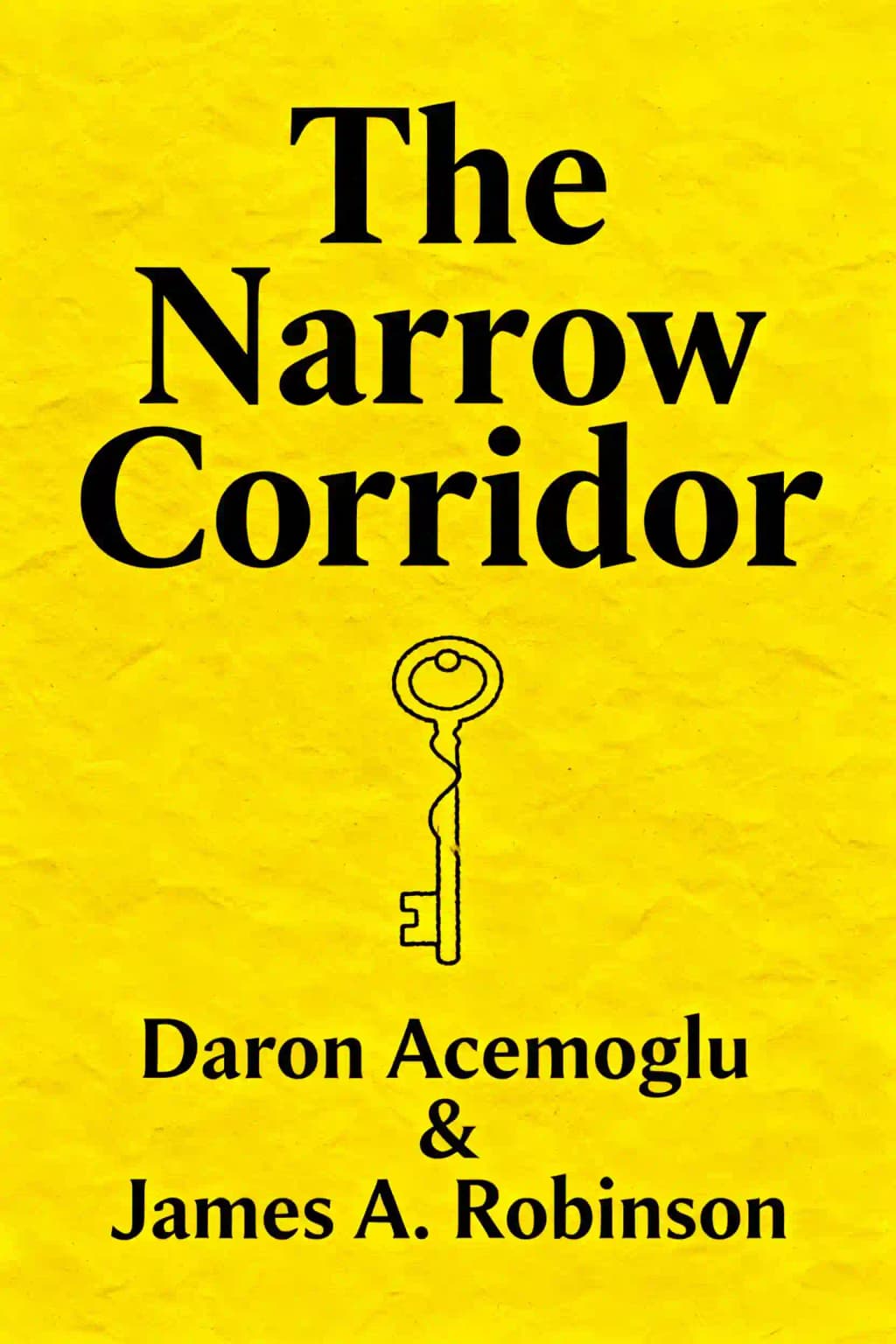
Narrow Corridor
How Nations Struggle for Liberty
Narrow Corridor 개요
In "The Narrow Corridor," Nobel laureate Daron Acemoglu reveals how liberty thrives only when state power and society exist in perfect balance. What made three Nobel economists call this "timely" and "powerful"? Discover why democracies fail - and how yours might be next.

Narrow Corridor의 핵심 주제
- state-society balance
- shackled leviathan
- red queen effect
- institutional liberty
- political power dynamics
Narrow Corridor의 명언
Liberty cannot be engineered from above-it must be claimed through struggle.
The Congolese state fails to provide basic services, protect citizens, or enforce its own laws.
If society doesn't keep pace with the growing state, despotism follows.
Living at another's mercy, where even the threat of violence forces compliance.
Narrow Corridor의 등장인물
- GilgameshKing of Uruk who illustrates the Gilgamesh problem
- SolonAthenian Archon who balanced power via reforms
- Emily DavisonBritish suffragette who died for women's rights
- Sani AbachaNigerian General whose rule exemplified dominance
- Wole SoyinkaNobel laureate who described life under autocracy
저자 소개
Narrow Corridor의 저자 소개
Daron Acemoglu and James A. Robinson, Nobel Prize-winning economists and bestselling authors of The Narrow Corridor, are renowned for their groundbreaking work on institutional economics and comparative development. Their book, a sequel to the internationally acclaimed Why Nations Fail, explores the delicate balance between state power and societal liberty, arguing that sustainable freedom emerges only when governments and citizens mutually constrain each other.
Acemoglu, the Elizabeth and James Killian Professor of Economics at MIT, and Robinson, a University Professor at the University of Chicago, draw on decades of research across Latin America, Africa, and Asia to analyze how nations navigate the “narrow corridor” toward democracy.
Their collaborative works, including Why Nations Fail (translated into over 30 languages and selling millions worldwide), have reshaped global discourse on political economy. Recognized with the 2024 Nobel Prize in Economics for elucidating the role of inclusive institutions in prosperity, their frameworks are taught in top universities and applied by policymakers. The Narrow Corridor received praise from figures like Fareed Zakaria and was shortlisted for the Lionel Gelber Prize, cementing their status as leading voices on the intersection of power, institutions, and human progress.
Narrow Corridor 요약 다운로드
Narrow Corridor 요약을 무료 PDF 또는 EPUB으로 받으세요. 인쇄하거나 오프라인에서 언제든 읽을 수 있습니다.
이 책에 대한 FAQ
The Narrow Corridor examines how societies balance state power and civil liberties to achieve lasting freedom. Acemoğlu argues that liberty emerges when a "Shackled Leviathan" state—strong enough to enforce laws but constrained by societal accountability—navigates a fragile equilibrium between chaos and authoritarianism. Historical case studies, from the Magna Carta to modern democracies, illustrate this dynamic pathway.
This book is ideal for political science students, policymakers, and readers interested in governance. It offers insights for those analyzing democratic institutions, state-building challenges, or historical patterns of liberty. Critics of authoritarianism and advocates for civil society will find its frameworks particularly relevant.
Yes, for its rigorous analysis of liberty’s prerequisites. Acemoğlu blends economics, history, and political theory to explain why some nations thrive while others falter. However, critics note oversimplification in applying the "Shackled Leviathan" model to societies with entrenched inequality or non-Western governance structures.
The "Shackled Leviathan" refers to a state powerful enough to provide public goods (security, infrastructure) but restrained by institutional checks and active civil society. This balance prevents authoritarianism while avoiding the chaos of weak governance, as seen in the UK’s post-Magna Carta evolution.
Acemoğlu traces liberty’s emergence to societal pushback against centralized power. For example, the Glorious Revolution (1688) weakened monarchic authority in Britain, enabling parliamentary oversight. Such milestones reflect the "Red Queen effect," where society and state continuously adapt to maintain balance.
Critics argue the book undervalues non-Western governance models and oversimplifies societies like ancient Athens, which coexisted with slavery. Others question its dismissal of pre-modern social norms as inherently oppressive, rather than adaptable foundations for liberty.
This concept describes the relentless competition between state and society to prevent either from dominating. Like the Red Queen in Alice in Wonderland, both must "run faster" to stay in the corridor—expanding capabilities while preserving accountability, as seen in U.S. civil rights movements.
Key examples include:
- Magna Carta (1215): Limited monarchic power, laying groundwork for British constitutionalism.
- Glorious Revolution (1688): Established parliamentary sovereignty.
- U.S. Constitution: Created checks and balances to shackle federal authority.
The book warns that democracies backslide without vigilant civil society. For instance, weakened press freedom or judicial independence can tip states into despotism. It advocates grassroots movements to counter authoritarian trends, as seen in 20th-century civil rights reforms.
This term describes rigid social structures—like feudalism or tribalism—that stifle innovation and liberty by prioritizing tradition over meritocracy. Acemoğlu contrasts these with "participatory norms" that empower broad civic engagement, as in Renaissance-era Italian city-states.
Both books link institutions to prosperity, but The Narrow Corridor focuses on liberty’s fragility, whereas Why Nations Fail emphasizes extractive vs. inclusive economies. The newer work delves deeper into civil society’s role, using historical narratives rather than purely economic analysis.
Acemoğlu argues despotic regimes can enter the corridor via bottom-up pressure, citing South Korea’s transition from dictatorship to democracy. However, this requires preexisting egalitarian norms and organized dissent—factors often suppressed in modern autocracies.