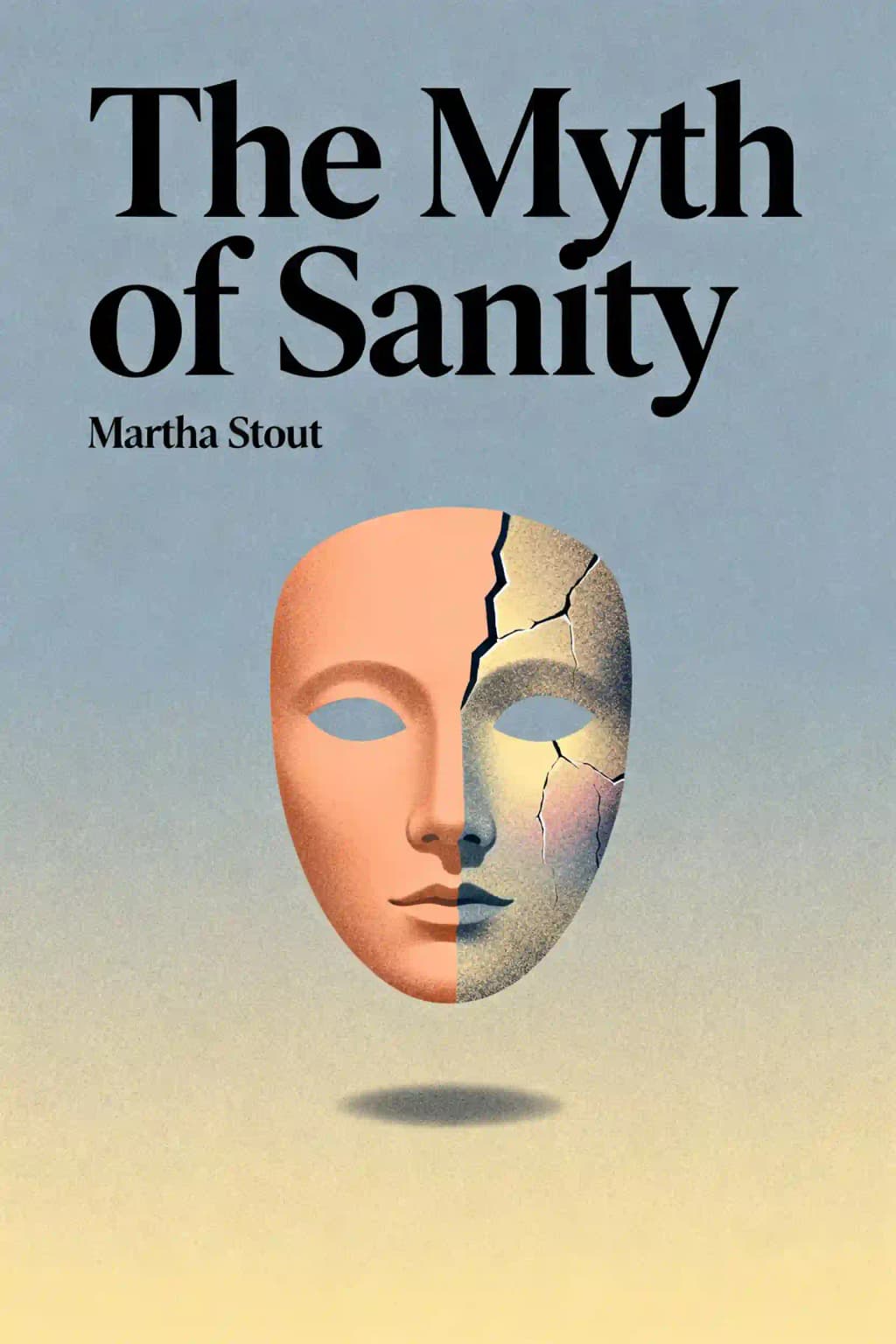
Dive into the hidden world of dissociation where sanity is merely a facade. Martha Stout's eye-opening exploration reveals how nearly 40% of American girls experience sexual abuse, challenging our understanding of trauma and the mind's extraordinary coping mechanisms. A psychological revelation that transforms how we perceive mental health.
Martha Stout, Ph.D., is a clinical psychologist specializing in trauma recovery and dissociative disorders, and is the bestselling author of The Myth of Sanity: Divided Consciousness and the Promise of Awareness.
As a faculty member at Harvard Medical School for over 25 years, she combines academic rigor with clinical expertise gained from her work at Massachusetts General Hospital and McLean Psychiatric Hospital. Her writing explores psychological resilience and the hidden impacts of trauma, themes rooted in her decades of treating PTSD survivors.
Stout is also the acclaimed author of The Sociopath Next Door (2005), which won the Books for a Better Life Award and established her as a leading voice on conscience and human behavior.
A frequent media commentator, she has appeared on NPR, CNN, and Good Morning America. Her works, translated globally, blend scientific insight with accessible storytelling to demystify complex mental health concepts. The Myth of Sanity remains a seminal text in understanding fragmented consciousness and healing.
The Myth of Sanity challenges conventional views of mental health, arguing that "sanity" is a spectrum shaped by trauma and dissociation. Martha Stout, a Harvard-trained psychologist, uses clinical case studies to show how fragmented consciousness—from mild daydreaming to dissociative identity disorder—protects the mind from overwhelming pain, redefining what it means to be mentally whole.
This book is essential for psychology students, trauma survivors, and mental health professionals seeking insight into dissociation’s role in coping. It’s also valuable for general readers interested in consciousness studies or reevaluating societal norms around mental health.
Yes—it offers groundbreaking insights into how trauma fractures identity, backed by 25+ years of clinical research. Stout’s compassionate narrative bridges academic rigor and accessibility, making it a seminal text for understanding hidden psychological struggles.
Key ideas include:
Stout rejects binary sanity/insanity labels, framing sanity as integrated awareness. She argues that "normal" behavior often masks dissociative splits, and true mental health requires acknowledging these fractured selves.
Case studies include patients with dissociative identity disorder, survivors of narcissistic abuse, and individuals unaware of childhood trauma—all showing how dissociation shields the mind but erodes self-cohesion.
Its focus on trauma’s enduring effects aligns with 2025 debates on systemic inequality, generational PTSD, and neurodiversity, offering a framework to destigmatize fragmented consciousness.
Some argue Stout overemphasizes dissociation’s prevalence, while others praise her humanizing approach to marginalized experiences. Critics note the lack of quantitative data, though supporters highlight its narrative depth.
While Sociopath examines external threats from manipulative personalities, Myth of Sanity focuses on internal psychological divides. Both emphasize resilience but target different facets of mental survival.
Yes—it provides tools to recognize dissociative patterns, validate hidden pain, and pursue integration through therapy. Stout’s empathetic tone reassures readers that fragmentation is a survival skill, not a flaw.
As global crises amplify collective trauma, Stout’s work helps normalize dissociative responses while advocating for holistic healing—a critical perspective in today’s mental health landscape.
저자의 목소리로 책을 느껴보세요
지식을 흥미롭고 예시가 풍부한 인사이트로 전환
핵심 아이디어를 빠르게 캡처하여 신속하게 학습
재미있고 매력적인 방식으로 책을 즐기세요
The most reliable sign, the most universal behavior of unscrupulous people is that they are always blaming others.
Our species developed sophisticated cognitive abilities that both helped us survive dangers and created new vulnerabilities.
Psychological trauma occurs when events violate our existing frameworks.
We have become "shell-shocked as an entire species".
The Myth of Sanity의 핵심 아이디어를 이해하기 쉬운 포인트로 분해하여 혁신적인 팀이 어떻게 창조하고, 협력하고, 성장하는지 이해합니다.
The Myth of Sanity을 빠른 기억 단서로 압축하여 솔직함, 팀워크, 창의적 회복력의 핵심 원칙을 강조합니다.

생생한 스토리텔링을 통해 The Myth of Sanity을 경험하고, 혁신 교훈을 기억에 남고 적용할 수 있는 순간으로 바꿉니다.
무엇이든 물어보고, 목소리를 선택하고, 진정으로 공감되는 인사이트를 함께 만들어보세요.

샌프란시스코에서 컬럼비아 대학교 동문들이 만들었습니다
"Instead of endless scrolling, I just hit play on BeFreed. It saves me so much time."
"I never knew where to start with nonfiction—BeFreed’s book lists turned into podcasts gave me a clear path."
"Perfect balance between learning and entertainment. Finished ‘Thinking, Fast and Slow’ on my commute this week."
"Crazy how much I learned while walking the dog. BeFreed = small habits → big gains."
"Reading used to feel like a chore. Now it’s just part of my lifestyle."
"Feels effortless compared to reading. I’ve finished 6 books this month already."
"BeFreed turned my guilty doomscrolling into something that feels productive and inspiring."
"BeFreed turned my commute into learning time. 20-min podcasts are perfect for finishing books I never had time for."
"BeFreed replaced my podcast queue. Imagine Spotify for books — that’s it. 🙌"
"It is great for me to learn something from the book without reading it."
"The themed book list podcasts help me connect ideas across authors—like a guided audio journey."
"Makes me feel smarter every time before going to work"
샌프란시스코에서 컬럼비아 대학교 동문들이 만들었습니다

The Myth of Sanity 요약을 무료 PDF 또는 EPUB으로 받으세요. 인쇄하거나 오프라인에서 언제든 읽을 수 있습니다.
Have you ever "come to" while driving, suddenly realizing you have no memory of the last several miles? This common experience hints at something profound about human consciousness. In "The Myth of Sanity," Martha Stout reveals that our sense of continuous awareness is largely an illusion. What we call "sanity" isn't the unbroken narrative we imagine but rather a patchwork of consciousness with natural gaps and divisions. This revolutionary perspective has transformed how therapists approach trauma and influenced cultural touchstones from Lady Gaga's public discussions of dissociation to films like "Memento" and "Us." The book's most powerful insight? Dissociation exists on a spectrum affecting us all-not just those with diagnosed disorders. Our minds naturally fragment when overwhelmed, a protective mechanism as ancient as humanity itself.