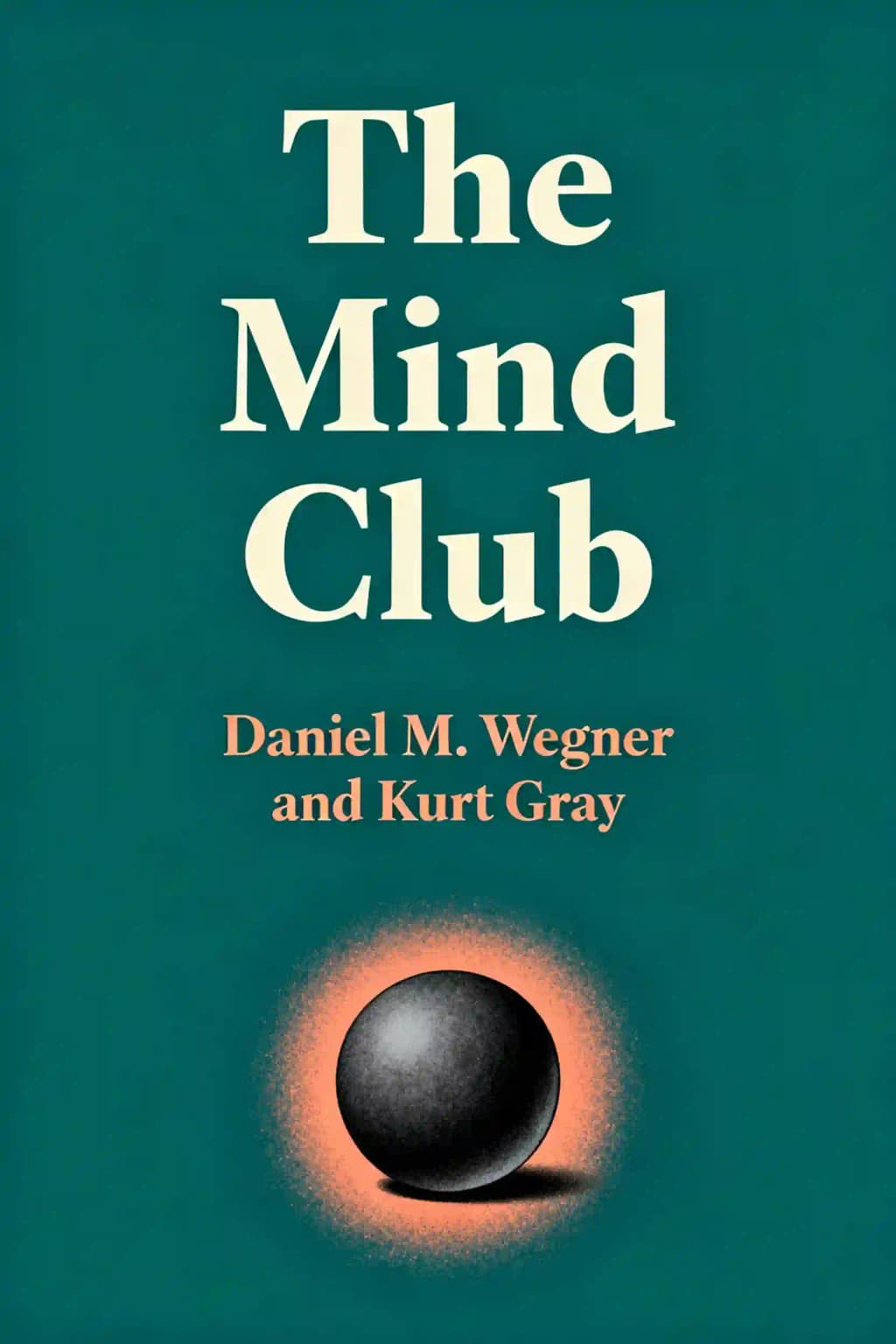
Explore how we decide who belongs to "The Mind Club" - entities with thoughts and feelings. Praised by Steven Pinker as "genuinely novel," this book reveals why we love some animals but eat others, challenging your perception of consciousness in everything from corporations to comatose patients.
Daniel M. Wegner (1948–2013) and Kurt Gray, award-winning psychologists and authors of The Mind Club: Who Thinks, What Feels, and Why It Matters, blend cutting-edge cognitive science with philosophical inquiry to examine how humans perceive minds in entities ranging from animals to AI.
Wegner, the late John Lindsley Professor of Psychology at Harvard University, pioneered research on conscious will and mind perception, while Gray leads the Mind Perception and Morality Lab at the University of North Carolina, Chapel Hill, focusing on the intersection of psychology and ethics. Their collaboration merges Wegner’s foundational work on human cognition (including The Illusion of Conscious Will) with Gray’s studies on moral judgment.
Praised by The Wall Street Journal as “compelling” and “beautifully written,” The Mind Club distills decades of research into accessible insights, earning recognition from thought leaders like Daniel Gilbert and appearances in major media. Wegner’s legacy as a Harvard visionary and Gray’s innovative lab leadership cement their authority in debates about consciousness, empathy, and artificial intelligence.
The Mind Club explores how humans perceive minds in others—from animals and robots to comatose patients and deities. It argues that mind perception hinges on two traits: agency (ability to act) and experience (capacity to feel). The book examines how these perceptions shape moral judgments, social interactions, and even legal rights.
This book is ideal for psychology enthusiasts, ethicists, and anyone curious about human behavior. It’s particularly relevant for those interested in AI ethics, animal rights, or the philosophy of consciousness. Readers will gain insights into why we humanize pets, distrust corporations, or attribute intentions to gods.
Yes—it combines rigorous research with engaging anecdotes, offering fresh perspectives on timeless questions. The authors, award-winning psychologists, use studies on moral dyads and mind perception to explain why we dehumanize enemies or empathize with fictional characters.
Daniel M. Wegner and Kurt Gray were pioneering psychologists specializing in social cognition. Wegner (known for work on ironic process theory) and Gray (expert in moral psychology) collaborated to decode how humans attribute minds to others. Their work has influenced fields from AI to criminal justice.
Dyadic completion describes how moral acts require pairing a moral agent (someone acting) with a moral patient (someone affected). For example, harm needs both a perpetrator and a victim. This framework explains why we instinctively seek blame or credit in every situation.
The book posits that we grant animals minds based on their perceived experience (ability to feel pain) rather than agency (planning skills). Dogs, seen as high in experience, earn empathy, while cows—often viewed as low in both traits—become “edible”.
Humans often ascribe minds to AI based on its agency (e.g., solving problems) but rarely grant it experience (e.g., emotions). This imbalance leads to paradoxical attitudes—trusting robots with tasks but denying them rights—and reflects broader debates about machine consciousness.
Dehumanizing enemies involves stripping them of experience, framing them as unfeeling threats. For example, soldiers might view opponents as “mindless” to justify violence. Conversely, humanizing others amplifies empathy, as seen in peace-building efforts.
Some argue the agency-experience model oversimplifies mind perception. Critics note cultural differences in attributing minds (e.g., animist societies) or question whether moral judgments always depend on dyadic pairs.
Corporations are often seen as high in agency (strategic planning) but lacking experience (emotions), making them liable for actions but unworthy of compassion. This explains public outrage over unethical practices without demands for corporate “empathy”.
“Minds are like eyewitnesses—their testimony is compelling but not always reliable.” This highlights how subjective mind perception shapes reality, from courtroom verdicts to everyday interactions.
As AI gains agency (e.g., self-driving cars), debates about its rights and responsibilities mirror historical struggles over slavery or animal welfare. The book’s framework helps navigate questions like: Should sentient AI be considered moral patients?
저자의 목소리로 책을 느껴보세요
지식을 흥미롭고 예시가 풍부한 인사이트로 전환
핵심 아이디어를 빠르게 캡처하여 신속하게 학습
재미있고 매력적인 방식으로 책을 즐기세요
Animals don't just think-they feel deeply too.
Entities with agency deserve blame.
Experience is what minds feel from inside.
Nothing seems more real than other minds.
The Mind Club의 핵심 아이디어를 이해하기 쉬운 포인트로 분해하여 혁신적인 팀이 어떻게 창조하고, 협력하고, 성장하는지 이해합니다.
The Mind Club을 빠른 기억 단서로 압축하여 솔직함, 팀워크, 창의적 회복력의 핵심 원칙을 강조합니다.

생생한 스토리텔링을 통해 The Mind Club을 경험하고, 혁신 교훈을 기억에 남고 적용할 수 있는 순간으로 바꿉니다.
무엇이든 물어보고, 목소리를 선택하고, 진정으로 공감되는 인사이트를 함께 만들어보세요.

샌프란시스코에서 컬럼비아 대학교 동문들이 만들었습니다
"Instead of endless scrolling, I just hit play on BeFreed. It saves me so much time."
"I never knew where to start with nonfiction—BeFreed’s book lists turned into podcasts gave me a clear path."
"Perfect balance between learning and entertainment. Finished ‘Thinking, Fast and Slow’ on my commute this week."
"Crazy how much I learned while walking the dog. BeFreed = small habits → big gains."
"Reading used to feel like a chore. Now it’s just part of my lifestyle."
"Feels effortless compared to reading. I’ve finished 6 books this month already."
"BeFreed turned my guilty doomscrolling into something that feels productive and inspiring."
"BeFreed turned my commute into learning time. 20-min podcasts are perfect for finishing books I never had time for."
"BeFreed replaced my podcast queue. Imagine Spotify for books — that’s it. 🙌"
"It is great for me to learn something from the book without reading it."
"The themed book list podcasts help me connect ideas across authors—like a guided audio journey."
"Makes me feel smarter every time before going to work"
샌프란시스코에서 컬럼비아 대학교 동문들이 만들었습니다

The Mind Club 요약을 무료 PDF 또는 EPUB으로 받으세요. 인쇄하거나 오프라인에서 언제든 읽을 수 있습니다.
Think about the last time you apologized to your car after hitting a pothole. Or felt guilty shutting down your laptop mid-update. These small moments reveal something profound: we're constantly deciding who-or what-gets to join the most exclusive club in existence. Not a country club or secret society, but something far more consequential: the club of minds. This invisible membership determines everything. It's why we mourn pets but eat pork, why we prosecute corporations but can't put them in jail, why a CEO punching a child feels monstrous while a child punching a CEO seems almost funny. The stakes couldn't be higher-throughout history, denying someone's mind has justified slavery, genocide, and unspeakable cruelty. Yet we rarely examine how we decide who gets in. Here's the unsettling truth: minds aren't objective facts we discover. They're perceptions we grant or withhold based on subtle cues. And understanding this changes everything about how we see the world.