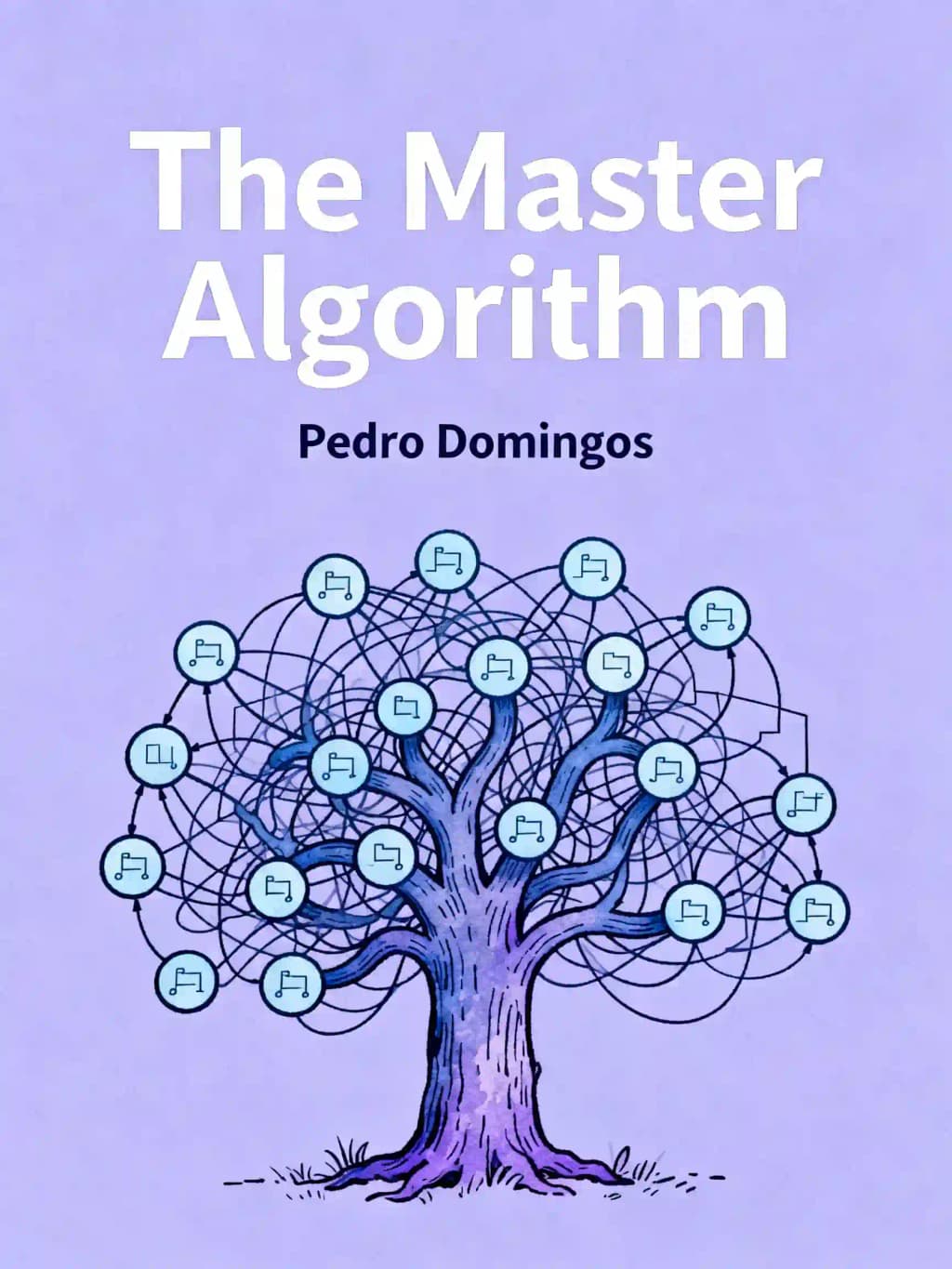
The ultimate AI quest: Pedro Domingos reveals how one master algorithm could extract all knowledge. Facebook AI director Yann LeCun endorses this vision of machines reshaping medicine, biotechnology, and society. Will this unified learning approach truly end poverty and enhance happiness?
Pedro Domingos, author of The Master Algorithm: How the Quest for the Ultimate Learning Machine Will Remake Our World, is a leading AI researcher and professor emeritus of computer science at the University of Washington. A pioneer in machine learning, he blends academic rigor with real-world impact—his work on Markov logic networks and adversarial learning has shaped modern AI frameworks.
The book, a global bestseller exploring the unifying principles of machine learning, reflects his decades of research and vision for AI’s transformative potential.
Domingos’ authority extends beyond academia: he’s been featured on CNN, PBS, and The New York Times, and his insights reach millions through keynote speeches and platforms like the Farnam Street podcast. A recipient of the SIGKDD Innovation Award and AAAI Fellowship, he bridges theory and practice, advising tech leaders while authoring over 200 publications. His follow-up book 2040 examines AI’s societal implications. The Master Algorithm has sold over 350,000 copies worldwide and earned praise from Bill Gates as essential reading for understanding AI’s future.
The Master Algorithm explores the quest for a universal machine learning formula capable of deriving all knowledge from data. Pedro Domingos outlines five foundational approaches—symbolists, connectionists, evolutionaries, Bayesians, and analogizers—and argues their unification could revolutionize fields from healthcare to AI. The book blends technical insights with accessible explanations of how algorithms shape modern technology.
This book suits AI enthusiasts, data scientists, and general readers curious about machine learning’s societal impact. Domingos avoids heavy math, making it ideal for non-experts seeking to understand algorithms’ role in smartphones, recommendation systems, and medical research. Professionals in tech or policy will value its vision for AI’s future.
Yes—it’s a seminal primer on machine learning’s potential to transform industries. Domingos distills complex concepts into relatable metaphors (e.g., “learning algorithms are seeds, data is soil”) and sparks critical debates about AI ethics. While some critics question the feasibility of a single master algorithm, the book remains influential in AI discourse.
Domingos identifies five schools:
The Master Algorithm is a hypothetical, all-encompassing learning system that could extract past, present, and future knowledge from data. Domingos posits it would unify probabilistic reasoning, neural networks, evolutionary principles, and more, enabling breakthroughs in personalized medicine, AI ethics, and automation.
The book highlights ML’s role in powering smartphones, election campaigns, and streaming recommendations. Domingos envisions broader applications, like curing diseases through personalized treatment models and addressing climate change via predictive systems. He also warns of ethical risks, such as biased algorithms.
Markov logic networks (MLNs), co-developed by Domingos, unify logical rules with probabilistic models to handle uncertain real-world data. This framework allows machines to reason flexibly, balancing hard rules (e.g., “smoking causes cancer”) with statistical patterns—a step toward the Master Algorithm.
Some researchers argue a single universal algorithm is impractical due to computational limits and domain-specific challenges. Others note the book understates ethical risks like job displacement or surveillance. Despite this, it’s praised for making ML accessible and sparking interdisciplinary dialogue.
Unlike niche technical manuals, Domingos’ work focuses on a unifying theory for AI, akin to physics’ “theory of everything.” It’s less hands-on than Hands-On Machine Learning but more visionary than Superintelligence, positioning it as a bridge between academic and popular science.
As AI advances toward general intelligence, Domingos’ framework helps contextualize tools like ChatGPT and AlphaFold. The book’s emphasis on ethical, unified learning systems aligns with 2025 debates about AI regulation and existential risks, keeping it a reference for policymakers and technologists.
The “complexity monster” refers to the challenge of managing intricate systems where small changes cascade unpredictably. Domingos argues machine learning tames this monster by automating pattern discovery, enabling robust solutions in chaotic domains like genomics or climate modeling.
저자의 목소리로 책을 느껴보세요
지식을 흥미롭고 예시가 풍부한 인사이트로 전환
핵심 아이디어를 빠르게 캡처하여 신속하게 학습
재미있고 매력적인 방식으로 책을 즐기세요
Learning algorithms are artifacts that design other artifacts.
Data becomes the strategic asset.
It's 'spears against machine guns.'
Could a single algorithm learn everything learnable from data?
The Master Algorithm would be universal for induction.
Master Algorithm의 핵심 아이디어를 이해하기 쉬운 포인트로 분해하여 혁신적인 팀이 어떻게 창조하고, 협력하고, 성장하는지 이해합니다.
Master Algorithm을 빠른 기억 단서로 압축하여 솔직함, 팀워크, 창의적 회복력의 핵심 원칙을 강조합니다.

생생한 스토리텔링을 통해 Master Algorithm을 경험하고, 혁신 교훈을 기억에 남고 적용할 수 있는 순간으로 바꿉니다.
무엇이든 물어보고, 목소리를 선택하고, 진정으로 공감되는 인사이트를 함께 만들어보세요.

샌프란시스코에서 컬럼비아 대학교 동문들이 만들었습니다
"Instead of endless scrolling, I just hit play on BeFreed. It saves me so much time."
"I never knew where to start with nonfiction—BeFreed’s book lists turned into podcasts gave me a clear path."
"Perfect balance between learning and entertainment. Finished ‘Thinking, Fast and Slow’ on my commute this week."
"Crazy how much I learned while walking the dog. BeFreed = small habits → big gains."
"Reading used to feel like a chore. Now it’s just part of my lifestyle."
"Feels effortless compared to reading. I’ve finished 6 books this month already."
"BeFreed turned my guilty doomscrolling into something that feels productive and inspiring."
"BeFreed turned my commute into learning time. 20-min podcasts are perfect for finishing books I never had time for."
"BeFreed replaced my podcast queue. Imagine Spotify for books — that’s it. 🙌"
"It is great for me to learn something from the book without reading it."
"The themed book list podcasts help me connect ideas across authors—like a guided audio journey."
"Makes me feel smarter every time before going to work"
샌프란시스코에서 컬럼비아 대학교 동문들이 만들었습니다

Master Algorithm 요약을 무료 PDF 또는 EPUB으로 받으세요. 인쇄하거나 오프라인에서 언제든 읽을 수 있습니다.
Why does your phone seem to know what you're thinking? That uncanny moment when Netflix suggests exactly what you want to watch, or when your email filter catches spam you haven't even seen yet-these aren't accidents. They're glimpses of a transformation reshaping civilization itself. Machine learning algorithms now orchestrate vast swaths of modern existence, yet most people have no idea how they work or what they're capable of becoming. What if all these different learning systems-the ones recognizing your face, recommending your music, predicting your purchases-were actually fragments of something larger? What if a single algorithm could learn anything learnable from data?