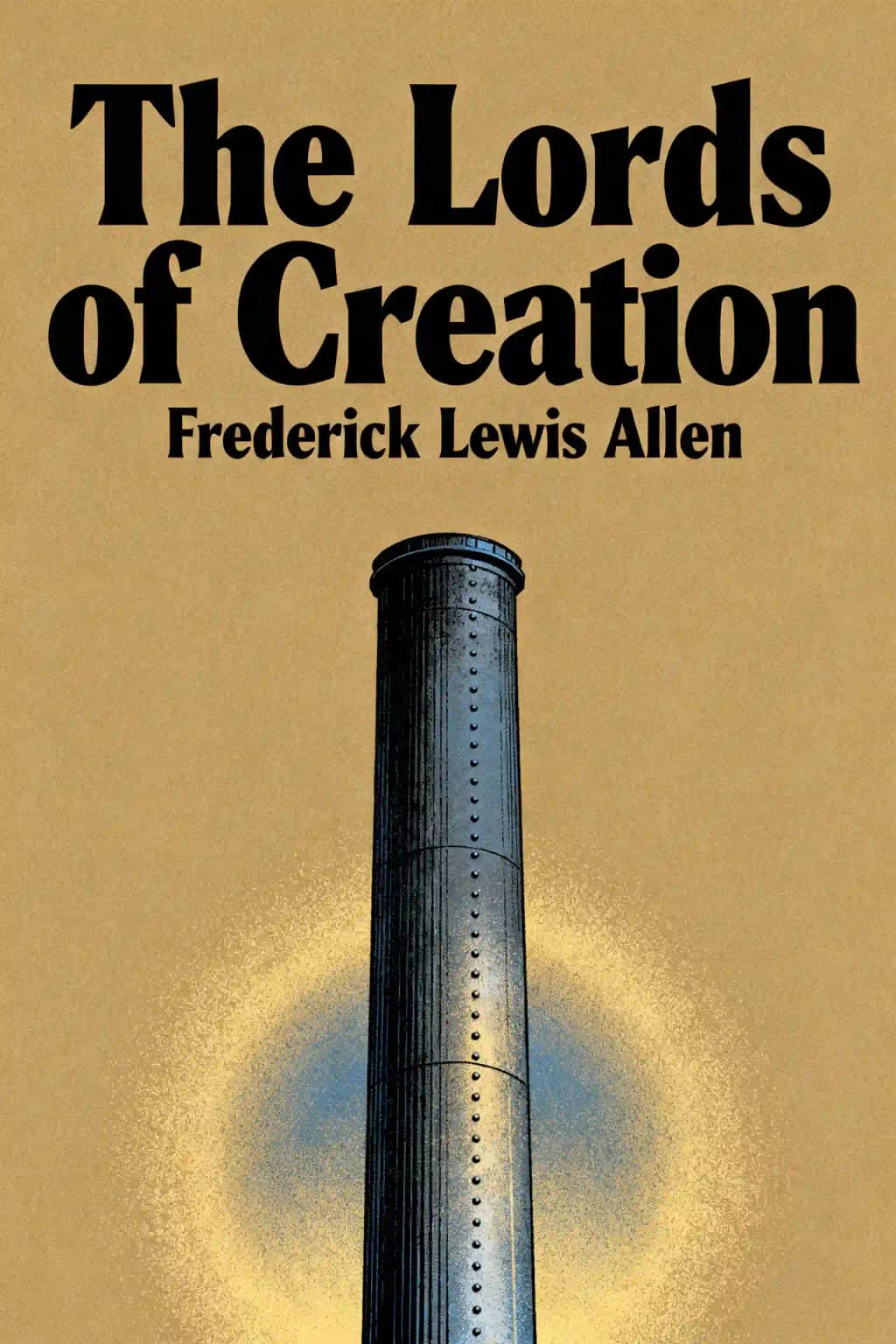
Written during the Great Depression, "The Lords of Creation" exposes how America's elite built financial empires that crashed in 1929. Allen's prescient analysis of wealth inequality still resonates today - a chilling reminder that history's economic cycles keep repeating.
Frederick Lewis Allen (1890–1954), author of The Lords of Creation, was a pioneering popular historian and longtime editor-in-chief of Harper’s Magazine.
Known for blending rigorous research with engaging storytelling, Allen specialized in chronicling America’s social and economic transformations. His 1935 work The Lords of Creation explores the rise of industrial titans and financial empires, reflecting his career-long focus on power dynamics in modern capitalism.
A Harvard-educated scholar and cultural commentator, Allen solidified his reputation with bestselling decade studies like Only Yesterday (1920s) and Since Yesterday (1930s), which remain seminal works of accessible historiography. As Harper’s leader from 1941 until his death, he shaped national discourse while maintaining his parallel career as a historian.
Allen’s books sold millions of copies, with Only Yesterday spending months on The New York Times bestseller list and becoming required reading in universities. His legacy as a bridge between academic history and public understanding was further cemented through his role as a Harvard overseer and trustee of Bennington College.
The Lords of Creation examines the rise of America’s financial elite in the early 20th century, focusing on industrialists like J.P. Morgan and their transformative impact on capitalism. Allen critiques their unchecked power, arguing that profit-driven decisions often neglected public welfare. The book blends economic history with social commentary, illustrating how concentrated wealth shaped modern corporate structures.
This book suits readers interested in Gilded Age economics, corporate history, or critiques of wealth inequality. Historians, economics students, and general audiences seeking insights into early 20th-century capitalism will find it accessible. Allen’s engaging prose makes complex financial maneuvers understandable, appealing to both academic and casual readers.
Yes—Allen’s analysis remains relevant for understanding modern wealth disparities and corporate influence. His vivid storytelling demystifies high finance, offering timeless lessons about power dynamics. Fans of The Big Change or Only Yesterday will appreciate his cohesive historical narrative.
Allen argues that early 20th-century financiers wielded disproportionate power, prioritizing profits over societal well-being. He highlights their role in creating monopolies and influencing policy, often bypassing democratic checks. The book warns against unchecked corporate influence, advocating for balanced economic governance.
“Though there was much sheer rascality in the Wall Street of the nineteen-twenties… a widespread betrayal of the fiduciary principle.”
This quote underscores Allen’s critique of Wall Street’s ethical failures and their systemic risks.
Unlike Only Yesterday (1920s social history) or The Big Change (broader 1900–1950 analysis), Lords zeroes in on financial elites. It shares Allen’s signature accessible style but offers a sharper critique of capitalism’s excesses.
Some modern scholars argue Allen overlooks labor movements and systemic racism’s economic role. His focus on “great men” may oversimplify complex historical forces, though this approach was common in mid-20th-century historiography.
Its themes—corporate overreach, wealth inequality, and regulatory challenges—mirror modern debates about Big Tech and Wall Street. Allen’s warnings about unchecked power resonate in an era of globalization and monopolistic practices.
It refers to financiers and industrialists who reshaped America’s economy through mergers, stock market manipulation, and political lobbying. Allen uses it ironically to critique their self-appointed role as societal architects.
As Harper’s editor-in-chief, Allen mastered distilling complex ideas into engaging prose. His magazine experience shines in the book’s clear structure and anecdotal style, making dense financial history accessible to lay readers.
저자의 목소리로 책을 느껴보세요
지식을 흥미롭고 예시가 풍부한 인사이트로 전환
핵심 아이디어를 빠르게 캡처하여 신속하게 학습
재미있고 매력적인 방식으로 책을 즐기세요
Free competition often led to destructive outcomes.
Carnegie prepared for war.
Wall Street plunged into chaos.
Half the brokerage firms were technically bankrupt.
Change the course of American economic history.
Lords of Creation의 핵심 아이디어를 이해하기 쉬운 포인트로 분해하여 혁신적인 팀이 어떻게 창조하고, 협력하고, 성장하는지 이해합니다.
Lords of Creation을 빠른 기억 단서로 압축하여 솔직함, 팀워크, 창의적 회복력의 핵심 원칙을 강조합니다.

생생한 스토리텔링을 통해 Lords of Creation을 경험하고, 혁신 교훈을 기억에 남고 적용할 수 있는 순간으로 바꿉니다.
무엇이든 물어보고, 목소리를 선택하고, 진정으로 공감되는 인사이트를 함께 만들어보세요.

샌프란시스코에서 컬럼비아 대학교 동문들이 만들었습니다
"Instead of endless scrolling, I just hit play on BeFreed. It saves me so much time."
"I never knew where to start with nonfiction—BeFreed’s book lists turned into podcasts gave me a clear path."
"Perfect balance between learning and entertainment. Finished ‘Thinking, Fast and Slow’ on my commute this week."
"Crazy how much I learned while walking the dog. BeFreed = small habits → big gains."
"Reading used to feel like a chore. Now it’s just part of my lifestyle."
"Feels effortless compared to reading. I’ve finished 6 books this month already."
"BeFreed turned my guilty doomscrolling into something that feels productive and inspiring."
"BeFreed turned my commute into learning time. 20-min podcasts are perfect for finishing books I never had time for."
"BeFreed replaced my podcast queue. Imagine Spotify for books — that’s it. 🙌"
"It is great for me to learn something from the book without reading it."
"The themed book list podcasts help me connect ideas across authors—like a guided audio journey."
"Makes me feel smarter every time before going to work"
샌프란시스코에서 컬럼비아 대학교 동문들이 만들었습니다

Lords of Creation 요약을 무료 PDF 또는 EPUB으로 받으세요. 인쇄하거나 오프라인에서 언제든 읽을 수 있습니다.
A private dinner in December 1900 changed everything. At New York's University Club, J.P. Morgan sat beside Charles Schwab, listening as the young steel executive painted a vision so compelling that Morgan decided to create U.S. Steel-a corporation that would reshape American economic life for decades. This wasn't just another business deal. It marked the beginning of an extraordinary era when a handful of men wielded more power than most governments, when financial empires rose and fell with dizzying speed, and when the very nature of American capitalism transformed beyond recognition. The timing was perfect: prosperity had returned after the 1893 depression, McKinley's business-friendly administration provided stability, and America stood poised to enter a new century of unprecedented wealth concentration.