1장
Capitalism's Broken Promise: How We Can Fix It
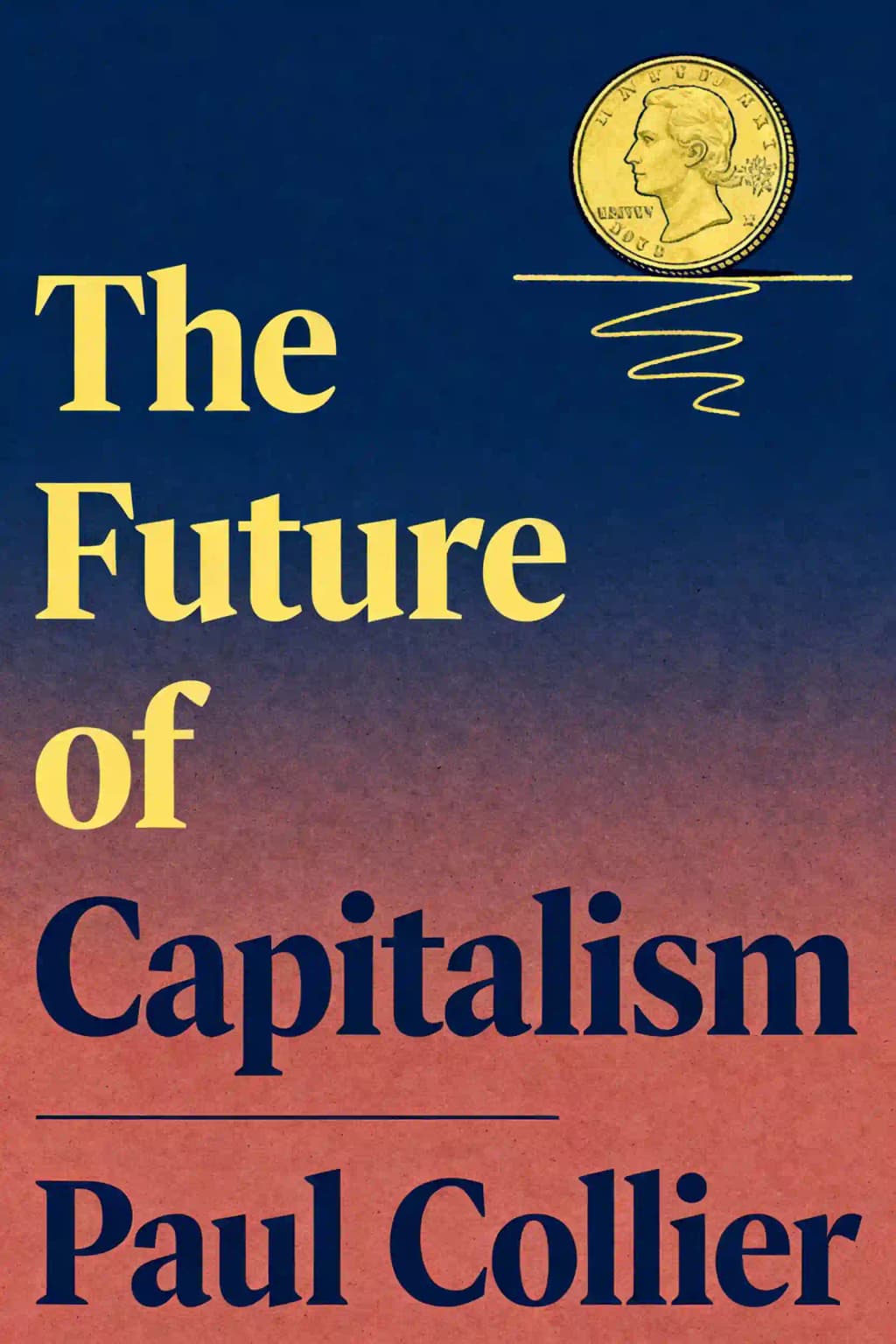
The Future of Capitalism isn't just another economics book-it's a deeply personal manifesto from someone who has lived the divides tearing our society apart. Paul Collier, the Oxford economist whose groundbreaking work on global poverty earned him a knighthood, now turns his analytical lens to the crisis in Western democracies. Named one of The Economist's Books of the Year and praised by both conservatives and progressives, this work arrives at a crucial moment when faith in capitalism is wavering. What makes this book particularly compelling is Collier's unique position-raised in a working-class Sheffield family, he witnessed firsthand how deindustrialization devastated his hometown while he ascended to academic success. Unlike many commentators who speak from ivory towers, Collier bridges worlds, offering pragmatic solutions that reject both ideological extremism and populist simplification. With over 100,000 copies sold and translations in 15 languages, the book has resonated deeply with readers seeking a thoughtful path forward in our increasingly divided world.
2장
The New Anxieties Tearing Society Apart
Deep rifts are tearing apart our societies, bringing new anxieties and anger to our politics. These divisions are geographic (booming metropolises versus declining provincial cities), educational (less educated rebelling against more educated), and moral (workers versus those seen as "scroungers").
Capitalism's promise of rising living standards has failed many-half of Americans born in the 1980s are worse off than their parents. Metropolitan areas surge ahead while provincial regions decline. Within cities, gains are heavily skewed toward the well-educated, who have formed a new class with distinct identity and morality. Meanwhile, less-educated workers face crisis as globalization and technology eliminate jobs, particularly affecting older workers and youth. Family breakdown, substance abuse, and declining life expectancy plague these communities.
This failure has fueled political mutinies across Western democracies. The vacuum created by these anxieties has empowered two types of politicians: ideologues offering simplistic moral certainties and populist celebrities providing entertaining distractions. Neither can address these complex societal rifts.
I've personally lived each of these grim divides. Geographically, I witnessed my hometown Sheffield collapse as a steel city while I moved to prosperous Oxford. Educationally, my cousin and I started with similar backgrounds, but while her life derailed into teenage motherhood after her father's death, I progressed through Oxford to academic success. Globally, I've experienced the stark contrast between comfortable living in Western nations and the desperate poverty of Africa where I work.
What went wrong? Social democracy-which once harnessed community bonds to address industrial anxieties-now faces existential crisis. Both left and right drifted from their origins in practical community reciprocity, becoming captured instead by middle-class intellectuals. The left embraced Utilitarianism, which detached morality from instinctive values and justified rule by technocrats. Meanwhile, the right either ossified into nostalgia or embraced libertarian philosophy.
We need a reset-a pragmatic approach grounded in moral values but rejecting ideology. I propose "social maternalism"-an active state that doesn't overtly empower itself. Welcome to the hard center and the future of ethical capitalism.
3장
The Foundations of Morality: From Selfish Gene to Ethical Group
Modern capitalism has the potential for unprecedented prosperity but is morally bankrupt. While market-based competition delivers prosperity, economic theory assumes people are lazy and self-interested, yet purposive work is crucial for esteem and belonging depends on mutual regard.
Adam Smith did not think we are merely "economic man." In The Theory of Moral Sentiments, he saw people as morally motivated within society. We predict others' actions by putting ourselves in their shoes-the "theory of mind"-which enables understanding and induces care. Morality stems from our sentiments, not reason.
Smith identified three intensities of obligation: strongest from intimacy (children, kin), weakest toward distant people (duty of rescue), and middle obligations based on reciprocity. People are better described as "social man" who cares about esteem rather than just consumption.
Research confirms that "oughts" matter more than "wants"-our deepest regrets are about letting others down, not missed opportunities for gain. Our capacity to reason evolved primarily for persuading others, not improving our decisions. The massive brain expansion of the past two million years was driven by sociality, not individual rationality.
Though natural selection might seem to favor selfishness, humans could only survive by cooperating in groups. The truly selfish were banished, as evolution selected for those craving belonging and esteem alongside material needs. Through narratives, we develop our sense of belonging long before we develop reason. Children acquire family and even national identity by age eleven, while reasoning capacity develops around fourteen.
Modern life depends on three types of organizations: families (86% of Europeans share households), firms (94% of Americans work in groups), and states (all prosperous societies have them). Leaders strategically use narratives to create moral norms and obligations, turning raw power into authority.
Johnson & Johnson exemplifies this approach. Their 1943 "Our Credo" prioritized product users above shareholders. When Tylenol was poisoned in 1982, local managers immediately pulled products from shelves-an unprecedented $100 million decision-because they internalized the credo's values. This moral action proved good business as the company quickly recovered market share.
We are social beings with six common values-care, liberty, loyalty, sanctity, fairness and hierarchy-none generated by reason alone. From this limited set, we generate virtually unlimited obligations through belief systems crafted by narratives. This matters for our societal choices. Ideologies sever morality from common values by privileging one value over others, while populists embrace values but discard centuries of social learning.
The collapse of social trust, especially among American youth (down 40%), indicates capitalism is delivering aggression, humiliation and fear instead of prosperity-a "Rottweiler society." Rebuilding mutual regard requires context and evidence-based reasoning.
4장
The Ethical State: Rise and Fall
States that combine ethical purpose with good ideas have achieved remarkable results. Between 1945 and 1970, states purposefully harnessed capitalism for society's benefit, creating unprecedented prosperity. This contrasted sharply with the 1930s, when states lacked both ethical purpose and practical ideas to address mass unemployment.
The ethical state flourished in the first two post-war decades, creating unprecedented reciprocal obligations administered by government. From pregnancy healthcare to old-age pensions, state-run national insurance enabled citizens to protect each other-the essence of communitarian social democracy. This approach spanned the political center, with remarkable bipartisanship in America, Germany's "social market economy," and Britain's National Health Service.
Underpinning social democracy's success was the Second World War's legacy-not just an economic stimulus but an immense common endeavor where leaders crafted narratives of belonging and mutual obligation. Citizens readily complied with high income taxes, military conscription, and social restraints that enabled massive expansion of the state.
However, the ethical state gradually morphed into the paternalist state as Utilitarian and Rawlsian vanguards took control. The collapse of social democracy resulted from eroding mutual obligation colliding with greater economic complexity. As economies grew more specialized, requiring highly educated workers, a societal split emerged. The educated elite increasingly identified with their professions rather than nationality, while less-skilled workers maintained national identity as their primary source of esteem.
This identity divergence undermined social cohesion and trust. The skilled actively signaled their separation by denigrating national identity, while those left behind felt marginalized. Without shared identity, the fortunate felt diminished responsibility toward the less fortunate, and opportunistic behavior increased.
Modern societies face a fundamental contradiction: our polities are inevitably spatial and predominantly national, while our identities and social networks are becoming less so. Smart phones represent extreme individualism, as people withdraw from face-to-face interaction into digital echo-chambers and anxious narcissism. Unless this divergence between our polities and social bonds is reversed, societies will become less generous, trusting and cooperative.
The answer to creating viable, inclusive identity lies in a sense of belonging to place. People have a fundamental need to belong, answering "who?" by identifying with a group and "where?" by identifying with home. Place-based identity is deeply hardwired by evolution-the instinct to defend territory has roots going back 4 million years.
President Macron has pioneered distinguishing patriotism (belonging to common territory) from nationalism. Surveys show "patriotism" resonates positively across age groups and political divides, associated with being "attractive," "inspiring," and "appealing to the heart." Unlike nationalism's zero-sum approach, patriotism promotes cooperation for mutual benefit while still protecting national interests.
5장
The Ethical Firm: Purpose Beyond Profit
In Britain, Imperial Chemical Industries was once the most respected company with a mission "to be the finest chemical company in the world." When it changed to "maximize shareholder value" in the 1990s following Milton Friedman's philosophy, the company declined and was eventually taken over. The public overwhelmingly rejects this profit-obsession three-to-one across all demographics.
Great firms don't behave like "vampire squids." Most employees at companies like Unilever, Ford or Nestle would describe their purpose as providing valuable products or services rather than simply making money for owners. Conversely, investment bank Bear Stearns proudly displayed its mission: "we make nothing but money." This philosophy evolved into employees making money for themselves through transactions that earned bonuses while exposing the company to hidden risks-ultimately bankrupting the firm and triggering the 2008-9 financial crisis.
The power of control in companies has become lodged with the wrong people. While capitalism assigns ownership to risk capital providers, many others bear significant risks when firms fail-especially long-term workers with company-specific skills and homeowners in company towns. Modern supply chains spread bankruptcy impacts globally, as seen when Lehman Brothers collapsed. Meanwhile, shareholders like pension funds face minimal personal risk.
Britain has become the "guinea-pig" for Friedman's economic ideology, with 80% of shares held by pension funds and insurance companies that make decisions via algorithms rather than direct company knowledge. This leads to short CEO tenures (typically four years) and compensation tied to short-term performance. CEO pay has skyrocketed-from 30 to 150 times worker pay in Britain and 20 to 231 times in America-despite no overall improvement in company performance.
CEOs desperate to drive up quarterly profits before their stock options kick in face three options: build trusting relationships (effective but slow), cut investment (since "fat" has already been trimmed), or manipulate accounting. The consequences are evident in corporate America and Britain where publicly traded companies invest at just 2.7% compared to 9% for privately held firms.
The problems of modern capitalism aren't inevitable but result from fixable policy mistakes. Anglo-Saxon law requiring directors to prioritize shareholder interests isn't intrinsic to capitalism but arose when raising finance was the binding constraint. Today, the largest undiversified risks are borne by long-serving employees and dependent customers, yet they lack board representation.
The John Lewis Partnership demonstrates a successful alternative-owned by a trust run for workers' benefit, with profits shared equally (same percentage for CEO and shop assistants), and workers electing 80% of the governing council.
Since both regulation and public ownership have severe limitations, three alternative approaches deserve consideration: differential corporate tax rates based on company size; public interest representation on corporate boards; and engaged citizens serving as guardians of corporate behavior. Government must re-establish credibility through signaling-taking costly actions that demonstrate commitment. Creating a crime of "bankslaughter" would show spine by holding executives accountable for reckless decisions even after retirement.
6장
The Ethical Family: Diverging Paths and Their Consequences
The family is humanity's most powerful collective entity, binding people through reciprocal obligations between spouses and across generations. By 1945, the "ethical family" was nearly universal across Western societies, with married couples accepting mutual obligations to both children and parents. Yet over subsequent decades, profound technological and intellectual shocks destabilized this system, creating divergent family structures between educated and less-educated classes.
The birth control pill revolutionized family formation by separating sex from conception, allowing better partner selection through cohabitation before marriage. This technological shock was followed by an intellectual revolution that replaced family obligations with self-fulfillment through personal achievement. Feminism for women and Playboy for men reframed temptations as moments of self-realization.
Among the educated, gender hierarchy gave way to mutual parental "hothousing"-intensively preparing children for competitive university admissions. Though the initial divorce epidemic eventually subsided, it permanently altered social norms. The educated class ultimately developed a new "dynastic family" structure with fewer extramarital births and divorces.
Meanwhile, the economic shock of manufacturing decline devastated less-educated households still following traditional family models. When husbands lost their breadwinner status, marriages became asymmetric-wives maintained esteem while husbands lost theirs, leading to depression, domestic violence, and ultimately divorce. Unlike among the educated, divorce rates among the less educated kept rising, reaching one-in-three marriages by 2010.
The selective breakdown in family obligations has profoundly affected children, particularly in America where over half will spend time in single-parent households before eighteen. This trend is highly class-selective: among educated households, family obligations have been restored and enhanced, while among less-educated households, single-parent or no-parent children have become the norm.
Social science has now demonstrated causally that children fare better when raised by two genetic parents from birth to adulthood. The divergence between classes is stark: educated parents practice "hothousing" with intensive, purposive interaction, while single, poor parents prioritize containing chaos over development. By kindergarten, children of professionals hear eight times more encouraging words than discouraging ones, while welfare children hear twice as many discouraging as encouraging words.
While some aspects of the traditional ethical family were stultifying or abusive, the "liberation" from family obligations often masked selfishness as self-discovery. The triumph of individual fulfillment over family obligations is increasingly revealed as psychologically flawed. David Brooks suggests in "The Road to Character" that future trends will restore fulfillment through meeting obligations to others. Social psychology research confirms this: "If you want well-being, you will not get it if you only care about accomplishment... Close personal relationships are central."
7장
The Ethical World: From Clubs to Duties of Rescue
What would an ethical world look like? Rather than following utilitarian ideologies demanding paternalist global government, Rawlsian lawyers asserting human rights, or celebrity populists calling for "global peace," we can apply our core precepts to conceive an ethical world analogous to ethical states, firms and families.
The leaders of 1945 transformed a world devastated by war, economic collapse, crumbling empires and totalitarian ideologies by replacing opportunistic national behavior with common obligations enforced by peer pressure. They created purpose-specific clubs with defined memberships and reciprocal obligations: NATO for security against Soviet threats, the EEC to address European fears of Germany, GATT to unwind protectionism, and the IMF as a mutual insurance system against economic crises.
Alongside these clubs, they built organizations to meet duties of rescue: the UNHCR for refugees, World Food Programme for famines, WHO for health in poor countries, and the World Bank to channel finance from affluent to poorer nations. These unprecedented collective responses delivered spectacular results, from NATO's success in the Cold War to the IMF's rescue of Britain in 1976.
As pragmatism gave way to ideology, the effective clubs expanded both their membership and aspirations. As groups expanded, the glue enforcing reciprocal obligations weakened, leading organizations to either become ineffective or transform into quasi-empires run by an inner core imposing rules on subject members.
Rather than reviving old clubs, we might form a new multipurpose club reflecting current economic and military realities. A smaller group of China, India, USA, EU, Russia and Japan would encompass enough global economic and military capacity to address collective problems even if non-members free-ride.
Our duty of rescue to refugees must be guided by both heart and head. The 65 million displaced people worldwide need familiar living conditions, jobs, and community. While neighboring countries should provide haven due to proximity and similarity, affluent societies have comparative advantages: they possess international firms that can create jobs and the money to help refugees become self-sufficient.
Sometimes our obligations to citizens of other countries exceed those of their fellow citizens. HIV sufferers in poor countries represent such a case-with modern drugs costing under $1,000 annually, they can lead normal lives for years.
Many African youth currently see escape to Europe as their only hope-a tragic vision that's unviable as a solution to mass despair. In an ethical world, each society should offer credible hope to its youth. Our role isn't to tempt bright young people into marginal lives in affluent societies, but to bring opportunities to them at home.
8장
The Geographic Divide: Booming Metropolis, Broken Cities
Since 1980, metropolises like London and New York have surged ahead while provincial cities have suffered economic decline, creating a widening divide in incomes, jobs, and house prices. This has fueled political resentment, with metropolitan areas voting against populist insurgencies while broken cities embraced them.
Two fundamental relationships underlie the new divergence: productivity through specialization ("learning by doing") and productivity through scale ("economies of scale"). Cities enable both by clustering people together, but require enormous infrastructure investments. Until the 1980s, only European and North American cities could afford them, creating highly productive industrial clusters like Sheffield's steel industry.
Since then, knowledge explosion and globalization have disrupted this pattern, supercharging large cities while exposing established clusters to devastating competition. The knowledge economy has expanded exponentially through university research and corporate R&D. As our cleverest people become ever more specialized to master complexity, they need to cluster together to be productive. The metropolis provides this connectivity-London offers access to 2.5 million workers within 45 minutes, international airports, high-speed rail, and government proximity.
When a city's industry collapses, it doesn't simply get replaced with something new. Property prices crash, trapping homeowners with negative equity while making them unable to move to booming cities with expensive housing. The fallen property prices attract only low-productivity businesses-warehouses, struggling manufacturers relying on cheap premises, and call centers using casual labor.
The growing divide between thriving metropolises and declining provincial cities demands solutions beyond ideological prescriptions. Populists advocate protectionism to turn back the clock, but this is doomed. The wiser approach is taxing the metropolis to revive provincial cities.
Henry George, a nineteenth-century American journalist, made an ethical case for taxing the gains from agglomeration through urban land taxes. His insight: as cities grow, workers become more productive due to clustering, but landlords capture these productivity gains through rising rents. The crucial ethical question George posed: Do landlords deserve these gains? Since the productivity increases come from interactions between masses of people-a collective achievement benefiting everyone-landlords who may have been "lying on a beach" receive income simply because they owned land where people clustered.
Beyond ethics, there's a powerful efficiency argument for taxing agglomeration gains. These gains constitute "economic rents"-payments exceeding what would have induced someone to do something. Taxing such rents doesn't affect work decisions, making them ideal tax targets.
To practically tax agglomeration gains, we need to target both city landowners and skilled city workers. First, capture land and property value appreciation through annual charges based on property values, with revenues accruing nationally rather than locally. Second, implement a metropolitan supplement on higher income tax rates. The supplements would be progressively larger at higher income levels, reflecting the greater agglomeration benefits for the highly skilled.
The purpose of taxing metropolises isn't merely to provide welfare benefits to declining cities, but to finance their restoration as productive economic clusters. Once broken, market forces alone cannot regenerate these clusters-they instead fill with low-productivity activities. A successful cluster forms when many different companies, even competitors, locate together to benefit from common economies of scale.
9장
The Class Divide: Having it All, Falling Apart
The growing class divide reflects an avoidable divergence between families. Some families have it all-highly educated adults who marry similar partners, embrace egalitarian family norms, and intensively nurture their children, creating stable dynasties. Meanwhile, other families fall apart-adults with limited education whose skills have lost value, who have fewer marriage prospects due to assortative mating among the educated, where men cling to traditional breadwinner roles they can't fulfill, and where parents leave education entirely to schools.
Addressing the class divide must begin with strengthening struggling families. The dramatic increase in children raised without one or both biological parents causes often irreversible damage, requiring early intervention policies that both help families stay together and provide additional support.
Encouraging two-parent families shouldn't be viewed as socially conservative-it's a fundamental aspect of human society. Research shows most unmarried parents initially want to stay together, but five years after childbirth, only 35% remain a couple. The consequences are severe: children with mothers in unstable relationships suffer 40% shorter telomeres (protective DNA caps) by age nine-a health impact eight times greater than doubling family income could positively provide.
Social paternalism has failed by intervening only after problems become severe. Financial cushioning against unemployment shocks is crucial, as research shows each 1% rise in unemployment increases child neglect by 20%, particularly affecting young children. Extended families provide vital support, but have shrunk horizontally while expanding vertically through greater longevity-grandparents now play more significant roles with grandchildren.
Technology hasn't leveled the playing field as Silicon Valley hoped-research shows internet access has widened opportunity gaps, with educated families' children using it for knowledge while others use it for distraction. The most valuable school improvement would be greater social mixing, currently prevented by catchment areas that mirror residential stratification.
Teacher quality matters more than money. Four key improvements are: attracting better recruits, evidence-based training, assigning the best teachers to challenging settings, and removing underperforming teachers. The Teach First program successfully brought talented graduates into teaching but was wrongly concentrated in London rather than struggling provincial areas.
America and Britain excel at university education through competition and decentralized management, with eight of the world's top ten universities between them. However, they fail the majority who need technical vocational education and training (TVET). Germany's superior model pairs firms with colleges in specific industries, developing not just technical skills but also routine expertise, resourcefulness, craftsmanship, functional capabilities, businesslike attitudes, and adaptability.
The housing crisis has worsened as all four policies that once restrained house prices were reversed. Local government building programs stopped, immigration controls relaxed, buy-to-let regulations encouraged asset speculation, and mortgage lending restrictions lifted. Consequently, house prices jumped to 7.6 times average earnings. The educated class and investors outbid young families seeking homes, causing homeownership among young families to drop from over half to around a third.
10장
Breaking the Extremes: Restoring Inclusive Politics
Capitalism is generating divided societies where many lead anxious lives, yet it remains the only economic system proven capable of creating mass prosperity. Recent problems aren't intrinsic to capitalism but represent a malfunction that must be corrected. While pragmatic policies could gradually restore capitalism as they did after the Great Depression, our political systems have become as dysfunctional as our economies.
Democratic political systems have increasingly inclined toward polarization. Most voting systems favor the two largest parties, and the dangerous step has been empowering party members to elect leaders. Since ideologically-motivated people are most likely to join parties, this has tilted leadership selection toward ideologues. With social democracy proving vulnerable, polarizing ideologies of Marxism and Nativism have dominated, leaving pragmatic voters facing a menu selected by extremes.
To drive mainstream parties back to the center, two rule changes to leadership selection could help. The most straightforward is confining leadership selection to elected representatives, who have incentives to appeal to wider voter groups and are less easily deceived by celebrity tricks. Alternatively, proportional representation systems can constrain ideological implementation through coalitions that encourage evidence-based pragmatism.
Political system reforms may help, but politics can't exceed the societies it reflects. Ethical, pragmatic politics requires a critical mass of citizens demanding it. The book summarizes policies addressing new divergences and strategies for restoring ethics in organizations, focusing on pragmatic approaches that require further development but face political rather than technical impediments.
National politics requires shared identity to build reciprocal obligations. This identity can't be ethnic or based on common values, but must be defined by place and purpose. It's strengthened through collective endeavors, social integration, and supportive political narratives. With declining trust in political leaders, influence has shifted to social networks that have become echo chambers, fragmenting common discourse.
Nations remain the essential frame for public policy, and their foremost political function is enabling reciprocal obligations. Shared identity becomes the foundation for far-sighted reciprocity, creating societies that work better than those based on individualism or revivalist ideologies. This moral pragmatism can guide politics from polarization to cooperation, addressing our unmet duties of care while restoring reciprocal obligations from shared identities.