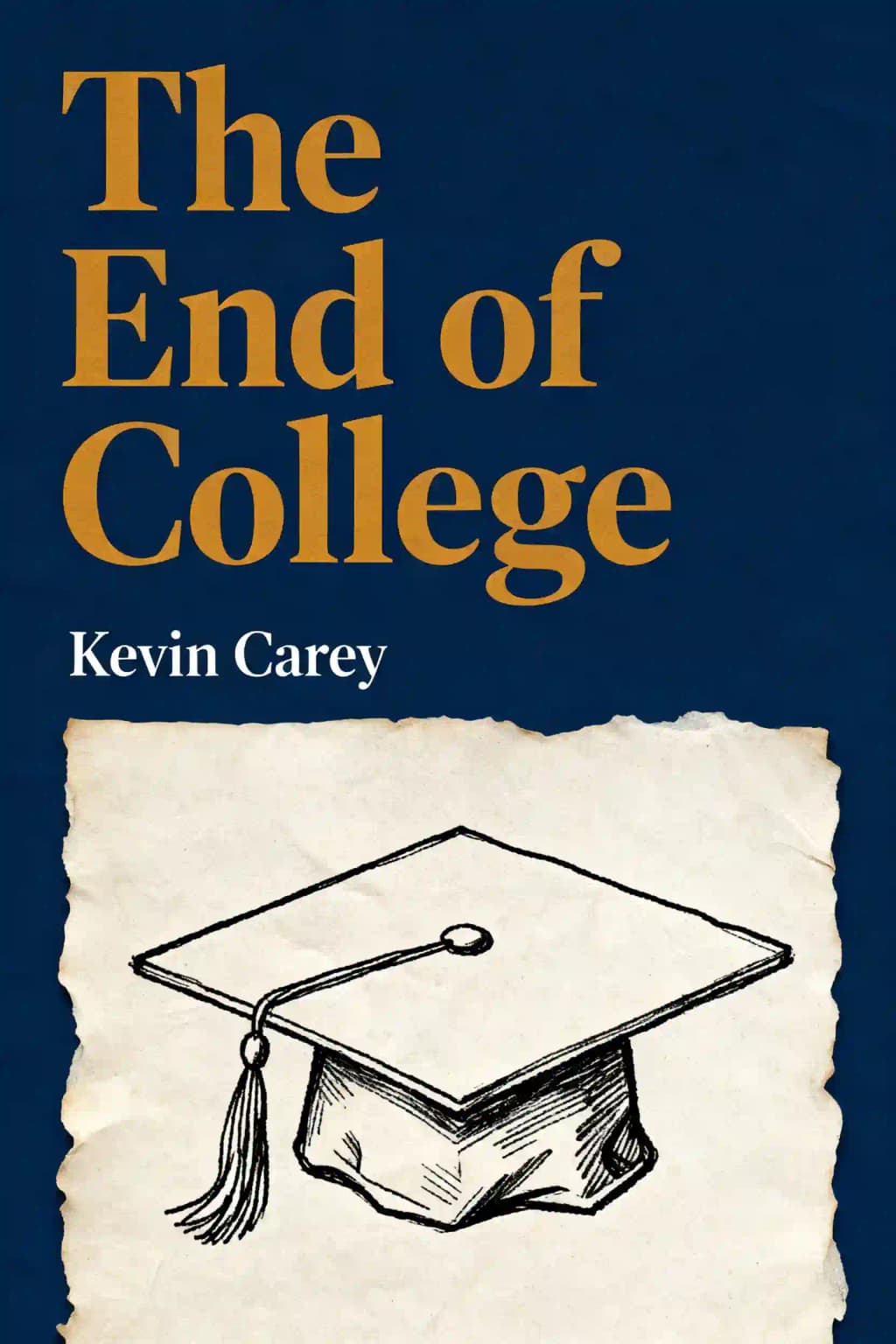
Kevin Carey's controversial manifesto challenges traditional higher education, envisioning a tech-driven "University of Everywhere" where learning transcends campus walls. While educators debate its utopian ideals, this book sparked crucial conversations about how digital access might democratize knowledge for everyone with an internet connection.
Kevin Carey, author of The End of College: Creating the Future of Learning and the University of Everywhere, is a leading higher education policy expert and vice president of education at New America. A seasoned analyst and commentator, Carey’s work explores systemic reform, online learning, and equitable access in education, themes deeply informed by his roles at Education Sector, the Education Trust, and Indiana’s state budget office.
His writings for The New York Times, Washington Monthly, and WIRED, alongside frequent NPR and CNN appearances, cement his status as a trusted voice in education discourse.
A graduate of Binghamton University and Ohio State, Carey combines policy expertise with a visionary critique of traditional academia. His book, praised for its bold reimagining of higher education’s future, has influenced national debates on affordability and innovation. Carey also edited the Washington Monthly college guide and authored the crime novel Murder in the Marsh and poetry collections like Jesus Was a Homeboy.
Recognized with two Education Writers Association awards, The End of College remains a pivotal text in education policy circles, frequently cited for its insights into technology’s transformative role in learning.
The End of College explores the transformation of higher education through digital learning, predicting a shift from traditional institutions to a decentralized "University of Everywhere." Carey argues that AI-driven platforms, massive open online courses (MOOCs), and data analytics will democratize education, offering personalized, affordable learning alternatives. He critiques the rising costs and inefficiencies of hybrid universities while envisioning a future where credentials lose relevance to skill-based outcomes.
This book is essential for educators, policymakers, and edtech innovators interested in higher education’s future. It also appeals to students and parents seeking alternatives to costly degrees, as well as lifelong learners curious about AI’s role in reshaping education. Critics of traditional university models will find Carey’s data-driven critique particularly compelling.
Yes, for its provocative analysis of higher education’s unsustainable costs and technological disruption. Carey combines historical context with forward-looking insights, though some critics argue his vision underestimates the value of in-person learning and risks exacerbating educational inequality. The book sparks critical dialogue about innovation’s trade-offs.
Carey highlights three core themes:
Carey envisions AI analyzing vast datasets from online courses to refine teaching methods, akin to A/B testing. This “learning engineering” could optimize foundational subjects like physics or math, tailoring content to individual needs and improving global access.
Critics argue Carey overestimates technology’s pace of adoption and underestimates the cultural value of campuses. The Chronicle of Higher Education warns his model could deepen inequality, privileging elites while relegating others to second-tier online credentials.
As a policy director at New America, Carey blends investigative rigor with accessible storytelling. His expertise in education reform and technology informs the book’s balance of historical analysis and speculative forecasting.
This concept describes a global, decentralized network of digital learning platforms replacing physical campuses. It emphasizes competency-based education, where learners access resources like lecture videos and interactive simulations anytime, anywhere.
Unlike Clayton Christensen’s The Innovative University, which focuses on institutional adaptation, Carey’s work anticipates a more radical upheaval. It aligns with Bryan Caplan’s The Case Against Education on credentialism but offers a tech-driven roadmap for alternatives.
Carey advocates for unbundling degrees into modular, skills-based credentials and leveraging open-source educational resources. He suggests regulatory reforms to shift funding from institutions to learners, fostering competition.
While MOOCs haven’t fully displaced universities, Carey’s predictions resonate amid growing acceptance of microcredentials and hybrid learning post-COVID. The book remains a touchstone for debates on AI’s role in education.
These lines encapsulate Carey’s faith in technology to dismantle traditional gatekeeping and prioritize scalable, individualized learning.
저자의 목소리로 책을 느껴보세요
지식을 흥미롭고 예시가 풍부한 인사이트로 전환
핵심 아이디어를 빠르게 캡처하여 신속하게 학습
재미있고 매력적인 방식으로 책을 즐기세요
The institutions that adapt will thrive; those that cannot will disappear.
The hybrid university was designed to be bad at the most important thing it does: educate people.
Admission becomes obsolete as students access learning from specialized organizations.
The system thrived, as it were, on ignorance with students as pawns.
Universities adapted because books remained expensive.
The End of College의 핵심 아이디어를 이해하기 쉬운 포인트로 분해하여 혁신적인 팀이 어떻게 창조하고, 협력하고, 성장하는지 이해합니다.
The End of College을 빠른 기억 단서로 압축하여 솔직함, 팀워크, 창의적 회복력의 핵심 원칙을 강조합니다.

생생한 스토리텔링을 통해 The End of College을 경험하고, 혁신 교훈을 기억에 남고 적용할 수 있는 순간으로 바꿉니다.
무엇이든 물어보고, 목소리를 선택하고, 진정으로 공감되는 인사이트를 함께 만들어보세요.

샌프란시스코에서 컬럼비아 대학교 동문들이 만들었습니다
"Instead of endless scrolling, I just hit play on BeFreed. It saves me so much time."
"I never knew where to start with nonfiction—BeFreed’s book lists turned into podcasts gave me a clear path."
"Perfect balance between learning and entertainment. Finished ‘Thinking, Fast and Slow’ on my commute this week."
"Crazy how much I learned while walking the dog. BeFreed = small habits → big gains."
"Reading used to feel like a chore. Now it’s just part of my lifestyle."
"Feels effortless compared to reading. I’ve finished 6 books this month already."
"BeFreed turned my guilty doomscrolling into something that feels productive and inspiring."
"BeFreed turned my commute into learning time. 20-min podcasts are perfect for finishing books I never had time for."
"BeFreed replaced my podcast queue. Imagine Spotify for books — that’s it. 🙌"
"It is great for me to learn something from the book without reading it."
"The themed book list podcasts help me connect ideas across authors—like a guided audio journey."
"Makes me feel smarter every time before going to work"
샌프란시스코에서 컬럼비아 대학교 동문들이 만들었습니다

The End of College 요약을 무료 PDF 또는 EPUB으로 받으세요. 인쇄하거나 오프라인에서 언제든 읽을 수 있습니다.
Picture a Japanese television crew filming a genetics lecture at MIT. The professor, Eric Lander, explains DNA with such infectious enthusiasm that you'd think he was revealing the secrets of the universe-which, in a way, he is. But here's the twist: this isn't just for the students sitting in that lecture hall. It's for anyone, anywhere, with an internet connection. What started as a simple recording has sparked a revolution that's dismantling the centuries-old gates of higher education. We're witnessing the birth of what might be called "the University of Everywhere"-a world where the word "admission" becomes as outdated as a rotary phone. Instead of begging elite institutions for acceptance, students will cherry-pick learning from specialized organizations across the globe, accumulating digital evidence of their knowledge rather than collecting dusty diplomas. The institutions flexible enough to adapt will flourish; the rest will become expensive museums of an educational model that no longer serves us. This isn't a distant fantasy-it's already happening, and the implications are staggering.
