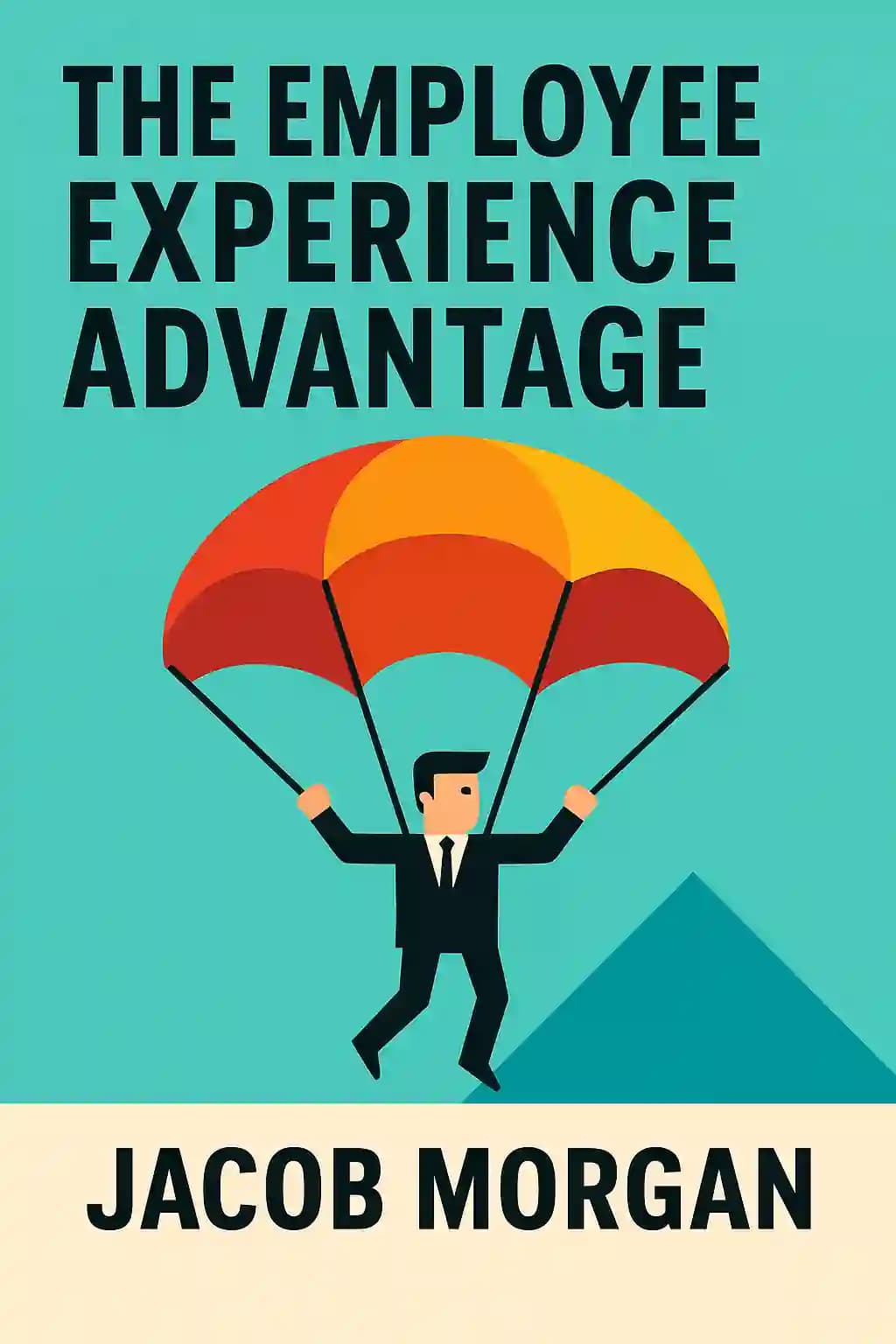
In "The Employee Experience Advantage," Jacob Morgan reveals why top companies outperform competitors by 4x in profits. Backed by research spanning 250+ organizations, this book - endorsed by leadership guru Marshall Goldsmith - shows how designing workspaces, tools, and culture reduces turnover by 40%.
Jacob Morgan, bestselling author of The Employee Experience Advantage, is a renowned futurist and leading authority on employee experience, leadership, and the future of work. Born in Melbourne, Australia, and raised in the U.S., Morgan combines his academic background in business management economics and psychology (UC Santa Cruz) with decades of research to address workplace challenges.
His work focuses on bridging technological advancements, organizational culture, and human-centric leadership, themes central to his bestselling trilogy: The Collaborative Organization (2012), The Future of Work (2014), and The Employee Experience Advantage (2017).
A sought-after keynote speaker, Morgan has delivered talks at over 50 annual conferences, including TED Academy, and advises Fortune 500 executives on adapting to trends like AI, hybrid work models, and generational shifts in the workforce. His insights are featured in proprietary frameworks and courses on employee experience design, leveraged by companies worldwide. Morgan’s content reaches over a million viewers annually, and his books are frequently cited in academic programs and corporate training curricula. The Employee Experience Advantage has become a cornerstone text for organizations prioritizing workplace culture, translated into multiple languages and adopted by industry leaders.
The Employee Experience Advantage explores how organizations can attract talent and drive business success by optimizing three environments: physical workspaces (design and amenities), technological tools (user-friendly systems), and cultural practices (values and inclusivity). Jacob Morgan argues that investing in these areas boosts engagement, innovation, and profitability, supported by frameworks like ACE (technology) and CELEBRATED (culture).
HR professionals, business leaders, and managers aiming to improve retention and workplace culture will benefit most. The book offers actionable strategies for aligning employee needs with organizational goals, making it valuable for anyone responsible for talent management or organizational design.
Yes. The book provides research-backed insights from 250+ companies, practical frameworks like the Employee Experience Score (EES), and case studies from firms like Airbnb and Cisco. It’s ideal for leaders seeking data-driven methods to enhance workplace satisfaction and productivity.
The ACE framework guides organizations in building effective technological environments:
A CELEBRATED culture includes 10 attributes: Celebrated values, Empowered employees, Leadership accessibility, Emotional connection, Belongingness, Recognition, Autonomy, Team collaboration, Engagement, and Development opportunities. These foster environments where employees feel valued and motivated.
Morgan categorizes organizations into:
Key metrics include:
Some argue the book overlooks granular workspace design factors (e.g., layout’s impact on collaboration) and scalability challenges for small businesses. However, its frameworks remain widely applicable for foundational improvements.
Engagement focuses on short-term perks, while employee experience holistically addresses daily interactions across physical, technological, and cultural environments. Morgan emphasizes long-term systemic changes over temporary fixes.
Companies like Salesforce (culture), Google (workspace design), and Microsoft (technology integration) exemplify experiential organizations. Morgan cites their 30%+ higher employee satisfaction and 2x faster innovation cycles compared to peers.
It advocates for “COOL” spaces: Collaborative, Open, Offering amenities, and Located in vibrant areas. While praised for highlighting workspace importance, critics note limited guidance on optimizing layout for specific workflows.
Morgan’s frameworks adapt well: remote teams need robust tech (ACE), virtual culture-building (CELEBRATED), and flexible workspaces. The book’s emphasis on adaptability aligns with post-pandemic trends toward personalized work environments.
저자의 목소리로 책을 느껴보세요
지식을 흥미롭고 예시가 풍부한 인사이트로 전환
핵심 아이디어를 빠르게 캡처하여 신속하게 학습
재미있고 매력적인 방식으로 책을 즐기세요
Humans essentially took jobs meant for robots.
Engagement efforts are merely cosmetic changes.
Average becomes the ceiling rather than the baseline.
Organizations with cash could treat employees however they wanted.
Purpose should avoid mentioning shareholder value.
The employee experience advantage의 핵심 아이디어를 이해하기 쉬운 포인트로 분해하여 혁신적인 팀이 어떻게 창조하고, 협력하고, 성장하는지 이해합니다.
The employee experience advantage을 빠른 기억 단서로 압축하여 솔직함, 팀워크, 창의적 회복력의 핵심 원칙을 강조합니다.

생생한 스토리텔링을 통해 The employee experience advantage을 경험하고, 혁신 교훈을 기억에 남고 적용할 수 있는 순간으로 바꿉니다.
무엇이든 물어보고, 목소리를 선택하고, 진정으로 공감되는 인사이트를 함께 만들어보세요.

샌프란시스코에서 컬럼비아 대학교 동문들이 만들었습니다
"Instead of endless scrolling, I just hit play on BeFreed. It saves me so much time."
"I never knew where to start with nonfiction—BeFreed’s book lists turned into podcasts gave me a clear path."
"Perfect balance between learning and entertainment. Finished ‘Thinking, Fast and Slow’ on my commute this week."
"Crazy how much I learned while walking the dog. BeFreed = small habits → big gains."
"Reading used to feel like a chore. Now it’s just part of my lifestyle."
"Feels effortless compared to reading. I’ve finished 6 books this month already."
"BeFreed turned my guilty doomscrolling into something that feels productive and inspiring."
"BeFreed turned my commute into learning time. 20-min podcasts are perfect for finishing books I never had time for."
"BeFreed replaced my podcast queue. Imagine Spotify for books — that’s it. 🙌"
"It is great for me to learn something from the book without reading it."
"The themed book list podcasts help me connect ideas across authors—like a guided audio journey."
"Makes me feel smarter every time before going to work"
샌프란시스코에서 컬럼비아 대학교 동문들이 만들었습니다

The employee experience advantage 요약을 무료 PDF 또는 EPUB으로 받으세요. 인쇄하거나 오프라인에서 언제든 읽을 수 있습니다.
Imagine spending a third of your life somewhere you dread going. That's the reality for most workers today. Jacob Morgan's research reveals a startling truth: only 6% of companies have mastered creating workplaces where people genuinely want to be. This isn't just a feel-good issue - it's a business imperative. Companies investing in employee experience outperform peers by staggering margins: 4.4x higher profits, 40% lower turnover, and consistently better stock returns. As automation reshapes work, the question becomes urgent: will your organization force humans to work like robots, or design environments that leverage uniquely human capabilities? The employer-employee relationship has undergone a dramatic transformation. We've moved through distinct eras, each representing a fundamental shift in how organizations view their people. First came the utility era - the most basic relationship where organizations provided minimal tools and employees received paychecks. Next, the productivity era emerged, where managers used stopwatches to optimize worker efficiency. The engagement era marked a revolutionary shift toward considering what employees actually care about. Yet most engagement efforts remain cosmetic - like putting fresh paint on a junkyard car without fixing the engine. Today, we're entering the employee experience era, which represents a fundamental redesign of organizations around "the intersection of employee expectations, needs, and wants and the organizational design of those expectations, needs, and wants."