1장
A Journey Down the Mississippi: Huck's Moral Awakening
Mark Twain's "The Adventures of Huckleberry Finn" isn't just a classic American novel-it's a cultural touchstone that has shaped our understanding of American identity for generations. Published in 1884 after years of writing and revision, the book was immediately controversial yet revolutionary in its use of vernacular language and unflinching portrayal of pre-Civil War America. Ernest Hemingway famously declared that "all modern American literature comes from one book by Mark Twain called 'Huckleberry Finn.'" The novel's influence extends far beyond literature-it has been adapted countless times for stage, film, and television. Oprah Winfrey once named it among her favorite books, praising its honest portrayal of friendship across racial lines. Despite periodic attempts to ban it from school curricula due to its language, the book remains a powerful examination of conscience, freedom, and humanity that continues to challenge readers to confront America's complicated history with race and morality.
2장
Huck's World: Civilization and Its Discontents
Huckleberry Finn begins his tale where "The Adventures of Tom Sawyer" left off-he and Tom have found a fortune of six thousand dollars each, and the Widow Douglas has taken Huck in to "sivilize" him. Life with the Widow and her sister Miss Watson feels suffocating to Huck. The starched clothes make him "sweat and feel all cramped up," the regular mealtimes with prayers over "perfectly good food" seem pointless, and the widow's prohibition against smoking (despite her own snuff habit) strikes him as hypocritical.
When his abusive father Pap returns after a long absence, demanding Huck's money and beating him for attending school, the contrast between "civilization" and Huck's natural state becomes even sharper. Pap embodies the worst of society-violent, racist, and alcoholic. In a particularly revealing scene, Pap launches into a drunken tirade against the government for allowing an educated Black man from Ohio to vote, declaring he'll never vote again himself if such things are allowed. His hypocrisy is evident as he rails against the government while simultaneously trying to steal his son's money through legal channels.
Huck's description of Pap is unforgettable: a man of about fifty with long, tangled greasy hair and black whiskers, eyes shining through "like he was behind vines," and a face "a sickly white, a fish-belly white" that makes Huck's flesh crawl. Dressed in nothing but rags with a busted boot showing two toes, Pap represents not wilderness but degraded civilization-a man corrupted by alcohol, greed, and hatred.
When Pap kidnaps Huck to an isolated cabin across the Illinois shore, Huck initially enjoys aspects of this "lazy life" without school or manners. Yet as Pap's drunken rages worsen-culminating in hallucinations of snakes and the "Angel of Death"-Huck realizes he must escape both the suffocating "civilization" of the Widow Douglas and the dangerous wilderness represented by his father. Neither extreme offers true freedom or moral clarity.
3장
The Great Escape: Faking Death and Finding Freedom
Faced with Pap's escalating violence and increasingly sinister threats to hide him where nobody could find him, Huck devises an ingenious escape plan that showcases both his practical intelligence and his flair for theatrical deception. While Pap is away on one of his frequent trips to town selling logs for whiskey money, Huck completes the painstaking work of sawing through the cabin logs - a task he had secretly been working on for weeks - and stages an elaborate fake murder scene that would have made even the most seasoned detective take notice.
The meticulous detail with which Huck executes his plan reveals not just resourcefulness, but a sophisticated understanding of human psychology. He first hunts and kills a wild pig, carefully collecting its blood to create authentic-looking violence. He strategically smears the blood on an axe he finds in the woodpile, creating a convincing murder weapon, then uses it to smash in the cabin door from the outside, making it appear as though an intruder had broken in. His attention to detail extends to creating footprints of different sizes around the cabin, suggesting a struggle with multiple assailants. The masterstroke comes when he drags a heavy sack of rocks to the river, leaving a clear trail and obvious drag marks, to suggest his body had been weighted down and disposed of in the Mississippi. To further misdirect any searchers, he creates a false trail with cornmeal leading north, while he himself heads south - a detail that shows his understanding of how tracking works.
The brilliant irony of Huck's situation unfolds as he secretly observes the town's reaction from his hiding place in the woods. He watches as the townspeople organize a search party with a ferryboat, firing a cannon over the water - a common practice believed to make drowned bodies rise to the surface. The scene becomes almost comedic as he witnesses Judge Thatcher solemnly discussing the tragedy, Tom Sawyer dramatically theorizing about murderous riverboat pirates, and even Pap himself putting on a show of drunken grief while likely relieved that he won't have to explain his son's disappearance. This elaborate performance represents Huck's first major rebirth in the novel - a calculated shedding of his old identity and all its societal constraints.
Finding refuge on Jackson's Island, Huck initially revels in his newfound freedom with the pure joy of a boy who has successfully orchestrated his own liberation. He methodically sets up a comfortable camp, demonstrating his outdoor skills by building a shelter, catching fish, and even smoking meat for preservation. He explores every inch of his new domain with the careful attention of a seasoned woodsman, marking good fishing spots and identifying useful resources. For the first time in his young life, he answers to no one - not the Widow Douglas with her suffocating civilizing mission, not the abusive and controlling Pap, not even the well-meaning but constraining Tom Sawyer with his romantic notions of adventure. Yet this glorious isolation proves short-lived, as Huck soon discovers that Jackson's Island harbors another fugitive, setting the stage for the novel's central relationship and greatest adventure.
4장
Jim and Huck: An Unlikely Alliance
The discovery of Miss Watson's slave Jim hiding on Jackson's Island marks the true beginning of Huck's moral journey. Jim has fled because he overheard Miss Watson planning to sell him to New Orleans for $800, despite her earlier promise not to. This betrayal by "civilization" parallels Huck's own reasons for escape and creates an immediate bond between them.
Their initial reunion is joyful, with Jim first believing Huck is a ghost. They quickly establish a partnership based on mutual need and growing respect. Jim's practical knowledge complements Huck's resourcefulness-he predicts weather from bird signs and suggests moving their supplies to a hidden cavern for safety. During a violent storm, Huck acknowledges he'd be drenched without Jim's help, showing his growing appreciation for Jim's wisdom.
Their relationship develops through shared experiences and conversations that reveal Jim's humanity. When they salvage items from a floating house containing a dead man, Jim compassionately covers the body before Huck can see it-we later learn this was Huck's father, a fact Jim keeps to himself to protect the boy. Their discussions about kings, dukes, and Solomon's wisdom reveal Jim's independent thinking and moral clarity. When Huck attempts to explain Solomon's famous judgment about splitting a baby, Jim rejects the conventional wisdom: "What use is half a chile?" His logic is unassailable, demonstrating that wisdom isn't confined to the educated or privileged.
The partnership faces its first major test when Huck discovers the townspeople suspect Jim is hiding on the island. Disguising himself as a girl, Huck crosses to the Illinois shore to gather information. His quick thinking when his disguise is discovered-creating a new identity as "George Peters" escaping an abusive farmer-shows his growing ability to navigate dangerous situations. Learning that men plan to search the island that night, Huck races back to warn Jim, and they flee together on their raft-a floating island of freedom that becomes the novel's central symbol.
5장
The Raft and the River: America's Moral Geography
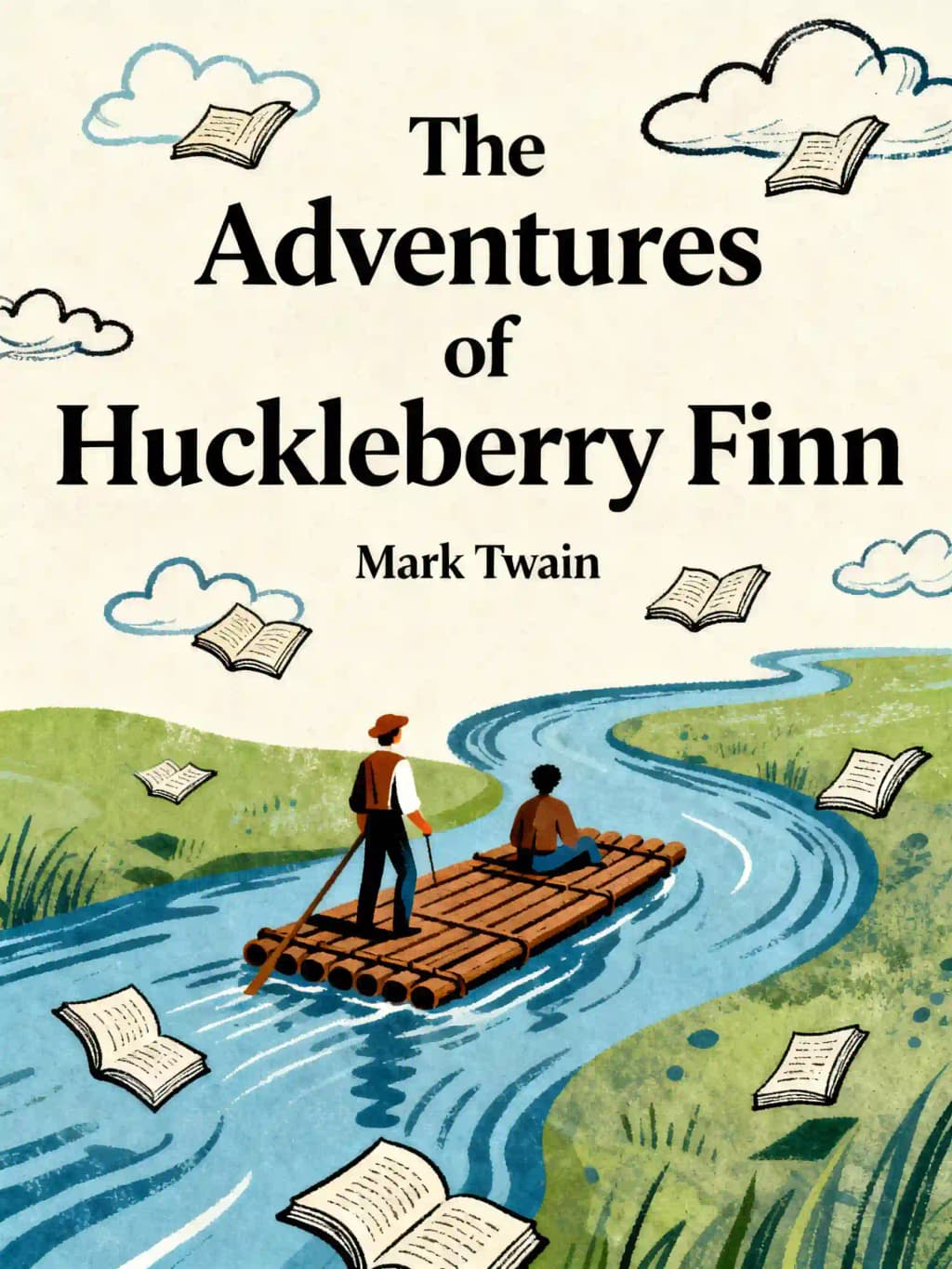
The Mississippi River becomes both the novel's primary setting and its most powerful symbol. For Huck and Jim, the river represents freedom and possibility-a constantly moving boundary between the slaveholding South and the free North. Their raft becomes a sanctuary where conventional social rules don't apply, where a white boy and a Black man can form a genuine friendship based on mutual respect.
Twain's descriptions of their nights on the river are among the novel's most beautiful passages. Huck recalls how they would "lie on our backs and look up at the stars, and discuss about whether they was made or just happened." The simplicity of these moments-swimming, fishing, and talking in hushed tones beneath the stars-creates an Eden-like atmosphere that contrasts sharply with the corrupt "civilization" they encounter on shore.
The geography of the river carries profound moral significance. Huck and Jim plan to travel north to Cairo, Illinois, where the Ohio River joins the Mississippi, then take a steamboat up the Ohio to the free states. Their journey is literally a quest for freedom. When they miss Cairo in the fog and continue drifting south-deeper into slave territory-it represents a moral crisis. The loss of their canoe (which Jim blames on the bad luck from touching a snakeskin) symbolizes their loss of control over their destiny.
The contrast between river and shore becomes increasingly stark as the journey continues. On the raft, Huck and Jim exist in a state of natural equality and friendship. On shore, they encounter violence, cruelty, and moral corruption. The Grangerford-Shepherdson feud, the Duke and the King's cons, and the casual cruelty toward slaves all reveal the hypocrisy of "civilized" society. The river itself remains morally neutral-it carries them toward both freedom and danger, depending on their direction.
This moral geography reaches its climax when Huck must decide whether to write to Miss Watson revealing Jim's location or to "go to hell" by helping Jim escape. Sitting alone with paper and pen, Huck weighs his society's values against his own experience and chooses friendship over convention-a moment that represents the novel's moral center.
6장
The Grangerfords and Shepherdsons: Civilization's Veneer
After being separated from Jim during a violent steamboat collision, Huck finds himself taken in by the Grangerford family-wealthy, aristocratic slaveholders who represent the pinnacle of Southern "civilization." Their mansion stands as a testament to antebellum luxury, with brass doorknobs that gleam like gold, an ornate clock with moving figures that dance on the hour, hand-painted decorative parrots, and furniture crafted from the finest mahogany and velvet. The walls are adorned with mournful "crayon drawings" of deceased family members, a common Victorian practice that Huck finds both fascinating and unsettling.
Colonel Grangerford, the family patriarch, embodies the idealized Southern gentleman-tall, slim, and dignified, dressed immaculately in pristine white linen suits regardless of the weather or occasion. He carries a silver-headed mahogany cane not just as an accessory but as a symbol of his authority and refinement. Huck observes that "when he turned into a cloud of wrath, he was awful to look at," but such moments are rare, as everyone from slaves to family members maintains perfect manners around him without being told, moving through the house with careful precision and speaking in measured tones.
Beneath this carefully maintained veneer of refinement lies a current of senseless violence that runs as deep as the Mississippi itself. The Grangerfords are locked in a generations-long blood feud with the equally aristocratic Shepherdson family, whose plantation lies just across the river. When Huck asks young Buck Grangerford what started the feud, the boy's response reveals the absurdity of the situation - no one remembers the original cause, only that it began thirty years ago over some forgotten dispute about property or honor. The toll has been devastating, with many deaths on both sides, including Buck's fourteen-year-old cousin who was shot from ambush while riding home through the woods.
The height of this hypocrisy manifests every Sunday when both families attend the same small church, arriving armed with rifles and pistols carefully concealed beneath their Sunday best. They sit through sermons about brotherly love and Christian charity while keeping their weapons between their knees, ready for violence at a moment's notice. The minister's words about forgiveness echo hollow through the sanctuary as two families who pride themselves on their Christian values maintain their deadly vendetta.
The feud reaches its tragic crescendo when Miss Sophia Grangerford, the family's beautiful young daughter, elopes with Harney Shepherdson. The resulting chaos erupts into a brutal gunfight along the riverbank, where Buck, his father, and his brothers are systematically gunned down. Huck witnesses Buck's death with horror, watching helplessly as his young friend dies in the mud: "I wished I hadn't ever come ashore that night to see such things." This senseless bloodshed, perpetrated by the most "civilized" members of society who pride themselves on their refinement and Christian values, reinforces Huck's growing conviction that societal conventions and institutions often mask the worst aspects of human nature. The episode serves as a stark illustration of how the trappings of civilization - fine clothes, good manners, and religious devotion - can coexist with barbaric violence and moral bankruptcy.
7장
The Duke and the Dauphin: Frauds and Human Nature
When Huck reunites with Jim, they soon encounter two con men who claim to be European royalty-"the Duke of Bridgewater" and "the Dauphin" (supposedly Louis XVII of France). These frauds represent another form of corruption-the exploitation of human gullibility and the perversion of authority. Though Huck quickly recognizes them as "low-down humbugs and frauds," he pragmatically decides to "let them have their own way" to avoid trouble.
The Duke and Dauphin's increasingly audacious scams provide both comedy and moral commentary. Their theatrical performances evolve from Shakespeare butchery to the crude "Royal Nonesuch" show advertised as "NOT TO BE SEEN BY LADIES AND CHILDREN." When audiences feel swindled, they conspire to "sell the REST of the town" rather than admit they were fooled-showing how pride and shame perpetuate corruption.
The frauds reach their moral nadir with the Wilks scam, where they impersonate the brothers of a recently deceased Peter Wilks to steal his inheritance from his nieces. The King's tearful performance as the grieving brother Harvey is so convincing it moves the townspeople to sing a doxology. Only Dr. Robinson sees through the deception, but the community's willingness to believe overcomes his skepticism.
Huck's growing moral awareness becomes evident when he witnesses Mary Jane Wilks's distress over the King selling a slave family separately, separating mother from children. Unable to stand this cruelty, Huck impulsively tells Mary Jane the truth about the frauds and helps expose them. This represents a significant development in Huck's character-he's willing to risk his own safety to prevent suffering, particularly when it involves the separation of families.
The Duke and Dauphin's eventual comeuppance-being tarred and feathered by townspeople-provokes unexpected compassion from Huck: "I was sorry for them poor pitiful rascals... human beings CAN be awful cruel to one another." This capacity for empathy, even toward those who deserve punishment, distinguishes Huck from the society that claims moral superiority while perpetuating cruelty.
8장
Tom's Return: Romanticism versus Reality
The novel's final section brings Huck to the Phelps plantation, where Jim is being held after being sold by the King. In a coincidence that strains credibility but serves Twain's narrative purposes, the Phelpses turn out to be Tom Sawyer's aunt and uncle, who mistake Huck for Tom. When the real Tom arrives, he immediately grasps the situation and pretends to be his brother Sid.
Tom's return shifts the novel's tone from Huck's pragmatic morality to Tom's romantic fantasies. When Huck proposes a simple plan to free Jim, Tom insists on an elaborate scheme drawn from adventure novels-complete with anonymous warnings, a rope ladder smuggled in a pie, inscriptions carved on the cabin wall, and a coat of arms for Jim. Tom's insistence that Jim keep a journal despite being unable to write and water a flower with his tears rather than spring water reveals the absurdity of his romantic notions.
The contrast between Tom and Huck becomes stark. Huck wants to free Jim efficiently because it's the right thing to do; Tom creates unnecessary complications for entertainment, knowing all along that Miss Watson had already freed Jim in her will before dying. Tom's "evasion" represents the privileged perspective that treats others' suffering as an opportunity for adventure-he can afford to play games with Jim's freedom because, as a white boy, his own freedom is never at risk.
Jim's patience through Tom's ridiculous demands-the rats, snakes, spiders, and grindstone that leave him barely room to sleep-shows his fundamental decency. His complaint that "between the rats, snakes, spiders, and grindstone, he barely had room to sleep" is understated given the absurdity of his situation. When Tom is shot during their escape and Jim risks his freedom to help him, it reveals the moral gulf between Jim's genuine compassion and Tom's self-centered playacting.
9장
The Moral Journey: Huck's Decision to "Go to Hell"
The novel's moral climax arrives in a pivotal scene where Huck Finn grapples with his conscience about helping Jim escape to freedom. This internal struggle embodies the novel's central theme-the profound tension between societal morality and personal conscience. Huck has been indoctrinated by his community to believe that helping a slave escape is not only stealing but a grave sin that will condemn him to eternal damnation. However, his intimate experiences traveling with Jim have revealed to him something deeper: Jim's fundamental humanity, emotional depth, and capacity for love and sacrifice.
In a scene charged with psychological complexity, Huck sits alone with paper and pen, initially resolving to write to Miss Watson to disclose Jim's location. When he composes the letter, he experiences momentary relief, believing he's "clean of sin" and has restored his moral standing in society's eyes. But this relief proves short-lived as memories flood his consciousness-Jim's countless acts of kindness, their profound conversations beneath starlit skies, the way Jim protected him like a father, and Jim's heartfelt declaration that Huck is his best friend. In what becomes the novel's most powerful and transformative moment, Huck tears up the letter, declaring: "All right, then, I'll go to hell."
This decisive action represents Huck's emergence into moral independence-his conscious rejection of society's corrupt and hypocritical values in favor of his direct experience and natural compassion. What makes this moment particularly remarkable is that Huck arrives at this profoundly moral choice without formal education, philosophical training, or religious guidance. Instead, his decision stems purely from human connection and emotional truth. The deep irony that society condemns as sinful what is actually the most moral action-helping another human being escape bondage-forms the foundation of Twain's scathing critique of pre-Civil War American society and its moral blindness.
The narrative achieves a powerful resolution when Jim reveals that the dead man they encountered in the floating house was Huck's abusive father. This disclosure closes a crucial narrative circle and carries multiple implications. Huck achieves true freedom on multiple levels-legally (his inheritance is now safe from his father's predations), physically (he's no longer under threat of abuse), and most importantly, morally (he's established his ethical independence from society's corrupting influences). However, Twain doesn't allow for a simple happy ending. Huck remains fundamentally uncomfortable with civilization and its constraints. His final declaration that he must "light out for the Territory" to escape Aunt Sally's attempts to "sivilize" him suggests that true freedom remains incompatible with organized society's demands for conformity. This conclusion reinforces Twain's broader critique of civilization's capacity to corrupt natural moral instincts.
10장
Freedom's Paradox: The American Conscience
"The Adventures of Huckleberry Finn" ultimately presents freedom as a profound paradox in American life. Physical freedom-embodied in Huck and Jim's journey down the Mississippi River-is perpetually threatened by society's constraints, from slave hunters to con men to well-meaning reformers. The river itself becomes a powerful metaphor for freedom, offering temporary escape while inevitably flowing through a landscape marked by bondage and restriction. Moral freedom-represented in Huck's pivotal decision to follow his conscience rather than convention-comes at the devastating potential cost of social acceptance and eternal salvation as he understands it.
The novel's deliberately ambiguous ending reflects this complex paradox. Jim gains his legal freedom through Miss Watson's will, a development that proves both triumphant and hollow since he had technically been free during much of their journey. He remains trapped in a society that fundamentally denies his humanity, where legal freedom doesn't translate to social equality or genuine autonomy. Huck's decision to "light out for the Territory" suggests an endless cycle of seeking a freedom that may be impossible within American society, reflecting the nation's own unresolved tensions between individual liberty and social order.
Twain's masterpiece continues to challenge readers because it refuses easy resolution of these fundamental contradictions. Through Huck's encounters with various communities along the river-from the feuding Grangerfords and Shepherdsons to the fraudulent Duke and King-the novel portrays America's moral contradictions in miniature. Each episode reveals how society's rules and conventions often serve to restrict rather than enhance human freedom and dignity. The relationship between Huck and Jim develops as a counterpoint to these social structures, demonstrating how genuine human connections can transcend inherited prejudices.
The enduring power of "Huckleberry Finn" lies in its unflinching examination of these contradictions. As readers follow Huck down the Mississippi, they're compelled to examine their own moral geography-the social boundaries they accept without question, the cultural prejudices they inherit without examination, and the potential for authentic human connection that exists beyond societal conventions. The novel forces confrontation with uncomfortable truths about the gap between American ideals and realities. Like Huck, who must decide whether to turn Jim in or "go to hell," readers must ultimately choose between accepting society's definitions of right and wrong or charting their own moral course, even when it means rejecting comfortable certainties in favor of difficult truths. This choice remains as relevant today as it was in Twain's time, as Americans continue to grapple with questions of individual conscience versus social conformity.