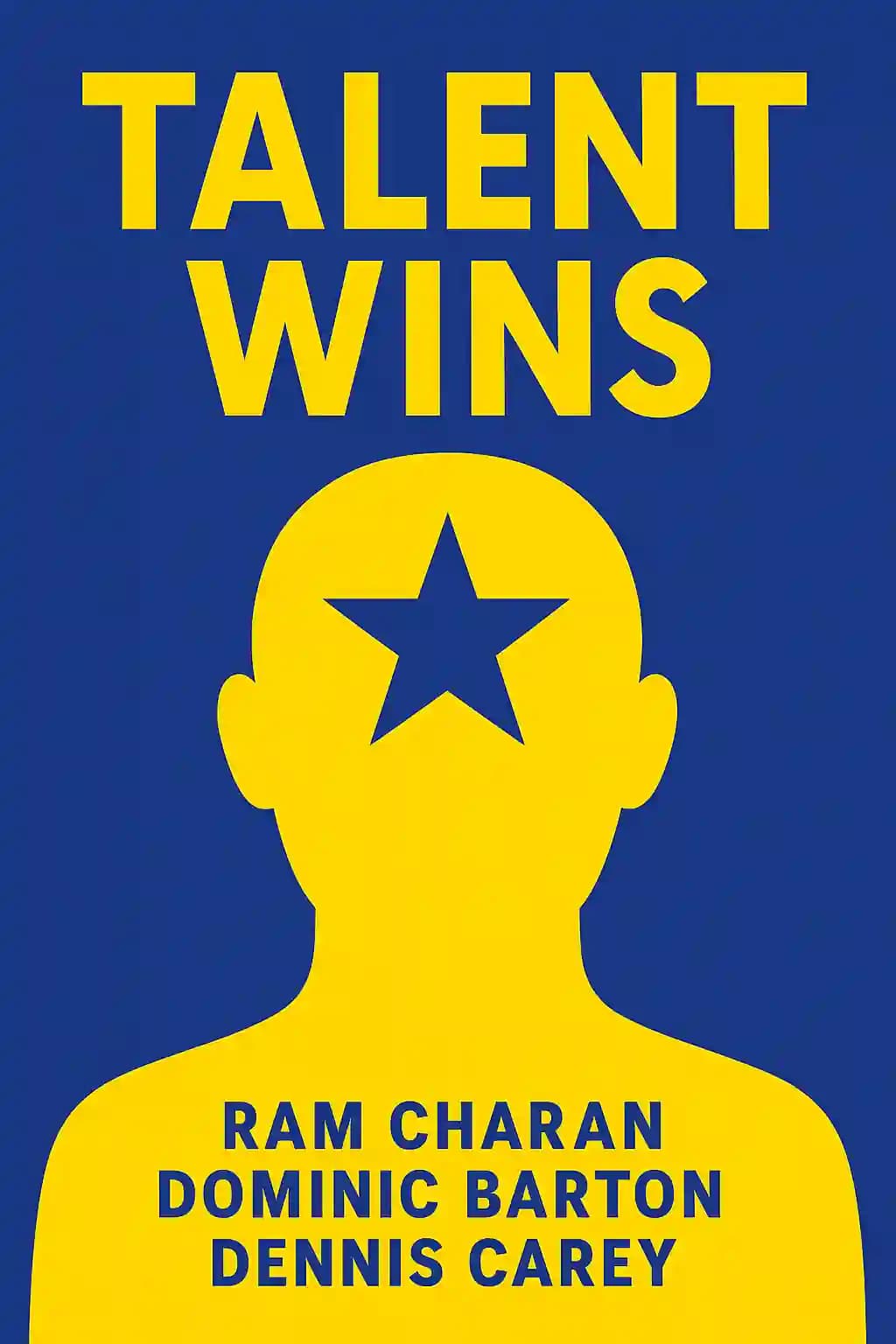
Talent Wins
The New Playbook for Putting People First
Talent Wins 개요
In "Talent Wins," McKinsey's Barton and experts Charan and Carey reveal why human capital trumps financial capital. CEOs at BlackRock and Amgen have adopted their G3 leadership model, transforming HR from administrative function to strategic powerhouse. What's your company's most underutilized asset? Your people.
Talent Wins의 핵심 주제
- human capital allocation
- executive triumvirate
- talent-first strategy
- critical two percent
- organizational value creation
Talent Wins의 명언
Talent Wins has become the mantra for forward-thinking CEOs.
CHROs need to be dynamite businesspeople.
Talent is inextricably tied to every agenda item.
Elevate talent to the top of the board’s agenda.
Talent is the true value creator.
Talent Wins의 등장인물
- Ram CharanCo-author and business advisor to CEOs
- Dominic BartonCo-author and former McKinsey managing director
- Dennis CareyCo-author and vice chairman of Korn Ferry
- John BerisfordCHRO of McGraw-Hill who led a major turnaround
- Jack CallahanCFO of McGraw-Hill who partnered in restructuring
저자 소개
Talent Wins의 저자 소개
Ram Charan, Dominic Barton, and Dennis Carey, co-authors of Talent Wins: The New Playbook for Putting People First, are globally recognized leadership and talent management experts reshaping modern HR strategies.
Charan, a bestselling author and corporate governance advisor, has penned influential titles like Execution and Boards That Lead, earning accolades for his work at Northwestern and GE.
Barton, former Global Managing Partner of McKinsey & Company, combines strategic rigor with insights from co-authoring Re-Imagining Capitalism, while Carey, Vice Chairman of Korn Ferry, draws on decades of executive recruitment experience and prior works like CEO Excellence.
Their collaboration merges finance and human capital, advocating for a CEO-CFO-CHRO "G3" leadership model to drive agile, talent-centric organizations. Published by Harvard Business Review Press, the book has become a cornerstone for companies like BlackRock, Volvo, and Tata Communications, redefining HR’s role in aligning talent with business strategy.
Charan’s earlier works on governance and Barton’s McKinsey leadership frameworks further anchor their authority in this 192-page business classic.
Talent Wins 요약 다운로드
Talent Wins 요약을 무료 PDF 또는 EPUB으로 받으세요. 인쇄하거나 오프라인에서 언제든 읽을 수 있습니다.
이 책에 대한 FAQ
Talent Wins argues that talent strategy must be central to corporate success, advocating for HR to shift from administrative functions to driving competitive advantage. Ram Charan emphasizes aligning talent with business priorities, redefining leadership roles, and leveraging data analytics for workforce decisions. The book provides frameworks for integrating talent management into boardroom agendas and fostering agility in turbulent markets.
CEOs, HR executives, and board members seeking to prioritize human capital as a strategic asset. The book also benefits mid-level managers navigating talent shortages or organizational restructuring. Startups and established firms aiming to build future-ready teams will find actionable insights on linking talent to innovation and growth.
Yes – its focus on talent-as-a-differentiator remains critical amid AI adoption and hybrid work challenges. Charan’s blueprint for decentralizing HR decision-making and empowering frontline leaders aligns with 2025’s emphasis on organizational resilience. The case studies and CEO-level perspectives offer lasting value despite evolving workplace dynamics.
- Talent-centric leadership: Boards must treat human capital with the same rigor as financial capital
- HR’s new mandate: Transition from compliance to strategic talent optimization
- The G3 framework: CEO-CHRO-CFO collaboration for resource allocation
- Micro-adaptability: Rapid team-level adjustments to market shifts
Charan advocates for “perpetual talent pipelines” – identifying high-potential employees early and rotating them through profit/loss roles. The book critiques traditional succession planning, urging real-time competency mapping and democratized access to leadership training through digital platforms.
Some argue it overestimates HR’s influence in traditional organizations and underaddresses DEI integration. Critics note the G3 model requires rare CEO-CHRO-CFO alignment. However, its actionable templates for talent analytics and board governance are widely praised.
While Execution focuses on operational discipline, Talent Wins positions human capital as the execution engine. Both emphasize CEO accountability, but Talent Wins expands the CHRO’s role and introduces talent valuation metrics absent in earlier works.
- “The war for talent is over – talent won.”
- “HR leaders must be bilingual: speaking the language of finance and strategy.”
- “There are no talent shortages, only imagination shortages in deployment.”
The book advises using AI for skill gap analysis and dynamic team composition but warns against over-automating talent judgments. It stresses human oversight in contextualizing algorithmic recommendations and maintaining equity in AI-driven promotions.
Yes – its merger chapter provides a 9-point checklist for talent prioritization during acquisitions, including culture-compatibility scoring and retention bonuses for critical innovators. Case studies demonstrate how poor talent integration doomed 73% of failed mergers.
- Decline of static job descriptions in favor of skill-cloud staffing
- Shareholder demands for talent health metrics
- CHROs joining mandatory board committees
- “Return on talent” becoming a standard financial ratio
Charan proposes the Talent Yield Ratio: (Value created by talent initiatives) ÷ (Total workforce investment). The book includes formulas for calculating innovation velocity per employee and attrition cost avoidance from engagement programs.