1장
The Overthinking Epidemic: How Our Minds Trap Us in Mental Mazes
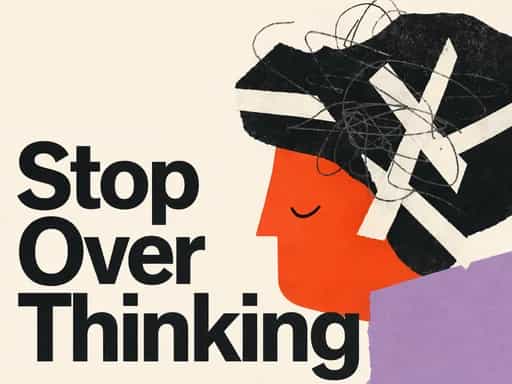
Did you know that the average person has over 6,000 thoughts per day? For chronic overthinkers, this number can be significantly higher-and far more distressing. "Stop Overthinking" by Nick Trenton has become a lifeline for the estimated 40% of Americans who identify as overthinkers, offering practical strategies to break free from mental spirals. The book has gained particular popularity among millennials and Gen Z, with social media influencers and celebrities like Emma Stone (who has openly discussed her anxiety struggles) recommending its approach. What makes this book stand out in the crowded self-help market is its blend of cognitive science, practical techniques, and the understanding that overthinking isn't simply "thinking too much"-it's a complex pattern of mental habits that can be systematically dismantled.
2장
Overthinking: The Misunderstood Mental Pattern
Imagine James, a generally self-aware young man who notices a strange mole on his arm. What begins as a reasonable health concern quickly spirals: he researches skin cancer symptoms online, which leads to questioning his overall health, which triggers memories of being called "sickly" as a child, which morphs into analyzing every perceived personal flaw, and finally descends into a pit of self-criticism and catastrophizing.
This isn't just "thinking a lot"-it's overthinking. The crucial distinction is that overthinking isn't productive problem-solving but rather a form of mental quicksand where the more you struggle, the deeper you sink. In our hyper-stimulated world, overthinking manifests as unwanted, unstoppable, and self-defeating mental activity that feels awful and offers no benefit.
What's particularly insidious about overthinking is that we often misidentify its source. When caught in a rumination spiral, we believe our thoughts are the problem ("if I could just figure out this thing that's bothering me, I'd feel better"). But these thoughts are merely symptoms of underlying anxiety, not causes. This misunderstanding leads us to dive deeper into the very thinking patterns that trap us, rather than stepping back to address the root anxiety.
Research reveals that while genetics play a role in anxiety predisposition-with chromosome 9 carrying genes associated with anxiety development-they only account for 26 percent of the variability in anxiety disorders. The remaining 74 percent comes from environmental factors, family history, past experiences, and lifestyle choices. Having a parent with anxiety increases your risk, but there are no "anxiety genes" that determine your fate. As we age and our environments change, genetic influence diminishes further.
The environment-genetics relationship creates a vulnerability model: genetic predisposition plus stressful events equals overthinking. Modern understanding shows mental health conditions arise largely from living in an increasingly stressful world. Not all stress is harmful-"eustress" challenges us positively-but persistent stress overwhelms our coping abilities, particularly when childhood trauma has sensitized us to adult stressors.
3장
The Mind-Body Connection in Overthinking
Anxiety isn't merely mental-it's a comprehensive physiological, psychological, social and spiritual phenomenon. When we perceive threats, our hypothalamic-pituitary-adrenal (HPA) axis triggers a cascade of stress hormones including cortisol, adrenaline, and norepinephrine, producing tangible physical effects: racing heart, headaches, muscle tension, digestive disturbances, and immune suppression. Even seemingly minor worries can activate this stress response, causing shallow breathing, increased blood pressure, and disrupted sleep patterns.
While our bodies handle brief stress well through natural recovery mechanisms, chronic anxiety leads to serious health conditions including cardiovascular problems, autoimmune disorders, and metabolic disruptions. Mentally, overthinking causes exhaustion, irritability, concentration problems, and depression. Memory becomes impaired as the brain's hippocampus can actually shrink under prolonged stress exposure. Socially, it damages relationships through decreased emotional availability, impairs work performance through decision paralysis, and leads to withdrawal and harmful behaviors like stress eating or substance abuse.
These effects create a vicious cycle-overthinking increases cortisol, which triggers more overthinking, affecting self-perception and decision-making. The amygdala becomes hyperactive, making us more sensitive to potential threats and creating a feedback loop of anxiety. Environmental stressors themselves are neutral until processed through our mental models and belief systems. Past experiences, cultural conditioning, and learned responses all influence how we interpret and react to situations. The good news? Overthinking isn't inevitable-it's a destructive habit we can actively choose to break through neuroplasticity and conscious intervention.
The key to breaking free starts with pinpointing what happens in our minds when overthinking begins. This includes identifying thought patterns, emotional triggers, and physical sensations that precede anxiety spirals. By identifying both triggers and effects with awareness-not rumination-we can take informed action. This awareness comes from regularly checking in with our bodily sensations, thoughts, and feelings through practices like body scanning and emotional tracking. Ensuring our lifestyle supports us through adequate sleep, nutrition, and exercise creates a foundation for resilience. Daily mindfulness practices, even brief moments of conscious breathing or meditation, help rewire our nervous system's stress response and build the capacity to observe thoughts without becoming entangled in them.
Understanding this mind-body connection empowers us to recognize early warning signs and implement interventions before anxiety escalates. Regular practices like progressive muscle relaxation, diaphragmatic breathing, and mindful movement can help reset the nervous system and break the cycle of overthinking.
4장
The 4 A's: A Systematic Approach to Stress Management
When facing any stressor, we have four potential responses: avoid, alter, accept, and adapt. This powerful framework provides a structured decision tree for handling situations that might trigger overthinking, allowing us to methodically address stress rather than becoming overwhelmed by it.
Avoidance means strategically walking away from unnecessary stress-inducing situations. This includes rearranging schedules to skip crowded stores during peak hours, limiting exposure to difficult people who drain your energy, saying "no" to excessive demands without guilt, and delegating tasks that others can handle. Many overthinkers feel morally obligated to endure stressful situations they could simply avoid, mistaking endurance for virtue. For example, if family gatherings consistently trigger anxiety, you might choose to attend shorter periods or select specific events rather than forcing yourself to participate in everything.
When avoidance isn't possible, alteration means actively changing the situation. This involves asking others to modify their behavior, communicating needs directly instead of hoping others will notice, or negotiating better terms. Rather than working through the night to meet an unrealistic deadline, request an extension with a clear plan. If a coworker's constant interruptions disrupt your focus, establish specific "do not disturb" hours. Alteration requires assertiveness and clear communication skills.
If a stressor can't be avoided or altered, acceptance becomes necessary. This means acknowledging feelings without judgment, forgiving others to release yourself from resentment, and reframing negative self-talk into more balanced perspectives. Acceptance doesn't mean passive resignation but rather acknowledging reality as it is while conserving emotional energy. For instance, accepting that traffic will be heavy during rush hour allows you to plan accordingly rather than getting frustrated daily.
Finally, adaptation involves implementing longer-term changes to your worldview and habits. This includes adjusting unrealistic expectations about yourself and others, deliberately practicing optimism through perspective-taking exercises, building resilience through daily gratitude practices, and developing personal mantras that remind you of your strength. Adaptation might mean learning to view challenges as growth opportunities rather than threats, or developing new skills to handle recurring stressors more effectively.
This systematic approach ensures you're never helpless against stress, providing multiple options for every situation. For each circumstance causing overthinking, methodically work through these options until you find an effective response. The key is to start with avoidance when possible, then progress through the other A's as needed, understanding that different situations may require different approaches or even a combination of strategies.
5장
Tracking and Transforming Your Stress Patterns
Stress diaries serve as powerful diagnostic tools to pinpoint anxiety triggers and responses when overthinking makes everything feel overwhelming. For each entry, record detailed information including the time, date, stress level (1-10), physical symptoms (such as headaches, muscle tension, or digestive issues), productivity level, recent stressful events, potential causes, your immediate responses, and both short-term and long-term outcomes. Include environmental factors like noise levels, time pressures, or interpersonal dynamics that may contribute to stress.
After collecting comprehensive data for at least a week, conduct a thorough pattern analysis: identify common stress triggers (such as deadlines, specific meetings, or particular relationships), how they affect your productivity levels throughout the day, typical emotional and behavioral responses (like procrastination, anger, or withdrawal), and your optimal stress level for peak performance. This detailed analysis often reveals surprising insights-perhaps one colleague or meeting type causes disproportionate stress, certain times of day are particularly challenging, or your defensive reactions consistently escalate situations.
With this heightened awareness, you can apply targeted stress-management techniques or make strategic lifestyle adjustments. Consider implementing specific interventions like scheduling buffer time between meetings, establishing clear boundaries with difficult colleagues, or restructuring your workflow around your energy patterns. Alternative journaling approaches include traditional free-writing for emotional release, structured gratitude journals (listing five specific daily experiences you're thankful for), or focused emotional release journaling for processing difficult experiences and tracking your progress over time.
When overthinking spirals out of control, the scientifically-backed 5-4-3-2-1 grounding technique effectively pulls you back into the present moment through systematic engagement of your five senses. While anxiety typically propels thoughts into past regrets or future fears, your body exists solely in the present moment. When panic strikes, begin by taking three deep breaths, then methodically identify five distinct things you can see (noting their colors and details), four different things you can physically touch (focusing on their texture and temperature), three separate sounds you can hear (from both near and far), two distinct scents you can smell (natural or artificial), and one thing you can taste. This exercise works through both neurological distraction and sensory engagement, effectively halting the cycle of rumination by anchoring your awareness in immediate physical experiences.
Complement these techniques with regular stress-relief practices like progressive muscle relaxation, scheduled worry time, or mindfulness meditation to build long-term resilience against overthinking patterns. Track the effectiveness of different interventions in your stress diary to continuously refine your personal stress management strategy.
6장
Time Management: The Hidden Anxiety Reducer
When the root cause of stress is poor time management, relaxation techniques alone won't help. Consider Susie, who attempts a lunch meditation but panics throughout because she's thinking about her 2:30 appointment. Many people need better time management rather than traditional stress-reduction methods.
Good stress management often equals good time management, which fundamentally requires identifying priorities to guide goal-setting. Ironically, many overthinkers prioritize stress-inducing activities while relegating rest to whatever time remains. A crucial mindset shift is seeing relaxation as equally important and worthy of deliberate scheduling.
Effective time management starts with understanding your unique challenges. Are you a "time martyr" who takes on too many obligations? A "procrastinator" who delays action? A "distractor" who gets easily sidetracked? An "underestimator" who misjudges task duration? A "firefighter" who's always reacting to crises? Or a "perfectionist" who can't complete tasks due to impossibly high standards?
Allen's Input Processing Technique helps manage the constant stream of information (emails, calls, messages) by establishing a simple decision framework: for each input, immediately decide whether it requires action. If no, ignore it or file it. If yes, determine if it must be done right away. For urgent tasks, act immediately; for non-urgent ones, schedule a specific time to address them.
Eisenhower's Method helps prioritize tasks by categorizing them along two dimensions: important/not important and urgent/not urgent. Important tasks advance your goals, while urgent ones require immediate attention. The resulting four categories determine your action: important and urgent tasks must be done immediately; important but not urgent tasks should be scheduled; not important but urgent tasks should be delegated; and not important, not urgent tasks should be eliminated.
7장
Instant Zen: Techniques for Immediate Relief
Even with excellent time management and organization, unexpected events can trigger anxious overthinking. Three main techniques-autogenic relaxation, progressive muscle relaxation, and visualization-work by encouraging the mind to focus calmly on the body in the present moment rather than on racing thoughts.
Autogenic training combines visual imagery, breathing, and body awareness to induce self-generated relaxation. Developed by Johannes Schultz in the 1920s, this systematic approach calms the central nervous system where anxiety begins. The practice involves six main techniques focusing on different bodily sensations: heaviness, warmth, heartbeat awareness, breath awareness, abdominal sensations, and coolness of the forehead.
During a session (typically 20 minutes), you repeat phrases like "I am completely calm" and "my right arm is heavy" while focusing intensely on those sensations. This deliberate practice empowers you to regulate your emotional state and physiological arousal.
Visualization harnesses your imagination to create calming mental experiences that affect your physical state. The technique engages all senses-sight, sound, touch, taste, and smell-to create a soothing mental environment. The power lies in the mind-body connection: when you vividly imagine a peaceful scene, your body responds as if it were real.
Progressive muscle relaxation addresses the physical manifestations of stress-the tense muscles that result from fight-or-flight hormones. The practice involves systematically tensing and releasing muscle groups throughout your body. Starting with extremities and moving inward, you inhale while contracting each muscle group for 5-10 seconds, then exhale while suddenly releasing.
8장
Rewiring Thought Patterns: The CBT Approach
Mind, body and emotions form an interconnected system, but anxiety primarily originates in the mind. Our thought patterns, mental structures, and cognitive interpretations shape our experience of reality. Cognitive behavioral therapy (CBT) targets these root perceptions, helping generate more adaptive thoughts.
The core premise of CBT is revolutionary yet simple: our thoughts-not external circumstances-create our emotions, which then shape our perceptions, beliefs, and behaviors. Change the thought, and everything else follows. For instance, reframing failure as a growth opportunity rather than a catastrophe transforms disappointment into motivation.
We all view reality through personalized filters of expectations, beliefs, and biases that distort our perception. Recognizing these cognitive distortions is the first step toward changing them. Common distortions include all-or-nothing thinking (black-and-white absolutism marked by words like "never" or "always"), overgeneralization (making sweeping statements from limited data), and internalizing/externalizing (incorrectly assuming responsibility or blame).
We also tend to favor negative information while discounting positive experiences, and engage in emotional reasoning ("if I feel it, it must be true"). Other distortions include catastrophizing, magical thinking, mind reading, fortune telling, and outdated thinking.
A dysfunctional thought record provides a structured way to capture automatic, unconscious thoughts so we can analyze them and develop better alternatives. Create a spreadsheet with columns for date/time, situation, automatic thoughts, emotions, alternative responses, and outcomes. Record strong negative emotions as they occur, documenting triggering events, resulting thoughts, emotional intensity, healthier alternative responses, and outcomes after reworking the original thoughts.
Behavioral experiments offer three distinct approaches for challenging distorted beliefs. The direct hypothesis testing method involves clearly stating your belief, creating an alternative hypothesis, designing a test, running it open-mindedly, analyzing results, and adjusting your belief based on evidence.
9장
Self-Talk: The Continuous Conversation in Your Mind
Our minds produce a constant stream of inner dialogue that goes beyond isolated thoughts - a mental soundtrack that plays throughout our waking hours. This self-talk, the ongoing narrative accompanying our daily lives, can be neutral, positive, or negative, fundamentally shaping how we experience and interpret the world around us. While individual distorted thoughts stem from core beliefs, self-talk is the emotional expression of these beliefs in a continuous mental conversation that colors every aspect of our experience.
For example, a core belief like "I must be perfect to be loved" generates a torrent of self-critical commentary: "You're such a loser... Who's going to want to hang around you... No wonder you're still single..." This negative self-talk can spiral into broader narratives about worthiness, success, and relationships. Rather than addressing each negative statement individually, CBT helps identify the emotional theme and underlying belief driving this pattern, allowing for more comprehensive change.
The impact of self-talk extends into physical manifestations - negative internal dialogue often creates tension in the body, affects posture, and can even influence hormone levels and immune function. Positive self-talk, conversely, can reduce stress, improve confidence, and enhance performance in various tasks, from public speaking to athletic competition.
Self-scripting goes beyond correcting individual thoughts to establish an entirely new relationship with yourself characterized by kindness and respect. It's about deliberately crafting the voice you use internally-is it positive or negative? Kind or unkind? Helpful or unhelpful? This involves developing a compassionate inner voice that speaks to you as a supportive friend would, offering encouragement, understanding, and constructive guidance.
This approach puts you in control of your inner dialogue through intentional practice. Create encouraging scripts when you're feeling strong and return to them during distress. For instance, before a job interview, you might prepare phrases like "I am well-prepared and capable" or "I bring valuable experience to this role." By identifying your triggers, you can prepare personalized scripts for challenging situations, combining breathing techniques and positive self-talk to counter catastrophizing.
The practice of mindful self-talk observation can help identify patterns and themes in your internal dialogue. Keep a self-talk journal to track recurring negative messages and their impact on your mood and behavior. This awareness allows you to consciously redirect harmful patterns into more supportive internal conversations, gradually rewiring your default mental response to stress and challenges.
10장
The Five Attitudes of a Calm Mind
Rather than merely offering tactical responses to anxiety, true transformation comes from adopting five fundamental attitudes that characterize the non-anxious person.
First, focus on what you can control, not on what you can't. Anxiety flourishes when we feel powerless. By fixating on circumstances beyond our influence, we ignore our genuine agency and waste energy pushing against immovable obstacles. Even in highly constrained situations, we always retain some choice-if only in how we respond.
Second, focus on what you can do, not on what you can't. Anxiety thrives in abstraction-possibilities, fears, what-ifs-while action provides clarity and grounding. By dwelling on limitations instead of possibilities, we reinforce feelings of frustration and helplessness. The most innovative solutions often emerge precisely because original plans failed, but only when we focus on new possibilities rather than dwelling on disappointments.
Third, focus on what you have, not on what you don't have. Confidence and contentment come from focusing on possible solutions and positive interpretations, while anxiety stems from fixating on what's wrong. By concentrating on your available resources, what's working well, and what you have to be grateful for, you prime yourself to see solutions and opportunities.
Fourth, focus on the present, not the past or future. Anxiety lives in the past and future-worrying about what has already happened or imagining stressful possibilities that may never materialize. Conscious awareness and useful action belong in the present. By focusing on what's happening right now, you narrow the scope for overthinking and direct your thoughts where they can actually help you.
Finally, focus on what you need, not what you want. Our personal narratives can create convoluted worlds disconnected from our actual lives. By focusing on needs rather than wants, we get to the core of what truly matters and prioritize accordingly. This simplifies decision-making and prevents the paralysis that comes from endless optimization.
11장
Emotion Regulation: The Final Piece
These five attitudes are supported by emotional regulation-the essential skill of mastering our emotional responses. This begins with emotional acceptance, not suppression or denial. Rather than fighting against uncomfortable feelings, we learn to acknowledge them as natural responses. The opposite action technique, a powerful tool in this process, involves "doing the opposite of what your emotions tell you" after first acknowledging those emotions without resistance or judgment.
When overthinking is driven by fear-whether fear of being out of control, failure, or perceived danger-we can observe these feelings without letting them dictate our actions. While fear might naturally lead us to avoid situations, stop taking risks, or become suspicious of others' motives, we can consciously choose to act differently. This might mean attending a social event despite anxiety, pursuing a project despite fear of failure, or extending trust despite past disappointments.
The process involves several distinct steps: First, identifying and experiencing the emotion without judgment or attempts to change it; second, carefully examining the thoughts and behaviors it typically causes; third, identifying the opposite emotion and its associated behaviors; fourth, making a conscious commitment to maintaining this opposite state for a fixed period; and finally, observing the results of this intentional shift.
This approach isn't about denying or suppressing emotions but rather bringing consciousness to automatic negative patterns. For example, choosing to remain calm during a heated confrontation rather than returning anger-after ten minutes of maintaining this opposite response, you might find the initial anger has naturally dissipated, leaving genuine calm in its place. Similarly, when anxiety about a presentation triggers overthinking, you might choose to focus on preparation and practice instead of worst-case scenarios.
The practice extends to various emotional states: responding to disappointment with renewed effort rather than withdrawal, meeting uncertainty with curiosity instead of worry, or addressing criticism with openness rather than defensiveness. Each application builds emotional resilience and flexibility.
Through consistent application of these principles and techniques, overthinking gradually transforms from an overwhelming force that controls your life into an occasional visitor that you know how to manage effectively. The mind that once trapped you in cycles of rumination becomes the very instrument of your freedom, capable of choosing responses rather than being driven by reactive patterns. This mastery develops through practice, patience, and persistent application of emotional regulation skills.