1장
Confronting Our Deepest Fear: The Journey to Acceptance
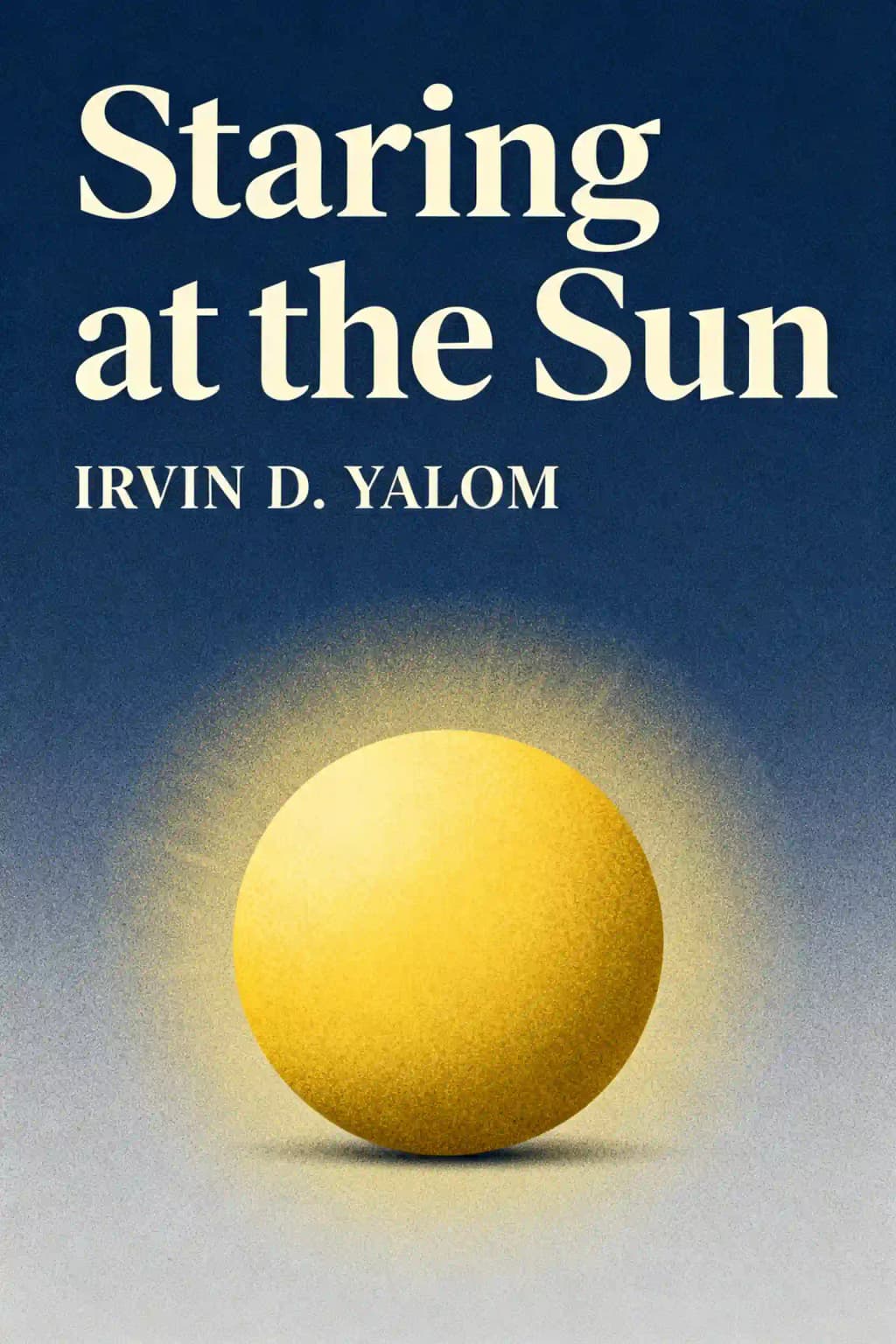
When we stare at the sun, we risk blindness. When we stare at death, we risk everything-and gain everything. Irvin D. Yalom's "Staring at the Sun" has become a landmark text in existential psychology since its 2008 publication, with over a million copies sold worldwide. Oprah Winfrey once called it "the book that changed how I think about life and death," while renowned psychiatrist Kay Redfield Jamison praised it as "a rare gift to us all." What makes this book so powerful is Yalom's unflinching honesty about our greatest universal fear. Drawing from his 50+ years as a psychiatrist at Stanford University, Yalom doesn't just theorize about death anxiety-he invites us into therapy sessions where real people confront their mortality, while candidly sharing his own struggles with finitude. The book resonates across cultures because it addresses what philosopher Martin Heidegger called our "possibility of impossibility"-the one certainty that shapes all human experience yet remains largely unexamined in our death-denying society.
2장
The Wound We All Share
Self-awareness is humanity's greatest gift and heaviest burden. Unlike other creatures, we alone know with certainty that we will die. This "mortal wound" shadows our existence from the moment we gain consciousness. As the ancient Gilgamesh epic demonstrated 4,000 years ago, the terror of death has haunted humanity since we first developed the capacity to contemplate our own extinction.
Death anxiety manifests differently across our lifespans. Children first encounter mortality through dead leaves, insects, or the disappearance of elderly relatives. These early confrontations with death go underground during elementary school years but resurface dramatically during adolescence, when teenagers process their fears through horror films, gallows humor, or risky behaviors. Young adults typically suppress death concerns while building careers and families until midlife, when mortality awareness returns with new urgency as we recognize we've crossed life's summit and now face the downward slope.
Since constant awareness of death would paralyze us, we develop sophisticated defenses. Some seek symbolic immortality through children, creative works, or wealth accumulation. Others embrace religious beliefs promising eternal life or develop rituals that provide structure and meaning. Many live "heroically," convinced of their immunity to death's reach, while some seek transcendence through merging with loved ones, causes, or spiritual entities.
Yet despite our most elaborate defenses, death anxiety always lurks in some hidden corner of consciousness. For some, it remains background music to daily life; for others, it erupts as paralyzing panic at 3 AM. Many fear specific aspects of dying-being buried alive, never seeing loved ones again, or the unbearable thought of personal nonexistence. Others struggle with the apparent meaninglessness that death seems to impose on life itself.
Contrary to traditional psychoanalytic approaches that interpret death fears as symbolic of other anxieties, existential psychology recognizes that death terror demands direct confrontation. As one 32-year-old patient realized with horror: "It would be ME who will die... I always thought about death obliquely, as something that might happen rather than would happen."
3장
When Death Anxiety Hides in Plain Sight
Death anxiety doesn't always announce itself directly. Sometimes it masquerades as other symptoms, requiring careful detection to uncover. Every nightmare contains death anxiety that has escaped its psychological corral and now menaces the dreamer. Dreams frequently feature symbolic deaths-being chased by murderers, falling from heights, or experiencing actual dying.
Certain life situations inevitably evoke death anxiety: serious illness, deaths of loved ones, or threats to basic security like being assaulted or fired. When someone shows disproportionate anxiety about an event, it often signals deeper existential concerns. Susan, a normally composed accountant, became completely unhinged when her adult son was jailed for a drug offense-a seemingly excessive reaction given his history of addiction. The bandage on her neck revealed recent cosmetic surgery coinciding with her sixtieth birthday, suggesting her anxiety about her son masked deeper fears about aging and mortality.
Once Susan recognized her son was serving as her "immortality project" and that her anxiety stemmed from her own mortality awareness, she made dramatic life changes. She left her "monastic" accounting career to pursue a long-deferred dream of running a bed-and-breakfast. Her story demonstrates how confronting death anxiety, rather than displacing it onto other concerns, can serve as a catalyst for authentic transformation.
Rollo May's insight that "anxiety about nothing tries to become anxiety about something" proves particularly useful in therapy. When patients present with seemingly inexplicable anxiety, exploring potential connections to death awareness often reveals the true source of their distress. This doesn't diminish their immediate concerns but places them within the broader context of human existence.
4장
The Paradoxical Gift of Mortality
The most profound paradox of human existence is that death awareness can transform lives through what Yalom calls "awakening experiences"-confrontations with mortality that enrich rather than diminish life. Literature offers powerful examples: Ebenezer Scrooge's transformation after seeing his neglected corpse, or Pierre in Tolstoy's "War and Peace" finding purpose after facing a firing squad.
Great thinkers throughout history understood this paradox. The Stoics taught that learning to live well means learning to die well. Medieval monks kept skulls in their cells as memento mori, and Montaigne suggested writing studios should overlook cemeteries. Though death physically destroys us, the idea of death can save us by awakening us to life's preciousness.
Heidegger clarifies how death awareness transforms us through two modes of existence: the everyday mode and the ontological mode. In everyday mode, we're absorbed in surroundings, focusing on appearances, possessions, and status. In ontological mode, we appreciate the miracle of being itself-marveling that things are, that we exist at all. This shift makes us more aware of mortality but also primes us for significant change, pushing us to construct authentic lives of engagement, connection, and meaning.
Many cancer patients demonstrate this transformation, rearranging priorities, communicating more deeply with loved ones, taking more risks, and appreciating elemental facts of life. As one patient noted: "What a pity I had to wait till now, till my body was riddled with cancer, to learn how to live!"
Tolstoy's masterpiece "The Death of Ivan Ilych" powerfully illustrates this awakening. Ivan-a self-absorbed, arrogant bureaucrat-faces a fatal illness and realizes he's lived badly, shielding himself from death through preoccupation with prestige. In a moment of clarity, he awakens to the fact that he's dying badly because he's lived badly. With death imminent, he discovers compassion, feeling tenderness for his son, servant, and even his wife. He ultimately dies not in pain but in the joy of intense compassion.
5장
Grief as a Gateway to Awareness
Grief often serves as a powerful awakening catalyst. When we lose someone we love, we're forced to confront our own mortality. The story of Alice illustrates this transformative process. After her husband Albert died following a long battle with Alzheimer's, she confronted both grief and relief. Soon after, she developed a terror of intruders-which a dream revealed as fear of her own death. "If he can die," she realized, "then so can I."
Moving to a retirement home forced Alice to dispose of possessions laden with memories. Seeing robin's-egg blue paint beneath her bookshelves, she recalled the bitter widow who'd sold her the house forty years earlier. She suddenly understood transiency not as an abstract concept but as lived reality-she was simply passing through, as were her possessions. Yet surprisingly, after moving, Alice felt happy. At 80, she finally had "a room of her own," fulfilling a lifelong desire. Freed from the weight of possessions and memories, she experienced a new beginning.
Julia, a 49-year-old British therapist, sought help after failing to recover from a friend's death. Her hypochondria and avoidance of risk stemmed from death anxiety. When asked what frightened her about death, she instantly replied: "All the things I would not have done." Though talented in art, she'd abandoned it for psychology, leaving countless unfinished works in drawers. Upon realizing she was "living a life of absurdity," Julia worked to confront how her unfulfilled creative potential directly correlated with her death anxiety. As Nietzsche advised: "Consummate your life"-the more unlived your life, the greater your fear of death.
6장
Life Milestones as Existential Turning Points
Life milestones often trigger subtle but powerful awakening experiences that confront us with mortality. School reunions, especially after twenty-five years, make the life cycle palpably real. Seeing classmates aged, comparing young photos to wrinkled faces, and hearing the roll call of deceased peers serves as a sobering wake-up call. These people knew you before your grown-up persona, representing stories begun decades ago against a backdrop of limitless hope.
Estate planning inevitably raises existential awareness as you confront your mortality through practical arrangements. The process forces profound questions: Whom do I love? Who will miss me? To whom should I be generous? One client with terminal illness spent days deleting emails from old lovers to spare his family discomfort. The final obliteration of passionate mementos evoked deep existential anxiety as he put his affairs in order.
Significant birthdays and anniversaries serve as potential awakening experiences. Though we celebrate with gifts and parties, perhaps these festivities attempt to dispel the sad reminder of time's inexorable rush. Will, a cerebral 49-year-old attorney seeking therapy for lost passion in work, mentioned casually during our fourth session: "Today is my fiftieth birthday." Though his wife planned a dinner, he disliked being "fussed over." When pressed about this discomfort, he admitted a "dark level" beneath that he couldn't access, except when reading about death. This led to his sudden recall of dreaming about his dead father and uncle the previous night, opening a pathway to confronting his hidden fears about death.
Dreams offer extraordinary opportunities for awakening experiences if we listen carefully. A young widow shared a dream where she saw a menacing beast with burning eyes waiting outside her cottage. Though she tried to placate it by tossing out a red plaid stuffed animal (representing her husband who died in red plaid pajamas), the beast remained fixed on her as its prey. This clarity shifted therapy from focusing on her catastrophic loss toward considering her own finiteness and how she should live.
7장
The Power of Ideas to Transform Fear
Ideas have tremendous power to help us manage death anxiety and find meaningful life paths. Throughout history, philosophers have developed concepts that can transform our relationship with mortality.
Epicurus believed philosophy's proper mission was relieving human misery, with our omnipresent fear of death being the root cause of suffering. He argued that death anxiety interferes with life enjoyment, making all activities intrinsically unrewarding. Epicurus anticipated modern views of the unconscious, noting that death concerns often manifest indirectly through excessive religiosity, wealth accumulation, or power-seeking-all counterfeit versions of immortality.
His argument against fearing death was elegantly simple: if we are mortal and the soul doesn't survive, we have nothing to fear after death-no consciousness, no regrets, nothing to fear from gods. "Death is nothing to us" because the dispersed soul cannot perceive anything. Where I am, death is not; where death is, I am not. Since death and consciousness can never coexist, what is there to fear?
Epicurus's "argument of symmetry" holds that our nonbeing after death mirrors our state before birth. Vladimir Nabokov beautifully restated this in "Speak, Memory": "The cradle rocks above an abyss... our existence is but a brief crack of light between two eternities of darkness." Many find comfort in recognizing we fear the second pool of darkness but feel no concern about the first.
Of all ideas that counter death anxiety, "rippling" proves singularly powerful. Rippling refers to how each person creates concentric circles of influence affecting others for years or generations. The idea that we leave something behind, even beyond our knowing, counters claims that meaninglessness inevitably flows from our finiteness. Rippling isn't about preserving personal identity (always futile) but passing on wisdom, virtue, or comfort to others, known or unknown.
Barbara found comfort in her mother's phrase "Look for her among her friends" when she physically felt aspects of her mother rippling into friends who would pass them on to future generations. Despite her lifelong terror of nothingness, which Epicurean arguments couldn't ease, the concept of rippling-continued existence through acts of caring-greatly reduced her fears.
8장
Wisdom from Great Thinkers
Pithy lines or aphorisms from great thinkers can jolt us out of familiar thought patterns about death and life fulfillment. As Nietzsche wrote: "A good aphorism is too hard for the tooth of time and is not consumed by all millennia, although it serves every time for nourishment."
In John Gardner's novel "Grendel," a wise man summarizes life's mystery with two profound propositions: "Everything fades: alternatives exclude." The first addresses mortality and transiency; the second explains why decisions cause such distress-every yes requires a no, every choice means relinquishing others. Les, a 37-year-old physician, struggled with this principle when he couldn't fully commit to his marriage, maintaining his old office and seeing former girlfriends. His therapy revealed he viewed himself as exempt from normal limitations, believing in an eternal upward spiral of growth without relinquishment.
Nietzsche's "mightiest thought" of eternal recurrence challenges us to consider how we would feel if forced to live our identical life repeatedly for eternity. This thought experiment reveals that if you find the prospect unbearable, you likely don't believe you've lived well. This powerful tool helps those whose death anxiety stems from not living fully, pushing them to consider: What can you do now to avoid accumulating more regrets?
Nietzsche's imperative to "become who you are" has survived through philosophical history from Aristotle to contemporary self-realization movements. It exhorts us to fulfill ourselves, realize our potential, and live boldly-only then can we die without regret. Jennie's dream of a mansion with thirty-one rooms (her age) where only two were furnished revealed her unlived potential. Her death anxiety masked deeper issues about an abusive marriage she needed to confront to truly "become who she was."
Otto Rank's insight that "some refuse the loan of life to avoid the debt of death" illuminates how people withdraw from life to avoid the pain of inevitable loss. Bernice began feeling inexplicable irritation toward her loving husband after his retirement, unconsciously distancing herself to avoid the pain of his eventual death. A nightmare about being chased by an alligator representing death revealed her deep fear of losing both her husband and her therapist.
9장
Connection as the Antidote to Death Terror
Death is our inevitable destiny, built into our very protoplasm. While some people authentically integrate mortality's shadow into their being, others cope through denial, diversion, or displacement. Throughout history, cultures have developed various methods to deny death, from Egyptian tombs filled with artifacts for the afterlife to religious promises of eternal life. The existential approach combines powerful ideas with human connectedness to diminish death anxiety.
Humans are hardwired for connection-we've always lived in groups with intense relationships, and intimate bonds are fundamental to happiness. Yet dying is profoundly lonely, separating us not just from others but from the world itself. We experience two distinct forms of loneliness: everyday interpersonal loneliness (isolation from others) and existential isolation. The dying often face a curtain of silence as friends and family grow distant, not knowing what to say or fearing their own mortality.
Existential isolation runs deeper-it's the unbridgeable gap between individuals and the knowledge that our unique, detailed world of memories and experiences will vanish forever with our death. While interpersonal isolation occurs throughout life, existential isolation intensifies as we age and approach death, realizing no one can fully accompany us on this journey.
Empathy is our most powerful tool for human connection-the glue that allows us to feel another's experience. Bergman's film "Cries and Whispers" powerfully depicts this through Agnes, a dying woman whose sisters cannot bear to touch her while the housemaid Anna holds her flesh to flesh. True connection with the dying requires facing our own mortality fears-the essence of compassionate, empathic action.
There is no greater service to someone facing death than offering your sheer presence. When Alice experienced paralyzing panic while moving from her home, our phone conversation helped not through intellectual arguments but through relationship. I demonstrated full willingness to be involved, refused to shrink from her anxiety, and implicitly conveyed I would never abandon her regardless of her terror. The lesson is simple: connection is paramount. Speak from your heart, reveal your own fears, and hold the suffering one however gives comfort.
10장
Rippling Through Generations
As we age, the concept of rippling-passing on values through generations-becomes increasingly meaningful. Just as my father Ben Yalom always picked up restaurant checks for family, I continue this tradition with my children, telling them I'm merely "a vessel passing on his generosity." In cancer therapy groups, patients discovered meaning through modeling-one member realized she could "offer an example of how to die with courage and dignity," lifting everyone's spirits.
Gratitude powerfully enhances rippling when expressed directly rather than saved for posthumous eulogies. The truly effective message isn't mere thanks but acknowledgment: "I've taken part of you into me. It has changed and enriched me, and I shall pass it on to others." The "gratitude visit" exercise developed in positive psychology addresses this "too little, too late" problem: write a letter to someone living toward whom you feel unexpressed gratitude, then read it to them in person.
Many people's death anxiety stems from disappointment at never fulfilling their potential-not just that dreams didn't come true, but that they didn't make them come true. Jack, a sixty-year-old attorney, came to therapy with obsessive death thoughts and nightmares. After three guarded sessions, he revealed his forty-year marriage to a daily marijuana user whose addiction he'd hidden from everyone. His shame and secrecy had eliminated all other relationships, and he'd chosen not to have children. Though he refused to consider leaving his wife, his death anxiety stemmed from having only partially lived while stifling his dreams. By sharing his secret and exploring neglected parts of himself, including his poetry, his terror diminished.
Regret, properly used, becomes a constructive tool rather than irredeemable sadness. It helps prevent further accumulation of missed opportunities. You can examine regret by looking backward at what you haven't fulfilled, or forward to potential new regrets. How can you live now without building new regrets? What must you change in your life?
11장
A Therapist Confronts His Own Mortality
Having presented observations about patients, Yalom candidly reveals his personal experiences with death. His first encounter came at age five or six when his father's grocery store cat, Stripy, was hit by a car. He watched helplessly as blood trickled from her mouth, feeling numbing impotence. Though he doesn't recall drawing the conclusion that he too must die, the details remain preternaturally clear in his memory decades later.
At fourteen, he narrowly escaped death when a stranger pulled him back from traffic as he reached for a fallen chess note. Years later, an orthopedic surgeon carelessly suggested a spot on his x-ray might be metastatic cancer. During those three agonizing days awaiting an MRI, he found comfort reading his own novel, "The Schopenhauer Cure," where his protagonist Julius faces terminal cancer.
Three outstanding mentors influenced Yalom's life and work profoundly, and with each he had a memorable encounter near their death. Jerome Frank, his professor at Johns Hopkins and pioneer in group therapy, remained a model of personal and intellectual integrity. During Yalom's last visit to him in a nursing home, when Frank was in his nineties with progressive dementia, he initially didn't recognize his former student. After gradually remembering, he apologized for his memory loss, demonstrating how his "slate is wiped clean" every morning. When Yalom expressed sympathy about how awful this must be, Frank surprised him: "It's not that bad... I enjoy everything I see. A lot of things I see as if for the first time. I enjoy just seeing and looking." Even with devastating dementia, he offered a final gift-teaching that when one loses everything, there remains the pleasure of sheer being.
At seventy-five, Yalom confronts his own mortality by asking what frightens him most about death. His first thought is the anguish of leaving his wife, his soul mate since they were fifteen-the image of her driving away alone after his death, without his protective gaze, fills him with inexpressible pain. Yet he finds comfort in Epicurus's view that "Where death is, I am not"-there will be no "me" to feel pain when consciousness is extinguished.
12장
The Therapeutic Relationship as Healing Force
For therapists working with death anxiety, the existential approach offers powerful tools. While ideas matter, it's the synergy of "ideas-plus-relationship" that creates real therapeutic power. The relationship has long been recognized as the healing element in therapy, with Rogers demonstrating improvement associated with therapist genuineness, accurate empathy, and unconditional positive regard. However, when working with death anxiety, genuineness takes on a far-reaching meaning that radically changes the therapeutic relationship.
When focusing on existential realities, there's no clear boundary between therapist as healer and patient as the afflicted. Since connectedness is the antidote to existential anguish, the therapist must be present without erecting artificial barriers-acting in good faith without hiding behind professional facades, denying shared dilemmas, refusing questions, or concealing vulnerabilities.
Therapist self-disclosure is valuable but must be used judiciously-only when it benefits the patient. Despite many therapists' fears about revealing themselves, transparency enhances therapeutic effectiveness. Research shows that thoroughly preparing patients for therapy improves outcomes. As for personal disclosure, therapists' fears of invasive questioning are largely unfounded. In Yalom's experience, no patient has ever insisted on uncomfortably intimate details.
Dreams offer extraordinary therapeutic value for addressing death anxiety. Rather than seeking complete interpretation, therapists can view dreams pragmatically as rich sources of information where death anxiety often seeps through. Nightmares represent moments when "naked death anxiety breaks out of its corral," while other dreams herald awakening experiences.
La Rochefoucauld's maxim that neither the sun nor death can be looked at directly reflects a folk belief Yalom challenges. While staring at the sun remains harmful, staring at death is essential. Throughout history, humans have denied death in countless ways-from Socrates' belief in immortal philosophical discourse to modern psychotherapy's avoidance of our deepest fear.
Confronting death, like confronting any fear, requires contemplation, familiarity, and rational analysis to discard childhood distortions. Denial exacts a price-narrowing our inner life and blunting our rationality. Though anxiety will always accompany our confrontation with death, raw terror can be transformed into manageable anxiety. Staring into death's face makes life more poignant, precious and vital. By truly grasping our finite nature and brief time in the light, we can savor each moment while increasing compassion for ourselves and all human beings.