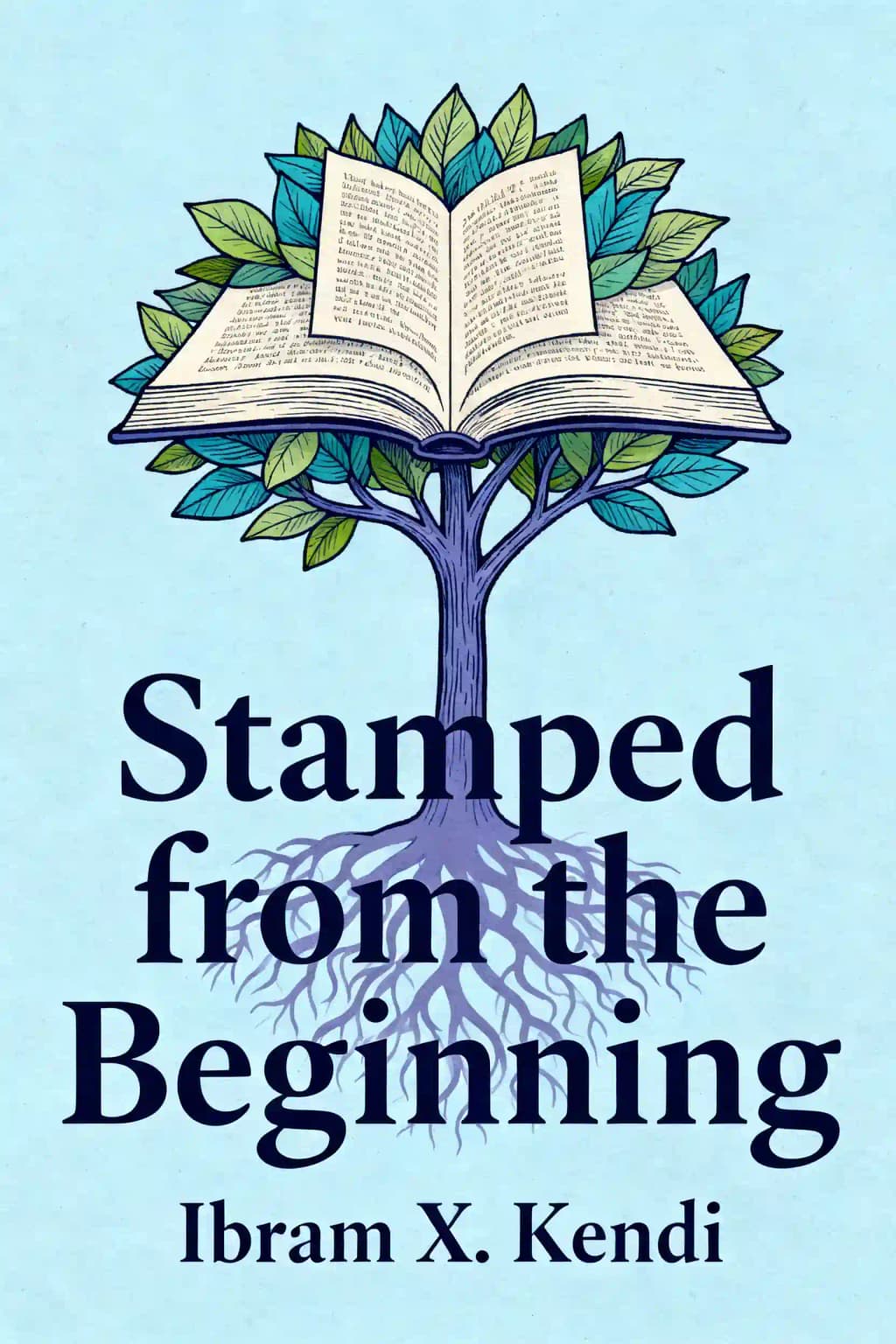
National Book Award-winner that dissects America's racist ideas through centuries. Endorsed by Angela Davis, adapted by Jason Reynolds for younger readers, and integrated into #BlackLivesMatter discourse. Kendi's unflinching historical analysis challenges the myth of a "post-racial" society - revealing uncomfortable truths we must confront.
Ibram X. Kendi, National Book Award-winning author of Stamped from the Beginning: The Definitive History of Racist Ideas in America, is a leading scholar of racism and antiracism in the United States. A professor and founding director of Boston University’s Center for Antiracist Research, Kendi combines rigorous historical analysis with accessible prose to trace the evolution of discriminatory ideologies. His expertise spans academia and public discourse, with roles as a CBS News Racial Justice Contributor and The Atlantic columnist.
Kendi’s groundbreaking work includes the New York Times bestsellers How to Be an Antiracist, a manifesto blending memoir and social critique, and Antiracist Baby, a children’s primer on equity. Co-editing Four Hundred Souls further cemented his authority on African American history. A 2021 MacArthur “Genius Grant” recipient, his research has reshaped national conversations about systemic inequality.
Stamped from the Beginning, lauded for its unflinching examination of racist thought from the 15th century to today, won the 2016 National Book Award for Nonfiction and was adapted into a 2023 Netflix documentary. Kendi’s works have collectively sold millions of copies and are widely taught in academic and corporate diversity programs.
Stamped from the Beginning traces the 600-year history of racist ideas in America, exposing how they were crafted to justify systemic oppression. Kendi analyzes five key figures—Cotton Mather, Thomas Jefferson, William Lloyd Garrison, W.E.B. Du Bois, and Angela Davis—to show how segregationist, assimilationist, and antiracist ideologies evolved. The book won the 2016 National Book Award for Nonfiction for its unflinching examination of racism’s intellectual roots.
This book is essential for educators, activists, and anyone seeking to understand systemic racism’s origins. It’s particularly valuable for readers interested in historical analysis paired with modern relevance, offering tools to identify and challenge racist frameworks. Kendi’s work bridges academic rigor with accessible prose, making it suitable for both scholars and general audiences.
Yes—it’s a Pulitzer Prize-finalist and National Book Award winner praised for reshaping conversations about race. While some critics argue its presentist lens oversimplifies historical contexts, its groundbreaking synthesis of racist ideas’ evolution makes it a vital resource for antiracist education.
Kendi categorizes racist thought as:
These frameworks underpin America’s historical and ongoing racial debates.
Adapted into a Netflix documentary, this metaphor compares systemic racism to self-perpetuating code. Kendi argues racist policies don’t require active maintenance—they persist through institutional inertia, like unchecked algorithms producing biased outcomes. Joel Christian Gill’s graphic adaptation visualizes this through imagery of foundational “garbage” embedded in societal structures.
Kendi condemns assimilationism as a racist ideology that perpetuates whiteness as the cultural standard. He highlights figures like William Lloyd Garrison, whose abolitionist efforts still framed Black people as needing white guidance, reinforcing inequality.
Kendi argues racist ideas persist through coded language (e.g., “thug” replacing racial slurs) and policies like mass incarceration. The 2024 graphic novel adaptation stresses how today’s AI and algorithms often inherit historical biases, demanding active antiracist intervention.
While How to Be an Antiracist offers actionable steps, Stamped provides historical context for those ideas. The former is a manifesto; the latter is a detailed genealogy of racist thought, linking past to present.
Some historians argue Kendi’s presentist approach unfairly judges past figures by modern standards. Critics also note minimal discussion of intersectionality or non-Black racial groups, focusing narrowly on Black-white dynamics.
Kendi analyzes Wheatley’s exploitation as the first published Black poet—forced to prove Black intellect to white audiences. Her ordeal exemplifies how assimilationist demands dehumanized Black achievements.
This metaphor underscores racism’s self-replicating nature. Like untreated cancer, racist systems metastasize when ignored, requiring deliberate “treatment” through policy and ideological change.
Yes—the 2024 graphic novel by Joel Christian Gill adapts Kendi’s work, while SparkNotes and LitCharts offer chapter summaries. These resources help unpack the book’s dense historical analysis.
저자의 목소리로 책을 느껴보세요
지식을 흥미롭고 예시가 풍부한 인사이트로 전환
핵심 아이디어를 빠르게 캡처하여 신속하게 학습
재미있고 매력적인 방식으로 책을 즐기세요
Follow the racist ideas...they lead not to ignorant minds but to powerful interests.
Racist ideas didn't begin with American slavery—they preceded and enabled it.
Enslavement [is] missionary work, portraying Africans as 'living like beasts'.
Black people [are] 'idle, slothful people,' codifying racist stereotypes into law.
[Black souls] are Destroyed for lack of Knowledge.
Stamped from the Beginning의 핵심 아이디어를 이해하기 쉬운 포인트로 분해하여 혁신적인 팀이 어떻게 창조하고, 협력하고, 성장하는지 이해합니다.
Stamped from the Beginning을 빠른 기억 단서로 압축하여 솔직함, 팀워크, 창의적 회복력의 핵심 원칙을 강조합니다.

생생한 스토리텔링을 통해 Stamped from the Beginning을 경험하고, 혁신 교훈을 기억에 남고 적용할 수 있는 순간으로 바꿉니다.
무엇이든 물어보고, 목소리를 선택하고, 진정으로 공감되는 인사이트를 함께 만들어보세요.

샌프란시스코에서 컬럼비아 대학교 동문들이 만들었습니다
"Instead of endless scrolling, I just hit play on BeFreed. It saves me so much time."
"I never knew where to start with nonfiction—BeFreed’s book lists turned into podcasts gave me a clear path."
"Perfect balance between learning and entertainment. Finished ‘Thinking, Fast and Slow’ on my commute this week."
"Crazy how much I learned while walking the dog. BeFreed = small habits → big gains."
"Reading used to feel like a chore. Now it’s just part of my lifestyle."
"Feels effortless compared to reading. I’ve finished 6 books this month already."
"BeFreed turned my guilty doomscrolling into something that feels productive and inspiring."
"BeFreed turned my commute into learning time. 20-min podcasts are perfect for finishing books I never had time for."
"BeFreed replaced my podcast queue. Imagine Spotify for books — that’s it. 🙌"
"It is great for me to learn something from the book without reading it."
"The themed book list podcasts help me connect ideas across authors—like a guided audio journey."
"Makes me feel smarter every time before going to work"
샌프란시스코에서 컬럼비아 대학교 동문들이 만들었습니다

Stamped from the Beginning 요약을 무료 PDF 또는 EPUB으로 받으세요. 인쇄하거나 오프라인에서 언제든 읽을 수 있습니다.
Picture a Portuguese chronicler in the 1400s, quill in hand, crafting the first European defense of African slavery. His name was Zurara, and he faced a problem: how do you justify buying and selling human beings? His solution was elegant and devastating-frame enslavement not as commerce but as charity. Africans, he wrote, lived "like beasts" and benefited from Portuguese bondage. This wasn't just propaganda; it was the birth of a powerful idea that would echo through centuries. Before the first enslaved African set foot in Boston in 1638, before cotton fields stretched across the American South, racist ideas had already been carefully constructed to make the unthinkable seem inevitable. The uncomfortable truth? Racism didn't emerge from ignorance or hatred bubbling up from the masses. It was engineered from the top down, designed by powerful interests to justify policies that enriched them. Follow the racist ideas, and they don't lead to ignorant minds-they lead to profit margins and political power.