1장
The Soul of a Nation: Baldwin's Unflinching Vision for America
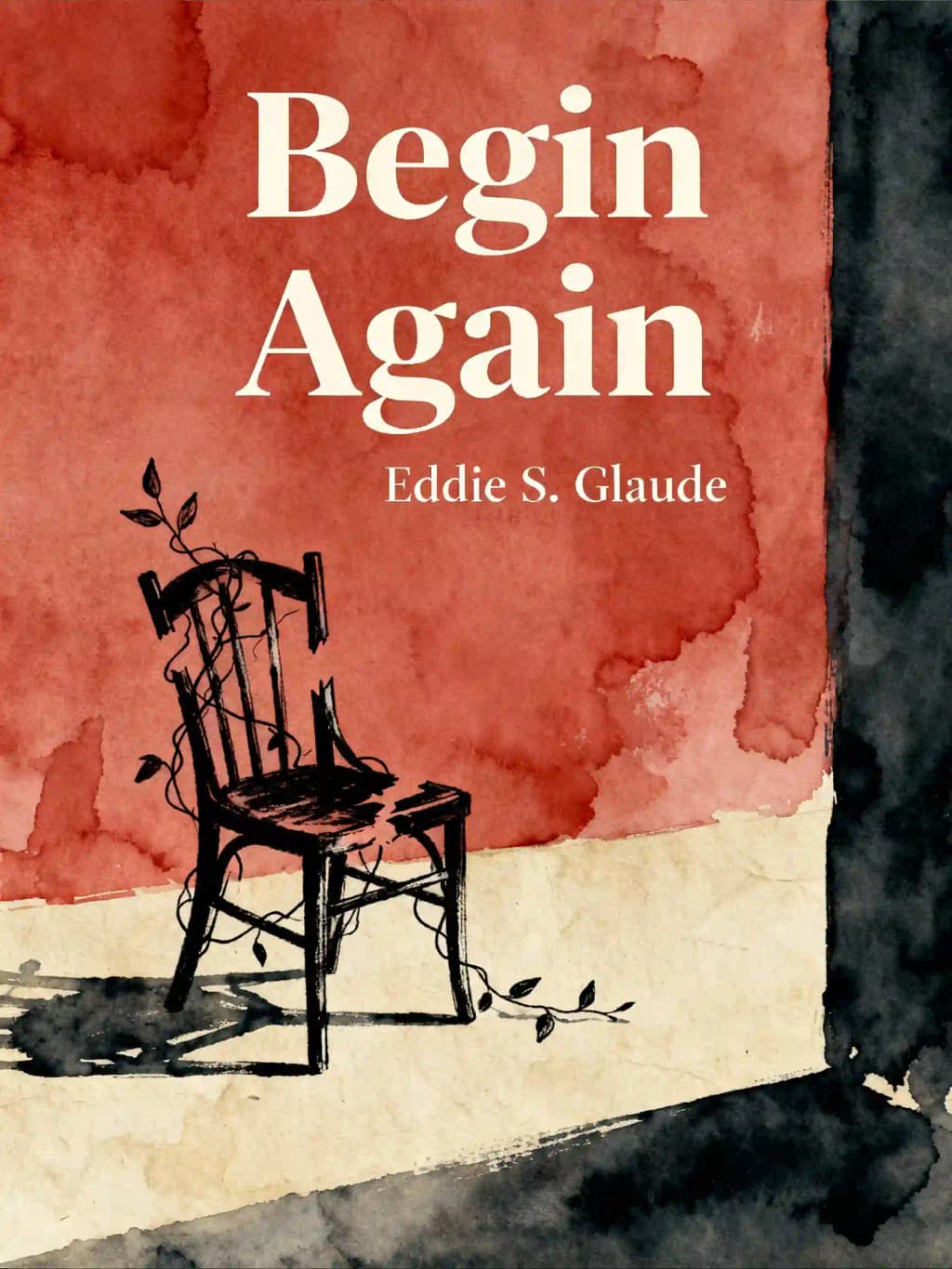
James Baldwin's "Begin Again" arrives at a moment when America desperately needs its message. This searing examination of America's racial history through the lens of one of our greatest writers has become required reading for those seeking to understand our current national crisis. When Barack Obama included it on his 2020 summer reading list, sales surged overnight, making it a fixture on bestseller lists for months. The book's popularity speaks to its timely resonance-as protests erupted across America following George Floyd's murder, Baldwin's decades-old insights felt prophetically current. What makes this work so compelling is how Glaude weaves Baldwin's unflinching moral clarity with our contemporary struggles, creating not just a biography or literary analysis, but a roadmap for confronting America's fundamental contradiction: the belief that white lives matter more than others. Through Baldwin's eyes, we see not just what America has been, but what it might become if we finally confront our history honestly.
2장
The Lie at America's Foundation
At the heart of America lies what Baldwin called "the lie"-a complex architecture of falsehoods supporting the value gap that deems white lives more valuable than others. This lie encompasses multiple deceptions: the debasement of Black people as inherently inferior; mythologized versions of American history that preserve our national innocence; and the deliberate distortion of events to protect that innocence. The lie allows America to avoid confronting the truth about its treatment of Black people and how this moral evasion deforms the national soul.
Baldwin first articulated these ideas during the civil rights movement. By 1963, he had become one of America's most prominent Black writers, with admirers across racial and political lines. That spring, he met with students from Howard University's Nonviolent Action Group, including Stokely Carmichael. These young activists had already faced brutal violence in the South. Baldwin worried about them like an older brother, seeing that legislation alone couldn't cure America's racial pathology. As dawn approached, he made them a solemn pledge: if they promised never to accept society's degrading definitions of them, he would never betray them-an avowal of love and his responsibility as a truth-telling writer.
Baldwin understood the writer's moral obligation was to disturb America's complacency by forcing confrontation with society as it truly was. He recognized that in critical moments of transition, when established hierarchies appear to collapse, deep-seated fears emerge about loss of standing and privilege. The language of "backlash" fails to capture this dynamic, cloaking white fears in innocence. These fears reveal what's at the heart of white identity-the terror that genuine democracy means surrendering particular material and symbolic advantages.
Today, we see the lie manifested in our "after times"-a response to Obama's presidency and Black Lives Matter's demands for justice. Trump's victory unleashed what Baldwin might call another cycle in America's tragic racial history. His refusal to condemn white supremacists, draconian immigration policies, and embrace of divisive rhetoric revealed how the country had lurched rightward, reasserting the lie while activists scattered, traumatized by their efforts. Baldwin's understanding of these cycles provides a powerful lens for interpreting our current moment, revealing that what appears new is actually a familiar pattern in American history.
3장
Bearing Witness to America's Trauma
Baldwin's concept of bearing witness forms the cornerstone of his moral vision. More than mere observation, witnessing for Baldwin meant confronting America's racial realities-the legacies of slavery, systemic discrimination, and the willful blindness sustaining it all-while transforming this experience into art. He lamented the suffering caused by our evasions and passed judgment on what we've done and not done. Baldwin bore witness for those who didn't survive and for those who survived wounded and broken.
This witnessing was inextricably linked with trauma-both personal and collective. In his book "No Name in the Street," Baldwin's memory fragments as past and present collide. "The mind is a strange and terrible vehicle," he wrote, describing how sorrow drove his mind backward to places and people he thought forgotten. His witness was colored by the betrayal of the civil rights movement and the horrors of American racism he had observed over sixteen years.
The power of Baldwin's witness is illustrated by his misremembered encounter with Dorothy Counts' story. In 1957, fifteen-year-old Counts attempted to integrate Harding High School in Charlotte, North Carolina. As she walked toward school in her new dress, white students hurled racial slurs, threw sticks and ice, and spat on her while police refused to protect her. After enduring this treatment for just four days, Dorothy never returned. Don Sturkey's photographs of this harrowing experience traveled worldwide. Baldwin later claimed these images prompted his return to America from Paris, though this was actually a memory error-the timeline didn't match his actual return.
This misremembering reveals how trauma colors witness. Baldwin understood that trauma fragments memory-we recall what we can to keep ourselves together. By 1972, writing in "No Name in the Street," Baldwin's misremembering sought to orient readers to the aftermath of the civil rights movement while highlighting ongoing trauma. "What one does not remember," he warned, "is the serpent in the garden of one's dreams." Baldwin consistently viewed traumatic memory as inescapable: "Terror cannot be remembered. One blots it out." Yet these terrors move us about despite our attempts to redirect memories.
America has never directly confronted its racial trauma because the lie doesn't allow for it. Instead, the country minimizes trauma by shifting blame to fringe actors, relativizing historical values, or blaming the traumatized themselves. Without mechanisms like truth and reconciliation commissions, America seeks rituals of expiation without admission of guilt. This "historical gaslighting" denies the crime Baldwin wrote about, as we lie, cover up sins, and mute the traumas they cause.
4장
The Dangerous Road Before Martin Luther King
On March 16, 1968, Baldwin introduced Dr. Martin Luther King, Jr. at a fundraiser at Anaheim's Disneyland Hotel. Rather than offering a triumphant narrative, Baldwin recounted how "what Rosa Parks was saying in 1956 in Montgomery... the country did not want to hear or did not hear." He spoke of activists "being beaten with chains, going to jail, marching up and down those dusty highways" while "nobody heard and nobody cared." Baldwin's introduction emphasized the wall of white supremacy blocking fundamental transformation and the urgency they faced at this crossroads.
By 1968, King faced intense pressure as the nation turned against his moral vision. His Vietnam War stance led some to call him a traitor, and The New York Review of Books declared he had been "outstripped by the times." Baldwin had foreseen this turn in his 1961 Harper's Magazine article "The Dangerous Road Before Martin Luther King," noting King was "more beleaguered than ever before" and facing criticism from within the Black community about his effectiveness as a leader.
The black freedom movement had upended traditional models of Black leadership that were codependent with the white world. King found himself caught in the crossfire between established civil rights organizations and a younger generation who "have never believed in the American image of the Negro and have never bargained with the Republic." By 1968, King was in a nearly impossible position, unable to deliver the change Black America sought yet unwilling to embrace more radical measures some deemed necessary.
Though temperamentally distant, both King and Baldwin resisted efforts to draft the civil rights movement into a narrative of American triumphalism. At Carnegie Hall, celebrating W.E.B. Du Bois's hundredth birthday, King acknowledged what Du Bois had taught: "black people have been kept in oppression and deprivation by a poisonous fog of lies that depicted them as inferior." Though King disagreed with Black Power rhetoric, he understood the conditions that made it necessary.
Their final meeting was at a New York fundraiser. Baldwin bought a new dark suit for the occasion, later recalling, "Two weeks later, I wore this same suit to Martin's funeral." When Baldwin received news of King's shooting while in Palm Springs, he dropped the phone and wept. Billy Dee Williams observed that "Martin's death was with Jimmy for a long time. I doubt if he ever got over it. Much of his hope died with King."
5장
The Battle Over American History
The battle over American history erupted violently in August 2017 when James Fields Jr., a neo-Nazi, drove his car into counterprotesters at the Unite the Right rally in Charlottesville, killing Heather Heyer and injuring thirty-five others. The rally had been organized to protest the removal of Confederate monuments, particularly the Robert E. Lee statue that the city council had voted to remove.
The Confederate monuments controversy reveals how American history shapes our identity and future. White nationalists celebrate these monuments as tributes to white supremacy, while others claim them as "heritage." But historians have shown these statues weren't contemporaneous Civil War memorials-most were erected decades later as ideological symbols of the "Lost Cause" mythology that denied slavery's centrality to the Civil War.
Black people have long challenged these monuments. W.E.B. Du Bois's 1935 book "Black Reconstruction" exposed the lies in the historiography around Reconstruction, criticizing historians who portrayed the period as corrupt federal overreach and viewed giving political rights to former slaves as "a monstrous mistake." As King later noted, these distortions were "a conscious and deliberate manipulation of history" designed to prove "freedom was dangerous in the hands of inferior beings."
When President Trump equated Confederate generals with Founding Fathers after Charlottesville, asking if Washington and Jefferson statues should also come down because they owned slaves, he revealed the complex question of how we confront our history. The issue isn't simply whether statues stay up or come down, but how we tell America's story in a way that neither glosses over cruelty nor demonizes the entire society.
Princeton University faced its own historical reckoning in 2015 when the Black Justice League staged a thirty-three-hour sit-in demanding the administration acknowledge Woodrow Wilson's racist legacy and remove his name from campus buildings. Wilson, celebrated as the architect of Princeton's rise to elite status, had also been a segregationist who reversed federal integration progress.
The university ultimately kept Wilson's name on buildings but agreed to complicate its narrative about him, adding signage acknowledging his racism and Princeton's racial history. They also diversified campus representation, notably renaming West College after Nobel Prize-winning writer Toni Morrison.
We must get the facts right about our history or risk perpetuating what Du Bois called "lies agreed upon." Washington and Jefferson owned slaves-Jefferson exploited Sally Hemings and questioned Black biological inferiority in his writings. Facts alone aren't enough; interpretation matters too. How we tell the story of America's founders and confront slavery's horror reflects the values and society we aspire to create.
6장
Between Black Power and Moral Vision
By 1967, Baldwin occupied a precarious position-rejected by white liberals for his "ingratitude" and criticized by Black militants who included him in their "Bootlickers gallery." His politics had evolved beyond liberal reform, recognizing that Selma, Birmingham, and the murders of Medgar Evers and Malcolm X had proven its inadequacy.
Yet Baldwin remained wary of Black Power's separatist tendencies and rejection of moral arguments. "I would like us to do something unprecedented," he wrote in 1967, "to create ourselves without finding it necessary to create an enemy." While acknowledging the necessity of policy and power, Baldwin insisted that what kind of human beings we aspire to be mattered more.
Baldwin's stance on Black Power was characteristically nuanced. He had identified early with young activists challenging traditional leadership models, even becoming a member of CORE and SNCC. He understood how the brutal experiences in the South had transformed these young people, making "We Shall Overcome" seem like a minstrel tune in the soft-shoe dance white folks demanded of Black protesters.
By 1967, Baldwin recognized that moral appeals seemed inadequate as the country turned its back on the movement. "The disaster [was] upon us," he wrote, arguing that white America's choice to remain racist made Black Power necessary. Yet he rejected separatism as a philosophical dead end-we were, and would always be, American. He also warned against essentialist notions of Blackness, echoing his earlier critique that "we will sacrifice all the beauty of our lives... in order to deny the fact of death, which is the only fact we have."
Baldwin's engagement with Black Power came at a significant cost to his reputation. His 1968 novel "Tell Me How Long the Train's Been Gone" received scathing reviews, with Mario Puzo suggesting Baldwin had sacrificed art for polemics. Hilton Als later claimed that "by 1968, Baldwin found impersonating a black writer more seductive than being an artist."
But this criticism often masked rejection of Baldwin's evolving politics as much as his art. Post-"Fire Next Time," Baldwin openly questioned capitalism, criticized white supremacy, condemned U.S. imperialism, and prophesied the West's decline. In his 1970 letter to Angela Davis, he declared: "We know that we, the blacks, and not only we, the blacks, have been, and are, the victims of a system whose only fuel is greed, whose only god is profit."
The nuance and complexity that estranged Baldwin from old friends similarly alienated him from the Black Panther newspaper, which included him among "bootlickers" in 1967. This rejection, particularly from Eldridge Cleaver, reflected their inability to grasp Baldwin's complex view of race and his fundamental critique of America. To many Black Power advocates, Baldwin seemed a relic obsessed with white people's moral state while cities burned.
7장
Finding Elsewhere in Troubled Times
Baldwin found solace in Istanbul, where he lived on and off for roughly a decade. Unlike Paris, he wasn't yet famous there when he first arrived. Istanbul provided the quiet space where he wrote or completed major works including "Another Country," "The Fire Next Time," and "No Name in the Street." When he appeared unexpectedly at Engin Cezzar's door in 1961, Baldwin was nearly penniless, exhausted, and desperate to finish "Another Country." Cezzar offered him friendship, shelter, and stability: "I saved Jimmy in a very, very bad period in his life." By 1970, Baldwin would tell Ebony magazine that Istanbul was "a place where I can find out again-where I am-and what I must do. A place where I can stop and do nothing in order to start again."
For Baldwin, "elsewhere" was that physical or metaphorical place affording space to breathe, to refuse adjustment to society's demands, and to live apart from deadly assumptions that threaten to smother. Istanbul became Baldwin's elsewhere-providing critical distance from American life's deadly dynamics. Despite living there for nearly a decade, he never learned Turkish, moving through teahouses and bookshops in relative silence except when with translators. This silence enabled him to hear his own language and feel his grief more deeply. Without such an elsewhere, Baldwin wrote, we can be "broken on the wheel of life." In America, he felt "free only in battle, never free to rest-and he who finds no way to rest cannot long survive the battle."
Baldwin sometimes used "exile" to describe his life outside America but never straightforwardly. "As an exiled American...I am faced with a choice of exiles," he told John Hall. For Baldwin, Black people were already "natally exiled"-in but not of America. He rejected being labeled an expatriate, preferring to use France and Istanbul as an elsewhere that allowed him to reorient himself toward America. "I was driven to Europe, and my position is a misleading one. I'm not a European... what I mainly learned was about my own country, my own past, and about my own language." America remained always on his mind, no matter where he laid his head.
In our own time, Trumpism deliberately occupies every ounce of our attention, forcing resignation to the "banality of evil and the mundaneness of cruelty." Like Baldwin after 1968, we must seek an elsewhere-not necessarily physical departure, but spaces to breathe and think amid political chaos. Baldwin would insist we find our elsewhere in these "after times" right here: in our refusals to accommodate the status quo and in small moments when we make choices outside confining norms. This elsewhere emerges when we cultivate communities of love that allow us to imagine different ways of being together-pulling loved ones closer and opening ourselves to new connections as counterweights to political ugliness.
8장
America's Ruins and Reagan's Shadow
By the mid-seventies, despite civil rights legislation, the black freedom movement's efforts to transform America had fallen apart. Deepening poverty engulfed large segments of black America, a growing carceral state menaced black communities in the name of law and order, and white supremacy continued choking American democracy. The movement had revealed America's true character, confirming black people's long-held suspicions about racism nationwide. As Baldwin observed in 1979: "I don't want to say that nothing has changed. Something is always changing. But the spirit of the South has not changed... The spirit of the South is the spirit of America." The 1970s forced a confrontation with a frightening truth: despite the sacrifices of the black freedom struggle, white America remained comfortable with profound racism.
Ronald Reagan's 1980 presidential campaign with its slogan "Let's make America great again" consolidated a new conservative era dominated by small government ideology, dismantling welfare, deregulation, privatization, tough-on-crime policies, tax cuts for the wealthy, and military strength. Meanwhile, modest gains by the black middle class and desegregation led some to believe sufficient racial progress had occurred. Baldwin recognized how time was making a lie of history, allowing white Americans to forget Reagan's negative reactions to the black freedom movement while becoming simply the genteel actor declaring "morning in America." For most black people, however, Reagan embodied white America's rejection of the 1960s movement.
For Black Americans, history and time blur as present traumas trigger recollections of past betrayals. Amiri Baraka called this "the changing same"-a sense of alienation rooted in terror and trauma that persists despite life's changes, worsened by America's deliberate forgetfulness. Baldwin saw the sixties' betrayals as connected to the century's broader horrors-from the Holocaust to Hiroshima to Vietnam-with Reagan and Thatcher emerging as supposed remedies to this postmodern malaise. Instead of confronting these horrors, America retreated into what Baldwin called a "weird nostalgia" for a time that never existed.
Baldwin's documentary "I Heard It Through the Grapevine" chronicled the collapse of the New Deal political order and the emergence of Reagan's conservatism. Just twelve years after the Fair Housing Act of 1968-the last major Great Society legislation aimed at addressing racial inequalities-America elected Reagan, whose mission was dismantlement. Reagan's campaign revealed his loyalties when he spoke at the Neshoba County Fair in Mississippi, near where civil rights workers Goodman, Schwerner, and Chaney were murdered, declaring his commitment to "states' rights." His attacks on affirmative action, engagement with apartheid South Africa, and gutting of civil rights commissions signaled a hard change in racial politics, all cloaked in the language of color blindness.
9장
Begin Again: Toward a New America
Baldwin's "begin again" concept demands we free ourselves from the lie and reimagine America's fundamental values. We must reckon with our trauma, understand our disappointments, and fight again. Baldwin struggled after King's murder and witnessed Reagan's election, which he saw as white America's refusal to change on race matters. Baldwin remained a "disturber of the peace" until his death.
America has faced two previous moments of moral reckoning-during the Civil War/Reconstruction and the black freedom struggle-both times failing to truly transform. Reconstruction represented a second founding with expanded federal power and citizenship untethered from race through the Civil Rights Act of 1866 and Civil War amendments. Now we face a moral reckoning of similar magnitude, requiring more than just changing laws or trusting politicians.
We must eliminate the belief that white people matter more, or we'll repeat our ugly history cycles. We need a third American founding without the value gap, requiring a new American story, different symbols, and policies of repair like H.R. 40 to establish a truth and reconciliation commission. This transformation must reject pre-Trump "normalcy" and untether our politics from racial assumptions.
At the National Memorial for Peace and Justice in Montgomery, visitors experience a sacred space designed for healing. The memorial begins with Kwame Akoto-Bamfo's haunting Nkyinkyim Installation showing chained slaves in agony and defiance. As visitors walk upward along the path, they encounter 800 vertical steel monuments representing counties where lynchings occurred, resembling "a prairie full of rusted, brown coffins." Initially at eye level, these monuments remain suspended as the floor descends, creating the unsettling impression of bodies hanging above. The memorial confronts America's traumatic history directly, offering what Bryan Stevenson calls a sequential path to reconciliation: "you can't have reconciliation without the truth."
America stands at a critical crossroads with the lie of the American idea fully exposed. We must either embrace the value gap as Trumpism demands or risk everything to become the first true multiracial democracy in the West. Baldwin's work teaches us that whiteness is a moral choice based on ugly things, but people can choose differently if we build a world where that choice comes easily.
If we organize and fight for an America free from binding categories, implement policies addressing generational injustices, and demonstrate that every human being is sacred, we can create a New Jerusalem where the value gap cannot survive. This requires bold vision beyond incremental approaches. Our history shows we've been stuck before, and our "after times" demand big ideas, not the comforts of the familiar.
The enslaved survived by imagining the world as it could be, finding power in love and imagination. Baldwin, despite his loneliness and the country's betrayals, always believed we could be better. He ran toward trouble because facing it honestly was our only path to salvation. We must walk through the ruins, confront our terror and fear, and expose the lie that corrupts American life. Baldwin wants us to imagine ourselves without enemies, to become a new creation reflecting a new America where Black children aren't born in exile and everyone can finally feel at home.