1장
The Earth's Whisper: Rediscovering Our Place in Nature
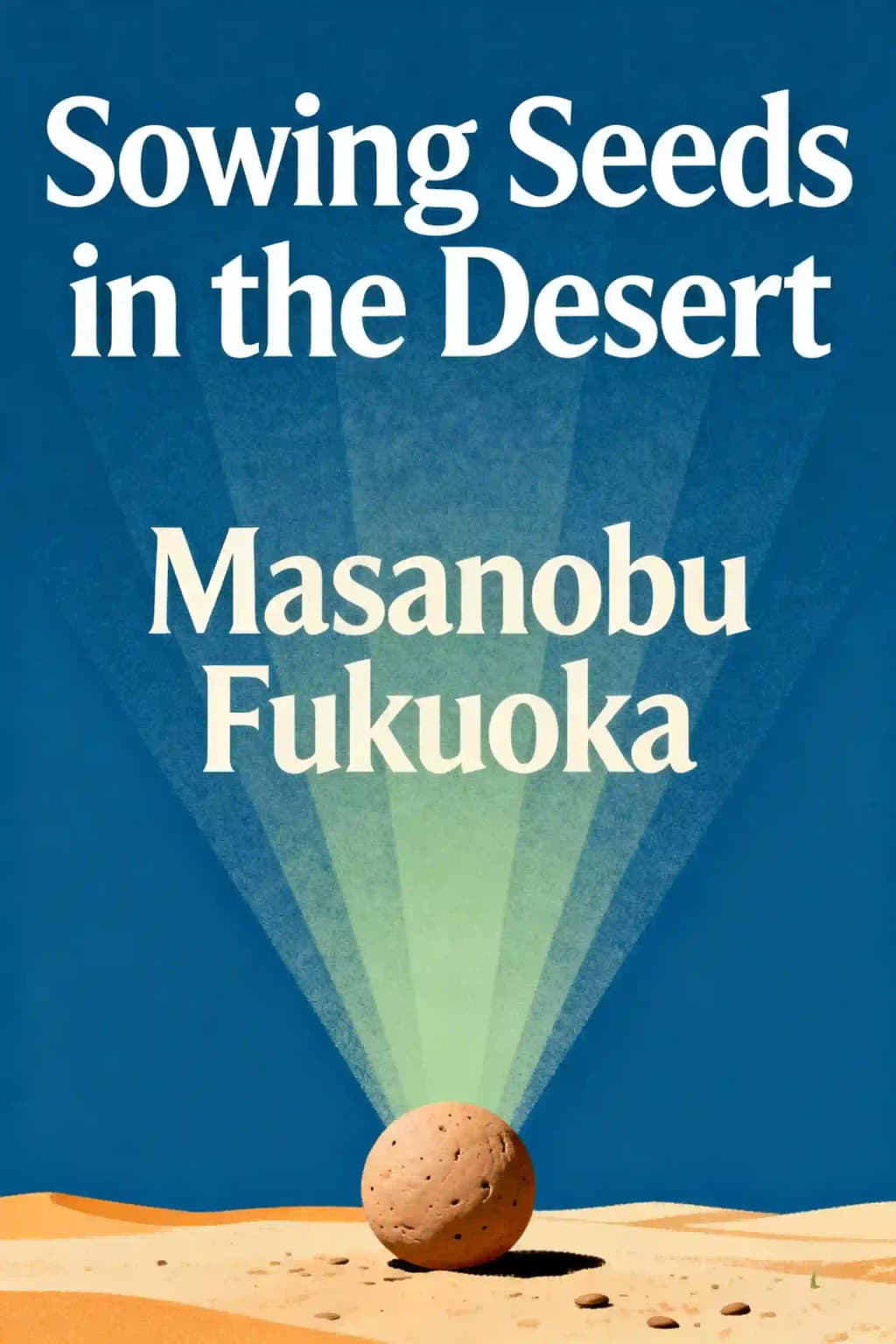
Masanobu Fukuoka's "Sowing Seeds in the Desert" represents the culmination of a revolutionary agricultural philosophy that has quietly transformed farming practices worldwide. Since its publication, this final work of the Japanese farmer-philosopher has become required reading for sustainable agriculture programs at universities like Yale and Stanford. Even celebrities like Leonardo DiCaprio and Willie Nelson have cited Fukuoka's natural farming approach as inspiration for their own environmental activism. What makes this book particularly remarkable is that its author-who never completed formal agricultural training-developed methods that consistently outperformed Japan's most scientifically advanced farms while using no machinery, chemicals, or prepared compost. His "do-nothing" approach isn't about laziness but rather about profound trust in nature's inherent wisdom-a radical notion that challenges virtually everything modern agriculture stands for.
2장
The Spiritual Awakening That Changed Everything
At twenty-five, Fukuoka's life took a dramatic turn during a harrowing battle with pneumonia that brought him face-to-face with his own mortality. After days of feverish contemplation about the meaning of life and death, he experienced what can only be described as a profound spiritual awakening. One night, in a state of existential crisis, he wandered aimlessly through the streets until exhaustion overtook him beneath a tree overlooking Yokohama harbor. As dawn broke, awakened by a heron's cry piercing the morning mist, he witnessed the world with entirely new eyes-everything appeared fresh, radiant, and interconnected in ways he had never before perceived. The trees, the soil, the birds, and even the morning dew seemed to pulse with a unified life force he had previously overlooked.
"I realized I had been foolishly searching for something that had been right before me all along," Fukuoka writes. "In that moment, I understood that all the knowledge I had accumulated was actually a barrier to true understanding." This revelation shattered his previous scientific worldview and compelled him to abandon his prestigious position as a plant inspector at the Customs Bureau, where he had been rapidly advancing in his career. Despite the protests of colleagues and family, he returned to his family farm in Ehime Prefecture with a singular mission: to create an agricultural system that honored his newfound understanding of nature's perfect balance.
His first experiment-simply doing nothing to the citrus orchard-ended in devastating failure, killing over 200 trees. This costly lesson taught him the crucial distinction between mere abandonment and true natural farming. The land, he discovered, had been so fundamentally altered by modern agricultural practices that it couldn't simply snap back to its natural state without thoughtful transition. During World War II, he reluctantly worked as a plant pathologist while developing his philosophy, using this time to carefully observe how nature operated without human intervention. After the war, he devoted himself entirely to perfecting his approach, meticulously documenting how each small change affected the entire ecosystem. Eventually, his methods yielded harvests equal to or greater than conventional farms while improving soil fertility each season, something his critics had deemed impossible.
What makes Fukuoka's journey so compelling is not just the personal sacrifice it entailed, but the profound courage it demonstrated. He abandoned a promising scientific career at its peak, sacrificing financial security and professional respect. He endured decades of ridicule from neighboring farmers who considered his methods absurd and openly mocked his failures. Local agricultural officials labeled him a madman, and his own family questioned his sanity. Yet he persisted through countless failures, driven by an unshakable conviction that modern agriculture was fundamentally misguided. His breakthrough came when he realized that each intervention to "fix" one problem inevitably created cascading new problems - pesticides killed beneficial insects along with pests, chemical fertilizers boosted growth but weakened plants' natural resilience, tilling solved short-term issues but destroyed soil structure. The solution, he concluded, wasn't better intervention but less-a counterintuitive approach that eventually proved revolutionary and influenced sustainable farming movements worldwide.
3장
The Illusion of Human Knowledge
At the heart of Fukuoka's philosophy lies a radical critique of human knowledge itself. He argues that what we call "knowledge" is merely the act of distinguishing between things based on surface appearances without grasping their intrinsic nature. This separation begins in childhood when we first distinguish between self and other-saying "I see the moon" creates a division between observer and observed that transforms our once intimate relationship with nature into something distant and analytical.
"A child's direct perception of the moon reveals more truth than all our scientific expeditions and moon rocks," Fukuoka insists. Our analytical approach to understanding-dividing knowledge into ever-smaller fragments-creates the illusion of increased comprehension while actually leading us further from holistic truth.
Fukuoka challenges foundational scientific theories that have shaped modern civilization. Darwin's theory of evolution, he argues, imposes arbitrary hierarchies on species based on human-centered logic rather than nature's reality. In nature, all living things depend on one another in cyclical relationships with no grounds for claims of superiority. Similarly, our linear conception of time-flowing from past through present to future-fails to capture what Fukuoka calls "transcendent time" where past, present, and future exist simultaneously in an eternal now.
Even our understanding of genetics misses the mark. The identical structure of DNA across all living organisms indicates their fundamental unity. Whether something becomes a plant or human depends merely on which genetic factors surface or remain dormant. Like islands in Japan's Seto Inland Sea that appear separate but connect beneath the water, all living things appear different but remain connected at their base.
This perspective leads Fukuoka to propose his "Dharma Wheel Theory of Flux in All Things" as an alternative to Darwin's linear evolution. Rather than species evolving sequentially over time, perhaps all seeds of life were scattered simultaneously, programmed to activate under specific conditions. Nature is one body, expanding three-dimensionally while simultaneously contracting, spinning like a cosmic wheel where "one is many, the individual is the whole, and nothing is useless."
What's remarkable about these philosophical insights is that they emerged not from academic study but from decades of careful observation in Fukuoka's fields. When insects created holes in rice grains allowing cross-pollination with different varieties, he discovered that natural hybridization occurred without human intervention. These natural hybrids flourished in his fields but couldn't survive in conventional fields sprayed with insecticides-living proof that nature's wisdom exceeded human design.
4장
Healing a World in Crisis
Fukuoka's critique extends beyond agriculture to medicine, economics, and our relationship with death. Western medicine, he observes, treats symptoms by examining ailing parts in isolation, while Eastern medicine assesses overall health through holistic observation. Though both aim to heal, they move in opposite directions-Western medicine focuses on curing sickness while Eastern medicine maintains health.
"Physicians should be guides to life," Fukuoka argues, "sometimes helping people live truthfully through death rather than extending biological life without joy." Our fear of death stems not from bodily death itself but from losing attachments to wealth, fame, and worldly desires. If people lived according to natural law, they could die peacefully like withering grasses, with nature-not priests or physicians-announcing death's coming.
Fukuoka's economic critique is equally penetrating. He calls our system the "money-sucking octopus economy" with politicians and the military-industrial complex at its center, and eight controlling tentacles: transportation networks, transportation agencies, communications, economic information, education, financial institutions, information control, and citizen registration. Everything gets pulled to the center, accumulating wealth that fuels centralized authority-a tragic dance performed on the backs of common people and farmers.
Modern agriculture exemplifies this dysfunction. What appears as "production" is actually deduction-depleting stored energy while creating the illusion of productivity. Fifty years ago in America, each calorie invested in rice farming yielded two calories of grain. Now, two calories of energy input produces only one calorie of grain-a net loss disguised as progress. This petroleum-dependent system means whoever controls oil controls the world's food supply, a disturbing reality as we squander the earth's stored solar energy while congratulating ourselves on our efficiency.
The environmental consequences are devastating. Flying over Somalia, Fukuoka discovered large, ancient trees-remnants of dense forests that had disappeared centuries ago. Colonial agricultural policies had introduced commercial crops like coffee and cotton while forbidding personal food crops, reducing farmers to mere laborers. The disruption of nomadic lifestyles through arbitrary national boundaries destroyed carefully balanced tribal grazing systems that had maintained the land for centuries.
5장
Sowing Seeds of Hope in the Desert
Fukuoka's solution to these interlocking crises is radical yet simple: revegetate the earth's deserts using natural farming methods. His approach involves mixing seeds of all plants-forest trees, fruit trees, vegetables, grasses, legumes, mosses, and lichens-along with fungi and soil microorganisms, encasing them in protective clay pellets, and broadcasting them widely across damaged landscapes. This comprehensive mixture ensures a diverse ecosystem can potentially establish itself, mimicking nature's own regenerative processes.
These clay pellets serve multiple critical functions: they protect seeds from animals and insects while providing moisture and nutrients for germination. The clay coating acts as a miniature greenhouse, maintaining optimal conditions for the seed until environmental conditions favor sprouting. When rain comes, heat-resistant, drought-tolerant pioneer species like acacia and mesquite survive first, creating vital shade and windbreaks for other vegetation to establish. One tree becomes a natural water pump, its transpiration acting as both sprinkler and fan, creating a microclimate that benefits surrounding plants. The tree's roots also break up compacted soil, allowing water to penetrate deeper. As plants multiply, they attract insects, birds, and animals that bring more seeds, creating a self-reinforcing cycle of regeneration.
Fukuoka deliberately mixes seeds from worldwide sources because global conditions have changed dramatically. Soil erosion, chemical agriculture, and climate change mean native plants may no longer thrive in their original environments. By mixing all species and scattering them worldwide-what he calls the "Second Genesis"-we give nature a full palette to establish a new balance under current conditions. This approach acknowledges that ecosystems must adapt to new realities while maintaining biological diversity. He includes both annual and perennial plants, nitrogen-fixing species, and plants with varying root depths to build soil structure.
This approach has shown remarkable success in diverse environments. In India's Ganges River delta, aerial seeding of mangroves produced twenty to thirty varieties stretching as far as the eye could see, creating habitat for shellfish, crabs, and numerous marine species. The mangroves also protect coastlines from erosion and storm surge. Even in the harsh conditions of Chambal Gorge's bare red earth hills, clay seed pellets began establishing vegetation where conventional approaches had failed. Similar success has been documented in arid regions of Africa and Australia.
What makes Fukuoka's method revolutionary is its simplicity, scalability, and low resource requirements. Unlike conventional desert revegetation that relies on scarce water resources, expensive infrastructure, and constant maintenance, his approach works with nature's own mechanisms to generate rainfall through vegetation. Starting from rivers and underground water sources, "plant-based irrigation" systems use vegetation that naturally carries water through the landscape. Trees planted sixty feet apart create living networks where roots spread thirty feet in all directions, carrying water with them and gradually improving soil fertility and water retention. This natural infrastructure becomes self-maintaining once established, requiring no further human intervention. The method can be implemented by local communities using locally available materials, making it both economically viable and culturally appropriate for large-scale restoration projects.
6장
A Growing Revolution in America
During Fukuoka's visits to the United States in the late 1970s and early 1980s, he discovered a burgeoning natural farming movement that exceeded his expectations. Weekend farmers' markets particularly delighted him-vibrant gatherings where locally-grown organic produce was sold alongside handcrafts amid music and performances. Unlike sterile supermarket environments, these markets fostered direct farmer-consumer relationships, with vendors enthusiastically explaining their growing methods, soil practices, and seasonal variations. The markets created community hubs where environmental awareness and sustainable agriculture principles could spread organically through conversation and demonstration.
Even large-scale commercial farmers were beginning to adopt his principles, challenging the notion that natural farming was only viable for small operations. When Fukuoka revisited Mr. Lundberg's 7,500-acre rice farm in the Sacramento Valley, he found all four brothers had fully embraced natural farming methods. Despite barnyard grass growing throughout his rice fields-something considered catastrophic failure in Japan's perfectionist agricultural culture-Lundberg's fields produced yields comparable to conventional Japanese methods. By marketing innovative blends of brown, black, and long-grained rice at premium prices to health-conscious consumers, he demonstrated that natural farming could be commercially viable at scale. The Lundberg success story became a powerful example that profitable farming didn't require chemical inputs or mechanical cultivation.
Fukuoka observed that Americans possessed a practical, down-to-earth approach and an openness to nature that made them more tolerant of natural farming's apparent disorder. With their spacious residential lots, often an acre or more in suburban and rural areas, American families could potentially achieve significant self-sufficiency through home gardens. He advocated transforming urban landscapes by replacing purely ornamental street trees with productive fruit trees and converting resource-intensive lawns into vegetable gardens. However, he noted Americans' deep cultural attachment to manicured lawns and pristine landscaping created resistance to widespread adoption of more natural approaches. This highlighted the challenge of shifting deeply ingrained cultural aesthetics around what constitutes a "proper" yard.
At agriculture departments like UC Davis-traditionally research stations for agribusiness-Fukuoka found encouraging signs of change, with students increasingly pulling faculty toward organic and sustainable methods. During lively discussions and seminars, he explained his holistic philosophy that understanding a single flower means understanding everything-that religion, philosophy and science are ultimately one unified whole, yet simultaneously nothing at all. Natural farming, he emphasized, aims to liberate the human heart by abandoning the hubristic notion that humans create things, instead allowing nature to return to its true form. This resonated particularly with young agricultural students seeking alternatives to industrial farming methods. Many were drawn to his integration of spiritual and practical dimensions in approaching agriculture.
7장
Creating Your Own Natural Farm
For those inspired to create their own natural farms, Fukuoka offers comprehensive practical guidance. The ideal location should include not just cultivated fields but surrounding hills and forests to create a complete, self-sustaining ecosystem. This diversity of landscape provides natural windbreaks, supports beneficial insects and wildlife, and creates microclimates that benefit crop production. Rather than laboriously burying organic matter to build soil fertility, it's better to plant diverse species with extensive root systems that naturally soften soil and cycle nutrients. Plants like daikon radish, comfrey, and deep-rooted perennials are particularly effective at breaking up compacted soil and mining minerals from deeper layers.
When creating an orchard, the natural approach involves selective thinning rather than wholesale clearing of land. Unlike conventional methods using bulldozers that strip precious topsoil and destroy soil structure, natural orchards maintain all organic matter on site. Cut trees are left to decay where they fall, with smaller trimmings and branches strategically piled along contour lines to create improvised terraces that prevent erosion and retain moisture. Plant fruit trees along the contour of slopes, ideally in holes enriched with coarse organic matter like wood chips, leaves, and straw, and in raised mounds that improve drainage and root development. Fukuoka recommends spacing trees according to their mature size, typically 15-20 feet apart for standard fruit trees.
In the spaces between fruit trees, grow companion crops without clearing or meticulously preparing the ground. Begin by controlling aggressive weeds and maturing the soil with fast-growing green manure plants like buckwheat and amaranth in summer, and daikon radishes and mustard in winter. These plants help suppress weeds while building organic matter. The following year, introduce nitrogen-fixing crops like adzuki beans, cowpeas, and soybeans in summer, and hairy vetch and crimson clover in winter. As the field matures and soil health improves, you can grow increasingly diverse crops including vegetables, herbs, and grains in a polyculture system.
For rice cultivation, Fukuoka points to the traditional paddies near Sukhothai, Thailand as exemplars of the natural farming approach. These systems harmoniously combine the work of farmers, beneficial plants, animals, and amphibians in a balanced ecosystem. Fish eat insect pests, while ducks control weeds and add fertilizer. In Japan, Fukuoka successfully demonstrated that rice can thrive in rain-watered dry fields using no-till methods, heavy straw mulch, and white clover ground cover. This approach improves soil structure and fertility year after year while controlling weeds without the need for flooding or chemical inputs. His methods typically yielded harvests comparable to or exceeding conventional farming while requiring significantly less labor and no purchased inputs.
8장
The Legacy of a Visionary
Perhaps the most touching moment in Fukuoka's American journey came during his return to the Zen Center's Green Gulch Farm. There he discovered that Harry Roberts, a Native American elder who had deeply understood his mission, had carefully planted Japanese cedar seeds Fukuoka had sent him years earlier. On his deathbed, Roberts had raised himself to plant these seeds, saying, "These seeds are Fukuoka's spirit. Sow them carefully." This act symbolized the deep spiritual connection between two men from vastly different cultures who shared a profound understanding of humanity's relationship with the earth.
When Roberts' students showed Fukuoka the Japanese cedars, some already six feet tall, and pointed to their teacher's simple grave across the valley, saying "Our teacher must be calling out to you, saying 'Let's plant seeds in the desert together,'" Fukuoka burst into uncontrollable tears. He realized this man who understood his mission to revegetate the earth might be the only person he would ever meet who truly comprehended him. The cedars stood as living monuments to their shared vision, bridging Eastern and Western approaches to land stewardship.
This moment encapsulates Fukuoka's legacy-not just as an agricultural innovator but as a philosopher who recognized the profound connection between human consciousness and the health of our planet. His "do-nothing" farming wasn't merely a technique but an invitation to fundamentally reconsider our relationship with nature. His methods, which included natural farming techniques like seed balls and no-till agriculture, demonstrated how working with nature rather than against it could produce abundant harvests while healing the land. By stepping back from our compulsion to control and improve, we might discover that nature already holds the solutions we desperately seek.
In a world increasingly dominated by technological approaches to environmental problems, Fukuoka's message remains radical and essential: the path forward isn't through more sophisticated intervention but through humble partnership with natural processes. His influence extends beyond agriculture into broader environmental philosophy, inspiring movements in permaculture, regenerative agriculture, and ecological restoration worldwide. As climate change accelerates and desertification threatens food security worldwide, his methods offer not just practical alternatives but a profound reorientation of human purpose-from conquerors of nature to participants in its regeneration.
Fukuoka's legacy lives on through countless practitioners who have adopted and adapted his principles. From small-scale garden projects to large-scale desert greening initiatives, his philosophy continues to influence how we think about sustainable agriculture and ecological restoration. His work demonstrates that the simplest solutions often prove the most powerful - not through technological complexity, but through careful observation and cooperation with natural systems. The success of his methods in various climates and contexts proves that his insights transcend cultural and geographical boundaries, offering hope for ecological restoration on a global scale.
9장
A Practical Path Forward
What makes Fukuoka's approach so powerful is that it offers immediate, practical steps anyone can take. Whether scattering clay seed pellets across damaged landscapes or simply replacing a lawn with clover and vegetables, these actions represent more than mere techniques-they embody a fundamentally different way of relating to the world. His methods demonstrate that profound change can begin with simple actions, accessible to farmers and gardeners at any scale.
The clay seed pellets Fukuoka developed combine seeds (10% of weight), powdered clay (50%), bittern from seawater with seaweed paste (15-20%), slaked lime (10%), and medicinal herbs (10%). These pellets protect seeds until germination, withstanding aerial dropping and resisting moisture changes while deterring pests without toxins. The clay coating serves multiple purposes: it prevents birds from eating the seeds, maintains optimal moisture levels, and provides essential minerals as it dissolves. This method has proven successful across diverse environments from Africa's arid regions to the tropical Philippines, where projects have restored degraded hillsides and abandoned farmland. In Greece, similar techniques have helped reestablish native vegetation on fire-damaged mountainsides.
For cultivating beneficial microorganisms, Fukuoka created a natural culture medium combining leaf mold from forests, rice bran, and vegetable infusions. This produces growth approximately ten times faster than conventional methods, with denser, more vigorous development. The process harnesses indigenous microorganisms already adapted to local conditions, creating robust soil ecosystems that support plant health naturally. Farmers using this approach report stronger plants, fewer disease problems, and improved soil structure within just a few growing seasons.
What began as one farmer's spiritual awakening has grown into a global movement. Fukuoka's books have been translated into more than twenty-five languages, and his methods are practiced on every continent. His influence extends beyond agriculture into permaculture design, ecological restoration, and urban farming. Notable success stories include desert greening projects in India, community gardens in urban food deserts, and large-scale regenerative agriculture initiatives in Australia. Though he passed away in 2008 at age ninety-five, his vision of humans living in harmony with nature continues to inspire farmers, environmentalists, and spiritual seekers worldwide.
In a world facing unprecedented environmental challenges, Fukuoka's message offers something rare and precious: genuine hope. Not the false hope of technological salvation, but the grounded hope that comes from recognizing our place within nature's wisdom. His approach demonstrates that ecological restoration need not require expensive equipment or complex techniques - sometimes the most powerful solutions are also the simplest. By sowing seeds in the desert-both literally and metaphorically-we participate in the regeneration not just of landscapes but of human culture itself. This regeneration begins with changing our relationship to the land, viewing ourselves not as controllers of nature but as participants in its processes.




![[PDF] Regenesis Summary - George Monbiot](/_next/image?url=https%3A%2F%2Fd1y2du6z1jfm9e.cloudfront.net%2Fassets%2Fpodcast%2Fyellow.png&w=1024&q=50)


