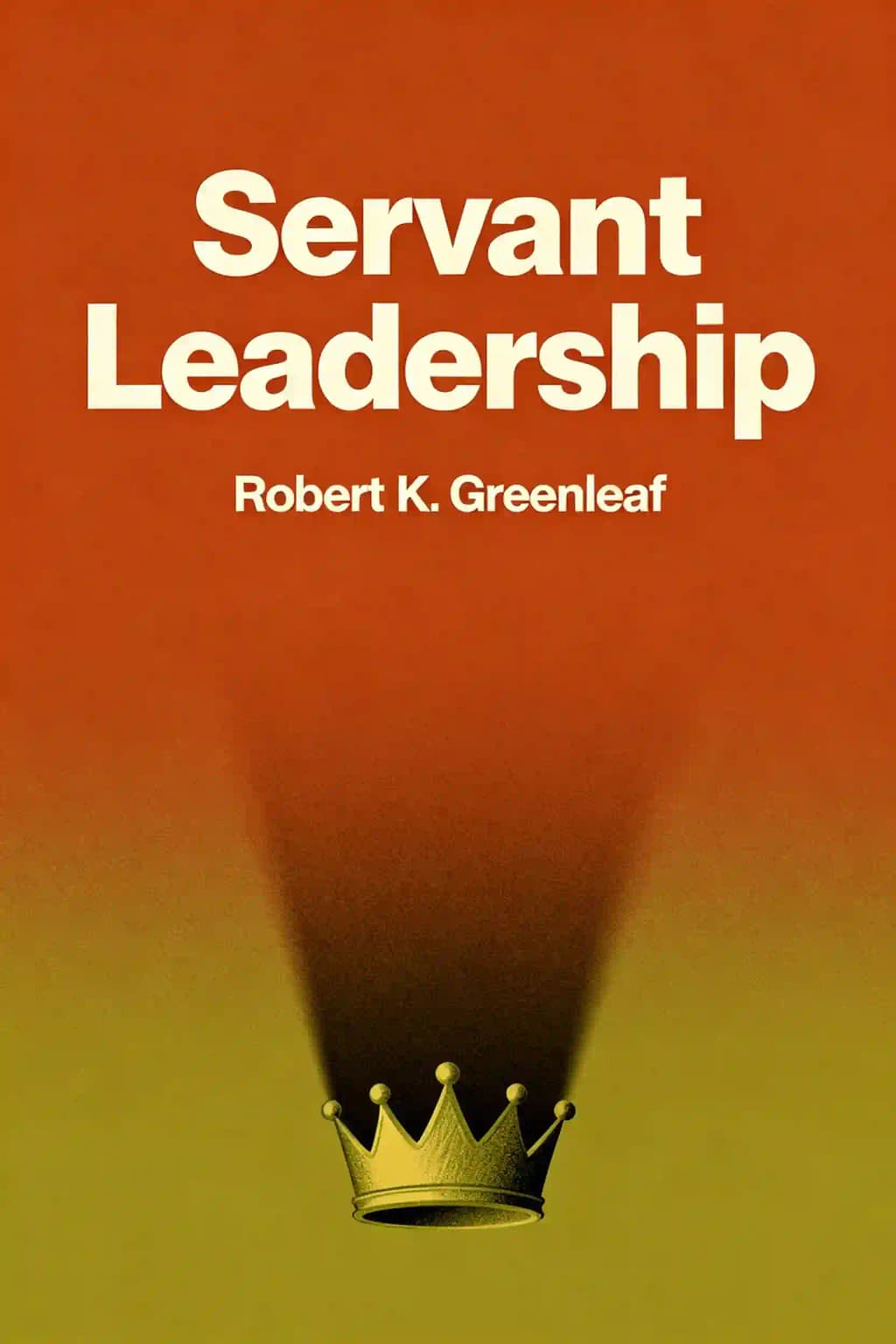
In "Servant Leadership," Greenleaf revolutionizes power dynamics by proposing leaders serve first. Embraced by Peter Senge and organizations worldwide, this philosophy transformed business culture from control to community. What if true leadership isn't about authority, but empowering others to achieve greatness?
Robert Kiefner Greenleaf (1904–1990) was the pioneering author of Servant Leadership: A Journey into the Nature of Legitimate Power and Greatness and the founder of the modern servant leadership movement. A management visionary and organizational ethicist, Greenleaf spent 38 years at AT&T developing groundbreaking leadership programs that blended liberal arts education with corporate training—an unconventional approach that shaped his revolutionary ideas about power dynamics and institutional responsibility.
His seminal 1970 essay The Servant as Leader, expanded into the book Servant Leadership, redefined leadership as an act of service, insisting the true measure of effectiveness lies in whether followers "become healthier, wiser, and more autonomous."
Greenleaf’s works, including The Power of Servant Leadership and The Institution as Servant, established ethical frameworks used in MBA programs worldwide and by organizations like Google and the U.S. military. After retiring from AT&T, he founded the Greenleaf Center for Servant Leadership, which continues advancing his philosophy through global workshops and publications. Translated into 12 languages, Servant Leadership remains a cornerstone text in leadership studies, with its 25th Anniversary Edition still featured in Harvard Business School’s recommended curriculum.
Servant Leadership argues that effective leaders prioritize serving others first, emphasizing empathy, ethical behavior, and team empowerment over traditional authority-driven models. Greenleaf introduces principles like active listening, healing interpersonal divides, and fostering community to create sustainable, ethical organizations. The book combines essays exploring how institutions and individuals can adopt this mindset to drive meaningful societal change.
This book is ideal for managers, educators, and organizational leaders seeking to build equitable, trust-driven teams. It’s also valuable for HR professionals interested in ethical leadership frameworks or those exploring alternatives to hierarchical management styles. Greenleaf’s insights resonate particularly in faith-based and nonprofit sectors, though applications span corporate and academic settings.
Greenleaf’s framework includes 10 core principles:
These prioritize collective well-being over individual authority.
Unlike transactional or autocratic models, servant leadership flips the hierarchy: leaders exist to support teams, not command them. It contrasts with transformational leadership by focusing less on inspiring change and more on addressing followers’ needs directly. Studies suggest it boosts employee satisfaction and organizational clarity compared to top-down approaches.
Robert K. Greenleaf (1904–1990) spent 38 years at AT&T pioneering inclusive HR practices, including promoting women and Black employees to non-menial roles. After retiring, he authored seminal essays on servant leadership, later compiled into this book. His work was influenced by Quaker values and observations of 1960s social movements.
Yes—its emphasis on psychological safety, diversity, and ethical decision-making aligns with contemporary trends like remote team management and corporate social responsibility. The rise of flat organizational structures and employee-centric cultures (e.g., Google’s Project Oxygen) reflects Greenleaf’s vision of leaders as enablers rather than controllers.
Critics argue it risks exploitation in competitive environments and may lack clear decision-making protocols during crises. Some note its ideals are easier to adopt in nonprofits than profit-driven corporations. However, proponents counter that its flexibility allows adaptation across sectors when combined with pragmatic governance.
Greenleaf advocates “gentle persuasion” and consensus-building during transitions, contrasting with disruptive change management. By prioritizing transparency and healing during upheaval, leaders mitigate resistance. For example, a servant leader might conduct listening sessions before restructuring teams to identify unspoken concerns.
These underscore the book’s focus on humility and introspection.
Key strategies include:
Greenleaf’s emphasis on trust aligns with async communication tools and results-oriented workflows common in remote settings.
The Greenleaf Center for Servant Leadership (greenleaf.org) offers workshops, case studies, and supplemental resources. Academic research through EBSCO or JSTOR explores modern applications, while books like Leaders Eat Last by Simon Sinek build on Greenleaf’s ideas.
저자의 목소리로 책을 느껴보세요
지식을 흥미롭고 예시가 풍부한 인사이트로 전환
핵심 아이디어를 빠르게 캡처하여 신속하게 학습
재미있고 매력적인 방식으로 책을 즐기세요
True leadership begins with the desire to serve others first.
The servant-leader is servant first.
The future of our civilization depends on inspired individuals.
True listening is a rare and transformative leadership quality.
Servant leadership의 핵심 아이디어를 이해하기 쉬운 포인트로 분해하여 혁신적인 팀이 어떻게 창조하고, 협력하고, 성장하는지 이해합니다.
Servant leadership을 빠른 기억 단서로 압축하여 솔직함, 팀워크, 창의적 회복력의 핵심 원칙을 강조합니다.

생생한 스토리텔링을 통해 Servant leadership을 경험하고, 혁신 교훈을 기억에 남고 적용할 수 있는 순간으로 바꿉니다.
무엇이든 물어보고, 목소리를 선택하고, 진정으로 공감되는 인사이트를 함께 만들어보세요.

샌프란시스코에서 컬럼비아 대학교 동문들이 만들었습니다
"Instead of endless scrolling, I just hit play on BeFreed. It saves me so much time."
"I never knew where to start with nonfiction—BeFreed’s book lists turned into podcasts gave me a clear path."
"Perfect balance between learning and entertainment. Finished ‘Thinking, Fast and Slow’ on my commute this week."
"Crazy how much I learned while walking the dog. BeFreed = small habits → big gains."
"Reading used to feel like a chore. Now it’s just part of my lifestyle."
"Feels effortless compared to reading. I’ve finished 6 books this month already."
"BeFreed turned my guilty doomscrolling into something that feels productive and inspiring."
"BeFreed turned my commute into learning time. 20-min podcasts are perfect for finishing books I never had time for."
"BeFreed replaced my podcast queue. Imagine Spotify for books — that’s it. 🙌"
"It is great for me to learn something from the book without reading it."
"The themed book list podcasts help me connect ideas across authors—like a guided audio journey."
"Makes me feel smarter every time before going to work"
샌프란시스코에서 컬럼비아 대학교 동문들이 만들었습니다

Servant leadership 요약을 무료 PDF 또는 EPUB으로 받으세요. 인쇄하거나 오프라인에서 언제든 읽을 수 있습니다.
What if everything we've been taught about leadership is backwards? Picture this: a humble servant tending to travelers' needs disappears one day, and suddenly the entire expedition falls apart. This isn't a tale of incompetence-it's Herman Hesse's "Journey to the East," where the servant Leo turns out to be the group's true leader all along. This paradox struck Robert K. Greenleaf so deeply that it sparked a revolution in how we understand power, authority, and influence. His radical proposition? The best leaders don't start by wanting to lead-they start by wanting to serve. This isn't just feel-good philosophy. Companies like Southwest Airlines and Starbucks built their cultures on it. Phil Jackson used it to win 11 NBA championships. Why does servant leadership work when so many leadership fads fade? Perhaps because it taps into something fundamental about human nature: we follow those who genuinely care about our growth, not those who merely command our compliance. Can you truly be both servant and leader? Most people see these as opposing forces-one submissive, the other dominant. But Greenleaf reveals they're actually two sides of the same coin, and understanding this fusion transforms everything. The servant-leader is servant first. Before any thought of leading emerges, there's a natural desire to serve others. This isn't strategy-it's orientation, a fundamental way of being in the world. Contrast this with leaders who lead first, driven by power needs or material ambitions. The difference shows up in a simple question: Are those you serve growing? Do they become healthier, wiser, freer, more autonomous? What about society's least privileged-are they benefiting or at least not further harmed? These aren't abstract metrics. They're deeply personal indicators of whether your leadership actually serves or merely uses people. Servant leadership requires constant experimentation under what Greenleaf calls "the shadow of doubt." You act on your best hypothesis, examine results honestly, and make fresh choices based on what truly serves others rather than what serves your ego.