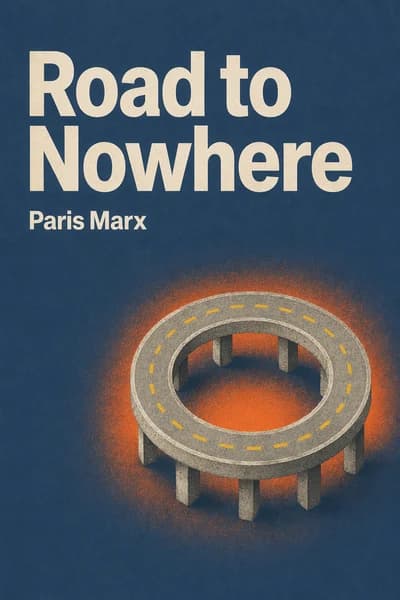
In "Road to Nowhere," Paris Marx demolishes Silicon Valley's car-centric transportation fantasies. This "brutally realistic analysis" reveals how tech's mobility solutions perpetuate inequality rather than progress. What if the future we're being sold is actually a high-tech return to our unsustainable past?
Paris Marx is a Canadian tech critic and host of the award-winning Tech Won’t Save Us podcast. Their book, Road to Nowhere: What Silicon Valley Gets Wrong about the Future of Transportation, offers a sharp critique of tech-driven urban mobility solutions.
Combining academic rigor with journalistic clarity, Marx draws on their background in geography and media studies to dissect Silicon Valley’s flawed visions of autonomous vehicles, gig economy platforms, and “frictionless” cities.
Their work, featured in NBC News, TIME, and MIT Tech Review, advocates for equitable, community-centered transportation systems over corporate-controlled models. Marx also writes the critical technology newsletter Disconnect and speaks internationally on tech’s societal impacts.
Road to Nowhere builds on their decade of research into tech industry practices, with insights translated into five languages and cited in policymaking circles.
Road to Nowhere critiques Silicon Valley’s tech-driven transportation visions, arguing that innovations like self-driving cars, delivery robots, and gig economy platforms prioritize corporate profits over public needs. Paris Marx exposes how these "solutions" exacerbate inequality, privatize public space, and fail to address systemic mobility challenges, advocating instead for democratic, equitable transit systems.
Urban planners, policymakers, tech critics, and anyone interested in transportation equity will find this book essential. It’s also accessible to general readers concerned about Silicon Valley’s growing influence on cities, labor rights, and climate-responsive infrastructure.
Yes. Marx combines sharp analysis with historical context, debunking tech industry myths while offering actionable alternatives. The book is praised for its clarity in linking transportation policies to broader capitalist dynamics, making it a vital resource for understanding 21st-century urban crises.
Marx argues that tech companies repackage flawed ideas (e.g., automated vehicles) as “progress,” masking privatization efforts and labor exploitation. These innovations often ignore proven solutions like public transit, cycling, and walkable cities, reinforcing class divides instead of solving mobility issues.
Marx advocates reclaiming public control over transit, expanding affordable options (buses, trains), and designing “15-minute cities” where daily needs are walkable. Examples include Oslo’s bike-friendly policies and Paris’s neighborhood-centric urban planning, which prioritize accessibility over corporate interests.
Marx dismisses self-driving cars as unrealistic distractions that centralize power in tech firms. These projects divert resources from equitable transit, rely on invasive data collection, and fail to address traffic or emissions meaningfully.
The title critiques Silicon Valley’s empty promises of a tech-utopian future. Marx argues these visions lead to “nowhere” beneficial for most people, instead perpetuating exploitative systems under the guise of innovation.
The book highlights how automation rhetoric (e.g., delivery robots) obscures human labor exploitation. Marx ties this to gig economy platforms like Uber, which profit from precarious work while undermining labor rights.
Marx hosts the Tech Won’t Save Us podcast and holds a master’s degree in urban geography. Their research focuses on tech’s socioeconomic impacts, particularly in transportation, blending academic rigor with accessible criticism.
Some reviewers note Marx focuses more on Silicon Valley’s speculative projects than real-world urban changes. Others argue the book’s social-democratic solutions lack concrete pathways to post-capitalist transit systems.
A central idea: “Silicon Valley’s vision of the future of mobility is a road to somewhere—but it’s not a good somewhere.” This underscores Marx’s warning against tech-driven urban futures that prioritize profit over people.
As tech firms expand into drone delivery, AI-driven transit, and gig labor, Marx’s critiques of corporate control over public space and data remain urgent. The book’s emphasis on democratic alternatives aligns with growing calls for climate-resilient cities.
저자의 목소리로 책을 느껴보세요
지식을 흥미롭고 예시가 풍부한 인사이트로 전환
핵심 아이디어를 빠르게 캡처하여 신속하게 학습
재미있고 매력적인 방식으로 책을 즐기세요
They were manufacturing it.
The automobile's dominance wasn't inevitable but deliberately engineered.
When drivers killed pedestrians, they were viewed as murderers.
The internet exemplifies public-sector technology consumed by corporations.
The tech industry's leaders have narrow worldviews shaped by privilege.
Road to Nowhere의 핵심 아이디어를 이해하기 쉬운 포인트로 분해하여 혁신적인 팀이 어떻게 창조하고, 협력하고, 성장하는지 이해합니다.
Road to Nowhere을 빠른 기억 단서로 압축하여 솔직함, 팀워크, 창의적 회복력의 핵심 원칙을 강조합니다.

생생한 스토리텔링을 통해 Road to Nowhere을 경험하고, 혁신 교훈을 기억에 남고 적용할 수 있는 순간으로 바꿉니다.
무엇이든 물어보고, 목소리를 선택하고, 진정으로 공감되는 인사이트를 함께 만들어보세요.

샌프란시스코에서 컬럼비아 대학교 동문들이 만들었습니다
"Instead of endless scrolling, I just hit play on BeFreed. It saves me so much time."
"I never knew where to start with nonfiction—BeFreed’s book lists turned into podcasts gave me a clear path."
"Perfect balance between learning and entertainment. Finished ‘Thinking, Fast and Slow’ on my commute this week."
"Crazy how much I learned while walking the dog. BeFreed = small habits → big gains."
"Reading used to feel like a chore. Now it’s just part of my lifestyle."
"Feels effortless compared to reading. I’ve finished 6 books this month already."
"BeFreed turned my guilty doomscrolling into something that feels productive and inspiring."
"BeFreed turned my commute into learning time. 20-min podcasts are perfect for finishing books I never had time for."
"BeFreed replaced my podcast queue. Imagine Spotify for books — that’s it. 🙌"
"It is great for me to learn something from the book without reading it."
"The themed book list podcasts help me connect ideas across authors—like a guided audio journey."
"Makes me feel smarter every time before going to work"
샌프란시스코에서 컬럼비아 대학교 동문들이 만들었습니다

Road to Nowhere 요약을 무료 PDF 또는 EPUB으로 받으세요. 인쇄하거나 오프라인에서 언제든 읽을 수 있습니다.
Picture a pin from 1939 that reads "I have seen the future." Millions of Americans wore these after visiting General Motors' Futurama exhibit at the World's Fair, marveling at gleaming highways and radio-controlled cars promised for 1960. But here's what those visitors didn't grasp: they weren't witnessing a prediction. They were being sold a product. Within decades, expressways would slice through neighborhoods, pedestrians would lose their streets, and over 3.7 million Americans would die in car crashes. The corporations weren't forecasting the future-they were manufacturing it. Fast forward to today. Silicon Valley's elite are pitching their own transportation visions, and the pattern feels uncomfortably familiar. Elon Musk promises salvation through electric cars and underground tunnels. Travis Kalanick imagines fleets of automated taxis. Google's founders dream of autonomous pods gliding through cities. Like that 1939 World's Fair, these visions are polished, seductive, and fundamentally flawed. They're not solving our transportation crisis-they're repackaging it with a tech-friendly aesthetic while deepening the same inequities that car culture created a century ago.