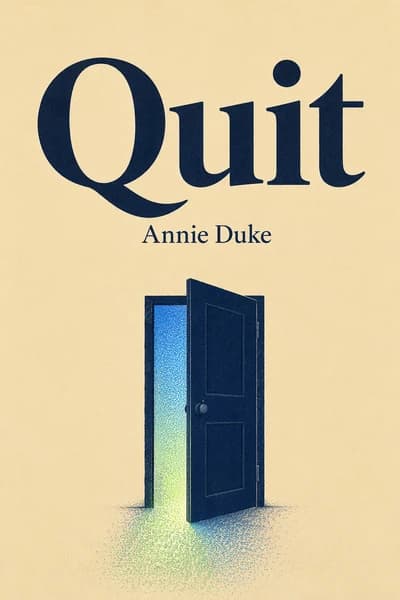
"Quit" revolutionizes how we view walking away, challenging the "winners never quit" mentality with strategic decision-making wisdom. Annie Duke's insights have transformed how business leaders evaluate sunk costs and set "kill criteria," proving that sometimes quitting is your most powerful move toward success.
Annie Duke, author of Quit, is a decision-making strategist, bestselling author, and former World Series of Poker champion whose work bridges cognitive psychology and real-world strategy.
A National Science Foundation Fellow who studied psychology at the University of Pennsylvania, Duke leverages her academic background and two decades of high-stakes poker experience—including a WSOP gold bracelet and over $4 million in tournament winnings—to teach readers how to make smarter choices under uncertainty. Her expertise in risk assessment and strategic quitting underpins Quit, a guide to optimizing decisions by knowing when to pivot or persevere.
Duke’s prior books, Thinking in Bets and How to Decide, are national bestsellers that distill decision science into actionable frameworks, cementing her reputation as a leading voice in behavioral strategy. A co-founder of The Alliance for Decision Education, she has raised over $18 million for philanthropic causes and advises organizations on risk management. Thinking in Bets has been translated into 15 languages and is widely taught in business schools, while her TED Talks on decision-making have garnered millions of views.
Quit challenges the stigma around quitting, framing it as a strategic skill for optimizing success. Annie Duke combines cognitive psychology and real-world examples from poker, business, and sports to teach readers how to identify sunk costs, set "kill criteria," and make data-driven exit decisions. The book emphasizes flexibility over blind persistence, offering tools to avoid emotional traps like the sunk cost fallacy.
Professionals, entrepreneurs, and anyone facing high-stakes decisions will benefit from Duke’s insights. It’s particularly valuable for those struggling with career pivots, failed projects, or unhealthy relationships. Cognitive psychology enthusiasts and fans of Duke’s previous works (Thinking in Bets, How to Decide) will appreciate her evidence-based approach to decision-making.
Yes—Duke provides actionable frameworks like pre-mortems and kill criteria to navigate complex decisions. While some business case studies may feel drawn-out, the book’s blend of academic rigor and real-world application (e.g., poker strategies, mountaineering disasters) makes it a standout guide for mastering strategic quitting.
Duke explains how emotional attachment to past investments (time, money, effort) clouds judgment. Using examples like California’s failed bullet train project, she demonstrates how to recognize this bias and prioritize future outcomes over irrecoverable costs. The book advocates for probabilistic thinking to objectively assess whether continuing aligns with goals.
Kill criteria are pre-defined thresholds (e.g., budget limits, timeline milestones) that trigger quitting. Duke advises readers to establish these metrics upfront, likening them to poker players folding when odds turn unfavorable. This approach minimizes emotional decision-making and prevents escalation of commitment to failing ventures.
| Persistence | Quitting | |-------------------------|-----------------------------| | Valuable when aligned with adaptable goals | Strategic when new information invalidates original plans | | Risks sunk cost fallacy | Mitigates wasted resources |
Duke argues quitting isn’t failure but a recalibration tool, using examples like her pivot from academia to poker and businesses abandoning outdated models.
Duke warns against letting self-image (e.g., “I’m a fighter”) trap you in unproductive paths. She cites athletes who retired early to preserve health and legacy, showing how identity flexibility enables smarter exits. The book encourages reframing quitting as evolution rather than defeat.
These lines underscore Duke’s thesis that quitting is a proactive skill for navigating uncertainty.
Some reviewers note that corporate case studies dominate the middle sections, which may feel less relatable to general readers. However, Duke balances this with personal anecdotes and psychological research, maintaining broad relevance.
The book teaches readers to conduct pre-mortems for job roles or projects, asking: “If I quit this in six months, what would cause it?” This reveals hidden risks and helps align actions with long-term goals. Duke also advises regular “quit audits” to reassess commitments.
Like Thinking in Bets, Quit emphasizes probabilistic decision-making under uncertainty. However, it focuses specifically on exit strategies, complementing her earlier books on general decision hygiene. Fans of behavioral economics will recognize themes from Daniel Kahneman and Richard Thaler.
These titles explore related themes of resource allocation and adaptive decision-making.
저자의 목소리로 책을 느껴보세요
지식을 흥미롭고 예시가 풍부한 인사이트로 전환
핵심 아이디어를 빠르게 캡처하여 신속하게 학습
재미있고 매력적인 방식으로 책을 즐기세요
Winners never quit.
Grit gets you up the mountain, but quit tells you when to come down.
Quitting is actually an essential decision-making tool in an uncertain world.
Good quitting feels premature.
Quit의 핵심 아이디어를 이해하기 쉬운 포인트로 분해하여 혁신적인 팀이 어떻게 창조하고, 협력하고, 성장하는지 이해합니다.
Quit을 빠른 기억 단서로 압축하여 솔직함, 팀워크, 창의적 회복력의 핵심 원칙을 강조합니다.

생생한 스토리텔링을 통해 Quit을 경험하고, 혁신 교훈을 기억에 남고 적용할 수 있는 순간으로 바꿉니다.
무엇이든 물어보고, 목소리를 선택하고, 진정으로 공감되는 인사이트를 함께 만들어보세요.

샌프란시스코에서 컬럼비아 대학교 동문들이 만들었습니다
"Instead of endless scrolling, I just hit play on BeFreed. It saves me so much time."
"I never knew where to start with nonfiction—BeFreed’s book lists turned into podcasts gave me a clear path."
"Perfect balance between learning and entertainment. Finished ‘Thinking, Fast and Slow’ on my commute this week."
"Crazy how much I learned while walking the dog. BeFreed = small habits → big gains."
"Reading used to feel like a chore. Now it’s just part of my lifestyle."
"Feels effortless compared to reading. I’ve finished 6 books this month already."
"BeFreed turned my guilty doomscrolling into something that feels productive and inspiring."
"BeFreed turned my commute into learning time. 20-min podcasts are perfect for finishing books I never had time for."
"BeFreed replaced my podcast queue. Imagine Spotify for books — that’s it. 🙌"
"It is great for me to learn something from the book without reading it."
"The themed book list podcasts help me connect ideas across authors—like a guided audio journey."
"Makes me feel smarter every time before going to work"
샌프란시스코에서 컬럼비아 대학교 동문들이 만들었습니다

Quit 요약을 무료 PDF 또는 EPUB으로 받으세요. 인쇄하거나 오프라인에서 언제든 읽을 수 있습니다.
What if everything you've been taught about success is backwards? We grow up hearing that "quitters never win" and "winners never quit," but what if the real secret to achievement is knowing exactly when to fold? Muhammad Ali's boxing career tells two contradictory stories: the fighter who staged an impossible comeback against George Foreman in 1974, and the same champion who refused to stop fighting for seven more years despite clear medical warnings, ultimately contributing to his Parkinson's diagnosis. The same grit that made him great destroyed his health. This paradox sits at the heart of a revolutionary insight-the qualities that fuel success can become toxic when circumstances shift but our behavior doesn't. We've built an entire culture around persistence, creating euphemisms like "pivot" and "starting a new chapter" to avoid the shame of admitting we quit. Even Olympic skier Lindsey Vonn, retiring with a body "broken beyond repair," felt compelled to insist she wasn't giving up. Yet research consistently shows we persist far too long in losing situations. The truth? Quitting isn't the opposite of grit-it's grit's essential partner. One gets you up the mountain; the other tells you when to come down before the storm kills you.