1장
A Summer That Changes Everything
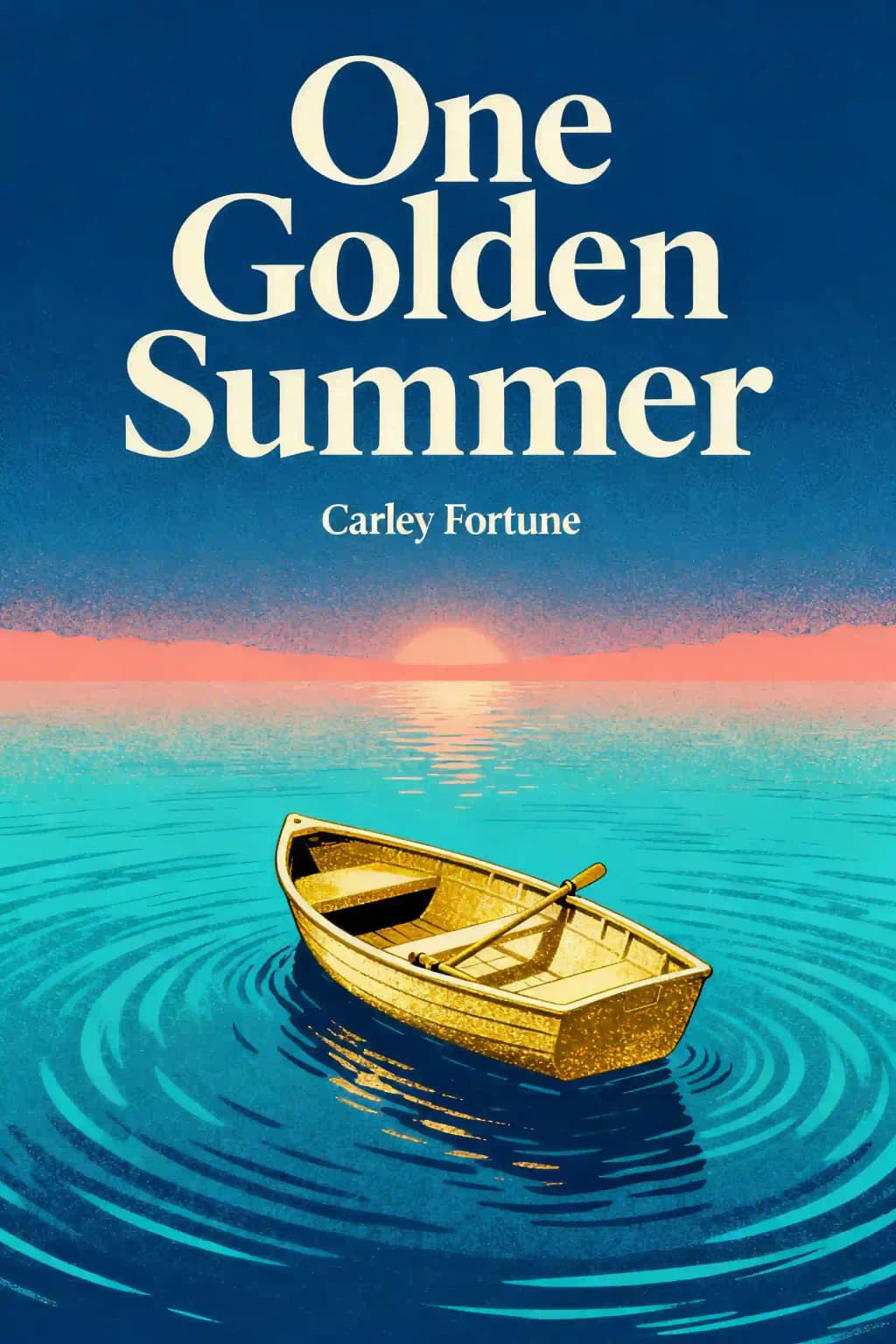
When you look at a photograph, what do you see? A moment frozen in time, or something deeper? In Carley Fortune's "One Golden Summer," a single photograph captures not just a fleeting moment but the beginning of a life-changing journey. This New York Times bestseller has captivated readers worldwide with its exploration of second chances and finding oneself through unexpected connections. Following the phenomenal success of "Every Summer After," Fortune's devoted fans clamored for this companion novel, making it an instant hit upon release. Even celebrities like Reese Witherspoon have praised Fortune's ability to craft "the perfect summer read" that balances nostalgia with authentic emotional depth. The story of Alice and Charlie reminds us that sometimes we need to return to where we once were to discover who we're meant to become.
2장
The Art of Seeing and Being Seen
Alice Everly has built her life around being behind the camera rather than in front of it. As a professional photographer specializing in portrait and editorial work, she's mastered the art of making others look beautiful while remaining invisible herself. Her talent lies in capturing authentic moments - the slight crinkle around someone's eyes during genuine laughter, the quiet confidence in a subject's posture, the unguarded tenderness between family members. During a high-profile photoshoot for Swish magazine featuring women of various ages, sizes, and backgrounds in bathing suits, Alice is in her element capturing their natural beauty and strength - until her editor asks her to digitally alter their bodies to meet conventional beauty standards. This request contradicts everything Alice values about authentic representation and honest storytelling through photography, yet she's too emotionally depleted to mount her usual passionate defense of untouched images.
The past six months have been particularly challenging since her breakup with Trevor, who left her for a yoga instructor he met at his gym. Work has become her refuge, with Alice taking on every possible assignment, from corporate headshots to wedding photography to fashion editorials. Her longtime mentor Elyse, who gave Alice her first professional camera, has noticed that Alice has "lost her inner light" - that spark of creativity and joy that once made her work stand out in Toronto's competitive photography scene. But Alice keeps pushing forward, filling her schedule with back-to-back shoots to avoid confronting the emptiness that greets her in her downtown condo each night. When her grandmother Nan shatters her hip in a dance class accident attempting an ambitious Charleston step, Alice immediately clears her calendar to care for her, recognizing an opportunity to be needed. Unlike her perpetually busy father Richard (a cardiac surgeon), her lawyer sister Heather (who's juggling three kids and a partnership track), or her irresponsible twin siblings Luca and Lavinia (who are "finding themselves" in Bali), Alice feels drawn to be useful, to have purpose in helping someone else heal.
While helping Nan recover in her charming Leaside home filled with memories and mementos from a life well-lived, Alice discovers an old photograph in a dusty basement box - one she took sixteen summers ago at Barry's Bay. The image shows three teenagers in a sun-bleached yellow boat, their faces caught in mid-laughter as golden hour light sparkles on the lake behind them. This shot, taken with her first point-and-shoot camera, launched her photography career and showed her seventeen-year-old self that she had a gift for capturing life's fleeting moments of joy. This discovery sparks an idea: why not take Nan to recover at John Kalinski's cottage on Kamaniskeg Lake? The peaceful setting could be perfect for rehabilitation, and when John - an old family friend who's known Alice since she was in pigtails - generously offers them the cottage for the entire summer, Alice sees it as the perfect opportunity for both Nan's physical healing and her own emotional recovery.
What Alice doesn't anticipate is how this return to Barry's Bay will force her to step out from behind her lens and finally allow herself to be seen - not just as the photographer who makes everyone else look beautiful, but as a woman worthy of being the subject of someone else's gaze. The lake holds memories both sweet and bitter, and facing them might be exactly what she needs to rediscover her own light.
3장
The Lake's Magnetic Pull
The journey to Barry's Bay winds through the Canadian Shield's ancient terrain, stirring deep memories for both Alice and Nan. As their car navigates the twisting roads between towering granite rock faces and stands of white pine and birch, Nan grows increasingly quiet. Her weathered hands rest in her lap, fingers occasionally twitching as if reaching for moments from the past decade since she last visited the cottage. The familiar landmarks - the rusted general store sign, the wooden bridge over Madawaska River, the sharp turn at Peterson's Point - each trigger another layer of reminiscence.
John Kalinski's cottage emerges exactly as Alice remembers: a masterpiece of traditional log construction perched on a granite outcropping, its red tin roof gleaming like a beacon against the forest backdrop. The stone chimney, built from river rocks each carefully selected and placed, rises strong and steady against the afternoon sky. The sight stirs something profound in Alice - a complex emotion somewhere between homecoming and discovering a new country.
Inside, the cottage exists in a time capsule of perfect preservation. Every surface tells a story: the knotty pine walls darkened by decades of wood smoke, the eclectic collection of furniture accumulated through generations - each piece with its own history. The familiar plaid couch still sags in the middle, and the old cast iron woodstove bears the same burn mark from Christmas 1998. Only the missing coffee table trunk - a family heirloom that had served as both storage and gathering spot - marks the passage of time. Through the expansive lakefront windows, Kamaniskeg Lake stretches out like a mirror, momentarily dissolving the boundary between past and present until Alice feels seventeen again - before the weight of adult responsibilities settled on her shoulders.
Charlie's meticulous preparation of the cottage reveals itself in thoughtful details outlined in his extensive note: rugs secured with professional-grade tape to prevent slipping, grab bars installed at precisely the right heights in the bathroom, furniture subtly rearranged to create wider pathways for Nan's walker. The freezer holds a treasure trove of homemade pierogi, labeled in his precise handwriting with cooking instructions. His note concludes with an almost proprietary tone about their inevitable summer interactions - a presumption that makes Alice bristle despite Nan's enthusiastic dubbing of him as their "guardian angel."
As day fades into evening, the lake calls to Alice with magnetic intensity. She slips into the water, letting it embrace her as she floats beneath a sky painted in deepening shades of lavender and rose. The vastness above her mirrors the depth below, and she feels suspended between two infinities - a tiny speck in the universe yet somehow part of everything. Six months ago, her life had seemed perfectly mapped out until Trevor's departure sent her into a spiral of sixty-hour workweeks and emotional numbness. Now, watching two children skip stones at the neighboring cottage, she's reminded of the teenage subjects from her photography project years ago - their faces full of possibility and uncertainty in equal measure.
The distinctive honk of a yellow motorboat breaks through her reverie - the same craft that had crossed her camera lens sixteen summers ago, down to the chrome trim and weather-beaten cushions. As twilight deepens into dusk, Alice can't shake the feeling that this coincidence carries meaning. The lake seems to be orchestrating something, drawing her toward an encounter that feels both inevitable and mysterious - as if the waters themselves are conspiring to bring about a meeting she didn't know she needed.
4장
First Encounters and Hidden Depths
Charlie Florek crashes into Alice's life with the same dramatic flair as his yellow speedboat. Their first phone conversation is a disaster-he's distracted, teasing, and calls her "City Girl" with maddening confidence. Their first in-person meeting is even worse when Alice crashes John's boat on a rock and needs to be rescued by a shirtless man with celery-green eyes in a yellow speedboat-the same infuriating Charlie, who also happens to be the handsome stranger she embarrassed herself in front of at the grocery store.
Despite her irritation, Alice can't help noticing everything about Charlie-his magnificent shoulders, pale green eyes, full lips, squared jaw with a slightly crooked nose, and those dimples that appear when he smiles. She's even more shocked when she realizes he's the older brother from the photograph she took sixteen summers ago, the one she secretly fantasized about as a teenager.
Charlie's confidence borders on arrogance as he flirts shamelessly, asking if she's single while pointing out landmarks during their ride back to the cottage. When he offers to take her around the lake another day, Alice declines, telling him he's not her type despite his handsome face-which only seems to amuse him more. "I'm everyone's type," he boasts with infuriating self-assurance.
Yet beneath Charlie's playboy exterior lie unexpected depths. When he discovers Nan is struggling with mobility, he installs grab bars in the bathroom without being asked. He brings end tables to make the cottage more accessible and delivers fresh vegetables from his garden. Most surprisingly, he takes Nan to her weekly choir practice, showing a thoughtfulness that contradicts Alice's initial impression.
As they begin spending time together, Alice discovers more layers to Charlie's character-his grief over losing his mother three years ago, his strained relationship with his brother Sam, and the way he uses humor to deflect from deeper emotions. When Charlie helps Alice complete her summer bucket list (including cliff jumping and reading a "smutty book"), their connection deepens beyond mere attraction.
What begins as mutual irritation evolves into friendship, then something more complex. Charlie insists they remain "just friends," even as their chemistry becomes increasingly difficult to ignore. His contradictory behavior-intense flirtation followed by emotional withdrawal-leaves Alice confused but increasingly drawn to this man who seems determined to keep her at arm's length.
5장
Rediscovering Passion and Purpose
Alice's summer at Barry's Bay becomes a journey of rediscovery-not just of her feelings for Charlie, but of her passion for photography. In Toronto, her work had become mechanical, focused on pleasing clients rather than creating art that moved her. The pressure to digitally alter women's bodies for magazine spreads had left her disconnected from what once gave her joy.
At the lake, Alice begins taking photographs purely for pleasure again. She captures the misty mornings, the way sunlight dapples through trees, and most significantly, the people she cares about in unguarded moments-Nan laughing with John after years of estrangement, Charlie teaching her to make his mother's pierogi recipe, her niece Bennett experiencing the lake for the first time.
When Charlie arranges for Alice to use the darkroom at his old high school, she's deeply touched by his thoughtfulness. The familiar chemical smells and precise science of developing film transport her back to when photography was her passion rather than just her profession. After developing three rolls of film, she emerges feeling lighter, having created art purely for herself again.
This rediscovery of artistic purpose parallels Alice's emotional awakening. Just as she learns to see her subjects with fresh eyes, she begins to see herself differently too-not as the invisible woman behind the camera, but as someone worthy of being the focal point in someone else's life. When Charlie posts a photo of her on Instagram with the simple caption "Alice," she's struck by how she looks in it-not just happy, but at peace.
The culmination of this journey comes when Alice decides not to participate in the photography exhibition her mentor Elyse has arranged. Instead of showing work that no longer represents her vision, Alice chooses to develop a new collection-one that captures the authentic moments and connections she's experienced at the lake. This decision marks a turning point in her career, a reclaiming of her artistic voice and a commitment to creating work that feels true to herself rather than what others expect from her.
6장
The Dance of Vulnerability and Protection
At the heart of Alice and Charlie's relationship is a delicate dance between vulnerability and self-protection. Both have been hurt before-Alice by her ex-boyfriend Trevor who left her after four years, and more deeply by her college best friend Oz, who slept with her once only to tell her afterward it was "just a one-time thing." These experiences have taught Alice to keep her heart guarded, to focus on work rather than risk emotional pain again.
Charlie's defenses are even more complex. Though he initially appears to be a carefree playboy, his reluctance to pursue a real relationship with Alice stems from deep-seated fears and insecurities. When he finally opens up about sleeping with his brother's girlfriend Percy years ago-a mistake that fractured his family and left him feeling unworthy of love-Alice begins to understand why he keeps pushing her away despite their obvious connection.
Their physical relationship develops in fits and starts, with Charlie repeatedly pulling back just when they seem on the verge of something deeper. "I want to do this differently," he tells her, suggesting he values her too much to treat her like his past hookups. Yet he remains adamant that they can only have a summer fling with no expectations beyond August.
The turning point comes when Alice develops a photograph that reveals something she missed in person-Charlie looking at her with pure adoration, the same expression she's seen between couples truly in love. Armed with this evidence, Alice finally admits her feelings: "I want you. I want all of you." Their passionate encounter in the darkroom marks a shift in their relationship, though Charlie's emotional walls remain firmly in place.
When Alice suggests continuing their relationship in Toronto, Charlie's rejection is devastating: "Alice, I can't." His excuse that they're too different and he'd eventually get bored rings hollow, prompting Alice to call him what he truly is-a coward. This confrontation forces both characters to examine what they truly want and what they're willing to risk to get it.
7장
Family Ties and Healing Old Wounds
While Alice and Charlie's relationship forms the central romance, the novel equally explores the healing of family relationships. Nan's estrangement from her old friend John Kalinski parallels the emotional distance in Alice's family. When Nan finally reveals that she and John shared a single kiss years after her husband died, leading to a terrible argument and years of silence, Alice encourages her to reconcile-life is too short to hold onto old hurts.
This wisdom applies to Alice's own family dynamics as well. Her relationship with her mother has been strained since her parents' separation, with Alice assuming her mother "fled" to British Columbia to escape family responsibilities. When Alice finally breaks down and asks for help after Charlie's rejection, her entire family rallies around her-including her mother, who flies in immediately upon hearing Alice needs her.
During their heart-to-heart conversation, Alice's mother explains she didn't leave to escape them but to discover who she is beyond being a mother and wife: "It won't be forever," she promises. This conversation helps Alice understand that relationships evolve and change, but love remains. When her sister Heather tells her, "Nothing lasts forever. That's why you should grab onto whatever makes you happy now and hold on for as long as you can," Alice begins to reconsider her approach to both family and romantic relationships.
Charlie's family dynamics mirror these themes of estrangement and reconciliation. His strained relationship with his brother Sam stems from his betrayal years ago, though they've found a way forward. The impending birth of Sam and Percy's baby represents new beginnings and the possibility of healing generational wounds. When Charlie builds an elaborate treehouse for his future niece, illuminated with thousands of twinkle lights, it symbolizes his desire to create something beautiful and lasting for the next generation despite his own feelings of unworthiness.
Through these parallel storylines, Fortune explores how families fracture and heal, how old wounds can be reopened but also finally allowed to mend. The message becomes clear: forgiveness-of others and ourselves-is necessary for moving forward.
8장
Facing Mortality and Embracing Life
A shocking revelation transforms the novel's final act when Alice discovers the real reason behind Charlie's emotional withdrawal - he's been diagnosed with multiple serious congenital heart conditions that likely caused his father's early death at thirty-five. His upcoming high-risk open-heart surgery carries a 40% mortality rate, and rather than "burden" Alice with his health issues, he pushed her away, convinced she deserves someone whole and healthy. The discovery comes during a heated confrontation at his apartment, where Alice finds his medical documents while retrieving her forgotten scarf.
This confrontation with mortality forces both characters to reevaluate their priorities and past choices. For Charlie, who has lived with the specter of his father's early death, turning thirty-five represents more than just a milestone - it's a deadline that has haunted him since childhood. His fear of not having a future has manifested in various self-sabotaging behaviors: refusing promotions, avoiding long-term commitments, and maintaining superficial relationships. When he finally breaks down and admits, "I'm broken - just like my father was," his vulnerability reveals years of suppressed grief and terror, allowing Alice to understand the depth of his fear and self-doubt.
Alice's response proves transformative for both of them. "You can't live in the what-ifs," she tells him, gripping his hands. "You're worth it, Charlie. Whether you believe it or not. And I'd rather have five years with you than fifty with someone else." This declaration marks her own profound growth from someone who once calculated relationship risks like business ventures to a woman willing to risk everything for love. Her courage represents a fundamental shift from her earlier caution and self-protection, demonstrated through flashbacks to her parents' bitter divorce.
Charlie's successful surgery and challenging recovery become a metaphorical rebirth for both characters. The six-hour procedure, followed by weeks of rehabilitation, strengthens their bond as Alice becomes his primary caregiver. Having faced the possibility of permanent loss, they develop a deeper appreciation for life's simple moments - morning coffee, shared laughter, quiet evenings together. When Charlie celebrates his thirty-sixth birthday - officially outliving his father - there's a new lightness in his eyes. "I made it," he says simply, holding Alice close. "And now you're here. I must have done something right in a past life."
This brush with mortality fundamentally transforms Charlie's outlook on life and career trajectory. He leaves his high-paying corporate position to become CFO at a heart disease research foundation, finding purpose in helping others facing similar challenges. He establishes a support group for young adults with genetic heart conditions, turning his personal struggle into a source of hope for others. The experience teaches both characters that life's uncertainty makes it more precious, not less valuable. Their decision to marry in a small ceremony six months after his recovery symbolizes their commitment to embracing life's possibilities together, regardless of what the future holds.
9장
Coming Full Circle: The Power of Being Seen
One year after their summer at Barry's Bay, Alice stands at her photography exhibition titled "Seen," with Charlie by her side. The collection includes intimate portraits-Nan and John reunited, Alice's mother embracing change, pregnant Percy, and most significantly, the original photo of teenage Charlie, Sam, and Percy in the yellow boat that started everything.
The exhibition represents Alice's artistic evolution-from commercial photographer who made others look perfect to an artist who captures authentic vulnerability. The final portrait in the show is one Alice took of herself-nude, without makeup or her usual protective layers. The accompanying plaque explains how her subjects' vulnerability inspired her to confront her own.
This self-portrait symbolizes Alice's complete transformation. The woman who once hid behind her camera now stands confidently before it, allowing herself to be truly seen. Similarly, Charlie has evolved from someone who used charm and humor to keep others at a distance to a man capable of genuine intimacy and commitment.
Their journey comes full circle as they purchase John's cottage, ensuring that the place where they found each other will remain part of their future. Though they still playfully argue-Charlie insists on keeping the cottage wood-paneled despite Alice's desire to paint it white-their relationship has found solid ground.
As Alice prepares to give her speech at the exhibition, she's momentarily frozen with nerves until she finds Charlie's extraordinary green eyes in the crowd. With "One Golden Summer" hanging behind him, she begins to speak, no longer the invisible woman behind the camera but an artist confidently sharing her vision with the world.
Their story reminds us that true connection requires courage-the courage to be vulnerable, to risk heartbreak, to show our authentic selves. Sometimes we need to return to where we began to discover who we're meant to become. And sometimes, the most beautiful view isn't what we see through our lens, but what happens when we finally allow ourselves to be the subject of someone else's loving gaze.