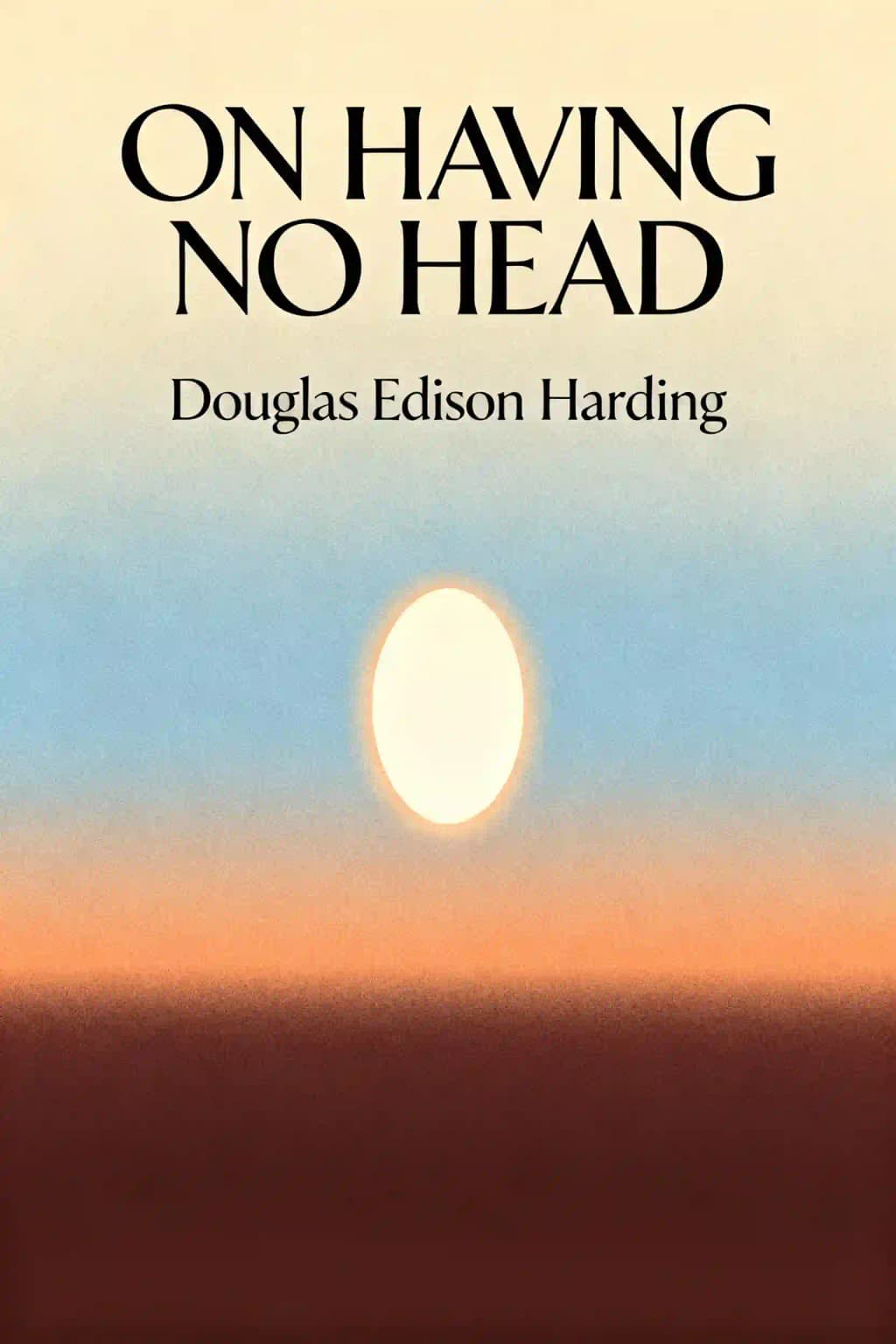
Discover a headless reality where your true self isn't what you think. Harding's 1961 philosophical classic blends Eastern spirituality with Western thought, creating a radical shift in perception. Experience the paradoxical joy of seeing everything except what you've always assumed was "you."
Douglas Edison Harding (1909–2007), author of On Having No Head, was an English philosopher and pioneer of experiential spirituality renowned for his "headlessness" philosophy.
A trained architect and Royal Engineers veteran, Harding's rejection of his fundamentalist Christian upbringing led to a lifelong exploration of consciousness, culminating in his 1961 breakthrough work that blends Western pragmatism with Eastern non-dual awareness.
His innovative "headless experiments"—simple perceptual exercises demonstrating the self as boundless awareness—established him as a unique voice in contemplative practices. Harding's influential The Hierarchy of Heaven and Earth (1952), foreworded by C.S. Lewis, remains a cult classic in philosophical spirituality.
His later works like The Face Game and Look For Yourself further refine his approach to identity beyond conventional boundaries.
Translated into over 15 languages, Harding's teachings continue inspiring spiritual seekers and consciousness researchers worldwide, with On Having No Head enduring as a minimalist masterpiece in mindfulness literature.
On Having No Head explores Douglas Harding’s transformative realization of "headlessness" – the direct experience of consciousness as boundless awareness rather than a physical head. Through autobiographical reflection, Harding argues that our true identity is an "open capacity" for the world, blending Zen-inspired insights with practical exercises to help readers perceive this non-dual reality firsthand.
This book suits seekers of non-dual spirituality, Zen enthusiasts, and readers curious about consciousness beyond intellectual frameworks. Its concise, experiential approach appeals to those tired of abstract philosophy and craving direct self-inquiry. Harding’s clear prose makes it accessible to both beginners and advanced practitioners.
Yes – its 80-page brevity delivers profound insights through Harding’s vivid Himalayan awakening account and actionable "experiments". Critics praise its unique fusion of Western logic and Eastern mysticism, though some find its headlessness metaphor oversimplified. Over 60 years later, it remains a cult classic in non-dual literature.
The Headless Way refers to perceiving oneself as a "no-thing" – an empty yet aware space that contains reality. Harding developed practical exercises (like pointing to where your face appears) to help individuals shift from identifying as a head-bound self to recognizing their true nature as limitless consciousness.
While sharing Zen’s emphasis on direct experience over doctrine, Harding’s approach uses Western-friendly visual experiments rather than koans. Both aim to reveal non-dual awareness, but Harding rejects meditation practices in favor of instantaneous "seeing". Critics argue this misses Zen’s gradual training.
Some philosophers argue Harding overemphasizes visual perception while ignoring tactile/mental self-awareness. Others claim his "no head" metaphor risks literal misinterpretation. Despite this, even critics acknowledge its value for sparking non-dual inquiry.
Its timeless theme of transcending limited self-identity resonates in an era of digital narcissism and existential anxiety. Modern mindfulness movements increasingly adopt Harding’s experiments for rapid de-identification techniques.
Harding coined "rebirthday" to describe his Himalayan awakening at age 33 – the moment he realized his true nature as headless awareness. The term symbolizes spiritual rebirth through directly perceiving consciousness rather than conceptualizing it.
He contrasts first-person experience (boundless awareness) with third-person observation (headed humans). While others see our heads, we only perceive the world from awareness itself – a perspective shift he calls "the greatest discovery".
Harding’s work bridges these themes with unique Western pragmatism.
저자의 목소리로 책을 느껴보세요
지식을 흥미롭고 예시가 풍부한 인사이트로 전환
핵심 아이디어를 빠르게 캡처하여 신속하게 학습
재미있고 매력적인 방식으로 책을 즐기세요
Our true nature is not what we think, but what we are when we stop thinking.
I had lost a head and gained a world-a world utterly free of 'me.'
It abolishes confrontation-meeting someone, there is only one face (theirs).
The best day of my life-my rebirthday-was when I found I had no head.
On Having No Head의 핵심 아이디어를 이해하기 쉬운 포인트로 분해하여 혁신적인 팀이 어떻게 창조하고, 협력하고, 성장하는지 이해합니다.
On Having No Head을 빠른 기억 단서로 압축하여 솔직함, 팀워크, 창의적 회복력의 핵심 원칙을 강조합니다.

생생한 스토리텔링을 통해 On Having No Head을 경험하고, 혁신 교훈을 기억에 남고 적용할 수 있는 순간으로 바꿉니다.
무엇이든 물어보고, 목소리를 선택하고, 진정으로 공감되는 인사이트를 함께 만들어보세요.

샌프란시스코에서 컬럼비아 대학교 동문들이 만들었습니다
"Instead of endless scrolling, I just hit play on BeFreed. It saves me so much time."
"I never knew where to start with nonfiction—BeFreed’s book lists turned into podcasts gave me a clear path."
"Perfect balance between learning and entertainment. Finished ‘Thinking, Fast and Slow’ on my commute this week."
"Crazy how much I learned while walking the dog. BeFreed = small habits → big gains."
"Reading used to feel like a chore. Now it’s just part of my lifestyle."
"Feels effortless compared to reading. I’ve finished 6 books this month already."
"BeFreed turned my guilty doomscrolling into something that feels productive and inspiring."
"BeFreed turned my commute into learning time. 20-min podcasts are perfect for finishing books I never had time for."
"BeFreed replaced my podcast queue. Imagine Spotify for books — that’s it. 🙌"
"It is great for me to learn something from the book without reading it."
"The themed book list podcasts help me connect ideas across authors—like a guided audio journey."
"Makes me feel smarter every time before going to work"
샌프란시스코에서 컬럼비아 대학교 동문들이 만들었습니다

On Having No Head 요약을 무료 PDF 또는 EPUB으로 받으세요. 인쇄하거나 오프라인에서 언제든 읽을 수 있습니다.
Imagine walking through the majestic Himalayas and suddenly realizing that where your head should be, there's nothing but empty space. This wasn't a hallucination or metaphor but a direct perception that transformed Douglas Harding's understanding of consciousness forever. At thirty-three, during a mountain trek, Harding experienced something extraordinary-looking down at his body, he saw his legs, torso, and arms, but where his head should be, there was only a boundless void containing the entire panorama before him. In that moment, he "lost a head and gained a world." This wasn't some mystical revelation requiring years of spiritual practice but something immediately verifiable through direct experience. What makes this insight so revolutionary is its sheer obviousness-a truth hiding in plain sight that anyone can verify for themselves. The experience brought an immediate sense of peace and quiet joy unlike anything he had known before. The usual boundaries between self and world completely dissolved, revealing a profound truth: we are not what we think we are.