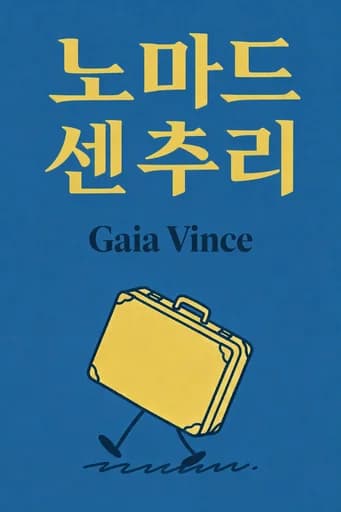
Nomad Century
How to Survive the Climate Upheaval
Nomad Century 개요
In "Nomad Century," Gaia Vince offers a radical blueprint for surviving climate upheaval through migration. Hailed as "the most important book" by Mary Roach, this Financial Times Best Book of 2022 challenges us: What if mass migration isn't our downfall, but our salvation?
Nomad Century의 핵심 주제
- climate migration
- planetary upheaval
- human adaptation
- borderless world
- anthropocene survival
Nomad Century의 명언
This isn't a distant threat; it's unfolding now.
Migration is our evolutionary response to crisis and opportunity.
Fire, heat, drought, and flood-the four horsemen of the Anthropocene-will transform our world.
Migration has fundamentally transformed our globe.
Nomad Century의 등장인물
- Gaia VinceAuthor, science journalist, and activist
저자 소개
Nomad Century의 저자 소개
Gaia Vince is an award-winning science journalist and broadcaster who explores the seismic impacts of climate migration in Nomad Century: How to Survive the Climate Upheaval.
A specialist in human-planetary systems, she blends fieldwork from more than 60 countries with rigorous analysis as an Honorary Senior Research Fellow at University College London’s Anthropocene Institute. Her 2.5-year global journey informed her Royal Society Prize-winning debut, Adventures in the Anthropocene, while Transcendence (shortlisted for the same prize) redefined human evolution through cultural-biological interplay.
Vince’s work regularly appears in The Guardian and on BBC platforms, where she hosts Inside Science. A former editor at Nature and New Scientist, she combines frontline reporting with solutions-oriented frameworks.
Nomad Century builds on her legacy of urgent, evidence-based storytelling, offering a blueprint for managing displacement in an era of climate crisis. The book has been widely cited in policy discussions on sustainable migration strategies.
Nomad Century 요약 다운로드
Nomad Century 요약을 무료 PDF 또는 EPUB으로 받으세요. 인쇄하거나 오프라인에서 언제든 읽을 수 있습니다.
이 책에 대한 FAQ
Nomad Century explores how climate change will force billions to migrate from uninhabitable regions, framing mass migration as an inevitable adaptation strategy. Gaia Vince argues for proactive planning to transform this crisis into an opportunity for global cooperation, suggesting policies for equitable resettlement and ecological restoration. The book combines climate science, geopolitics, and human stories to envision a sustainable future.
This book is essential for policymakers, environmentalists, and readers interested in climate resilience or migration studies. It appeals to those seeking data-driven solutions to global warming’s societal impacts, offering actionable ideas for governments and organizations. Critics of current migration policies will also find its evidence-based arguments compelling.
Yes—it won praise from figures like Kim Stanley Robinson and Andrea Wulf for its bold vision and rigorous research. While some critique its optimistic tone, the book’s urgency and innovative proposals make it a vital read for understanding 21st-century challenges. The Irish Times called it “refreshing” in a climate-denialist world.
Vince advocates for international migration treaties, climate-resilient city planning, and retraining programs for displaced populations. She highlights successful models like Canada’s immigration systems and proposes “new wandering cities” in habitable zones. These strategies aim to reduce conflict and leverage migration for economic growth.
Vince reframes migration as a natural human survival strategy, not a crisis. She argues that managed mobility could revitalize aging populations and distribute labor efficiently, calling for a shift from border control to adaptive governance. Historical examples and climate projections support this perspective.
- “Migration is a solution, not a problem” (core thesis).
- “We must plan for a billion climate migrants” (urgency of scale).
- Henry Mance: “Read this to understand our future” (endorsement of foresight).
The book cites a 4°C global temperature rise by 2100, rendering equatorial regions uninhabitable and displacing 3.5 billion people. Rising sea levels threaten coastal megacities, while droughts and extreme weather disrupt food systems. Vince stresses these outcomes are avoidable with immediate action.
Some reviewers argue Vince underestimates political resistance to open borders and over-relies on techno-optimistic fixes. Others note sparse details on funding mechanisms or cultural integration challenges. Despite this, critics acknowledge its groundbreaking scope.
Like her Royal Society-winning Adventures in the Anthropocene, this book examines human-planetary interdependence. However, Nomad Century focuses specifically on societal adaptation rather than ecological impacts, marking a shift toward policy-driven solutions.
The term, endorsed by Kim Stanley Robinson, refers to reimagining geopolitical boundaries and identities for a mobile world. Vince urges abandoning static notions of nation-states in favor of fluid, transnational communities adapted to climate realities.
Vince emphasizes that low-emitting Global South nations face the worst displacement, demanding climate reparations and migrant rights protections. She proposes wealthier countries accept proportional responsibility through resettlement quotas and green investment.
With record heatwaves displacing millions in Asia and Africa, Vince’s warnings feel prescient. The book’s framework informs debates on EU migration reforms and UN climate adaptation funds, making it a timely resource for leaders and activists.