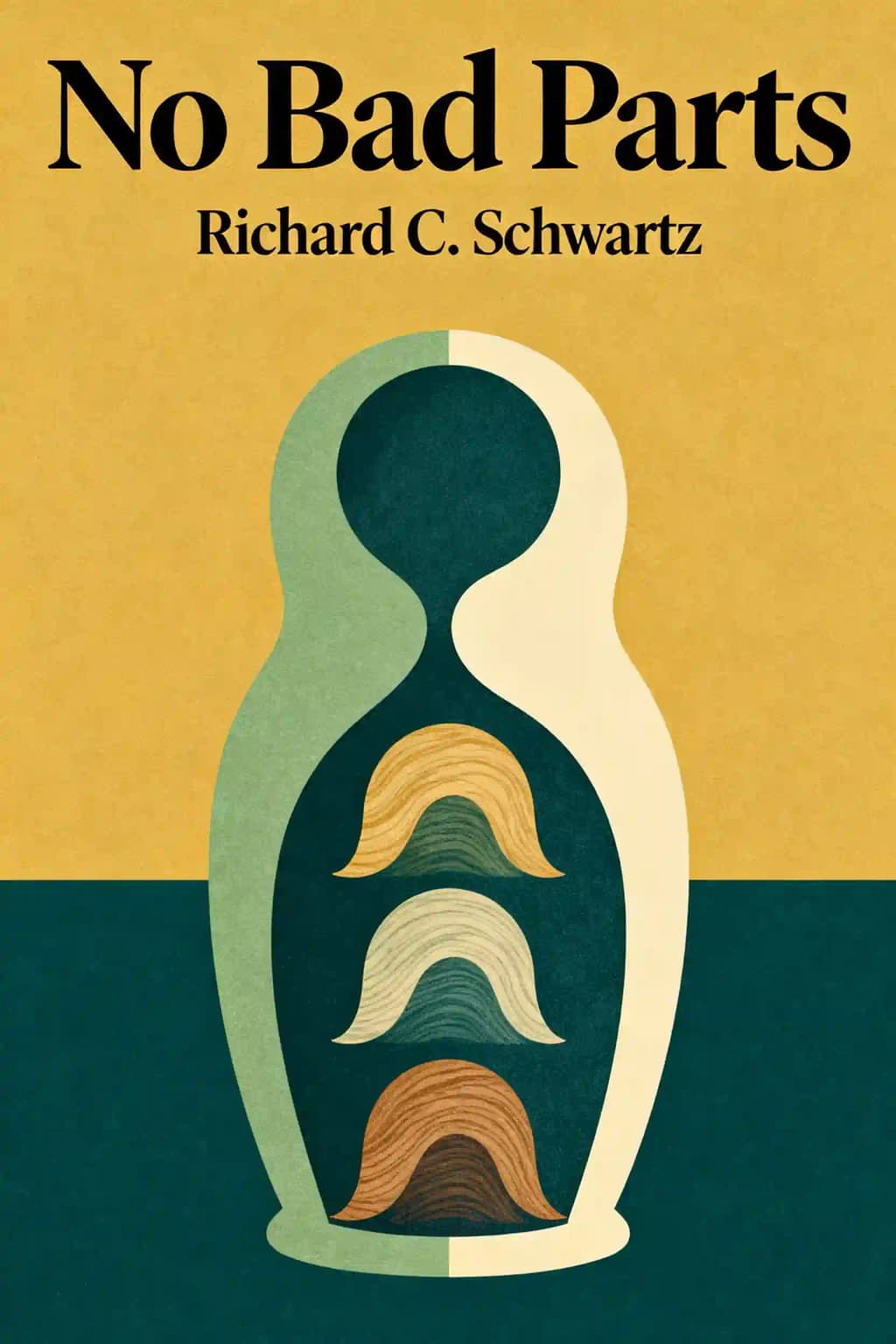
Discover your internal family of "parts" in this groundbreaking psychological framework endorsed by Alanis Morissette. What if your anxiety, anger, and shame aren't enemies but protectors? Schwartz's IFS model transforms trauma healing by revealing the revolutionary truth: there are no bad parts - only misunderstood ones.
Richard C. Schwartz, author of No Bad Parts, is a pioneering psychotherapist and the creator of the evidence-based Internal Family Systems (IFS) model.
A licensed marriage and family therapist with a PhD from Purdue University, Schwartz developed IFS through decades of clinical work, revealing how recognizing and integrating our inner “parts” leads to healing and wholeness. His groundbreaking approach, taught at Harvard Medical School and applied in trauma therapy worldwide, redefines mental health by emphasizing self-compassion over pathologization.
Schwartz’s other influential works include Introduction to the Internal Family Systems Model and You Are The One You’ve Been Waiting For, which expand on relationship dynamics and systemic healing. As founder of the IFS Institute, he trains clinicians across 30 countries, advancing a paradigm shift in psychotherapy.
No Bad Parts distills his 40+ years of research into actionable insights, solidifying IFS as a transformative framework embraced by therapists, coaches, and individuals seeking self-led resilience.
No Bad Parts introduces the Internal Family Systems (IFS) model, challenging the "mono-mind" belief by asserting everyone has multiple inner "parts." These parts, when understood and integrated, foster healing from trauma, addiction, and emotional struggles. The book emphasizes accessing the innate "Self"—a compassionate core that guides harmony and transformation.
This book is ideal for therapists, trauma survivors, and anyone seeking self-discovery. It’s particularly relevant for those interested in trauma recovery, addiction therapy, or depression treatment. Schwartz’s accessible writing also appeals to general readers exploring mindfulness and inner healing.
Yes, for its innovative approach to mental health. The IFS model offers practical exercises for mapping parts and accessing the Self. While some critiques note unanswered questions about how Self-led healing works, the book’s transformative framework has been widely praised in therapeutic circles.
The 8 Cs represent qualities of the core Self: Curiosity, Compassion, Calm, Clarity, Courage, Confidence, Creativity, and Connectedness. Schwartz argues these traits emerge when parts trust the Self’s leadership, enabling healing and harmony.
Schwartz reframes inner critics as protective parts trying to prevent harm. For example, a harsh self-critic might aim to shield you from rejection. By dialoguing with these parts—not silencing them—readers reclaim balance.
The phrase rejects the idea that any inner part is inherently negative. Even destructive behaviors (e.g., addiction) stem from parts acting as protectors. Healing involves unburdening these parts to restore their original positive roles.
Trauma creates "exiled" parts holding pain. The book guides readers to safely reconnect with exiles by first calming protective parts (e.g., inner critics or avoidant behaviors). This allows the Self to gently heal wounded fragments.
Healing involves building trust between these groups through Self-leadership.
While CBT focuses on modifying thoughts, IFS emphasizes understanding and integrating parts. Schwartz views negative patterns as misguided protectors, not flaws to fix. This approach complements CBT by addressing underlying emotional drivers.
Key practices:
Some note the book doesn’t fully explain how the Self facilitates healing, risking perception as overly idealistic. Skeptics may find concepts like “inner dialogues” abstract without guided therapy.
By healing internal conflicts, individuals relate more calmly to others. For example, understanding a partner’s anger as a protective part reduces defensiveness. Schwartz argues inner harmony fosters healthier external connections.
As mental health prioritizes holistic, non-pathologizing approaches, IFS aligns with trends toward self-compassion and trauma-informed care. Its focus on multiplicity also resonates in an era embracing diverse identities.
저자의 목소리로 책을 느껴보세요
지식을 흥미롭고 예시가 풍부한 인사이트로 전환
핵심 아이디어를 빠르게 캡처하여 신속하게 학습
재미있고 매력적인 방식으로 책을 즐기세요
There are no bad parts within us, only parts playing roles they were forced into.
The problem isn't our multiplicity but our culture's pathologizing of it.
Even the most destructive parts have protective intentions.
Our culture's 'rugged individualism' encourages us to 'get over it'.
No Bad Parts의 핵심 아이디어를 이해하기 쉬운 포인트로 분해하여 혁신적인 팀이 어떻게 창조하고, 협력하고, 성장하는지 이해합니다.
No Bad Parts을 빠른 기억 단서로 압축하여 솔직함, 팀워크, 창의적 회복력의 핵심 원칙을 강조합니다.

생생한 스토리텔링을 통해 No Bad Parts을 경험하고, 혁신 교훈을 기억에 남고 적용할 수 있는 순간으로 바꿉니다.
무엇이든 물어보고, 목소리를 선택하고, 진정으로 공감되는 인사이트를 함께 만들어보세요.

샌프란시스코에서 컬럼비아 대학교 동문들이 만들었습니다
"Instead of endless scrolling, I just hit play on BeFreed. It saves me so much time."
"I never knew where to start with nonfiction—BeFreed’s book lists turned into podcasts gave me a clear path."
"Perfect balance between learning and entertainment. Finished ‘Thinking, Fast and Slow’ on my commute this week."
"Crazy how much I learned while walking the dog. BeFreed = small habits → big gains."
"Reading used to feel like a chore. Now it’s just part of my lifestyle."
"Feels effortless compared to reading. I’ve finished 6 books this month already."
"BeFreed turned my guilty doomscrolling into something that feels productive and inspiring."
"BeFreed turned my commute into learning time. 20-min podcasts are perfect for finishing books I never had time for."
"BeFreed replaced my podcast queue. Imagine Spotify for books — that’s it. 🙌"
"It is great for me to learn something from the book without reading it."
"The themed book list podcasts help me connect ideas across authors—like a guided audio journey."
"Makes me feel smarter every time before going to work"
샌프란시스코에서 컬럼비아 대학교 동문들이 만들었습니다

No Bad Parts 요약을 무료 PDF 또는 EPUB으로 받으세요. 인쇄하거나 오프라인에서 언제든 읽을 수 있습니다.
Have you ever snapped at someone you love, then immediately wondered, "Why did I do that?" Or perhaps you've committed to a diet in the morning only to find yourself raiding the refrigerator by evening. This inner conflict isn't a sign of weakness - it's evidence of our fundamental multiplicity. According to Dr. Richard Schwartz's groundbreaking Internal Family Systems (IFS) approach, we all contain various "parts" that interact like members of an inner family. This isn't pathological - it's the natural state of being human. The problem isn't our multiplicity but our culture's insistence on a unified "mono-mind," which leaves us feeling defective when we can't control our thoughts and emotions through sheer willpower. Our Western psychological tradition, influenced by Calvinist notions of "total depravity" and Freudian theories of dark impulses lurking beneath civility, has taught us to fear our inner diversity rather than embrace it. What if those troublesome parts aren't enemies to be conquered but allies playing protective roles they don't actually want? What if there are no bad parts within us - only parts doing the best they can with the burdens they carry?
