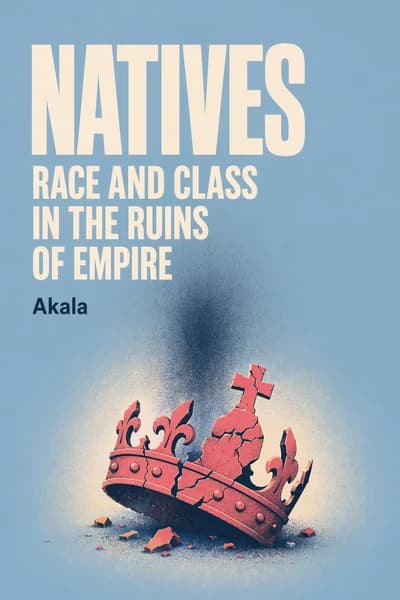
Akala's "Natives" dissects race and class in Britain through personal experience and historical analysis. Surging in popularity after George Floyd's murder, this unflinching examination impressed even skeptics like Piers Morgan while arming readers with facts to challenge imperial myths and systemic racism.
Kingslee James McLean Daley, better known as Akala, is the award-winning author of Natives: Race and Class in the Ruins of Empire, a Sunday Times Bestseller that blends memoir, history, and social critique. A groundbreaking rapper, historian, and activist, Akala has become a leading voice on systemic racism, colonialism, and class inequality. His work as founder of The Hip-Hip Shakespeare Company and his MOBO Award-winning music career inform the book’s incisive analysis of Britain’s imperial legacy.
Born to a Jamaican father and Scottish mother in 1983, Akala draws from his lived experience of poverty and racial profiling in London to dismantle myths of meritocracy. His 2012 mixtape Knowledge Is Power and graphic novel Visions further cement his reputation as a polymath bridging art and activism. Regularly featured on BBC, MTV, and global speaking circuits, Akala’s TED Talks and university lectures have amplified his call for systemic change.
Natives has been translated into multiple languages and remains a seminal text in anti-racist education. The book’s unflinching exploration of structural oppression has solidified Akala’s status as one of the UK’s most influential Black thinkers.
Natives blends memoir, historical analysis, and social critique to examine Britain’s racial and class inequalities. Akala interweaves his experiences growing up mixed-race in 1980s–90s London with explorations of imperialism, systemic racism, and myths of meritocracy. The book connects historical atrocities like the Atlantic slave trade to modern issues like police violence and educational disparities, arguing that race and class remain inseparable forces shaping British society.
This book is essential for readers interested in anti-racism, British colonialism, or class dynamics. Educators, policymakers, and activists will find its critiques of systemic inequality particularly relevant, while fans of Akala’s music or journalism gain insight into his intellectual foundations. It also appeals to those seeking narratives bridging personal trauma with broader historical patterns.
Yes—Natives offers a searing, well-researched perspective on Britain’s racial and economic hierarchies. Its blend of autobiography and history makes complex theories accessible, while Akala’s sharp critiques of media bias, educational inequity, and imperial legacies provide fresh angles on enduring social issues. The book’s unflinching honesty and multidisciplinary approach have earned praise for illuminating systemic oppression.
Akala (born Kingslee Daley) is a British-Jamaican rapper, historian, and activist known for his work on race and class. A MOBO Award-winning hip-hop artist, he founded the Hip-Hop Shakespeare Company and has become a prominent voice on imperialism. His lived experience with racism in London and autodidactic approach to education inform Natives’ blend of scholarly rigor and personal narrative.
Akala dismantles the myth that Britain rewards talent and effort equally, showing how race and class gatekeep opportunity. He highlights biased teacher expectations, discriminatory policing, and media dehumanization of Black figures like Linford Christie, arguing these systems ensure working-class and minority groups face structural barriers to advancement.
The book examines Japan’s imperialism, Spanish conceptions of Blackness in the 1400s, the Arab and Atlantic slave trades, and British rule in Hong Kong. Akala ties these to modern issues, showing how colonial violence and racial hierarchies underpin contemporary capitalism, immigration policies, and cultural attitudes.
Akala details being placed in remedial classes despite academic talent, linking this to studies showing teachers mark Black students more harshly. He contrasts this with Pan-African Saturday schools that fostered critical thinking, arguing mainstream education often perpetuates racism by erasing non-European histories and lowballing minority students.
This chapter dissects media obsession with athlete Linford Christie’s body instead of his achievements, exposing how Black masculinity is hypersexualized and dehumanized. Akala frames this as part of a broader pattern where Black success is diminished through racist stereotyping in sports and pop culture.
Yes—Akala critiques far-right rhetoric like the “white genocide” conspiracy theory and examines how “free speech” arguments amplify hate groups. He connects modern xenophobia to imperial ideologies, showing how fear of lost dominance fuels anti-immigrant and anti-Black policies.
Unlike purely historical or theoretical works, Natives merges memoir with academic analysis, offering a visceral, intersectional perspective. It complements texts like Brit(ish) by Afua Hirsch but stands out for its class-conscious lens and critique of liberal complacency.
Some argue Akala’s pessimism about systemic change lacks actionable solutions, while others note the dense historical sections demand prior knowledge. However, most praise its ambition in linking personal and political, calling it a vital intervention in debates on race and class.
The book exposes how imperialism’s legacy shapes everything from gentrification to Brexit-era nationalism. By connecting Windrush deportations, knife crime, and media racism to deeper colonial patterns, Akala provides tools to dissect modern inequalities rooted in Britain’s unresolved past.
저자의 목소리로 책을 느껴보세요
지식을 흥미롭고 예시가 풍부한 인사이트로 전환
핵심 아이디어를 빠르게 캡처하여 신속하게 학습
재미있고 매력적인 방식으로 책을 즐기세요
Education as battlefield.
Black excellence in British culture.
Natives Race and Class in the Ruins of Empire의 핵심 아이디어를 이해하기 쉬운 포인트로 분해하여 혁신적인 팀이 어떻게 창조하고, 협력하고, 성장하는지 이해합니다.
Natives Race and Class in the Ruins of Empire을 빠른 기억 단서로 압축하여 솔직함, 팀워크, 창의적 회복력의 핵심 원칙을 강조합니다.

생생한 스토리텔링을 통해 Natives Race and Class in the Ruins of Empire을 경험하고, 혁신 교훈을 기억에 남고 적용할 수 있는 순간으로 바꿉니다.
무엇이든 물어보고, 목소리를 선택하고, 진정으로 공감되는 인사이트를 함께 만들어보세요.

샌프란시스코에서 컬럼비아 대학교 동문들이 만들었습니다
"Instead of endless scrolling, I just hit play on BeFreed. It saves me so much time."
"I never knew where to start with nonfiction—BeFreed’s book lists turned into podcasts gave me a clear path."
"Perfect balance between learning and entertainment. Finished ‘Thinking, Fast and Slow’ on my commute this week."
"Crazy how much I learned while walking the dog. BeFreed = small habits → big gains."
"Reading used to feel like a chore. Now it’s just part of my lifestyle."
"Feels effortless compared to reading. I’ve finished 6 books this month already."
"BeFreed turned my guilty doomscrolling into something that feels productive and inspiring."
"BeFreed turned my commute into learning time. 20-min podcasts are perfect for finishing books I never had time for."
"BeFreed replaced my podcast queue. Imagine Spotify for books — that’s it. 🙌"
"It is great for me to learn something from the book without reading it."
"The themed book list podcasts help me connect ideas across authors—like a guided audio journey."
"Makes me feel smarter every time before going to work"
샌프란시스코에서 컬럼비아 대학교 동문들이 만들었습니다

Natives Race and Class in the Ruins of Empire 요약을 무료 PDF 또는 EPUB으로 받으세요. 인쇄하거나 오프라인에서 언제든 읽을 수 있습니다.
"Mum, the white boy..." Five-year-old Akala stopped mid-sentence, a sudden realization washing over him. "But you're white, aren't you Mummy?" In that playground moment, race became real-not as an abstract concept but as a lived reality that would shape every aspect of his existence. His mother's response was brilliant in its simplicity: she acknowledged her whiteness but created psychological distance by saying she was German while they were English. This mental safety valve allowed him to report racist abuse without the crushing worry of hurting her feelings. Growing up mixed-race in 1980s Camden meant navigating contradictions-council housing and free school meals alongside pan-African Saturday school and politically conscious parents. His identity formed through Sunday dinners at his grandmother Millicent's home, where Caribbean food and cultural traditions became his anchor. Yet when he visited Jamaica at seven, he initially displayed fierce English nationalism, criticizing the island as "backwards." Weeks later, after hunting lizards with cousins and swimming in rivers, he begged his mother to move there permanently. Race isn't just about how others see you-it's about the complex dance between external categorization and internal belonging, between family dynamics and cultural practices, between what society tells you and what your heart knows.