Dive into humanity's collective unconscious with Jung's final masterpiece. This groundbreaking exploration of dreams and symbols has influenced thinkers like Jordan Peterson, revealing how ancient archetypes secretly shape our modern lives. What hidden forces might be speaking through your dreams tonight?
Carl Gustav Jung (1875–1961), the Swiss psychiatrist and founder of analytical psychology, authored Man and His Symbols, a seminal work exploring the language of dreams, archetypes, and the collective unconscious. A pioneering figure in psychology, Jung’s expertise spanned psychiatry, mythology, and symbolism, with his theories reshaping modern understanding of the human psyche. The book synthesizes his decades of clinical research and interdisciplinary studies, offering accessible insights into how universal symbols bridge conscious and unconscious realms.
Jung’s professional journey began at Zürich’s Burghölzli Hospital under Eugen Bleuler, where he developed concepts like introversion/extroversion and individuation. His collaboration and subsequent divergence from Sigmund Freud marked a turning point in psychology. Beyond Man and His Symbols, Jung’s influential works include Memories, Dreams, Reflections (his autobiographical classic), The Red Book, and Psychology and Alchemy, all delving into spirituality, alchemy, and self-realization.
Translated into over 20 languages, Man and His Symbols remains a cornerstone of Jungian thought, bridging academic rigor and public accessibility. Jung’s legacy endures through his analytical frameworks, which continue to inspire psychology, literature, and spiritual studies worldwide.
Man and His Symbols explores Carl Jung’s theory of the unconscious mind, emphasizing how symbols in dreams and myths reveal universal archetypes shared across humanity. Jung argues that understanding these symbols bridges the gap between conscious and unconscious realms, fostering self-realization and psychological wholeness. The book critiques Western society’s over-reliance on rationality, advocating for integration of the "shadow" and "anima/animus" to resolve internal conflicts.
This book is ideal for psychology enthusiasts, spiritual seekers, and anyone interested in dream analysis or self-discovery. Jung’s accessible writing style makes complex concepts like archetypes and the collective unconscious approachable for both academic and general readers.
Yes, it’s a cornerstone of analytical psychology, offering timeless insights into human behavior and symbolism. Jung’s final work, completed days before his death, provides a comprehensive overview of his theories, enriched by contributions from his closest collaborators.
The collective unconscious refers to innate, universal psychic structures (archetypes) shared by all humans, such as the Hero or the Shadow. Jung posits that these archetypes surface in dreams, myths, and art, shaping human behavior and cultural narratives across societies.
The shadow represents repressed traits, fears, and desires buried in the unconscious. Jung urges readers to confront and integrate this dark aspect to achieve psychological balance, warning that ignoring it leads to neuroses and existential dissatisfaction.
Dreams are the unconscious mind’s primary communication tool, using symbols to reveal unresolved conflicts or guidance. Jung interprets them as personalized roadmaps for individuation—the process of becoming one’s authentic self.
Jung argues that Western society’s obsession with rationality has alienated individuals from their unconscious, causing anxiety and spiritual emptiness. He contrasts this with Eastern philosophies that honor intuitive and symbolic thinking.
The anima (feminine energy in men) and animus (masculine energy in women) represent counter-gendered aspects of the psyche. Jung views embracing these archetypes as vital for emotional maturity and harmonious relationships.
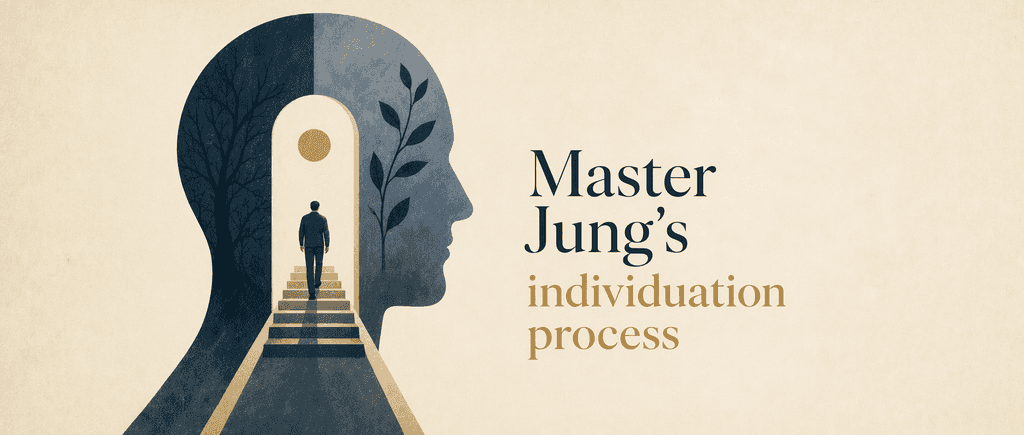
Individuation is the lifelong journey of integrating conscious and unconscious elements of the psyche to achieve self-realization. Jung illustrates this through case studies, showing how confronting archetypal symbols leads to psychological wholeness.
Jung and his collaborators analyze myths as expressions of universal archetypes. For example, hero myths symbolize the ego’s struggle to overcome the shadow, reflecting humanity’s shared psychological struggles.
It’s Jung’s only book aimed at a general audience, written in plain language and richly illustrated. Co-authored with his protégés, it synthesizes his decades of research into a cohesive guide for understanding the unconscious.
Its insights into symbolism, mental health, and societal disconnection resonate in modern contexts like AI-driven alienation and existential anxiety. The book’s focus on self-awareness offers tools for navigating contemporary psychological challenges.
저자의 목소리로 책을 느껴보세요
지식을 흥미롭고 예시가 풍부한 인사이트로 전환
핵심 아이디어를 빠르게 캡처하여 신속하게 학습
재미있고 매력적인 방식으로 책을 즐기세요
The dream is a little hidden door in the innermost and most secret recesses of the soul, opening into that cosmic night which was psyche long before there was any ego-consciousness, and which will remain psyche no matter how far our ego-consciousness extends.
The shoe that fits one person pinches another; there is no recipe for living that suits all cases.
As far as we can discern, the sole purpose of human existence is to kindle a light in the darkness of mere being.
Symbols always point to something beyond their obvious meaning.
Man and His Symbols의 핵심 아이디어를 이해하기 쉬운 포인트로 분해하여 혁신적인 팀이 어떻게 창조하고, 협력하고, 성장하는지 이해합니다.
Man and His Symbols을 빠른 기억 단서로 압축하여 솔직함, 팀워크, 창의적 회복력의 핵심 원칙을 강조합니다.

생생한 스토리텔링을 통해 Man and His Symbols을 경험하고, 혁신 교훈을 기억에 남고 적용할 수 있는 순간으로 바꿉니다.
무엇이든 물어보고, 목소리를 선택하고, 진정으로 공감되는 인사이트를 함께 만들어보세요.

샌프란시스코에서 컬럼비아 대학교 동문들이 만들었습니다
"Instead of endless scrolling, I just hit play on BeFreed. It saves me so much time."
"I never knew where to start with nonfiction—BeFreed’s book lists turned into podcasts gave me a clear path."
"Perfect balance between learning and entertainment. Finished ‘Thinking, Fast and Slow’ on my commute this week."
"Crazy how much I learned while walking the dog. BeFreed = small habits → big gains."
"Reading used to feel like a chore. Now it’s just part of my lifestyle."
"Feels effortless compared to reading. I’ve finished 6 books this month already."
"BeFreed turned my guilty doomscrolling into something that feels productive and inspiring."
"BeFreed turned my commute into learning time. 20-min podcasts are perfect for finishing books I never had time for."
"BeFreed replaced my podcast queue. Imagine Spotify for books — that’s it. 🙌"
"It is great for me to learn something from the book without reading it."
"The themed book list podcasts help me connect ideas across authors—like a guided audio journey."
"Makes me feel smarter every time before going to work"
샌프란시스코에서 컬럼비아 대학교 동문들이 만들었습니다

Man and His Symbols 요약을 무료 PDF 또는 EPUB으로 받으세요. 인쇄하거나 오프라인에서 언제든 읽을 수 있습니다.
Have you ever dismissed a vivid dream as "just random brain noise"-only to feel its mood shadow you all day? Carl Jung spent his final months racing against death to complete a book that would crack open this mystery for ordinary people. Days before his final illness in 1961, he finished "Man and His Symbols," a work born from an unusual source: his own dream of speaking to masses who actually understood him. Unlike Freud's ideas, which quickly saturated popular culture, Jung's revolutionary concepts-archetypes, the collective unconscious, symbolic language-remained locked in academic jargon until this book. Today, his fingerprints appear everywhere from Star Wars mythology to Ursula K. Le Guin's novels, yet most people still don't grasp the profound system he created for decoding the messages our psyche sends us nightly. The unconscious isn't just a psychological basement where we dump repressed memories. It's an active, intelligent force that continues guiding you even when consciousness fails. Ever walked into a room, forgotten why you came, yet found your hand unconsciously reaching for the exact object you needed? That's your unconscious maintaining continuity while your conscious mind stumbles.