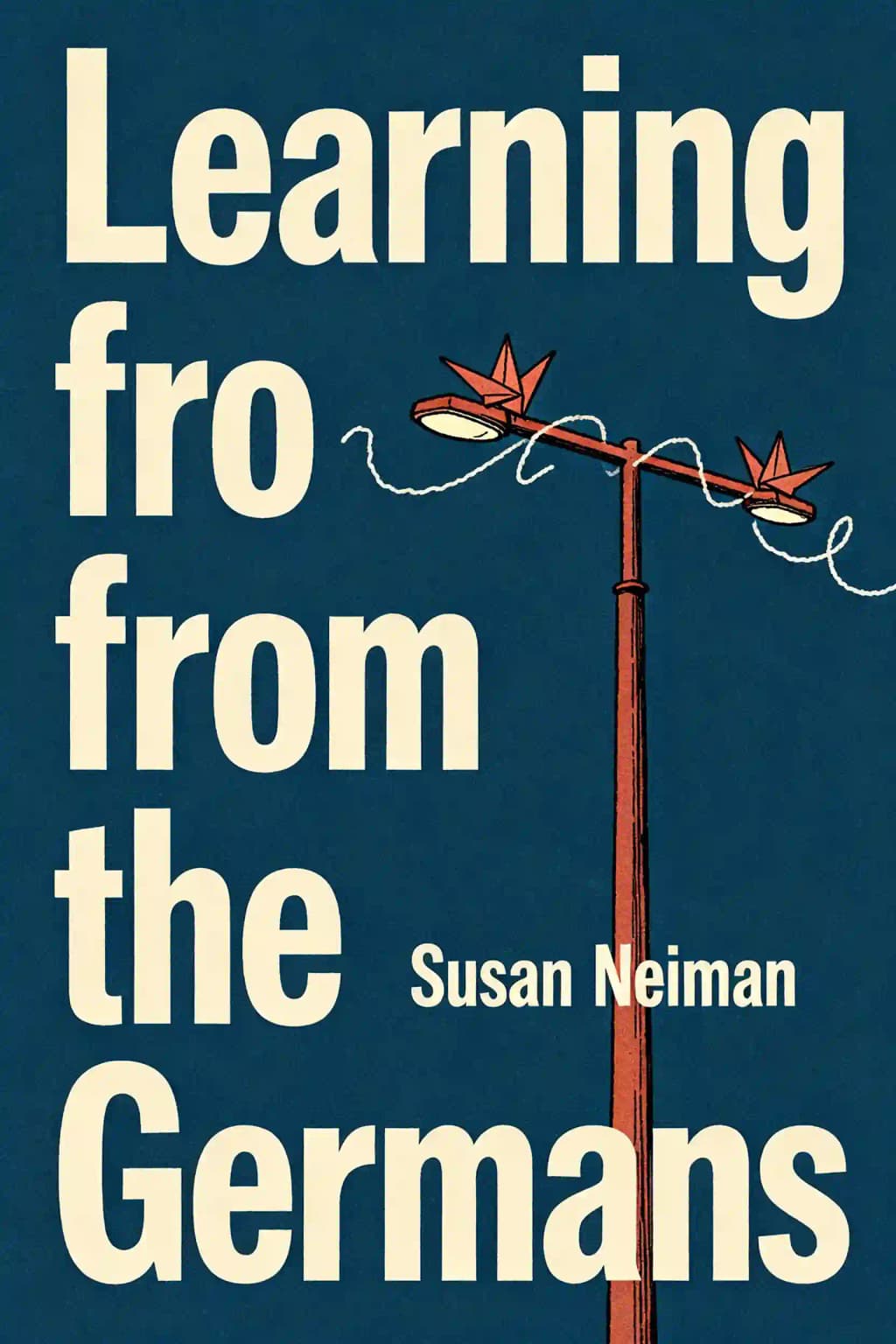
Susan Neiman's groundbreaking exploration of how Germany confronted its Nazi past offers America a blueprint for addressing slavery and racism. Featured in discussions with scholar Jelani Cobb, this provocative work asks: Can one nation's moral reckoning illuminate another's path toward healing?
Susan Neiman, author of Learning from the Germans: Race and the Memory of Evil, is a renowned moral philosopher and cultural commentator whose work bridges Enlightenment thought and contemporary ethical debates.
A Harvard-trained philosopher and director of Potsdam’s Einstein Forum, Neiman explores historical reckoning and collective memory in this genre-defying blend of historical analysis, political theory, and memoir.
Her Jewish heritage and decades living in Germany inform her examination of how societies confront systemic injustice—a theme central to her acclaimed works like Evil in Modern Thought and Moral Clarity: A Guide for Grown-Up Idealists.
A frequent contributor to The New York Review of Books and The Guardian, Neiman’s insights have shaped global discourse on morality and justice. Learning from the Germans has been translated into 15 languages and praised for its bold interweaving of Holocaust memory with America’s racial legacy, solidifying Neiman’s reputation as a vital voice in ethical philosophy.
Learning from the Germans examines how Germany confronted its Nazi past through Vergangenheitsaufarbeitung (reckoning with history) and compares this process to America’s struggle to address slavery and systemic racism. Neiman argues that honest historical acknowledgment, education, and public dialogue are vital for moral progress, offering lessons for nations grappling with legacy injustices.
This book is ideal for historians, policymakers, and activists interested in comparative approaches to justice, reparations, and collective memory. It’s also relevant for readers exploring how societies can ethically address past crimes while fostering inclusive national identities.
Yes—Neiman’s blend of philosophical rigor, historical analysis, and firsthand observations in Germany provides a unique framework for understanding reparative justice. The book’s interdisciplinary approach makes it valuable for discussions on race, memory, and accountability in modern societies.
Vergangenheitsaufarbeitung refers to Germany’s structured process of confronting Nazi crimes through memorials, education, and legal accountability. Neiman highlights its success in fostering national healing and argues the U.S. could adopt similar measures to address slavery and racism.
Germany’s systematic efforts—memorials, reparations, and education—contrast with America’s fragmented acknowledgment of slavery and racism. Neiman critiques the U.S. for downplaying its history while advocating for Germany’s model as a blueprint.
Some scholars argue Neiman overly idealizes Germany’s reckoning, noting its reluctance to address colonial crimes or East Germany’s communist past. Others question whether its lessons can transcend cultural contexts.
The book underscores the need for institutional accountability (e.g., reparations, curriculum reforms) and symbolic acts (e.g., removing Confederate statues) to align with movements like Black Lives Matter.
Neiman advocates for curriculums that critically examine national histories, citing Germany’s mandatory Holocaust education. She contrasts this with U.S. schools often omitting systemic racism’s enduring impacts.
Like Evil in Modern Thought, this book explores moral philosophy through historical lenses. Neiman consistently ties Enlightenment ideals to contemporary justice, emphasizing reason and ethical responsibility.
As debates over critical race theory and reparations intensify globally, Neiman’s analysis provides a roadmap for reconciling democratic values with historical truth—a pressing issue in polarized societies.
저자의 목소리로 책을 느껴보세요
지식을 흥미롭고 예시가 풍부한 인사이트로 전환
핵심 아이디어를 빠르게 캡처하여 신속하게 학습
재미있고 매력적인 방식으로 책을 즐기세요
National redemption is possible through persistent effort.
Holocaust denial is unthinkable and Nazi symbols are banned.
East Germany declared itself 'the other Germany'.
Learning from the Germans의 핵심 아이디어를 이해하기 쉬운 포인트로 분해하여 혁신적인 팀이 어떻게 창조하고, 협력하고, 성장하는지 이해합니다.
Learning from the Germans을 빠른 기억 단서로 압축하여 솔직함, 팀워크, 창의적 회복력의 핵심 원칙을 강조합니다.

생생한 스토리텔링을 통해 Learning from the Germans을 경험하고, 혁신 교훈을 기억에 남고 적용할 수 있는 순간으로 바꿉니다.
무엇이든 물어보고, 목소리를 선택하고, 진정으로 공감되는 인사이트를 함께 만들어보세요.

샌프란시스코에서 컬럼비아 대학교 동문들이 만들었습니다
"Instead of endless scrolling, I just hit play on BeFreed. It saves me so much time."
"I never knew where to start with nonfiction—BeFreed’s book lists turned into podcasts gave me a clear path."
"Perfect balance between learning and entertainment. Finished ‘Thinking, Fast and Slow’ on my commute this week."
"Crazy how much I learned while walking the dog. BeFreed = small habits → big gains."
"Reading used to feel like a chore. Now it’s just part of my lifestyle."
"Feels effortless compared to reading. I’ve finished 6 books this month already."
"BeFreed turned my guilty doomscrolling into something that feels productive and inspiring."
"BeFreed turned my commute into learning time. 20-min podcasts are perfect for finishing books I never had time for."
"BeFreed replaced my podcast queue. Imagine Spotify for books — that’s it. 🙌"
"It is great for me to learn something from the book without reading it."
"The themed book list podcasts help me connect ideas across authors—like a guided audio journey."
"Makes me feel smarter every time before going to work"
샌프란시스코에서 컬럼비아 대학교 동문들이 만들었습니다

Learning from the Germans 요약을 무료 PDF 또는 EPUB으로 받으세요. 인쇄하거나 오프라인에서 언제든 읽을 수 있습니다.
A white Jewish woman who grew up in the segregated American South now lives in Berlin, the former capital of Nazi Germany. This unlikely journey positions her at the intersection of two nations wrestling with unspeakable crimes-Germany's Holocaust and America's slavery. What can a country that systematically murdered six million Jews teach a nation built on centuries of enslaved labor? The answer isn't simple, but it's urgent. As Confederate monuments fall and debates over reparations intensify, we're forced to ask: Can a nation truly transform itself by confronting its darkest chapters? Or are some wounds too deep to heal?