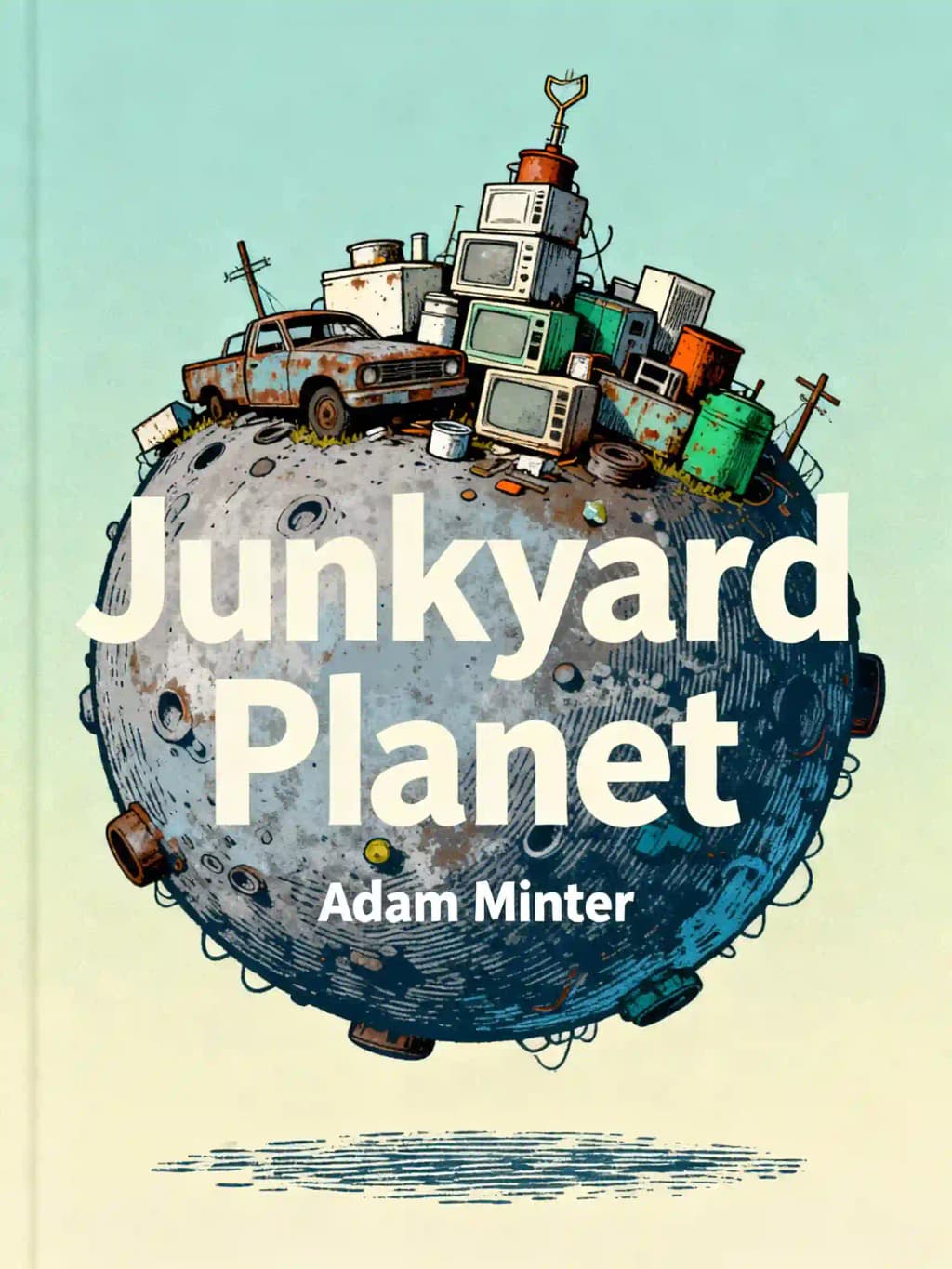
Discover how your trash becomes treasure in the billion-dollar recycling industry. "Junkyard Planet" reveals the surprising economics behind global waste, challenging environmental assumptions with vivid storytelling that earned it "Best Non-Fiction" honors and sparked crucial conversations about consumption's true cost.
Adam Minter is the acclaimed author of Junkyard Planet: Travels in the Billion-Dollar Trash Trade and a leading voice on global recycling and sustainable economies.
A Bloomberg Opinion columnist covering China, technology, and the environment, Minter’s work is rooted in his multigenerational scrap industry heritage—his family has operated scrap yards for over a century. This deep personal connection informs his exploration of the intricate networks transforming discarded materials into valuable commodities.
His critically acclaimed debut, Junkyard Planet, unravels the environmental and economic realities of international waste trade, while his follow-up, Secondhand: Travels in the New Global Garage Sale, examines the lifecycle of used goods.
Recognized with the Stephen Barr Award for investigative journalism, Minter’s insights have been featured in prominent platforms like TTBook.org and the Impact Podcast. Junkyard Planet remains a seminal work, praised for making complex supply chains accessible and highlighting recycling’s role in globalization.
Junkyard Planet by Adam Minter explores the $500 billion global recycling industry, tracing how discarded materials like metals, plastics, and electronics are transformed into valuable resources. Through firsthand accounts from scrapyards in China, India, and the U.S., Minter reveals the economic interdependence between nations, environmental trade-offs, and how consumer habits fuel this hidden supply chain.
Environmental advocates, economics enthusiasts, and readers interested in global trade will find value in this book. It appeals to those curious about sustainability’s complexities, the circular economy, or the unseen journeys of everyday waste. Minter’s blend of memoir and investigative journalism also suits fans of narrative nonfiction.
Yes—it combines rigorous reporting with engaging storytelling, offering a rare look into an industry critical to modern consumption. Minter’s deep expertise (shaped by his family’s scrapyard) and global perspective make it essential for understanding how recycling sustains economies and mitigates environmental harm.
“The clean, crisp picture of waste dumping that exists in the West is an illusion... [It’s] the emergence of a truly global market in old goods.” This underscores how recycling is driven by demand, not altruism.
Minter acknowledges criticisms of labor conditions and pollution in developing-world scrapyards but argues recycling’s economic benefits often outweigh alternatives like landfills. He highlights innovations reducing environmental harm, like automated sorting systems.
While Junkyard Planet focuses on industrial recycling, Secondhand examines the global secondhand-goods trade. Both reveal hidden economies but differ in scope: one tracks raw materials, the other consumer reuse.
Minter contrasts U.S. “single-stream” recycling with developing nations’ labor-intensive methods. For example, Chinese entrepreneurs profitably repurpose U.S. scrap metal, while American consumers remain disconnected from waste’s afterlife.
As the son of a scrapyard owner and a journalist covering China, Minter combines personal nostalgia with decades of industry access. His reporting blends technical detail (e.g., metal grading) with human stories of waste pickers and magnates.
With circular economies gaining traction, the book clarifies challenges in scaling recycling sustainably. It remains a primer on balancing economic growth with environmental stewardship amid rising e-waste and climate pressures.
Some argue Minter downplays labor exploitation and pollution in unregulated recycling hubs. Critics also note his optimism about market-driven solutions contrasts with calls for stricter environmental regulations.
The book reframes trash as a commodity: an aluminum can’s value lies in its potential reuse, not its initial purpose. Minter shows how markets determine whether items are recycled, landfilled, or repurposed.
저자의 목소리로 책을 느껴보세요
지식을 흥미롭고 예시가 풍부한 인사이트로 전환
핵심 아이디어를 빠르게 캡처하여 신속하게 학습
재미있고 매력적인 방식으로 책을 즐기세요
One person's trash becomes another's treasure.
Recycling isn't driven by altruism but by market forces.
Chinese recognize that recyclables have monetary value.
Recycling has always been about economics first.
Without extraterrestrial mining, reusing existing materials remains our best option.
Junkyard Planet의 핵심 아이디어를 이해하기 쉬운 포인트로 분해하여 혁신적인 팀이 어떻게 창조하고, 협력하고, 성장하는지 이해합니다.
Junkyard Planet을 빠른 기억 단서로 압축하여 솔직함, 팀워크, 창의적 회복력의 핵심 원칙을 강조합니다.

생생한 스토리텔링을 통해 Junkyard Planet을 경험하고, 혁신 교훈을 기억에 남고 적용할 수 있는 순간으로 바꿉니다.
무엇이든 물어보고, 목소리를 선택하고, 진정으로 공감되는 인사이트를 함께 만들어보세요.

샌프란시스코에서 컬럼비아 대학교 동문들이 만들었습니다
"Instead of endless scrolling, I just hit play on BeFreed. It saves me so much time."
"I never knew where to start with nonfiction—BeFreed’s book lists turned into podcasts gave me a clear path."
"Perfect balance between learning and entertainment. Finished ‘Thinking, Fast and Slow’ on my commute this week."
"Crazy how much I learned while walking the dog. BeFreed = small habits → big gains."
"Reading used to feel like a chore. Now it’s just part of my lifestyle."
"Feels effortless compared to reading. I’ve finished 6 books this month already."
"BeFreed turned my guilty doomscrolling into something that feels productive and inspiring."
"BeFreed turned my commute into learning time. 20-min podcasts are perfect for finishing books I never had time for."
"BeFreed replaced my podcast queue. Imagine Spotify for books — that’s it. 🙌"
"It is great for me to learn something from the book without reading it."
"The themed book list podcasts help me connect ideas across authors—like a guided audio journey."
"Makes me feel smarter every time before going to work"
샌프란시스코에서 컬럼비아 대학교 동문들이 만들었습니다

Junkyard Planet 요약을 무료 PDF 또는 EPUB으로 받으세요. 인쇄하거나 오프라인에서 언제든 읽을 수 있습니다.
That plastic bottle you just tossed in the recycling bin? It might end up in a Chinese factory, transformed into a fleece jacket destined for a store near you. The Christmas lights tangled in your garage could become copper wire in a Guangzhou electronics plant. This isn't environmental fantasy-it's the hidden reality of a $500 billion global industry that employs more people than any sector except agriculture. Most of us imagine recycling as a noble local effort, our discards sorted by friendly neighbors and reborn in nearby facilities. The truth is far stranger and more complex. Your recyclables are commodities in a vast international marketplace, shipped across oceans in containers that would otherwise travel empty, sorted by workers you'll never meet, and reborn into products that may circle back to your local store. Understanding this journey reveals uncomfortable truths about consumption, globalization, and what we really mean when we talk about sustainability.