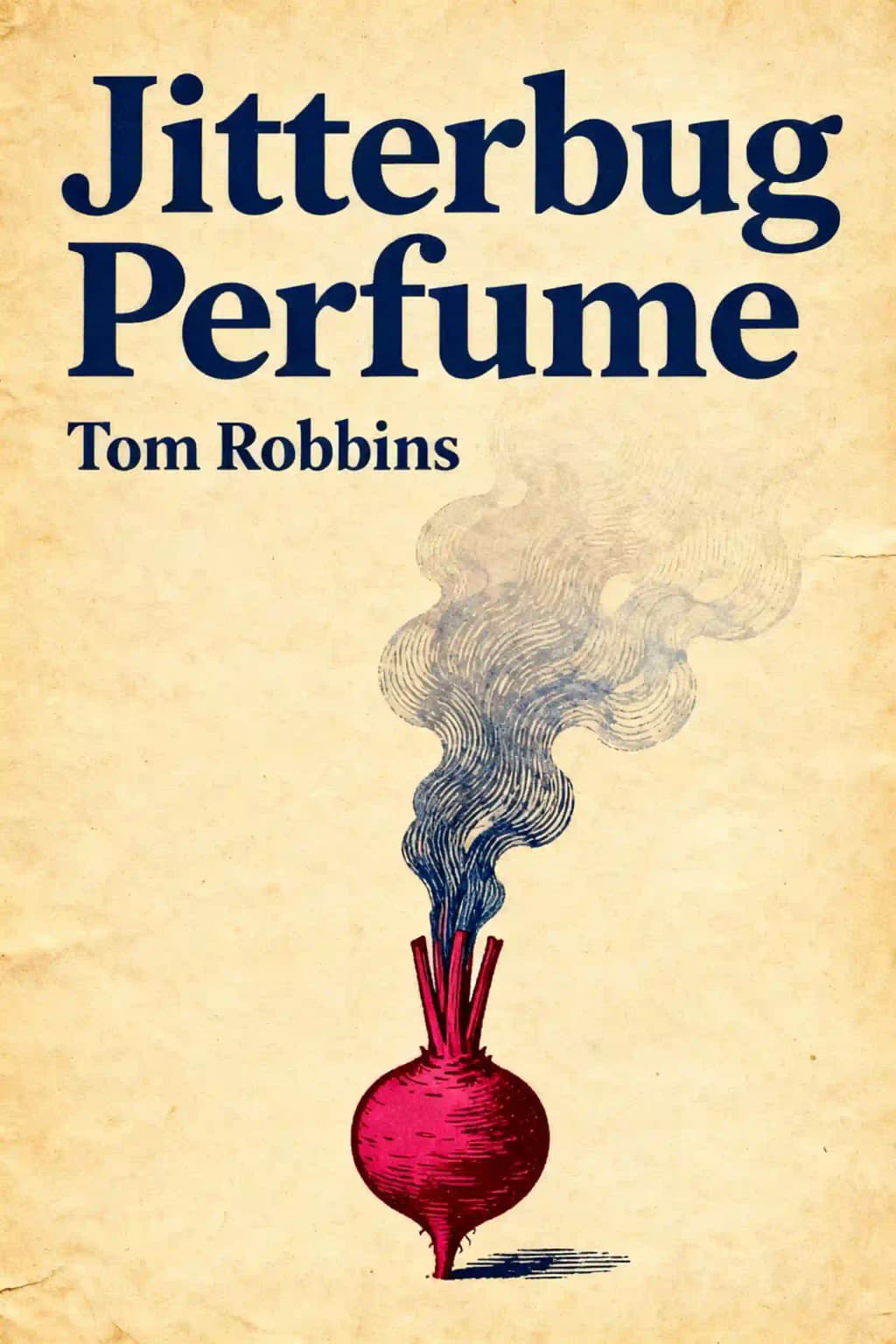
Jitterbug Perfume weaves immortality and perfumery across centuries, from ancient Bohemia to modern Seattle. Tom Robbins' bestselling masterpiece commands $750 for signed first editions, ranking second among his works with its "astounding" figurative language. What floral consciousness awaits in this goofily lyrical adventure?
Thomas Eugene Robbins (1932–2025) was the bestselling author of Jitterbug Perfume and a celebrated American novelist renowned for his genre-bending "seriocomedies" that fuse philosophical inquiry with whimsical humor. Born in Blowing Rock, North Carolina, Robbins crafted novels that challenged conventional thinking about spirituality, sexuality, and freedom, blending mysticism with playful wordplay and eccentric characters.
Jitterbug Perfume exemplifies his signature style, weaving together multiple timelines and narratives to explore immortality, the power of scent, and the interconnectedness of human experience. After serving in the U.S. Air Force and working as a journalist and art critic, Robbins settled in La Conner, Washington, in 1970, where he wrote nine books over five decades. His other acclaimed works include Even Cowgirls Get the Blues, which was adapted into a feature film, Another Roadside Attraction, Still Life with Woodpecker, and Skinny Legs and All.
Throughout the 1980s and 1990s, Robbins contributed essays to Esquire, Playboy, and The New York Times, establishing himself as a distinctive voice in American countercultural literature. His novels have captivated readers worldwide with their celebration of nonconformity and exploration of life's absurdist mysteries.
Jitterbug Perfume by Tom Robbins is an epic novel that follows two interweaving storylines across centuries, connecting ancient King Alobar's quest for immortality with modern-day perfumers in Seattle, Paris, and New Orleans. The story centers on a mysterious perfume called K23, created by Alobar and his lover Kudra, who discover the secrets to eternal life while befriending the dying Greek god Pan. Through magical realism, philosophy, and irreverent humor, Robbins explores themes of life, death, love, and the power of scent.
Jitterbug Perfume is ideal for readers who enjoy philosophical fiction blended with magical realism, sensual prose, and unconventional humor. This novel appeals to those interested in exploring themes of mortality, spirituality, and human potential through eccentric characters and richly detailed, multi-temporal settings spanning from ancient Bohemia to modern America. Readers who appreciate absurdist literature, counter-cultural philosophy, and narratives that challenge conventional thinking about life and death will find this book particularly rewarding.
Jitterbug Perfume is worth reading for its unique combination of intellectual depth, sensory-rich storytelling, and joyous celebration of life's absurdity. Published in 1984 and listed on the New York Times Best Seller list, Tom Robbins' fourth novel remains a favorite among fans for its unforgettable characters, imaginative world-building, and thought-provoking exploration of immortality. The book offers both entertainment and philosophical insight, encouraging readers to embrace curiosity, defy convention, and find meaning in everyday pleasures.
Tom Robbins wrote Jitterbug Perfume, his fourth novel, which was first published in 1984 by Bantam Books and later reprinted by Random House. The book became a commercial success, appearing on the New York Times Best Seller list in 1985, and is considered possibly Robbins' most successful work. Robbins is known for blending realism with fantasy, comedy, and philosophical themes in his distinctive literary style.
The primary themes in Jitterbug Perfume are life and death, with each character seeking to overcome mortality and achieve immortality. Secondary themes include the power of scent and perfume, which connects all characters across centuries, and the importance of love, sex, and intimate relationships as essential to vitality. The novel also explores spirituality, meditation, Pan's mythological decline due to Christianity's rise, and critiques modernity's emphasis on reason over sensuality and authentic experience.
The main characters in Jitterbug Perfume include King Alobar, an ancient Bohemian ruler who fakes his death to escape aging rituals, and Kudra, an Indian woman who becomes his immortal lover and partner in perfume-making. Other key characters are Priscilla Partido, a modern Seattle waitress attempting to recreate the legendary perfume K23; Wiggs Dannyboy, an Irish philosopher and founder of the Last Laugh Foundation; the Greek god Pan, who loses power as belief in him fades; and V'lu, who works between competing perfume houses in New Orleans and Paris.
Beets in Jitterbug Perfume represent a crucial ingredient in the legendary perfume K23 and symbolize earthiness and vitality throughout the novel. Wiggs Dannyboy strategically sends beets to notable perfumers to help them progress toward discovering the secret formula, recognizing that beet pollen extract is essential to recreating Alobar's immortal perfume. The recurring beet imagery appears across multiple contexts—as food, spiritual symbolism, and ultimately the key ingredient—creating a narrative thread that connects ancient wisdom to modern discovery.
K23 is the legendary perfume created by Alobar using trace amounts of beet pollen extract, originally designed to mask the Greek god Pan's supernatural stench during their voyage to America. The perfume becomes a central mystery connecting modern perfumers Priscilla Partido, Marcel LeFever, and V'lu Devalier, who all seek to recreate its incomparable scent. Named after Alobar's lost love Kudra, K23 embodies the essence of immortality and serves as the bridge between past and present storylines when all characters converge in New Orleans during Mardi Gras.
Jitterbug Perfume explores immortality through the Bandaloop Doctors' secrets, which involve four elements: air (controlled breathing), water (ritual bathing), earth (simple diet), and fire (desire and sex between partners). Alobar and Kudra live together for thousands of years by practicing these principles while maintaining a strong libido and mutual love. The novel suggests that immortality requires not just physical practices but also lightheartedness, laughter, and rejecting society's fear of death—ultimately advocating for celebrating life's absurdity rather than frantically fighting the inevitable.
"Lighten up" is the central message of Jitterbug Perfume, delivered by Kudra when she rematerializes at the novel's end, and represents the philosophy that life is extended through laughter and a light heart rather than grim determination. This phrase encapsulates Tom Robbins' theme that obsessing over death and future legacy prevents enjoying present pleasures, encouraging readers to embrace life's absurdity and sensuality instead of dwelling on mortality. The message challenges the Age of Reason's emphasis on seriousness, suggesting that taking life too seriously actually shortens it spiritually and emotionally.
Pan, the Greek god of nature and wildness, appears in Jitterbug Perfume as a dying deity losing his powers due to mass conversion to Christianity and the Age of Reason's dismissal of pagan beliefs. Alobar befriends Pan during his travels and later cares for the now-invisible god alongside Kudra in 17th-century Paris, attempting to hide Pan's supernatural stench with perfume. Pan's decline symbolizes modernity's suppression of natural instincts, sensuality, and primal consciousness, representing the tension between rational thought and authentic, embodied experience that runs throughout the novel.
The four elements of immortality in Jitterbug Perfume are air, water, earth, and fire, revealed by the Bandaloop Doctors to Alobar and Kudra.
These elements work together holistically, suggesting that immortality requires balancing physical discipline, spiritual practice, and emotional vitality—with particular emphasis on maintaining a healthy, passionate relationship as essential to longevity.
저자의 목소리로 책을 느껴보세요
지식을 흥미롭고 예시가 풍부한 인사이트로 전환
핵심 아이디어를 빠르게 캡처하여 신속하게 학습
재미있고 매력적인 방식으로 책을 즐기세요
"The purpose of art is to provide what life does not"
His flight from death becomes a philosophical rebellion
Resentment of death is inferior to genuine fear
Pleasure must be paid for with pain.
He excites her because he challenges the gods
Jitterbug Perfume의 핵심 아이디어를 이해하기 쉬운 포인트로 분해하여 혁신적인 팀이 어떻게 창조하고, 협력하고, 성장하는지 이해합니다.
생생한 스토리텔링을 통해 Jitterbug Perfume을 경험하고, 혁신 교훈을 기억에 남고 적용할 수 있는 순간으로 바꿉니다.
무엇이든 묻고, 학습 스타일을 선택하고, 나에게 맞는 인사이트를 함께 만들어보세요.

샌프란시스코에서 컬럼비아 대학교 동문들이 만들었습니다
"Instead of endless scrolling, I just hit play on BeFreed. It saves me so much time."
"I never knew where to start with nonfiction—BeFreed’s book lists turned into podcasts gave me a clear path."
"Perfect balance between learning and entertainment. Finished ‘Thinking, Fast and Slow’ on my commute this week."
"Crazy how much I learned while walking the dog. BeFreed = small habits → big gains."
"Reading used to feel like a chore. Now it’s just part of my lifestyle."
"Feels effortless compared to reading. I’ve finished 6 books this month already."
"BeFreed turned my guilty doomscrolling into something that feels productive and inspiring."
"BeFreed turned my commute into learning time. 20-min podcasts are perfect for finishing books I never had time for."
"BeFreed replaced my podcast queue. Imagine Spotify for books — that’s it. 🙌"
"It is great for me to learn something from the book without reading it."
"The themed book list podcasts help me connect ideas across authors—like a guided audio journey."
"Makes me feel smarter every time before going to work"
샌프란시스코에서 컬럼비아 대학교 동문들이 만들었습니다

Jitterbug Perfume 요약을 무료 PDF 또는 EPUB으로 받으세요. 인쇄하거나 오프라인에서 언제든 읽을 수 있습니다.
Imagine a world where the scent of jasmine and beets could unlock the secret to eternal life. Where gods fade into mist as humans learn to transcend death. Where a thousand-year journey begins with a single gray hair discovered by a king facing ritual sacrifice. This is the intoxicating universe of "Jitterbug Perfume," where immortality isn't about escaping life but embracing it fully - breathing deeper, loving fiercer, and dancing longer than seems humanly possible. The story spans continents and centuries, weaving together the lives of an ancient king, a widow who refused to burn, modern perfumers, and eccentric scientists - all connected by a mysterious fragrance that bridges worlds. At its heart lies a radical proposition: what if death isn't inevitable? What if, with the right combination of breathing techniques, bathing rituals, diet, and tantric sexuality, we could extend life indefinitely? And would immortality be a blessing or a burden?
In a small Bohemian kingdom during the early Middle Ages, King Alobar discovers a gray hair-triggering ritual sacrifice in his culture. Rather than accepting this fate, he escapes and begins a journey spanning centuries. Fleeing through medieval Europe into Asia, Alobar encounters Pan, the ancient goat-god fading as Christianity spreads. Their meeting reveals a fundamental shift as nature-worship gives way to religions separating humans from their environment. Alobar develops a complex relationship with mortality, singing about the world's roundness as a metaphor for cyclical existence while pursuing immortality. After twenty years in a Tibetan lamasery, Alobar reunites with Kudra, whom he'd first met when witnessing suttee-ritual widow burning. Born into a perfumer's family, Kudra had learned fragrance-making before marrying an older merchant. When widowed, she escaped her funeral pyre by disguising herself as a boy and fleeing to Tibet. Their relationship blossoms near Mount Everest, with Kudra drawn to Alobar's defiance of gods and demand for accountability in "a system where pleasure must be paid for with pain." Their bond becomes both physical and philosophical-a shared rebellion against natural laws and social constraints.
At the heart of their quest lies K23, the mysterious perfume symbolizing immortality. After meeting the Bandaloop tribe in the remote Himalayas, Alobar and Kudra develop a comprehensive longevity regimen incorporating the four elements: air (specialized breathing), water (bathing rituals), earth (a beet-centered diet), and fire (tantric sexuality). Their perfume represents years of experimentation, containing jasmine absolute for transcendence, citrus for vitality, and a mysterious base from beet pollen harvested during full moons. Each ingredient serves both practical and symbolic purposes in their practice. The fragrance becomes a sophisticated tool embodying their alchemical transformation. When Kudra mysteriously disappears, possibly crossing to "the Other Side" through meditation, Alobar continues with the precious perfume. Through its scent, he experiences vivid memories of their centuries together - triggering something closer to time travel than mere remembrance. The beet - "the most intense of vegetables" - symbolizes resilience and authenticity. The perfume connects the novel's multiple storylines across time and continents.
In Seattle, waitress Priscilla secretly crafts perfumes in her apartment. Trained in her stepmother's New Orleans perfumery, she fled with an ancient perfume bottle found in Mississippi mud. She struggles to recreate its formula, receiving mysterious beets connected to Alobar's story. In New Orleans, Madame Lily Devalier and V'lu continue the perfumery tradition. After acquiring jasmine from a Jamaican beekeeper, they too receive beets - signals from the immortal Alobar orchestrating events across continents. In Paris, Marcel LeFever ("Bunny") runs his family's elite perfume house. He grows uneasy with their synthetic perfume "New Wave," sensing "sinister vapors of fascism" - a tension between natural authenticity and artificial creation. The Last Laugh Foundation connects these characters. Founded by eccentric psychiatrist Wiggs Dannyboy after imprisonment, it researches immortality scientifically. When Priscilla receives an invitation to a foundation dinner, she meets Dannyboy, who challenges her pessimism by declaring "unhappiness is the ultimate form o' self-indulgence."
Dannyboy theorizes that aging is cellular "rusting" - degeneration through free radicals, toxins, and nucleic acid deterioration. Despite Priscilla's skepticism, he insists this process is preventable, comparing modern doctors to medieval mariners unaware the world was round. The novel uses Dannyboy to explain Alobar and Kudra's longevity practices scientifically. Their breathing techniques addressed cellular damage from oxygen metabolism. Their bathing rituals potentially reset the hypothalamus to maintain lower body temperature. Their beet-rich diet supplied nucleic acids essential for cell reproduction. Dannyboy's consciousness evolution theory forms the novel's intellectual core. He posits humanity is entering the "floral stage" of development, marked by Pan's mythological death. Our brains evolved through reptilian (cold, aggressive) and mammalian (warm, social) stages toward the floral stage, represented by the neocortex. Floral consciousness offers spiritual transcendence through altered time perception and will enhance light processing and olfactory abilities. Dannyboy connects this shift to religious history, suggesting Christ and Buddha prepared us not for deliverance from evil but from mammalian consciousness. The true cosmic drama is "destined versus obsolete."
Bingo Pajama appears as a prototype of floral man-laughing, defying convention, and producing "neocortical honey" that attracts bees. Dannyboy suggests religious halos might represent either an illuminated brain or symbolically, a swarm of bees, connecting religious iconography to his evolutionary theory. This framework unifies the novel's elements-Alobar's immortality quest, perfume's significance, Pan's fading, and emerging consciousness forms. The foundation represents science pursuing what Alobar sought through intuition, suggesting ancient immortality quests continue in contemporary forms, with science potentially validating mystical traditions. The modern storylines converge as characters are drawn together by their connection to the ancient perfume. Their lives become intertwined with Alobar's immortality quest, demonstrating how transcendence continues to be pursued in the modern world, though in different forms.
As the novel concludes, Alobar prepares to depart after Mardi Gras with mixed feelings about modern times: "So much is artificial, synthetic, watered-down, and standardized." He laments how agricultural diversity has dwindled from sixty-three varieties of California lettuce to just four standardized types. Yet Alobar remains curious about the future. His parting wisdom captures the novel's philosophy: "Make our perfume, my friends. Make it well. Breathe properly. Stay curious. And eat your beets." The beet metaphor returns as a powerful symbol. Unlike other vegetables that turn brown during digestion, beets remain vibrant red - representing resistance to homogenization. This symbolizes how humans begin vibrant but are gradually "digested" by society until uniform. The lesson? Preserve your "divine blush" and "innate rosy magic" or become "indigo" and ultimately "indigone." The novel's mantra "ERLEICHDA" (lighten up) suggests that taking life too seriously paradoxically makes it heavier and shorter. True immortality comes from maintaining a light heart while preserving one's essential nature in a world that wants conformity. When Claude LeFever finally meets Kudra, we see that boundaries between past and present are permeable. Their perfume connects them across centuries - proving fragrance's power to transcend ordinary limitations.