1장
When Capitalism Fails the People
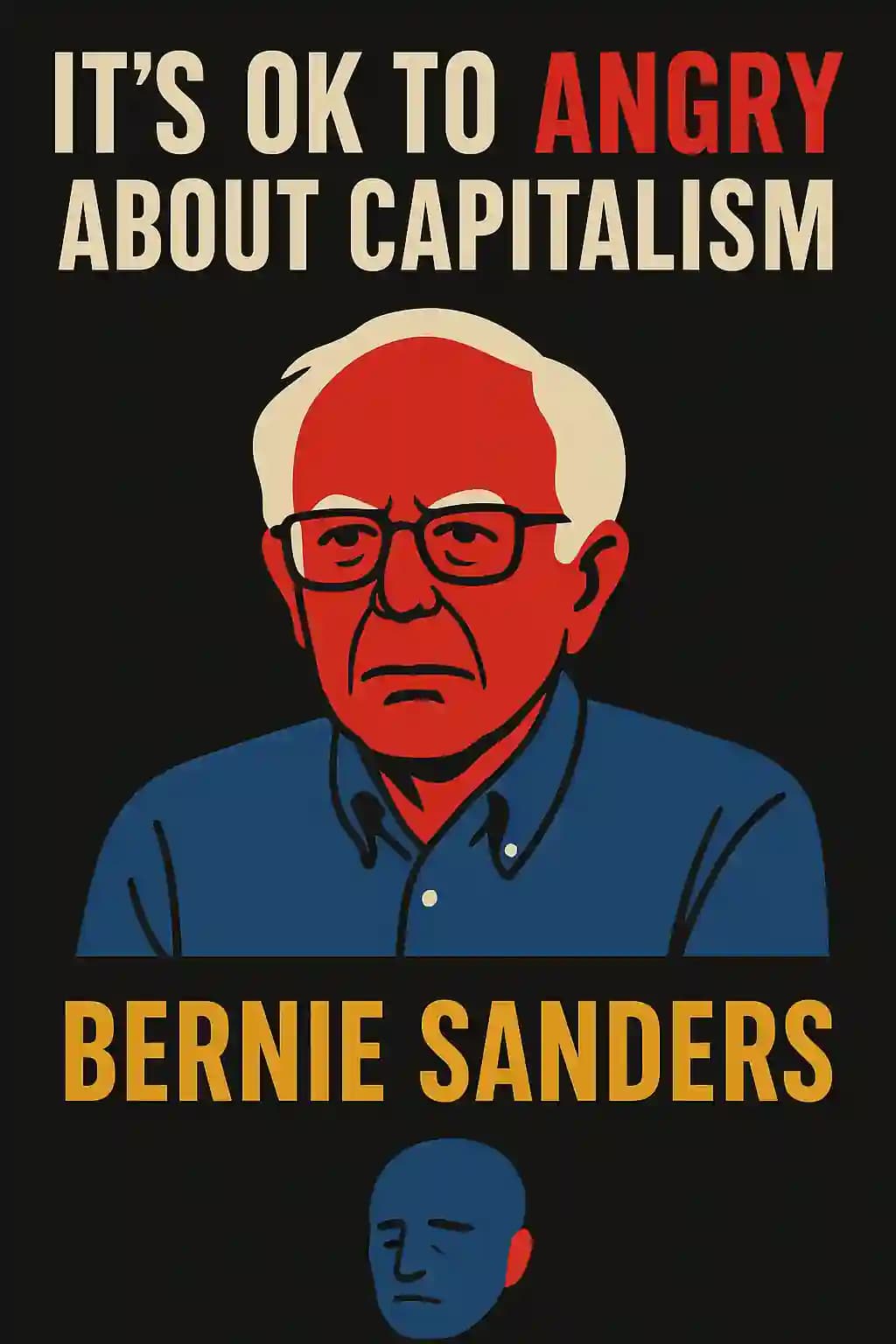
In the wealthiest nation on earth, millions of Americans struggle to afford basic necessities while billionaires launch themselves into space. This stark contrast forms the foundation of Bernie Sanders' impassioned critique of modern American capitalism in "It's OK to Be Angry About Capitalism." The book, which rocketed to #2 on the New York Times bestseller list upon its 2023 release, resonated deeply with readers across generational lines. Sanders' authentic voice and unapologetic challenge to the economic status quo has made him one of the most influential political figures of our time, with his ideas gaining remarkable traction despite establishment resistance. As one of the few politicians who speaks directly about class struggle in America, Sanders articulates what many Americans feel but rarely hear expressed in mainstream politics: that our economic system has been deliberately rigged against ordinary people, and that righteous anger is not only appropriate but necessary for change.
2장
The Oligarchy's Iron Grip on American Democracy
America's economic system works perfectly-for those who own it. While the middle class steadily declines, the ultra-wealthy enjoy unprecedented prosperity with multiple mansions, private islands, expensive art collections, yachts, private jets, and even personal spaceships. In Palm Beach alone, billionaires own dozens of properties worth over $50 million each, while in Manhattan, penthouses regularly sell for over $100 million to buyers who may visit only a few weeks per year. Their ownership extends far beyond luxury possessions to the very mechanisms of our democracy itself.
The wealthiest 1% spend billions on campaign contributions to effectively purchase politicians and hire armies of lobbyists to influence government at every level. In 2020 alone, lobbying expenditures exceeded $3.5 billion, with industries like pharmaceuticals, insurance, and finance leading the charge. Major corporations often employ dozens of lobbyists each, maintaining permanent offices in Washington to shape legislation. This explains why for fifty years we've witnessed policies that consistently benefit the rich: tax cuts skewed toward the wealthy, deregulation of financial markets, weakened labor protections, and corporate subsidies. The same billionaires who control our political system also own our media, with just six corporations controlling 90% of what Americans read, watch, and listen to.
This concentration of wealth and power isn't merely unjust-it's fundamentally undemocratic. Three Wall Street firms-BlackRock, Vanguard, and State Street-control assets worth over twenty trillion dollars with stakes in almost every major corporation. Their influence extends into every sector of the economy: they are the largest shareholders in major banks like JPMorgan Chase and Citibank, dominate transportation as top owners of all four major airlines, own significant portions of pharmaceutical companies, and control major media conglomerates. For perspective, BlackRock alone manages more money than the GDP of Japan, the world's third-largest economy. This isn't democracy-it's oligarchy.
The ultra-wealthy live in a world utterly disconnected from ordinary Americans. Their children attend $50,000-per-year private schools, while they travel in $65 million Gulfstream jets between multiple residences. They access elite healthcare with specialists on call and medical jets at their disposal, paying $50,000 annual fees just to have priority access to top doctors. Rather than visiting museums, they buy great artworks for private enjoyment, with single paintings often costing more than most Americans earn in a lifetime. Their wealth passes to heirs-the Waltons, Mars family, and Kochs own a combined $348.7 billion, four million times the median American family's wealth of $87,000.
The struggle isn't against individuals like Musk or Bezos, but against a system that creates obscene inequality, where 45 percent of new income goes to the top 1 percent, CEOs make 350 times more than average employees (up from 20 times in 1965), and the top 1 percent gained $21 trillion in wealth while the bottom half lost $900 billion over thirty years. This concentration of wealth has accelerated during crises - during the COVID-19 pandemic, American billionaires increased their net worth by $1.8 trillion while millions of workers lost jobs and savings.
3장
A Political Revolution Takes Shape
Sanders' 2016 and 2020 presidential campaigns shocked the political establishment by building an unprecedented grassroots movement that challenged the billionaire class and entrenched interests in both parties. His approach fundamentally reimagined campaign financing, rejecting traditional PAC money and corporate donations in favor of small-dollar contributions from ordinary Americans. This strategy proved remarkably successful - in March 2020 alone, the campaign raised $45 million from 2.2 million individual contributions, with an average donation of just $18. This feat demonstrated that grassroots funding could compete with corporate war chests.
This revolutionary funding approach wasn't just practical-it was philosophically essential. As Sanders repeatedly emphasized, no elected official can genuinely represent ordinary Americans while being financially beholden to corporate interests. The conflicts are inherent: you can't effectively lower prescription drug prices while accepting pharmaceutical industry contributions, meaningfully combat climate change while taking fossil fuel money, or implement pro-worker reforms while depending on anti-union CEO donations. The campaign proved that politicians could break free from this dependency on corporate money.
The campaigns transformed political communication through innovative digital strategies. While traditional candidates relied heavily on expensive TV ads and mainstream media coverage, Sanders' team built a robust social media presence across platforms like Twitter, Facebook, and YouTube. This direct-to-voter approach allowed them to bypass corporate media filters and engage in substantive policy discussions that went far beyond typical twelve-second sound bites. Through live-streamed rallies, detailed policy videos, and constant social media engagement, Americans discovered they weren't alone in seeking fundamental change to the system.
Perhaps most significantly, Sanders won overwhelming support from Americans under forty across all demographic backgrounds-the future electorate. These young voters, facing stagnant wages, crushing student debt, unaffordable housing, and looming climate crisis, understood from lived experience that unfettered capitalism wasn't working for their generation. Recent polling shows this shift in consciousness: among Gen-Z adults (ages 18-24), 54% now hold negative views of capitalism, while 56% support some form of democratic socialism. Even among millennials (ages 25-40), trust in free-market capitalism has eroded significantly.
Though Sanders ultimately didn't secure the Democratic nomination, his movement succeeded in fundamentally shifting the Overton window of American political discourse. Ideas once dismissed as radical - Medicare for All, Green New Deal, free public college, $15 minimum wage - became mainstream positions within the Democratic Party. His supporters went on to win dozens of congressional seats and state party leadership positions. Progressive champions like Alexandria Ocasio-Cortez, Rashida Tlaib, and Jamaal Bowman entered Congress explicitly building on Sanders' political revolution. The movement demonstrated that a different kind of politics - one funded by working people and focused on bold structural change - was not only possible but increasingly necessary.
4장
The Fight for Economic Justice in Congress
Biden's inauguration with Democratic control of Congress provided an unprecedented opportunity to stand up for working families during one of the most severe economic crises since the Great Depression. The $1.9 trillion American Rescue Plan, passed in March 2021, emerged as one of the most consequential pieces of legislation in modern American history, delivering comprehensive assistance during a pandemic that had devastated communities nationwide.
Sanders, leveraging his position as Budget Committee chairman, became the driving force behind the bill's most impactful provisions. His fight for $2,000 direct payments to working Americans exemplified his tactical approach to legislative negotiations. When initial proposals suggested lower amounts, Sanders employed a bold strategy: using his senatorial power to block the critical defense bill vote, effectively forcing Senate leadership to consider higher direct payments. This move, while controversial, demonstrated how procedural knowledge could be wielded to advance progressive priorities.
The American Rescue Plan's scope was unprecedented in recent history. Beyond the headline-grabbing stimulus checks, it included a revolutionary child tax credit that cut child poverty by 40%, extended unemployment benefits of $300 per week, provided $350 billion to state and local governments, allocated $170 billion for schools, and invested $160 billion in vaccine distribution and testing. The legislation created four million new jobs, reduced unemployment from 6.2% to 3.9%, and funded a vaccine program that would ultimately help America lead global vaccination efforts.
However, the more ambitious Build Back Better bill, which proposed $3.5 trillion in spending over ten years, faced a more challenging path. The bill included transformative proposals: universal pre-K, Medicare expansion to cover dental and vision, aggressive climate change measures, and extended child tax credits. Despite polls showing 65% public support, two conservative Democrats - Joe Manchin of West Virginia and Kyrsten Sinema of Arizona - became insurmountable obstacles. Their opposition, fueled by millions in corporate donations from industries like pharmaceuticals and fossil fuels, ultimately proved decisive.
The year following the infrastructure bill's passage became one of Sanders' most demoralizing periods in his three decades of congressional service. The progressive movement had come tantalizingly close to achieving generational change. The original Build Back Better framework would have transformed American social policy, expanding Medicare, establishing paid family leave, and investing unprecedented sums in climate action. Yet despite months of negotiations, compromises, and public pressure, corporate interests prevailed. Manchin and Sinema's resistance revealed a deeper truth about modern American politics: even with Democratic control of government, the influence of billionaire donors and corporate lobbyists could effectively veto popular progressive reforms. This episode highlighted both the potential and limitations of progressive politics in a system dominated by money in politics.
5장
America's Healthcare Crisis: A Moral Failure
America's healthcare system works perfectly for its owners but disastrously for patients. While the industry made over $100 billion in profits in 2021 with soaring stock prices and generous CEO compensation packages - including UnitedHealth's CEO earning $142.2 million - 44% of Americans struggle to pay for healthcare, with 30% skipping needed care due to costs. Even those with insurance face crushing deductibles averaging $4,364 for family plans.
Despite spending nearly twice as much per capita on healthcare as other developed nations ($12,530 annually versus around $5-6,000 in the UK, Canada, France, and Germany), American healthcare ranks near the bottom in outcomes, accessibility, coverage, and efficiency. The U.S. ranks 30th in global healthcare metrics, behind nearly every other industrialized nation. The fundamental problem is that our system prioritizes profit over wellness, with insurance companies acting as costly middlemen who contribute nothing to actual care delivery while consuming 15-30% of healthcare dollars in administrative overhead.
The human costs are devastating: over 85 million Americans are uninsured or underinsured, with over 437,000 medical GoFundMe campaigns between 2016-2020 as people begged for money to receive treatment. Cancer patients report skipping treatments, diabetics ration insulin, and parents avoid taking sick children to doctors. Most tragically, approximately 60,000 Americans die annually from preventable causes because they can't access timely care - equivalent to 20 times the deaths from 9/11 every year.
Unlike every other major country with universal coverage, Americans depend on employment for healthcare-a system whose absurdity became painfully clear during COVID when millions lost both jobs and insurance simultaneously. Nearly 27 million Americans lost employer coverage during the pandemic. Low-wage workers often can't afford the premiums even when coverage is offered, with average family premiums exceeding $21,000 annually. Countless Americans remain trapped in jobs they hate simply to maintain their family's insurance coverage, stifling entrepreneurship and innovation - a phenomenon known as "job lock."
The wealthy live longer, healthier lives with less chronic illness and mental health issues than poor and working-class Americans. A growing life expectancy gap has emerged between wealthy and working-class Americans, expanding from 4.5 years in 1980 to over 12 years today. In McDowell County, West Virginia, one of America's poorest counties, men live to just 64 years, while men in wealthy Fairfax County, Virginia, live to 82-an 18-year difference despite being just 350 miles apart. Similar disparities exist in major cities, where life expectancy can vary by 20-30 years between affluent and poor neighborhoods.
Sanders' Medicare for All legislation would expand this successful model to provide comprehensive coverage for all Americans without premiums, deductibles or co-payments. The Congressional Budget Office found that a Medicare for All system would save Americans between $42 billion and $743 billion annually by 2030 through reduced administrative costs, negotiated drug prices, and preventive care emphasis. Sanders' proposal would save $650 billion yearly while covering everyone with no out-of-pocket costs. The plan would be funded through progressive taxation, with 95% of Americans paying less for healthcare than they currently do through premiums, deductibles, and co-pays.
6장
The Struggle for Worker Power in an Age of Greed
The coronavirus pandemic exposed the ugliness of modern American uber-capitalism-billionaires and CEOs safely isolated while millions of essential workers risked their lives. The pandemic merely crystallized a decades-long trend: a massive transfer of wealth from working families to the very rich. Despite enormous increases in worker productivity through technological advances, the average worker makes $44 less per week today than fifty years ago when adjusted for inflation.
Between 1979 and 2020, productivity increased by 61.8% while worker pay grew just 17%-one of the biggest heists in American economic history. From World War II until the late 1970s, productivity and worker pay increased in parallel. Then policymakers dismantled protections that ensured workers benefited from productivity gains-tolerating unemployment, allowing minimum wage stagnation, failing to protect unions, lowering top tax rates, and pushing deregulation.
For much of the 20th century, unions were understood as essential counterbalances to powerful business interests. Under FDR, private-sector union membership rose from 11% to 35%. But since Reagan fired striking air-traffic controllers in 1981, unions have been systematically attacked. Today, fewer than 11% of Americans are union members-just 6% in the private sector.
Corporate America deliberately weakened unions through aggressive anti-union campaigns: 75% hire consultants to fight unionization, 63% force employees to attend anti-union meetings, and workers who organize face a one-in-five chance of being fired. The decline of unions has devastated working Americans economically and politically, particularly affecting young people and people of color.
Amazon represents uber-capitalism in its rawest form-unbounded greed and vicious opposition to workers' rights. In 2021, Amazon made a record $36 billion profit while paying nothing in federal income taxes in 2017 and 2018. Meanwhile, Jeff Bezos became the world's second wealthiest person with $170 billion, including a $65 billion increase during the pandemic when his workers were dying on the job. While Bezos enjoys multiple mansions, yachts, and rocket ships, Amazon workers face dangerous conditions, 150% turnover rates, and injury rates 2.5 times the industry average.
When we strengthen unions, we strengthen America's middle class and reduce inequality. To rebuild union power today, we need concrete actions: doubling union membership through NLRB reforms, establishing "just cause" protections against firing, ensuring companies negotiate first contracts, denying federal contracts to union-busting corporations, and eliminating Right to Work laws.
7장
Confronting the Technological Revolution
While corporations enthusiastically embrace technological innovation, they steadfastly maintain organizational structures that concentrate control in the hands of billionaire owners rather than workers. This pattern became evident in the late 20th century when corporations systematically relocated jobs from unionized northern states to anti-union southern states, before ultimately shipping millions of manufacturing jobs overseas through Clinton-era free trade agreements. Cities like Detroit, Pittsburgh, and Cleveland saw their industrial bases hollowed out, leaving once-thriving manufacturing communities devastated and creating vast "rust belt" regions of economic decline.
While establishing fair trade policies remains crucial, 21st-century workers now face an even more fundamental challenge: competition from machines themselves. The World Economic Forum's comprehensive studies warn that artificial intelligence and advanced robotics could replace 30-40% of human jobs within the next decade, with the COVID-19 pandemic dramatically accelerating this transition. Companies across industries rapidly fast-tracked automation initiatives to cut costs and reduce reliance on human workers, from self-checkout kiosks to automated warehouse systems.
The optimistic 1960s vision that automation would create a society where people worked fewer hours while machines handled dangerous and tedious tasks has failed to materialize. Instead, technology has often intensified work demands, forcing humans to maintain exhausting paces to keep up with machines. Amazon warehouse workers, monitored by sophisticated tracking systems, face relentless pressure to meet ever-increasing productivity quotas, often without adequate rest or bathroom breaks. The disruption spans every sector - from retail cashiers replaced by self-checkout systems, to truck drivers threatened by autonomous vehicles, factory workers displaced by robots, nurses assisted by AI diagnostics, accountants superseded by automated software, and journalists competing with AI-generated content.
The McKinsey Global Institute's detailed analysis estimates that approximately 50% of all current paid work activities could be automated by 2055 using existing technologies, with artificial intelligence eliminating "lots of jobs in the most unexpected ways and at an unprecedented pace." White-collar professions once considered immune to automation now face AI systems capable of performing complex analytical and creative tasks. This technological revolution's impact on workers must be urgently addressed before economic inequality reaches catastrophic levels.
To prepare for this automated future, Sanders proposes several comprehensive strategies: establishing a cabinet-level agency specifically focused on the future of work and automation; strengthening antitrust regulation to prevent tech giants from monopolizing our economic future; implementing robot taxes at levels comparable to human worker taxation to fund social programs; gradually shortening the workweek to better distribute available work; guaranteeing Medicare for All, free college education, and expanded Social Security as essential safety nets during this economic transition; and empowering workers through mandatory board representation and employee ownership stakes in companies. These policies aim to ensure that technological advancement benefits society as a whole rather than exacerbating existing inequalities.
8장
Reclaiming Democracy from Corporate Media
Media shapes not just our political process but our entire public consciousness, determining what issues matter and what solutions are "realistic." Despite the illusion of media diversity, roughly 90 percent of U.S. media is controlled by just eight major conglomerates, with ownership becoming increasingly concentrated through mergers and acquisitions.
A handful of billionaire-owned media conglomerates control what Americans see, hear, and read. Companies like Comcast ($276 billion in assets) dominate telecommunications, cable TV, internet service, and entertainment production across multiple platforms. These corporations aren't run as public services but to advance their owners' wealth and power agendas, which rarely align with working families' interests.
The concentration problem runs deeper than individual conglomerates. Three Wall Street firms controlling over $20 trillion in assets are major institutional investors across supposedly competing media companies. Vanguard Group and BlackRock are top investors in Fox Corporation, Warner Bros. Discovery, Disney, and Comcast, creating an illusion of competition while financial control remains concentrated.
The problem with corporate media isn't "fake news" but what they choose to cover versus ignore. As Noam Chomsky calls "manufacturing consent," there's a virtual blackout on issues of class and power. Billionaire owners have no interest in publicly discussing how they exercise wealth and power, preferring these matters remain behind closed doors.
The crisis in American media extends beyond corporate control and hostility toward transformative change. When media companies don't generate sufficient profits, they cut back, disinvest, or disappear entirely. This raises a fundamental question: How can democracy survive when local media vanishes and citizens receive no information about their communities?
The media crisis is so severe that, as Margaret Sullivan noted in 2022, "every week, two more newspapers close" with "news deserts" expanding rapidly. Northwestern University's research reveals alarming trends: over 70 million Americans live in counties without newspapers or with just one weekly publication covering vast areas.
To revitalize America's news deserts, we need substantial investment in public media. If the United States spent proportionally what the UK spends on the BBC, we could invest $35 billion annually in public media nationwide-less than what senators added to Biden's Pentagon budget in 2022. This could support newsrooms in every one of America's 3,000+ counties, eliminating news deserts through primarily digital operations with local governance structures directing resources to competing newsgathering operations.
9장
Building a Movement for Transformational Change
The struggle against uber-capitalism will be harder than any other justice movement because all forces of greed and power will oppose us. Corporate elites will use unlimited resources to maintain a rigged economy of unprecedented inequality. They'll prevent unionization, enact anti-worker trade policies, oppose wage increases, and secure new tax breaks through their politicians and lobbyists.
American oligarchs will use their media to trivialize working families' issues while "entertaining us to death." Big Money interests will spend billions controlling our political system, with billionaires often donating to both parties to ensure their interests are protected regardless of who wins.
Real politics isn't about complicated strategies from pollsters and focus groups-it's about creating a simple, progressive agenda that transforms lives and is widely supported by Americans from all backgrounds. This approach creates grassroots excitement, overcomes racial divisions, and wins elections.
To restore confidence in government, we need an agenda that changes lives. Our progressive agenda should include: funding pharmaceutical research while ensuring affordable prices; protecting children from poverty and food insecurity; providing paid family leave; fixing our dysfunctional childcare system; improving public education; making higher education affordable; increasing Social Security benefits by lifting the cap on taxable income for the wealthy; addressing senior housing shortages; building millions of affordable housing units; breaking up monopolistic corporations that dominate our economy; making billionaires pay their fair share of taxes; and rapidly transforming our energy systems to combat climate change.
Democrats must evolve beyond being merely a consultant-driven election machine to become a year-round movement party unequivocally committed to economic, social, and racial justice. Most importantly, it must become the party of a united working class, redefining politics by functioning continuously rather than just during election seasons.
There is no middle ground between insatiable uber-capitalism and a fair deal for workers, between saving our planet and destroying it, between preserving democracy and abandoning it. Democrats must make an unequivocal choice: stand with working people who create the nation's wealth or with the billionaire class who hoard it. The danger isn't being too bold-it's being too cautious. A political revolution is what polls show Americans want.