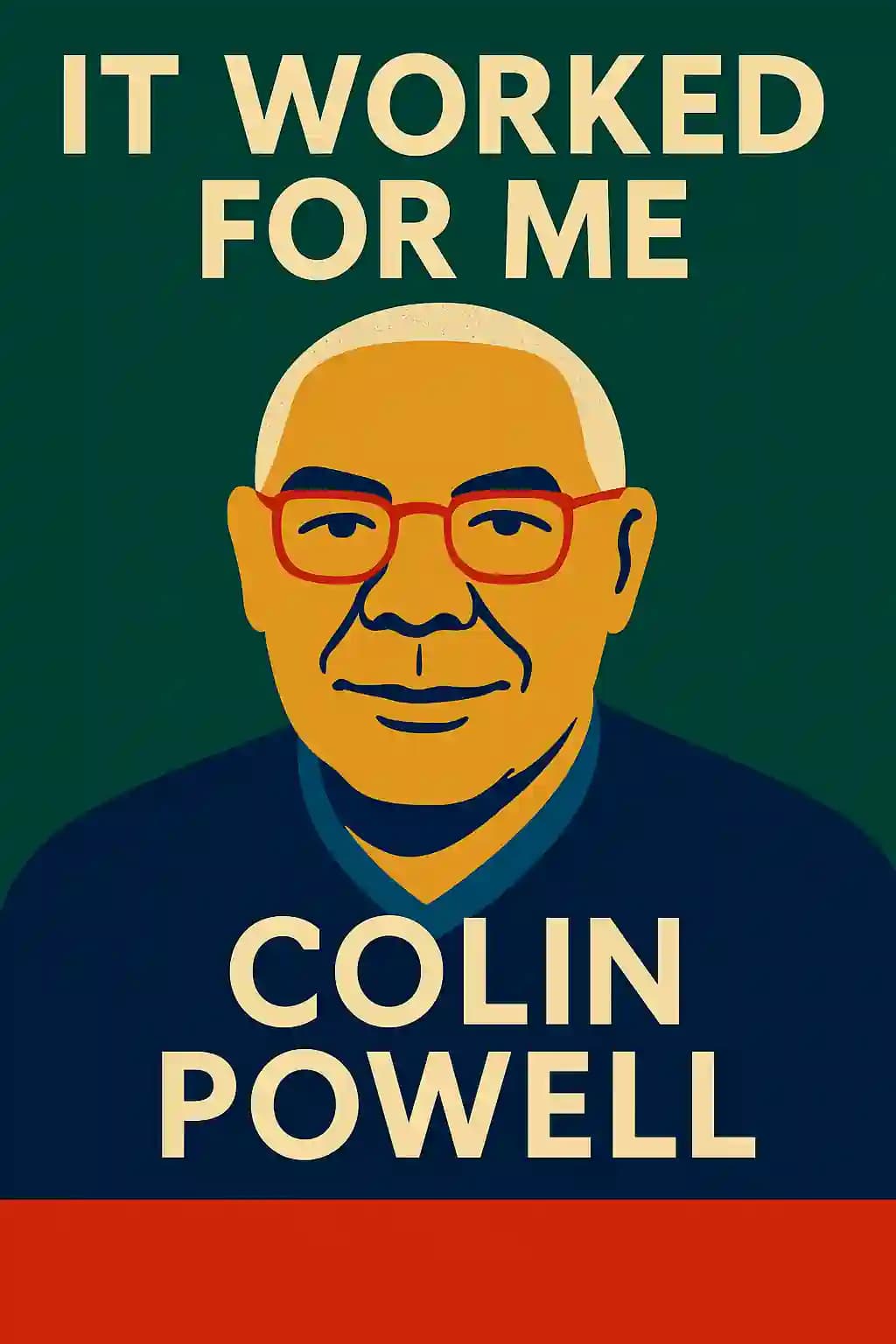
It Worked for Me
In Life and Leadership
It Worked for Me 개요
Colin Powell's bestselling memoir reveals the leadership secrets that shaped American history. Beyond his infamous UN presentation, Powell offers thirteen practical rules that transformed boardrooms and battlefields alike. What leadership principle does the four-star general call his most powerful? The answer might surprise you.

It Worked for Me의 핵심 주제
- military leadership principles
- organizational trust
- perpetual optimism
- servant leadership
- character based management
It Worked for Me의 명언
It ain’t as bad as you think. It will look better in the morning.
Get mad, then get over it.
Share credit.
Check small things.
Perpetual optimism is a force multiplier.
It Worked for Me의 등장인물
- Colin PowellFormer Secretary of State and author
- Jay SickserToy store owner and early mentor to Powell
- Charles GettysMajor General who coined the term 'busy bastards'
저자 소개
It Worked for Me의 저자 소개
Colin Luther Powell (1937–2021), author of It Worked for Me: Lessons in Life and Leadership, was a decorated four-star general, statesman, and pioneering leader who shaped modern military strategy and diplomatic policy.
As the first African American to serve as U.S. Secretary of State and Chairman of the Joint Chiefs of Staff, Powell’s memoir distills leadership principles honed over 35 years in uniform—including orchestrating Operation Desert Storm and formulating the Powell Doctrine. The book blends autobiographical reflection with pragmatic advice on decision-making, accountability, and mentorship, reflecting his reputation as a strategic thinker who balanced military rigor with diplomatic finesse.
Powell also penned the bestselling autobiography My American Journey, chronicling his rise from a Bronx childhood to the highest echelons of government. His honors include two Presidential Medals of Freedom, the Congressional Gold Medal, and the Spingarn Medal from the NAACP.
It Worked for Me remains a cornerstone text for leaders in business, government, and education, praised for its actionable insights drawn from Cold War-era crises to post-9/11 diplomacy.
It Worked for Me 요약 다운로드
It Worked for Me 요약을 무료 PDF 또는 EPUB으로 받으세요. 인쇄하거나 오프라인에서 언제든 읽을 수 있습니다.
이 책에 대한 FAQ
It Worked for Me by Colin Powell is a leadership guide blending personal anecdotes and actionable principles from the four-star general’s career. Centered on his “Thirteen Rules”—such as “Get mad, then get over it” and “Perpetual optimism is a force multiplier”—the book emphasizes resilience, humility, and practical decision-making in military, political, and everyday contexts. Powell’s stories span his Bronx upbringing, ROTC training, and roles in four presidential administrations.
Aspiring leaders, professionals, and military enthusiasts will benefit from Powell’s insights. The book’s accessible, story-driven style appeals to readers seeking actionable advice on teamwork, crisis management, and ethical leadership. It’s particularly relevant for managers, public servants, and those navigating career transitions.
Yes—Powell’s blend of humility, humor, and real-world experience makes it a standout leadership resource. The concise chapters and memorable rules (e.g., “Check small things”) offer timeless strategies for decision-making and team-building. Readers praise its practicality and relatability.
Powell’s core principles include:
- “It ain’t as bad as you think”: Maintain optimism in crises.
- “Share credit”: Recognize team contributions.
- “Avoid letting ego dictate decisions”: Stay adaptable.
- “Check small things”: Attention to detail prevents errors.
The Powell Doctrine stresses avoiding unnecessary conflict, using overwhelming force if war becomes unavoidable, and having clear exit strategies. This philosophy, shaped by his military career, underscores strategic patience and rigorous risk assessment.
- “Perpetual optimism is a force multiplier”: Positivity amplifies team effectiveness.
- “Get mad, then get over it”: Address emotions but stay focused.
- “Trust your people”: Delegation empowers subordinates.
Powell’s emphasis on transparency, adaptability, and respect aligns with agile management trends. His advice on delegating tasks (e.g., trusting junior aides with high-stakes briefings) resonates in flat organizational structures.
Some note the book prioritizes anecdotal lessons over structured theories, which may frustrate readers seeking systematic frameworks. Others highlight its military-centric examples, though Powell bridges these to civilian contexts.
Unlike habit-focused Atomic Habits or combat-driven Extreme Ownership, Powell’s book blends personal narrative with broadly applicable leadership tenets. It’s less prescriptive but rich in diplomatic and organizational wisdom.
In an era of rapid change, Powell’s lessons on crisis resilience (“It will look better in the morning”) and ethical leadership offer stability. His focus on optimism and teamwork aligns with hybrid work challenges.
“Force multipliers” are strategies amplifying effectiveness, like clear communication, thorough preparation, or morale-building. For example, Powell credits optimism and logistics superiority as key multipliers in leadership.
Powell views failure as a teacher, urging readers to “never let adverse facts block a good decision.” He advocates learning from missteps while maintaining momentum—a balance reflected in his Gulf War planning.