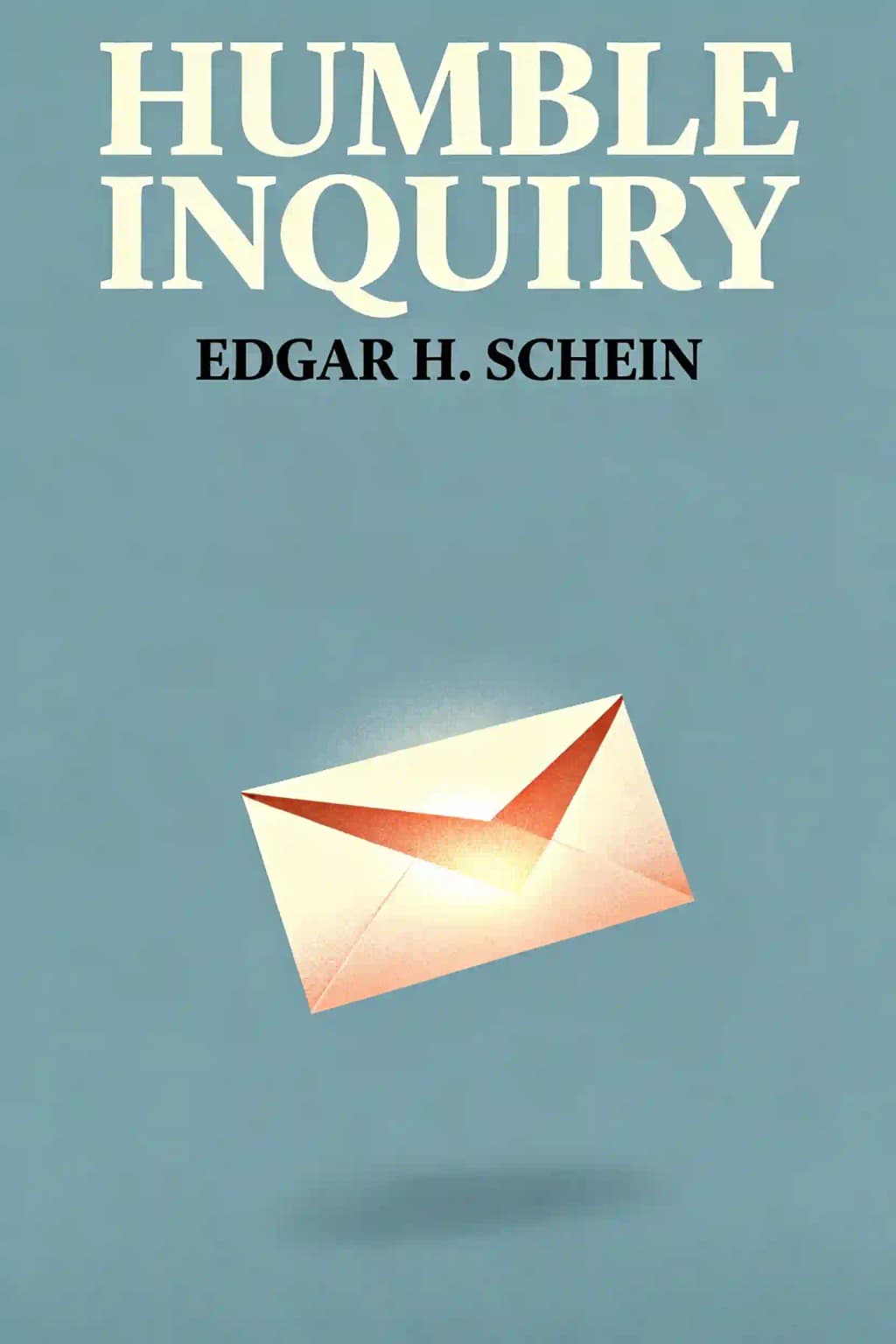
In "Humble Inquiry," Edgar Schein reveals why asking trumps telling in our hyper-complex world. Translated into seventeen languages with 200,000+ copies sold, this book transforms how leaders build trust. As Charles Handy notes, it's "a masterful take on a critical human skill too infrequently practiced."
Edgar H. Schein, a renowned organizational psychologist and MIT Sloan School of Management professor emeritus, authored Humble Inquiry as part of his lifelong exploration of leadership, communication, and organizational culture.
A pioneer in organizational development, Schein developed foundational frameworks like the Organizational Culture Model and career anchors theory, informed by his early work studying POW indoctrination during the Korean War. His 14 books, including Organizational Culture and Leadership and Process Consultation, established him as a leading voice in management practices, blending academic rigor with real-world application.
Schein’s insights stemmed from six decades at MIT, where he chaired the Organizational Studies Group and advised global institutions. Honored with the Association for Talent Development’s 1999 Lifetime Achievement Award, his work remains standard reading in MBA programs and corporate training worldwide.
Humble Inquiry reflects his signature focus on trust-building through humility—a principle echoed in his later works Humble Leadership and Humble Consulting. Translated into over 20 languages, Schein’s frameworks continue shaping leadership education and organizational strategy decades after their inception.
Humble Inquiry explores the power of asking open, curious questions to build trust and improve communication in hierarchical relationships. Schein argues that prioritizing inquiry over directive "telling" fosters collaboration, surfaces critical information, and enhances workplace safety. The book introduces frameworks like Humble, Diagnostic, and Confrontational Inquiry to reshape leadership approaches.
Leaders, managers, HR professionals, and team members in hierarchical organizations will benefit most. It’s particularly relevant for those in high-risk industries (e.g., healthcare, aviation) where open communication prevents errors, and for leaders seeking to dismantle barriers between management and staff.
Yes—its principles remain vital for remote/hybrid teams and industries grappling with AI-driven workflow changes. The book provides timeless strategies for fostering psychological safety, a concept increasingly prioritized in modern organizational culture.
Edgar Schein (1928–2023) was an MIT Sloan professor and organizational psychology pioneer. He authored 14 books, including foundational work on organizational culture and career dynamics. His Army research on POW brainwashing influenced his later focus on trust-building communication.
By replacing assumptions with curiosity, it reduces power imbalances. For example, a manager asking “What obstacles do you see?” instead of dictating solutions encourages frontline employees to share safety concerns or inefficiencies.
Schein identifies status differences, cultural biases toward action (e.g., “time is money”), and personal insecurity. In the U.S., individualism and achievement-centered values often discourage leaders from appearing vulnerable through questioning.
“Humble inquiry is the skill and art of drawing someone out, of asking questions to which you do not already know the answer, of building a relationship based on curiosity and interest in the other person.” This underscores its focus on mutual respect over transactional exchanges.
Both emphasize implicit assumptions driving behavior. Just as his culture model reveals unspoken norms, Humble Inquiry exposes how hierarchical communication patterns hinder problem-solving.
Yes—asking “What outcome would work for both of us?” shifts dynamics from adversarial to collaborative. Diagnostic Inquiry helps uncover root causes without assigning blame.
Some practitioners note its concepts require systemic cultural change, which can be difficult in rigid hierarchies. Others suggest it could provide more tactical scripts for initiating inquiry in tense situations.
While both emphasize questioning, Appreciative Inquiry focuses on strengths and future possibilities. Humble Inquiry prioritizes relationship-building through vulnerability, making it more effective for addressing immediate misunderstandings or power gaps.
저자의 목소리로 책을 느껴보세요
지식을 흥미롭고 예시가 풍부한 인사이트로 전환
핵심 아이디어를 빠르게 캡처하여 신속하게 학습
재미있고 매력적인 방식으로 책을 즐기세요
In a complex, interdependent world, Humble Inquiry is essential.
Humble Inquiry is the fine art of drawing someone out, of asking questions to which you do not already know the answer, of building a relationship based on curiosity and interest in the other person.
Our cultures of task accomplishment and efficiency have trained us to tell rather than ask.
When someone consistently tells rather than asks, they signal that their knowledge and perspective matter more than others'.
Humble Inquiry의 핵심 아이디어를 이해하기 쉬운 포인트로 분해하여 혁신적인 팀이 어떻게 창조하고, 협력하고, 성장하는지 이해합니다.
Humble Inquiry을 빠른 기억 단서로 압축하여 솔직함, 팀워크, 창의적 회복력의 핵심 원칙을 강조합니다.

생생한 스토리텔링을 통해 Humble Inquiry을 경험하고, 혁신 교훈을 기억에 남고 적용할 수 있는 순간으로 바꿉니다.
무엇이든 물어보고, 목소리를 선택하고, 진정으로 공감되는 인사이트를 함께 만들어보세요.

샌프란시스코에서 컬럼비아 대학교 동문들이 만들었습니다
"Instead of endless scrolling, I just hit play on BeFreed. It saves me so much time."
"I never knew where to start with nonfiction—BeFreed’s book lists turned into podcasts gave me a clear path."
"Perfect balance between learning and entertainment. Finished ‘Thinking, Fast and Slow’ on my commute this week."
"Crazy how much I learned while walking the dog. BeFreed = small habits → big gains."
"Reading used to feel like a chore. Now it’s just part of my lifestyle."
"Feels effortless compared to reading. I’ve finished 6 books this month already."
"BeFreed turned my guilty doomscrolling into something that feels productive and inspiring."
"BeFreed turned my commute into learning time. 20-min podcasts are perfect for finishing books I never had time for."
"BeFreed replaced my podcast queue. Imagine Spotify for books — that’s it. 🙌"
"It is great for me to learn something from the book without reading it."
"The themed book list podcasts help me connect ideas across authors—like a guided audio journey."
"Makes me feel smarter every time before going to work"
샌프란시스코에서 컬럼비아 대학교 동문들이 만들었습니다

Humble Inquiry 요약을 무료 PDF 또는 EPUB으로 받으세요. 인쇄하거나 오프라인에서 언제든 읽을 수 있습니다.
Imagine a world where asking the right question is more powerful than having the right answer. In our achievement-oriented culture, we're trained to tell, not ask-to demonstrate knowledge rather than curiosity. Yet in today's complex, interdependent world, this approach increasingly fails us. When a nurse notices a potential mistake but hesitates to speak up to a surgeon, when team members withhold crucial information from leaders, or when relationships deteriorate because we never truly understood others' perspectives-these are the costs of our tell-dominant culture. What if the most crucial leadership skill isn't assertiveness or decisiveness, but the humility to ask genuine questions? Humble Inquiry is the art of drawing others out through questions to which you don't already know the answers, building relationships based on authentic curiosity. It's not just about asking more questions-it's about creating an environment where genuine dialogue can flourish. In a world where complexity demands collaboration across hierarchies, disciplines, and cultures, this skill has become essential for both personal and organizational success. The most effective leaders today recognize that their greatest strength lies not in having all the answers, but in knowing how to access the collective wisdom around them.