1장
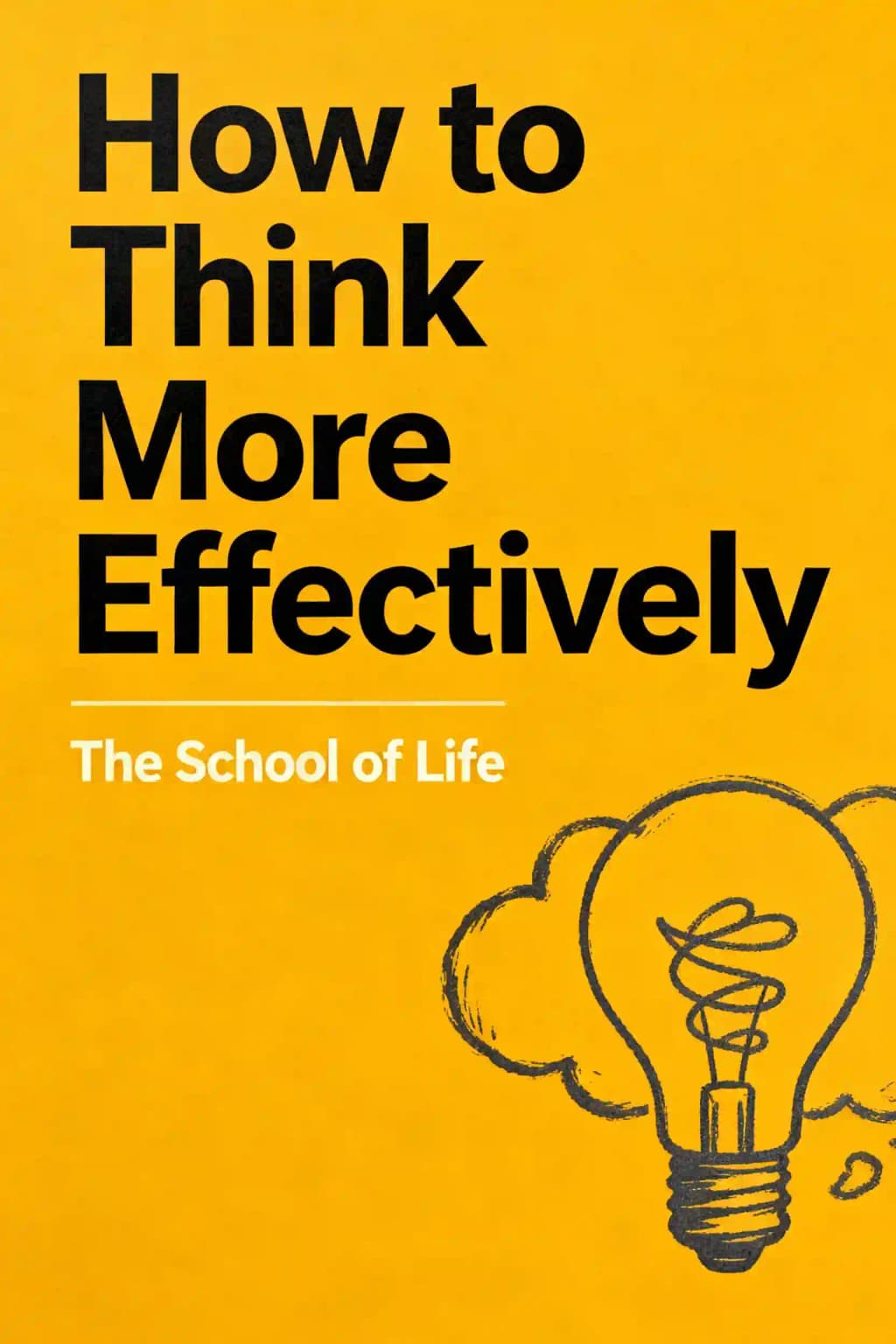
The Art of Thinking: Unlocking Your Mind's Hidden Potential
In a world obsessed with productivity and outcomes, we rarely pause to consider the quality of our thinking itself. Yet our minds vary dramatically in their output-sometimes brilliant, other times frustratingly dull. "How to Think More Effectively" has become a surprise bestseller among Silicon Valley executives and creative professionals alike, with figures from Brene Brown to Tim Ferriss citing its influence on their work. What makes this slim volume so powerful is its radical premise: that good thinking isn't mystical or uncontrollable but can be systematically improved through observation and practice. While our education system emphasizes memorization and society celebrates the fruits of thought, the actual process of thinking remains largely neglected. This book offers a refreshing alternative-practical techniques to access our better mental capacities and hold onto our most valuable insights, teaching us to harvest rather than merely forage for our most necessary thoughts.
2장
The Strategic Mind: Why We Execute Without Direction
There's a crucial distinction between determining what we want to achieve (strategy) and figuring out how to achieve it (execution). Though strategy should logically come first, we paradoxically excel at execution while neglecting strategic thinking. We focus on making money rather than how to spend it meaningfully, on becoming "successful" without questioning what success means to us personally.
This bias appears everywhere-in corporations pursuing growth without purpose, nations building infrastructure without vision, and in our personal lives-leading to frantic pursuit of poorly chosen goals. How many of us live lives of superhuman effort toward wrong destinations? The person working eighty-hour weeks to afford a lifestyle they're too exhausted to enjoy; the couple maintaining a beautiful home while their relationship crumbles; the student pursuing a prestigious degree in a field they secretly despise.
Our evolutionary history explains this bias: for most of human existence, strategic goals were obvious survival imperatives, while execution presented the real challenges. When food was scarce and predators abundant, the "why" questions were self-evident. Modern life, with its abundance of choices, demands strategic thinking our education never prepared us for.
To overcome this execution bias, we should consciously redistribute our time, aiming for at least 20% on strategic "why" questions rather than the current 5%. Notice your discomfort with fundamental questions and your suspicious devotion to busyness. Redefine what "hard work" looks like-the person gazing thoughtfully out a window might be working harder than someone rushing between meetings.
Medieval monasteries offer insights into creating environments for focused thinking. Recognizing how our minds naturally flee from deep contemplation, monasteries were deliberately designed with features to minimize distraction: remote locations, imposing architecture, thick walls, calming courtyards, and sparse but uplifting spaces. They regulated diet, enforced periods of silence, provided uniform clothing, and balanced reflection with physical exercise.
What would your personal "monastery of the mind" look like? Perhaps it involves morning hours without digital devices, a dedicated thinking chair, or walks without podcasts. The conditions for good thinking require radical steps that may seem odd but are necessary to combat our culture of distraction.
3장
The Cumulative Thinker: Building Ideas Over Time
Our minds don't reveal their best thoughts all at once. They work intermittently, producing ideas in dribs and drabs with long fallow periods between insights. We mistakenly assume others' polished thoughts emerged coherently, when they actually assembled them painfully over time. This misconception often leads to frustration when our own thinking doesn't immediately yield brilliant results.
Consider Marcel Proust's manuscripts-dense layers of revisions reveal how his seemingly fluid prose was actually an artificial voice assembled over years. Each page shows crossed-out sentences, margin additions, and inserted fragments that eventually became his masterpiece. What appears as genius was actually persistence. Similar patterns appear in Darwin's notebooks, Einstein's papers, and da Vinci's journals - all showing how great ideas emerge through accumulation rather than sudden inspiration.
Our thinking is constrained by physical factors (what we've eaten, time of day, season) and mental circumstances (recent reading, people we've been around). Have you noticed how your mental clarity changes throughout the day? How certain environments stimulate particular types of thoughts? Morning thoughts often differ markedly from evening reflections. Some people find their analytical powers peak before noon, while creative insights more commonly emerge during evening hours or during physical exercise.
For any complex thinking task, we must accept that we won't access all necessary ideas at once, but must assemble them across different mental states. The notebook becomes essential as a secondary memory, allowing ideas from different moments to meet and be refined. Writing thoughts down lets us revisit them objectively and improve them through multiple iterations. This external system serves as both archive and incubator, where fragmentary thoughts can mature and combine in unexpected ways.
The implications are profound: rather than expecting complete solutions to emerge in single sittings, we should create systems to capture fragments of insight as they appear. A brilliant solution to a problem might combine a morning insight with an evening reflection from last week and a random observation from last month. Without a system to collect these pieces, they remain isolated and incomplete. Great thinkers throughout history have relied on such systems - from commonplace books to index cards to digital notes.
This explains why some of our best ideas come when we're not actively pursuing them-the subconscious continues assembling pieces in the background, occasionally presenting a completed thought when we least expect it. The cumulative thinker recognizes this process and creates conditions to support it. They understand that creativity isn't about waiting for inspiration but about building a repository of thoughts that can cross-pollinate over time.
The most effective cumulative thinkers develop habits that support this natural process. They carry notebooks everywhere, schedule regular review sessions of their collected thoughts, and create environments conducive to different types of thinking. They understand that insight is less about intensity of focus and more about creating conditions where diverse thoughts can naturally combine and evolve.
4장
Capturing Butterfly Thoughts: The Art of Holding Onto Insights
Our most important thoughts frustratingly tend to escape our grasp. Great thinkers have compared ideas to winged creatures-Plato likened the mind to a cage where bird-like thoughts rarely perch long enough to be caught, while Nabokov saw ideas as butterflies requiring patient pursuit. Virginia Woolf envied Proust's remarkable ability to capture these elusive "butterfly shades" in words.
Haven't we all experienced that moment of brilliant clarity while falling asleep, only to find it vanished by morning? Or had a perfect solution appear during a shower, evaporating before we could dry off and write it down?
We struggle to hold onto crucial ideas because they often induce anxiety, threatening our mental status quo by contradicting existing commitments or suggesting uncomfortable changes. The thought "I should leave my job" or "My relationship isn't working" creates such psychological turbulence that our minds reflexively reject it before we can fully examine it.
Rather than demanding we "think harder," we need mental tricks to bypass our defensive barriers. Long solitary journeys, walks in nature, or sitting in cafes can help-the semi-automatic rhythm of these activities distracts our rigid, paranoid surface mind, allowing deeper thoughts to emerge. Even showers provide ideal thinking conditions, with just enough distraction from water and steam to lower our mental guard.
What environments consistently produce your best thinking? For some, it's driving alone; for others, gardening or cooking. The key is finding activities that occupy the conscious mind just enough to let the subconscious speak. Our world prizes good ideas but rarely considers how to create the conditions that generate them.
The butterfly thinker develops habits that increase the chances of capturing elusive insights: carrying notebooks, creating regular periods of semi-distracted activity, and learning to recognize the physical sensations that accompany important thoughts. They understand that the greatest insights don't arrive through force but through creating the right conditions for them to land.
5장
Trusting Your Own Mind: The Challenge of Independent Thinking
From childhood, we're taught that important ideas come from outside ourselves-from prestigious thinkers and authorities. We learn to cite others rather than trust our own minds. While respecting existing knowledge has merit, Montaigne objected to our reluctance to value our own experiences. He criticized the habit of manically footnoting others, noting that many people "would not venture to tell me that he has scabs on his arse without studying his lexicon."
Our minds contain rich potential insights from our unique experiences. We've encountered hundreds of people, visited many places, and had countless sensations-raw material for valuable thoughts. What separates "geniuses" from others isn't different thoughts but their willingness to take their thoughts seriously. As Emerson noted, "In the minds of geniuses, we find-once more-our own neglected thoughts."
Under-confidence makes us disavow our most promising ideas. Children are interesting precisely because they haven't learned what not to think. The moment when we censor ourselves is exactly when the so-called genius starts paying attention to their inner world. True intelligence comes from attending properly to what passes through consciousness-something available to us all if we overcome our hesitancy.
To practice independent thinking, try this mental maneuver: imagine the truth doesn't lie outside you; put aside external authorities; ask what you truly think; stay faithful to your feelings; believe in your capacity to know; learn to catch your unthought thoughts; and examine your own experiences directly rather than deferring to others.
This doesn't mean ignoring others' wisdom, but rather balancing it with confidence in your own perceptions. When was the last time you trusted an insight that contradicted conventional wisdom? Or pursued a hunch that seemed too simple to be valuable? The independent thinker develops a healthy skepticism toward authority while nurturing faith in their own observations.
6장
The Precision of Thought: Moving Beyond Vagueness
Our minds naturally produce vague thoughts-not wrong, but imprecise. This vagueness prevents us from understanding what we truly feel or want, hampering our ability to formulate exact plans. We say we want jobs that are "creative" or complain about lacking "fun" without specifying what these terms actually mean to us.
Think about how often we use words like "interesting," "meaningful," or "fulfilling" without defining them. What exactly makes something interesting to you? What specific activities create meaning in your life? Without precision, these terms become empty containers that fail to guide our decisions.
To counter this mental inertia, we must break down general feelings into their constituent parts through questioning. Socrates pioneered this approach in Athens, revealing how people confidently used terms like "justice" or "courage" without being able to define them clearly. There's no internal alarm system to warn us when our thinking is out of focus.
Vagueness matters because it means failing to identify what truly matters to us. Like miners who initially hit compound ore, we need to sift out the valuable essence of our thoughts. The big words we rely on-courage, love, justice-are merely approximate containers for our specific experiences. Understanding ourselves requires discovering the precise words behind our first words.
This difference between vagueness and focus separates great art from mediocre work. Proust criticized his friend's novel for using cliches like "the sky is on fire at sunset"-not because they contain false ideas, but because they're superficial articulations of good ones that fail to capture authentic experience. Great artists take us into specifics of valuable experiences, moving from generalities to authentic details that bring scenes alive in our minds.
When you catch yourself using vague terms, ask: "What specifically do I mean?" If you want a "better relationship," what exactly would that look like? If you seek "success," what concrete achievements would satisfy you? The focused thinker relentlessly pursues clarity, understanding that precision is the foundation of effective action.
7장
Philosophical Meditation: Processing Your Mental Landscape
To understand ourselves, we must regularly examine the thoughts flowing through our consciousness. While Eastern meditation practices encourage emptying the mind of anxieties to focus on immediate sensations, Philosophical Meditation from the Western tradition directs us to deliberately confront our worries and ambitions.
This practice recognizes that most emotions driving our behavior exist in an unprocessed form. By regularly turning over three key questions, we can sieve the confused content muddying our consciousness.
First, we ask what we're anxious about, giving every "small" worry a chance to be heard. By forcing vague catastrophic forebodings into clear paragraphs or lists, they lose their hold on us. That nebulous work anxiety might resolve into specific concerns about an upcoming presentation or uncertainty about a colleague's expectations-problems that become manageable once articulated.
Second, we examine what upsets us. Daily life exposes us to small hurts we typically brush aside, but these accumulate into blocks of resentment that impair our ability to love and trust. Depression often stems from sadness and anger that haven't been acknowledged. The offhand comment from a friend, the dismissive email from a boss-these seemingly minor incidents can fester when unexamined.
Third, we explore what excites us. Our forward-thinking mind constantly seeks new directions, registering as vague restlessness. These excitements often contain messages about our potential, as Rilke discovered when an ancient Apollo statue prompted his realization: "You must change your life." The book that captivates you, the career path that sparks envy, the hobby you can't stop researching-all contain clues about your authentic desires.
This structured exercise guides us through these inquiries methodically: listing worries and unpacking them; cataloging hurts and exploring their deeper meanings; identifying excitements and considering their implications. The recommendation is to perform this meditation at least twice weekly.
Philosophical Meditation doesn't solve problems but creates space for the mind to order and understand itself. Through regular practice, we become less afraid of our own thoughts, calmer, and clearer about our direction. It transforms the mind from a chaotic jumble of impressions into an organized landscape we can navigate with confidence.
8장
Embracing 'Mad' Thinking: The Value of Unconventional Ideas
We often dismiss thoughts as "mad"-too mean, flawed, absurd or petty to explore further. Yet among these discarded ideas are potentially valuable ones we've rejected simply because they seem unconventional or speculative. Our thinking suffers from this excessive self-censorship.
Many of humanity's greatest ideas have an unusual, even seemingly insane dimension. The first person to suggest flying machines, submarine travel, or wireless communication was undoubtedly considered mad. Jules Verne exemplified this approach, imagining submarines and moon missions long before technology could realize them-creating visions that eventually helped inspire actual innovations.
What if we temporarily suspended our practical constraints? By setting aside normal restrictions like money concerns or fear of failure, we can access valuable insights about our true ambitions and desires. 'Mad' thinking isn't opposed to reality; it's a mechanism for revealing important possibilities within it.
To practice this approach, allow yourself private time to explore your biggest ambitions without practical constraints. Ask what you'd do if you couldn't fail, if others wouldn't laugh, or if money were no object. Consider how you'd reform the world if you had absolute power. Complete the sentence: "If I didn't have to be sensible, I would..." Describe your ideal country, including housing, corporations, relationships and technologies.
The goal isn't to act on every wild idea but to mine these explorations for elements that might actually be achievable in modified form. Perhaps your fantasy of living on a remote island reveals a legitimate need for more solitude that could be addressed through a home office or regular retreats. Your utopian vision of education might contain innovations worth implementing in your community.
The 'mad' thinker recognizes that our initial filter is often too restrictive, eliminating worthy ideas before they can develop. By creating safe spaces for unconventional thoughts, we access creative solutions and authentic desires that conventional thinking suppresses. What seemingly ridiculous ideas might you be dismissing too quickly?
9장
The Power of Dialogue: How Others Help Us Think
Despite our best efforts, thinking deeply alone is difficult-we lose focus, doubt ourselves, or get distracted. Surprisingly, another mind can help structure our thoughts. A good listener provides the gentle pressure needed to clarify our jumbled impressions.
The good listener doesn't interrupt to intrude their own ideas but to help us return to our original concerns. They create safety by accepting our follies without judgment, making strategic confessions to normalize human imperfection. Not every friend is a good thinking friend-the best ones are loyal not to entertainment or gossip, but to our still not fully developed ideas.
To practice friend thinking, sit with a companion, designating one as listener and one as speaker. The listener should avoid interrupting or inserting their own experiences, instead encouraging with sympathetic looks and gentle "hmms." When conversations become factual rather than emotional, guide with "How did that make you feel?" When things get vague, ask for clarification without demanding perfect answers.
Show special kindness when painful topics arise, giving permission to feel emotions that might be suppressed. Use follow-up questions to deepen conversation, pay particular attention to childhood experiences, and create space for discussing shame without judgment. Remember that listening is more valuable than advice-being heard with kindness often helps people find their own solutions.
This approach transforms conversation from mere social exchange into a thinking tool. Consider how differently you speak when truly listened to versus when someone is waiting for their turn to talk. The quality listener creates a psychological container that allows half-formed thoughts to develop into insights.
The dialogue thinker recognizes that certain types of understanding emerge only through conversation. They cultivate relationships that support intellectual exploration and learn to be the kind of listener who helps others access their deeper wisdom. Both friends should take turns in each role, creating a mutual exchange of attentive thinking support.
10장
Mortality as Mental Clarity: Death-Aware Thinking
One of our greatest challenges is thinking seriously about life's meaning. Daily pressures prevent us from gaining the perspective needed to evaluate our life direction. Our implicit sense of immortality-not literal but evident in how we defer important decisions-creates a dangerous complacency. We're simultaneously too timid and too arrogant, fearing mistakes while acting as if we have centuries to correct course.
Throughout history, thoughtful people kept skulls in their studies as stark reminders of mortality. Without this consciousness, death remains abstract-something happening to others, not us-breeding faulty thinking. We linger in unsatisfying relationships, waste evenings on trivialities, and tolerate inadequate friendships, always believing we have decades to get it right.
The skull's grim reminder should both energize our decision-making and paradoxically liberate us from excessive caution-if everything ends in the grave, we might as well risk rejection or failure in pursuit of what truly matters. A childhood photo alongside the skull creates a powerful reminder: just as we once couldn't imagine becoming adults yet did, our death will surely come too.
Consider your mortality by using an online death clock to calculate your remaining time statistically. While confronting this countdown, reflect with renewed urgency on fundamental life questions: what relationship you truly desire, which parts of the world you wish to see, what job would suit your talents, and what your mission and purpose might be.
These reminders exist not to depress us but to save us by focusing our energy on what matters in our precious present. Death-aware thinking doesn't lead to nihilism but to a more authentic engagement with life's possibilities. It asks: if your time is finite-and it absolutely is-how will you use what remains?
The death-aware thinker regularly steps back from immediate concerns to evaluate life from this ultimate perspective. They use mortality not as a morbid obsession but as a clarifying lens that burns away trivialities and illuminates essential truths. What decisions might you make differently if you truly internalized your finite time on earth?
11장
Love as Understanding: The Ultimate Thinking Challenge
When faced with difficult people, we typically resort to simplistic moral judgments: they're just terrible people. Love thinking offers a more nuanced alternative-a challenging intellectual exercise that may represent our highest ethical achievement. This approach requires looking beyond immediate behaviors to understand underlying complexities.
Love thinking involves using imagination to picture why someone might have acted poorly while remaining worthy of sympathy; recognizing that bad behavior stems from hurt rather than inherent evil; seeking stories rather than headlines; remembering the vulnerable child within every adult; acknowledging the possibility of tragedy befalling good people; practicing patience during others' momentary lapses; identifying redeeming features alongside weaknesses; and accepting our own imperfections.
This isn't merely being nice-it's pursuing a deeper truth: that there are no monsters, only people experiencing pain, anxiety and suffering that manifest as unfortunate actions. The difficult colleague might be struggling with an ill parent; the rude cashier might have received devastating news; the critical friend might be battling self-doubt.
Identify the most "awful" people in your life-someone who shouts frequently, a bitter person, someone who greatly inconvenienced others, and even yourself when you're self-loathing. Apply love thinking principles to transform these perceived monsters back into humans deserving of understanding.
Love thinking doesn't mean accepting harmful behavior or remaining in toxic situations. Rather, it means maintaining intellectual complexity even when emotions push us toward oversimplification. It acknowledges that understanding is not the same as excusing, but that genuine comprehension is impossible without empathy.
The love thinker develops the capacity to hold multiple perspectives simultaneously-seeing both the harm someone causes and the wounds that drive their actions. They recognize that true intelligence includes emotional understanding alongside logical analysis. This approach doesn't make life easier, but it makes our judgments fairer and our responses more effective. How might your relationships transform if you approached difficult people with curiosity rather than condemnation?