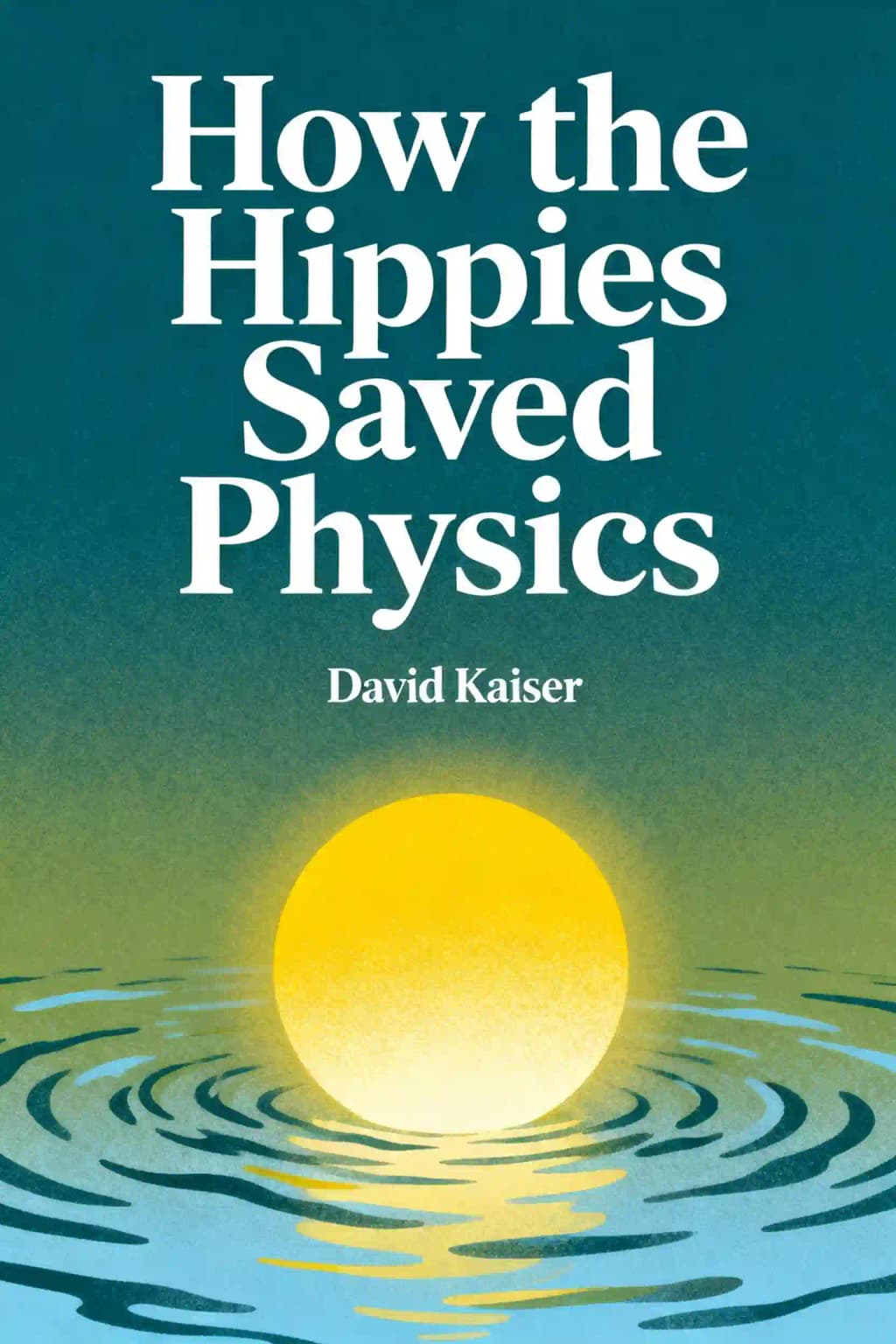
How a band of hippie physicists revived quantum foundations and launched quantum computing. Named "Book of the Year" by Physics World, Kaiser's narrative shows how counterculture rebels blended Eastern mysticism with physics, transforming fringe theories into tomorrow's technologies.
David Kaiser is the Germeshausen Professor of the History of Science and Physics at MIT. His work merges interdisciplinary expertise, as seen in How the Hippies Saved Physics: Science, Counterculture, and the Quantum Revival.
Kaiser, who trained as both a physicist and historian at Harvard, explores the unconventional intersections between 20th-century quantum theory and countercultural movements. He reveals how fringe thinkers revitalized research on Bell’s theorem and entanglement.
His award-winning works include Drawing Theories Apart, which won the Pfizer Award, and Quantum Legacies, named Physics Today's Book of the Year. These works trace the human stories behind scientific breakthroughs.
Kaiser’s insights have appeared in The New York Times, The New Yorker, and PBS NOVA documentaries. His MIT course on the history of physics reaches global audiences through OpenCourseWare.
A trusted voice on science and society, Kaiser advises the U.S. National Academy of Sciences on AI ethics. How the Hippies Saved Physics earned the Davis Prize and was hailed as Physics World's Book of the Year for bridging Cold War science with cultural rebellion.
How the Hippies Saved Physics explores how 1970s counterculture revived interest in quantum mechanics’ philosophical questions. David Kaiser details how the Berkeley-based Fundamental Fysiks Group blended Eastern mysticism, psychedelics, and physics to challenge the "shut up and calculate" dogma, reigniting exploration of entanglement, Bell’s theorem, and nonlocality—ideas now foundational for quantum computing and cryptography.
This book appeals to science enthusiasts, history buffs, and counterculture scholars. Readers interested in quantum physics’ oddities, 1970s countercultural movements, or the interplay between science and society will find it engaging. Kaiser’s narrative style also suits general audiences curious about how fringe ideas can reshape mainstream science.
Yes—Kaiser’s blend of rigorous scholarship and storytelling makes complex physics accessible. While critics argue he overstates hippies’ direct impact, the book illuminates how marginalized thinkers revived foundational debates, bridging academia and pop culture. It’s particularly valuable for understanding quantum mechanics’ cultural and scientific evolution.
Bell’s theorem, which disproved local hidden variables in quantum mechanics, became a focal point for the hippie physicists. Kaiser shows how John Clauser’s experiments—validating Bell’s work—emerged from this countercultural milieu. These efforts laid groundwork for modern quantum technologies like encryption, proving entanglement’s reality.
The 1970s counterculture encouraged physicists to explore quantum theory’s metaphysical implications, such as nonlocality and consciousness. Drawing from Zen Buddhism, LSD experiences, and New Age philosophy, groups like the Fundamental Fysiks Group reintegrated “big questions” into physics, defying Cold War-era institutional rigidity.
Some scholars argue Kaiser overemphasizes hippies’ role, noting foundational quantum debates persisted in academia independently. Critics also highlight the group’s ties to paranormal claims (e.g., ESP research). Yet most praise Kaiser for capturing an understudied, pivotal era in physics’ history.
These quotes underscore the tension between mainstream physics and countercultural curiosity.
David Kaiser is an MIT physicist and historian of science with dual PhDs from Harvard. A leading voice in quantum foundations and science studies, he’s won awards like the History of Science Society’s Pfizer Prize. His work bridges technical rigor and cultural analysis, exemplified in Hippies.
Kaiser traces today’s quantum advancements—like quantum computing—to 1970s explorations of entanglement and Bell’s theorem. The hippie physicists’ insistence on studying these “fringe” concepts helped transition quantum mechanics from abstract theory to applied science.
This Berkeley-based collective of underemployed physicists, including Jack Sarfatti and Fred Alan Wolf, met in the 1970s to discuss quantum mysteries. Their work on entanglement, funded by eccentric patrons, bridged academic physics and New Age thought, fostering a renaissance in foundational research.
As quantum tech accelerates, Kaiser’s book highlights the importance of interdisciplinary curiosity. It serves as a reminder that transformative ideas often emerge from unconventional spaces—a lesson for tackling modern challenges like AI ethics or climate change.
Unlike purely technical accounts, Kaiser intertwines social history with physics, resembling works like The Age of Entanglement but with a countercultural lens. It complements broader histories (e.g., Quantum by Manjit Kumar) by focusing on marginalized contributors.
저자의 목소리로 책을 느껴보세요
지식을 흥미롭고 예시가 풍부한 인사이트로 전환
핵심 아이디어를 빠르게 캡처하여 신속하게 학습
재미있고 매력적인 방식으로 책을 즐기세요
God does not play dice with the universe.
Shut up and calculate.
Quantum weirdness, consciousness, and even parapsychology.
Paradoxes and queer logical points.
How the Hippies Saved Physics의 핵심 아이디어를 이해하기 쉬운 포인트로 분해하여 혁신적인 팀이 어떻게 창조하고, 협력하고, 성장하는지 이해합니다.
How the Hippies Saved Physics을 빠른 기억 단서로 압축하여 솔직함, 팀워크, 창의적 회복력의 핵심 원칙을 강조합니다.

생생한 스토리텔링을 통해 How the Hippies Saved Physics을 경험하고, 혁신 교훈을 기억에 남고 적용할 수 있는 순간으로 바꿉니다.
무엇이든 물어보고, 목소리를 선택하고, 진정으로 공감되는 인사이트를 함께 만들어보세요.

샌프란시스코에서 컬럼비아 대학교 동문들이 만들었습니다
"Instead of endless scrolling, I just hit play on BeFreed. It saves me so much time."
"I never knew where to start with nonfiction—BeFreed’s book lists turned into podcasts gave me a clear path."
"Perfect balance between learning and entertainment. Finished ‘Thinking, Fast and Slow’ on my commute this week."
"Crazy how much I learned while walking the dog. BeFreed = small habits → big gains."
"Reading used to feel like a chore. Now it’s just part of my lifestyle."
"Feels effortless compared to reading. I’ve finished 6 books this month already."
"BeFreed turned my guilty doomscrolling into something that feels productive and inspiring."
"BeFreed turned my commute into learning time. 20-min podcasts are perfect for finishing books I never had time for."
"BeFreed replaced my podcast queue. Imagine Spotify for books — that’s it. 🙌"
"It is great for me to learn something from the book without reading it."
"The themed book list podcasts help me connect ideas across authors—like a guided audio journey."
"Makes me feel smarter every time before going to work"
샌프란시스코에서 컬럼비아 대학교 동문들이 만들었습니다

How the Hippies Saved Physics 요약을 무료 PDF 또는 EPUB으로 받으세요. 인쇄하거나 오프라인에서 언제든 읽을 수 있습니다.
In 1974, an unlikely scene unfolded: physicists Fred Alan Wolf and Jack Sarfatti met with Werner Erhard, founder of the controversial est movement. Despite Sarfatti bluntly calling Erhard "an asshole," Erhard embraced him and promised funding. Soon, thousands of dollars flowed to support quantum physics research that mainstream institutions wouldn't touch. This unusual alliance would help spark a scientific renaissance that transformed our understanding of reality itself. While conventional physics departments had become dominated by a "shut up and calculate" mentality, a ragtag group of physicists - many unemployed due to the post-Apollo job crash - formed the Fundamental Fysiks Group in Berkeley. They dared to ask the philosophical questions their mentors had abandoned: What does quantum mechanics actually mean about reality? Could consciousness play a role in quantum effects? Their explorations of quantum weirdness would eventually lead to technologies we now consider essential to our digital future, including quantum encryption and computing.