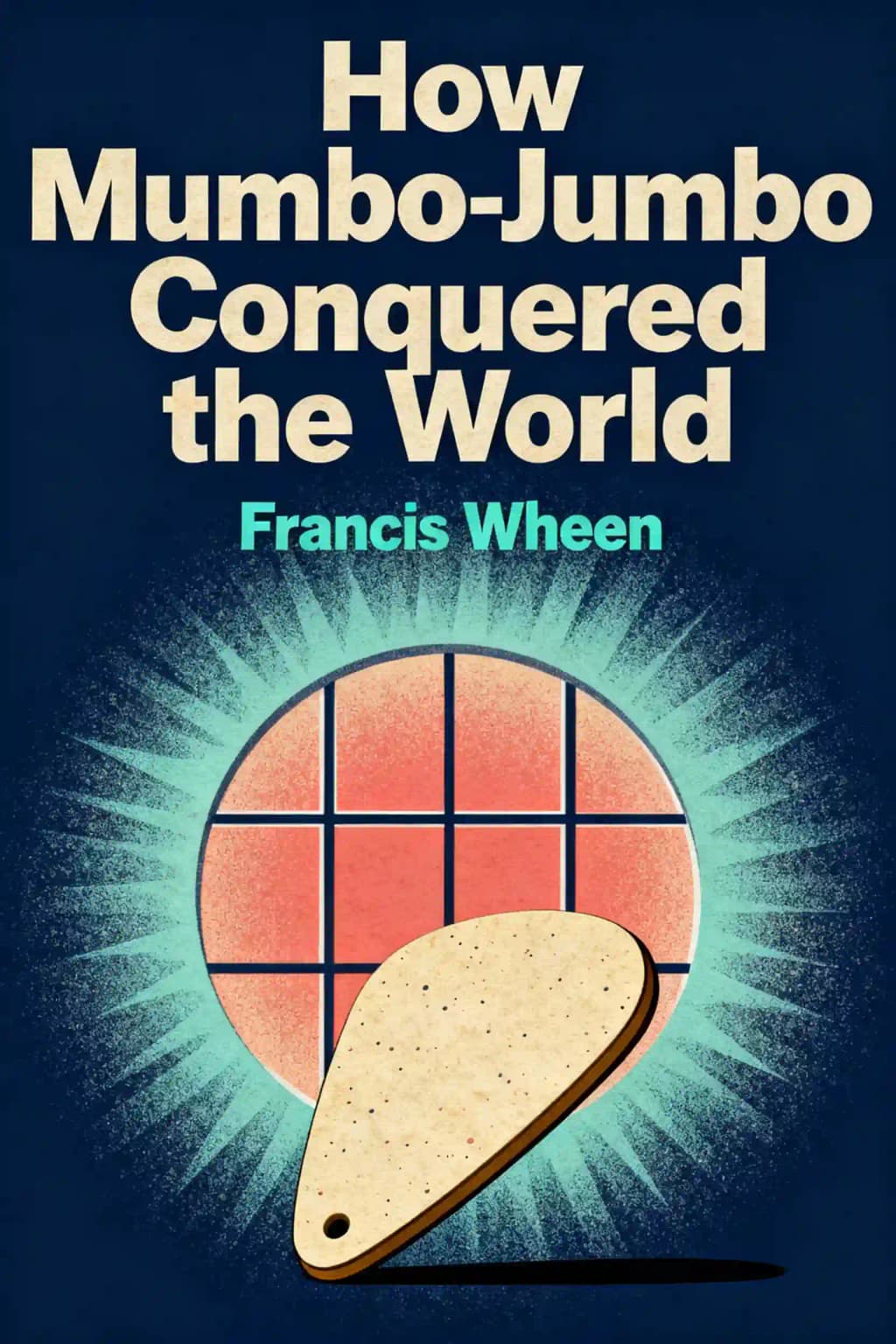
How Mumbo-Jumbo Conquered the World
A Short History of Modern Delusions
How Mumbo-Jumbo Conquered the World 개요
Francis Wheen's razor-sharp expose reveals how irrationality conquered modern society. Jeremy Paxman called it "hilarious" as Wheen dismantles postmodernism, management gurus, and political ideologies. What happens when Enlightenment values collapse? Discover why this controversial defense of rationalism remains urgently relevant today.
How Mumbo-Jumbo Conquered the World의 핵심 주제
- irrationalism in politics
- enlightenment values
- voodoo economics
- magical thinking
- postmodernist critique
How Mumbo-Jumbo Conquered the World의 명언
Enlightenment is man's emergence from his self-incurred immaturity.
Affluence is simply our natural state.
Where there is discord may we bring harmony...
The sleep of reason bringing forth monsters.
How Mumbo-Jumbo Conquered the World의 등장인물
- Francis WheenAuthor and critic of modern irrationalism
- Ayatollah KhomeiniIranian leader who established an Islamic theocracy
저자 소개
How Mumbo-Jumbo Conquered the World의 저자 소개
Francis James Baird Wheen, author of How Mumbo-Jumbo Conquered the World, is an award-winning British journalist and author renowned for his incisive critiques of modern irrationality and political delusions.
A deputy editor at Private Eye and former columnist for The Guardian and London Evening Standard, Wheen’s career spans decades of sharp commentary on culture, ideology, and dogma.
His expertise in debunking pseudoscience and authoritarianism stems from his acclaimed biography Karl Marx: A Life (1999), which won the Deutscher Memorial Prize and has been translated into 20 languages, as well as Marx’s Das Kapital: A Biography (2006). Wheen’s 2003 Orwell Prize-winning collection Hoo-Hahs and Passing Frenzies cemented his reputation as a fearless polemicist.
How Mumbo-Jumbo Conquered the World (2004), a Sunday Times bestseller, dissects the rise of anti-rationalism in politics, finance, and culture—a theme amplified through his BBC Radio 4 appearances and television commentary.
Born in 1957, Wheen’s work remains essential reading for understanding modern disinformation.
How Mumbo-Jumbo Conquered the World 요약 다운로드
How Mumbo-Jumbo Conquered the World 요약을 무료 PDF 또는 EPUB으로 받으세요. 인쇄하거나 오프라인에서 언제든 읽을 수 있습니다.
이 책에 대한 FAQ
How Mumbo-Jumbo Conquered the World by Francis Wheen examines the late 20th-century rise of irrationality, pseudoscience, and anti-Enlightenment ideologies. The book critiques trends like postmodern relativism, political spin, New Age mysticism, and economic delusions, arguing that reason and evidence-based thinking have been sidelined by emotionalism and superstition. Examples include the 1990s dot-com bubble, celebrity culture, and political reliance on "gut feelings" over facts.
This book appeals to readers interested in cultural criticism, political analysis, or the history of ideas. It’s particularly relevant for skeptics of pseudoscience, students of postmodernism, and those concerned with misinformation in public discourse. Wheen’s sharp wit and accessible style make it engaging for both academic and general audiences.
Yes, the book offers a provocative, well-researched critique of modern irrationality. Wheen combines historical analysis with biting humor, dissecting topics from corporate greed to political charlatanism. While some critiques feel dated (e.g., 1990s examples), its core themes remain urgent in an era of conspiracy theories and "post-truth" rhetoric.
Wheen argues that Enlightenment values like rational inquiry and empiricism have been eroded by:
- Postmodern relativism in academia, dismissing objective truth
- Political spin prioritizing slogans over substance (e.g., Tony Blair’s rhetoric)
- Economic delusions, exemplified by the Enron scandal and dot-com bubble
- New Age mysticism and celebrity-driven sentimentality (e.g., Princess Diana’s media canonization)
Wheen lambasts Blair for embracing "Third Way" political vagueness and relying on emotional appeals over policy rigor. He highlights Blair’s use of spiritualist advisors and symbolic gestures (e.g., Mayan birth rituals with Cherie Blair) as emblematic of a leader prioritizing image over rational governance.
The book dissects:
- Reaganomics and Thatcherite deregulation as ideologically driven pseudoscience
- The Enron collapse, where fabricated profits masked systemic fraud
- The dot-com bubble, where irrational exuberance overvalued tech startups with no revenue
Wheen condemns postmodern thinkers like Jacques Derrida for promoting relativism that undermines objective truth. He argues this academic trend enabled conspiracy theories and "alternative facts" by dismissing shared reality as a social construct.
Wheen critiques the 1990s "cult of sentimentality" around figures like Princess Diana, whose death sparked public grieving he deems performative and manipulative. He parallels this with politicians like Al Gore using emotional narratives over factual arguments.
While focused on 1980s–2000s, its analysis of misinformation, anti-intellectualism, and political theatrics foreshadows modern issues like QAnon, climate denialism, and AI-driven deepfakes. Wheen’s warnings about eroded critical thinking feel prescient.
Some reviewers argue Wheen oversimplifies complex topics like globalization and dismisses valid critiques of Enlightenment ideology. His tone can veer into smugness, with chapters feeling like "fish-in-a-barrel" takedowns of easy targets (e.g., astrologers).
Unlike his acclaimed Marx biography, Mumbo-Jumbo prioritizes polemic over rigorous scholarship. Both works share a focus on ideological systems, but Mumbo-Jumbo adopts a more journalistic, satirical approach to contemporary issues.
Key lines include:
- "The Enlightenment has been hijacked by the merchants of woo-woo" – condemning New Age peddlers co-opting rational discourse
- "Globalization became a mantra, not an analyzable phenomenon" – critiquing economic buzzwords replacing scrutiny